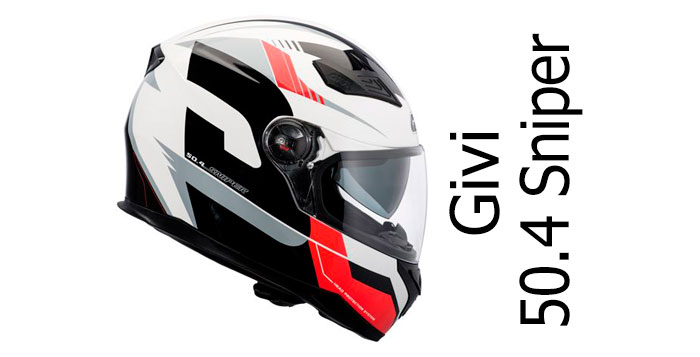
Givi have just released their latest full face lid, the 50.4 Sniper. It’s a polycarbonate-shelled helmet with a drop down sun visor, micrometric fastener, removable/washable liner and, on paper at least, decent ventilation. It’s also Pinlock ready and comes with a breath deflector and is available in 8 different color schemes. What more do you want? Oh yeah, a decent price. $120 at the time of writing seems pretty decent to me.
Givi 50.4 Sniper ‘Caschi’ rear view
Full Face helmet
Polycarbonate
3-point ventilation
Removable liner
3.2lbs/1.45Kg weight (pretty light for a polycarb helmet)
Size XS-XL
Expect to pay about $120
Givi reckon it’ll weigh about 3.2lbs/1.45kg – which is actually very light for a polycarb helmet – and comes in 1 shell size (boo, but expected at this price point).
On paper it looks pretty good so is probably worth a look. Givi have only had one helmet tested by SHARP so far – that was a fiberglass full face that scored 3/5 – so the Sniper is a bit of an unknown.
However, if you’re after a nice looking helmet with some practical features, then the Sniper should offer good value for money and is going to be worth checking out. It’s available now.
The X-Lite X-551 crash helmet is made by Nolan and aimed at supermoto on/off road adventure riders. It’s an interesting combination of full-faced helmet with an integral slide down sun visor as well as a removable/adjustable peak.
3.5Lbs/1.6Kg (medium weight)
Not Snell/SHARP tested
Great for ventilation
Pinlock anti-fog visor
Only average for noise supression
Integral sun visor
Typical price range: $330-$430
Note. X-Lite X-551 is now discontinued. Take a look at our adventure helmets section for some great alternatives.
If you’re after something a bit different from the usual full or open faced helmets, you might fancy giving the X-551 from X-lite a try. Plus if you’re riding something like a GS12 or a Multistrada and want something that suits the look, this could be the baby.
Safety
The X-551 has been ECE 22.05 approved for sale in the EU, however it hasn’t been Snell/SHARP tested yet so we’re not really sure how well it’ll perform in the real world (or as close as we can get without headbutting an A-road!). However, looking through all previous SHARP tests, no X-lite helmet has scored lower than 4 out of 5 and they came 5th in our review of the safest crash helmet brands, so the X-551 is hopefully going to perform well too.
Noise
Reports are that the X-551 is about average for sound proofing. The peak, vents and underside of the helmet all add a bit of turbulence which is always noisy, and the amount of noise does of course depend on the sort of bike you ride and your riding position (a naked at 110 is going to be a tad noisier than stuck behind a barn door fairing). But that said, it’s not a particularly noisy or quiet helmet – bang in the middle according to most riders.
Size
The helmet is made in three different shell sizes – which is a good thing. Manufacturers of cheaper helmets try and get away with having to create fewer physical shells, instead padding out a larger helmet with more lining to fit smaller heads. X-Lite using three different shell sizes means that the X-551 will fit more optimally, and stop you looking like a lollipop if you wear smaller sizes. They’re also arguably safer. The X-551 is available in sizes XS – XXL.
Rear view with large central exhaust vent
Ventilation
The X-lite has great ventilation from multiple chin vents and three forehead/crown vents. All vents are pretty easy to use even in gloves. The top vents use a swivel plate – press down at the back to open and the front pops up to act as a little scoop. Simple and effective. Users rate it as really good for ventilation – both to keep the head cool or keep it from misting up in cold weather.
Shield
It’s got two visors – the main shield that users say is particularly optically clear and gives a nice wide view – and a drop down sun visor, operated with a slider on the side of the helmet. The main shield comes with a Pinlock anti-fog insert (these are bang on if you ride in the cold or rainy weather) and the ratchet is nice and firm, locking the shield in four positions that stay there in the wind blast. The sun visor is optically pretty good too and it’s easy to use with a slider. If you’ve got a big snout, some riders reckon the sun visor can catch on it though as it’s set quite far back.
Comfort
Good quality lining with removable cheekpads so you can micro-adjust the helmet if you find it’s not fitting quite right. Provided you give the helmet a trial so there aren’t any pressure points, users reckon it’s a really comfy place to be.
X-551 Front view
Peak, Aero, Finish
Onto the rest of the stuff. The peak’s really useful for keeping the sun out. It’s adjustable and removable too if you don’t need it. With all that plastic stuck up front, you’d expect it to create a real racket in the wind. But apparently not. It does make some noise of course, but folks reckon much less than you’d think. They also say the finish of the helmet is great – the water based paint gives a lovely glossy and lacquered finish that’s up there with the best.
Overall
It’s a reasonably cool looking helmet that’s got some great features such as the sun visor and easy-to-use vents. It performs well in pretty well all respects and is a reasonable buy at the price point. It’s not really outstanding at anything though, other than its ventilation, but buy one and it should perform pretty well for you.
For other helmet reviews check out either our Crash Helmet Reviews or Safest Crash Helmet reviews sections! And, as always, if you have experience of the X-551, please add your thoughts in the comments section below – cheers!
AGV’s top of the range flip-up crash helmet – the AGV Numo EVO (Compact in EU)
The AGV Numo EVO is designed for typical road riders – urban riders and touring types who don’t spend hours in a sportsbike tuck position. There are some great modular crash helmets out there, so the competition’s hot. But the Numo EVO looks like it has a few tricks up its sleeve including a good SHARP safety rating along with a 100% locking chin guard (see safety section below) which not all modulars can manage.
Summary
The AGV Numo EVO is a great helmet with some really useful features, including sun visor and lockable chin guard. It’s well rated for safety (SHARP 4 star tested), looks good and is comfortable, well ventilated – and owners love it. The only thing they don’t love so much is the noise, but then that’s a bit of a problem with most modular helmets.
Stick in some quality ear plugs and you’ll get a practical helmet at a very competitive price.
There’s two big ticks in the AGV Numo EVO’s box when it comes to safety. First, even though it hasn’t been Snell tested, it did score a very respectable 4/5 stars in the SHARP crash helmets safety test. It’s not a maximum score (see here for crash helmets that scored 5 stars) but it’s very good and means that you can probably rely on the Numo EVO to do its job in most accidents.
Thing is, when they test modular helmets, there’s a chance the chin guard will flip open under impact – and many do (see our guide to crash helmet safety for analysis on this and more).
However, the Numo EVO’s locking mechanism is very well constructed – so much so it remained locked in 100% of the tests. Which is obviously very good and a real comfort to know if you buy a flip-up helmet. Great work AGV.
The AGV Numo EVO is also dual homologated. That means, unlike some modulars, it’s been ECE 22.05 tested and approved for use on the road whether you’re riding with it in either full-face or open-face configuration. Also on the Numo EVO, you can lock the chin guard in the open position using a lever on the right hand side of the helmet. This should help with safety if you come off with the chin guard up, meaning it doesn’t flap around. It’s also useful because you can ride around quite happily all day with the Numo EVO operating as an open faced helmet and knowing the chin guard won’t drop down.
Front view of the AGV Numo EVO in matt black Audax design
Shell & sizing
The AGV Numo EVO has a thermoplastic shell that’s manufactured in just one shell size.
Thermoplastic shells can be great performers, though they can be prone to a little more degradation over time than more expensive fiberglass and composite helmets for example.
More expensive helmets are often constructed with multiple shell sizes (corresponding to different internal fitment sizes). However, the AGV Numo EVO has just one shell size to cover all fitment sizes.
This is achieved through under-padding the helmet for larger fitments (probably L and XL) or over-padding for smaller sizes (such as XS and S). We’ve discussed the potential effects of fewer shell sizes here, and one or two owners have remarked that the helmet liner feels very thin. They’re probably referring to larger sizes because AGV may thin out the liner in these larger sizes so they can accommodate a larger head size – it’s something worth being aware of if you’re looking to buy a Numo EVO in a larger size.
Helmet Noise
Numo EVO with chin guard raised showing integral UV sun visor
Noise is one area that lets down the AGV Numo EVO.
Most modulars are somewhat compromised in this area – being generally quite a bit louder than full face lids. However the Numo EVO is slightly noisier than the average flip-up, meaning, you’ll have to wear ear plugs (most of us do anyhow) and don’t expect your in-helmet communicators/ bluetooth to not be much good above 60-70 MPH.
If having a quiet helmet is important to you, check out our quietest helmets section.
Ventilation
The AGV Numo EVO has what AGV calls its IVS or Integrated Ventilation System. In truth, it’s the same system adopted by pretty well all the helmets we review – namely lots of front vents routing air around the scalp and exiting through rear exhaust vents.
It works well on the Numo EVO too. There’s one chin and two forehead vents, both easily closeable with gloved hands via simple switches. There are three rear exhaust vents – one at each side and another in at the bottom/rear of the helmet. Again, these work well, with the top ones ducting plenty of air around the scalp and the chin vent pushing plenty across the visor and across the face when required – so no problems reported here.
Shield
There’s a nice, wide, clear main shield and an integral drop down sun visor operated by a slider on the left hand side of the helmet.
The main shield is anti-fog coated and owners report it has a nice wide opening giving good peripheral vision.
The sun visor is also anti-fog coated and drops down nice and low (not all do) and doesn’t interfere with glasses. So AGV have covered all the basics well.
Numo EVO Course white/blue showing chin guard locking lever.
Chin Guard
The chin guard opens by way of a small red button in the bottom centre of the guard. It also has a lever on the right hand side of the helmet that allows you to lock the chin bar in place – and it’s been designed to remain pretty aerodynamic with the chin bar locked open to reduce wind resistance on the move. This is a very useful feature for a number owners who say it works very well.
As mentioned in the Safety section, the locking mechanism on the Numo EVO’s chin bar is very good and resulted in it staying locked 100% of the times during SHARP’s safety testing – outstanding.
It has a fully removable and washable lining constructed of breathable Lycra. It also has antibacterial-treated dual-density moisture-wicking cheek pads – all making for a helmet that can be worn all day without discomfort.
Pure gloss white version showing sun visor switch
Looks & Graphics
As the name suggests, the Numo EVO masks the fact that it’s a modular helmet pretty well – looking more like a standard full-face helmet than a flip-up. It’s also very sleek and modern-looking, mirroring many of the latest gen AGV helmets that are all very pointy with that distinctive raptor bill front.
The graphic options are relatively understated. The usual plain color options are available (whites/blacks) as well as a bright fluorescent ‘Fluo Yellow’ version (top picture) which isn’t that dissimilar from the other bright yellow Audax design (bottom). There’s also the Numo EVO Course range of colors – again there’s a bright yellow option for this, as well as variants which are almost identical apart from Blue/Red/Grey detailing.
As usual, you can see most of the colors and designs across this review – but for the latest reviews and prices, you can always click through to our featured retailers using the link towards the bottom of the page.
It is slightly above average weight for a modular helmet, but about average for a thermoplastic modular. Most owners say the weight’s fine for all but the longest days in the saddle.
If you’re a glasses wearer, you should be OK with the Numo EVO – flip-ups make it really easy to put your glasses on/off – and the drop down sun visor is far enough away to not interfere.
Finally, the Numo EVO has been designed for use with AGV’s SHARE communicator and has speaker pockets cut into the liner of the helmet. Owners of other systems, including Sena, have said that it fits their speakers no problem.
[xyz-ihs snippet=”Link-to-guides-page”]
Alternatives
There are plenty of great alternatives to the AGV Numo EVO out there. Check out or Top 5 Flip-up Crash Helmet Reviews section for more options.
Sena announce world’s first noise-cancelling crash helmet
Sena are best known for their in-helmet comms – bluetooth communicators, intercoms and the like. But they’ve decided to put all that audio-nouse to good use by, for the first time, integrating it into their own crash helmet. And it looks very interesting – not just because it’s a sweet-looking carbon fiber helmet – but because it’s the world’s first noice-cancelling crash helmet too!
The full range of available colors
As you can see from the diagram below, there’s a whole load of audio electronics and cabling built into the fabric of each helmet. The noise-cancelling tech uses an array of four connected microphones to take in external noise. If it works in a similar way to traditional noise-cancelling tech, it’ll then process the opposite phase then feed that into your ears to cancel out noise. It’s tech that’s been around for ages now, but it’s the first time we’ve seen it integrated into a helmet in this way.
I say integrated, but it’s unclear that the tech – called Intelligent Noise Control or INC for short – will actually be shipped in the helmet or made available as an extra that attaches to the helmet, in the same way their Bluetooth module is an optional extra (which is bizarre coming from a manufacturer known for their bluetooth kit!).
Sena Smart Helmet in silver
That aside, the tech sounds pretty impressive. It cuts out wind noise while allowing things like emergency sirens, other traffic and engine noise to get through, i.e. just the noises you want. There’s also an ‘ambient mode’ – press a button on the side of the helmet, and it allows you to hear what’s been said to you without taking your helmet off. Nice.
Sena haven’t announced a release date yet – when they do, we’ll let you know. In the meantime, if you’re looking for the quietest helmets on the market, check out our quietest helmets section.
The LS2 FF352 Rookie is their entry-level helmet aimed at folks who don’t want to spend too much but still want a helmet that works well – one that’s comfortable, reasonably quiet with a nice shield and that’s going to protect them in an accident. So even though you’re not wanting to spend too much, it’s still gotta perform.
Well, at around $75 that sounds like a big ask. So we’ve scoured all the reviews we can find and we’ve incorporated what we’ve found owners think of the LS2 Rookie in our review below.
One thing to note though. At this price point, many owners seem to be new to riding or have limited experience of other helmets – so what’s comfy and quiet to them might be irritating and noisy to you in your $600 Schuberth!
Folks who bought an LS2 Rookie FF352 resoundingly seem to like it.
Sure, it’s short of a few features you expect on more expensive helmets, but that’s not why people bought it. They want a good all rounder at a reasonable price – and the LS2 delivers in spades.
It’s comfortable, has a nice shield, decent ventilation and – to top it all – scored highly in the SHARP crash helmet tests, scoring a massive 4/5 stars (that’s the same as a $500 Arai!).
So, if you’re after good protection for not much doe, we’d recommend you check out an LS2 Rookie (along with our suggested alternatives at the bottom of the page). Oh, and the best place to buy one? From our recommended retailers below of course!
Safety
Even though this might be what folks call an entry-level helmet, it has to give good protection.
Well, if it’s on sale in Europe, it has to be ECE 22-05 certified, which the Rookie is. So it offers a decent all-round level of protection. We don’t have any information on US DOT certification though – we’re awaiting word from the US distributor on that (when we get it, we’ll update here).
However, it has been tested by SHARP and rated four stars out of a maximum five for safety.
That’s a great score for any helmet full stop. But at this price point, it’s an incredible score and proves, once again, that you don’t have to pay big bucks to get a helmet that’s going to offer you lots of protection.
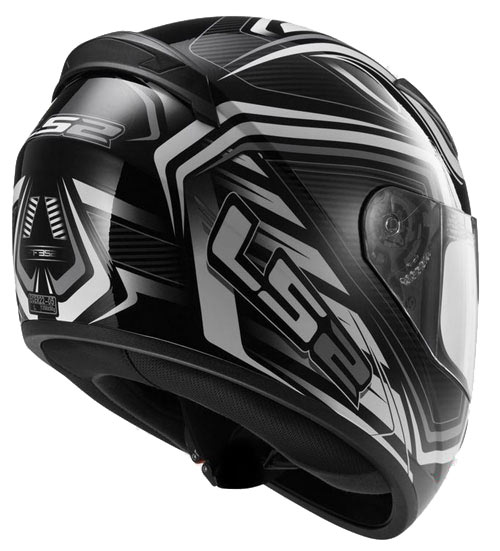
Rear view of the Rookie Fluo black/white
So what’s making the LS FF352 score so highly?
It’s got a thermoplastic shell which are tough and durable (even though they’re cheaper to manufacture). That’s backed by multi-density EPS or expanded polystyrene foam liner. Multi-density liners are good at absorbing energy at different speeds and are what you find in the most effective helmets.
And even though the Rookie is only manufactured in one shell size (which is not great for a number of reasons) it obviously works well in the form of the LS2 Rookie.
Helmet Noise
Owners seem to think the liner on the LS2 FF352 Rookie is pretty plush feeling – that’s nice and thick and soft – which helps with noise reduction. Unfortunately though, it doesn’t come with a chin curtain, which is a shame because that usually helps with reducing noise too.
However, owners mostly seem to reckon it’s not too noisy as it is.
Classy FF352 Rookie Flutter is available in purple/white (above) or purple/black
As usual, we’ve gotta warn you that noise perception is relative – and depends on lots of factors individual to you (riding style, type of bike, last helmet noise etc. etc.).
But having said that, consensus seems to be that it’s pretty good at suppressing noise, as long as you don’t go too fast where things can become a bit noisy.
Of course, that shouldn’t be too much of a problem anyway if you wear decent ear plugs.
Ventilation
No complaints on the ventilation, except that the shield can fog up. But that goes for any helmet without an anti-fog treatment on the shield.
The FF352 Rookie has a single chin vent operated by a slider (that’s easy to use in gloves).
It also has a single brow vent and a pair of rear exhaust vents just below the small spoiler at the back.
And like most higher-priced helmets, it has channels cut in the EPS lining to allow air to circulate around the scalp before it exits the lid via the rear exhausts.
Top vents and rear exhaust on the FF352 Rookie Ranger
Word is that ventilation’s good – though as I mentioned at the top of the page, most owners we came across (though by no means all) seem to be new to biking or after a cheap helmet for a pillion for example, so whether the ventilation will work for you on a day’s tour in 100 degree heat is unclear.
However, there’s no issues reported other than the fogging of the shield.
Shield
Which leads me neatly into talking about the shield.
The LS2 Rookie has an optical class A shield – which is amazing because we usually only see those on expensive helmets. Class A shields are designed so they shouldn’t distort your vision at all.
It’s also quick release (open the shield, push a lever and out it comes) and is supposed to come with an anti-fog coating.
This one’s the solid gloss white version
Having said that, one or two owners reckon it steams up pretty easily so don’t expect it to stay clear if it’s cold or raining and your shield’s closed.
But that’s not a fault of the Rookie – it’s just what all helmets do without an anti-fog treatment or Pinlock on the shield.
It has a nice thick comfort lining that’s hypo-allergenic and breathable and it can be unclipped and removed for washing.
Again, removable and washable linings used to be the preserve of more expensive helmets so it’s good to see budget helmets like the Rookie now being fitted with them.
If you’re going to buy an LS2 Rookie, one or two owners reckoned they needed a size larger than they’re used to. So if you’re in two minds about which size you need (or in between sizes) we’d go a size larger – and buy from a retailer who’ll accept returns/replacements without quibbling (like one of our recommended retailers).
Looks & Graphics
The LS2 Rookie FF352 is a nice and modern looking helmet. It comes in the usual plain colors (matt/gloss black and gloss white) as well as six other designs – at the time of reviewing.
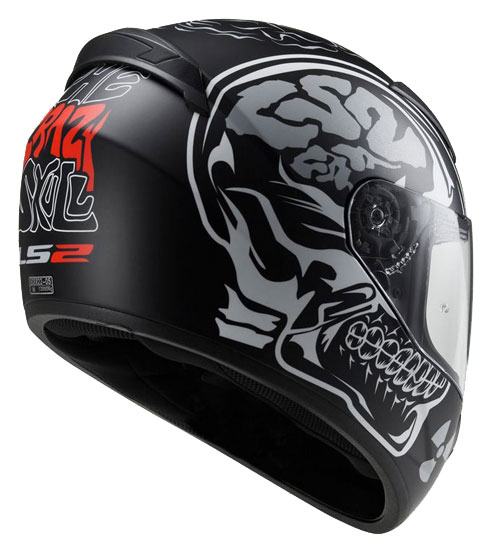
They are the Fluo and Fan designs (including hi-vis yellow versions) as well as the Flutter, One and Ranger. There’s also a skull design called the X Ray.
As usual, we’ve put pics of those designs up and down the page – but to check out any new designs and see the latest prices, please see below.
LS2 Rookie Video
A three minute video by a guy who’s just upgraded to an LS2 Rookie – and really likes it.
Other stuff – fasteners, audio, warranty
Rear of the LS2 Rookie Ranger
The LS2 FF352 Rookie comes with a micrometric fastener (dead easy to use and safe as houses).
There’s not much information around about how well it works with bluetooth headsets – but check out the video above as he explains how he’s attached a mic and a Go-Pro, so it sounds like it’s possible to fit one.
Finally, the LS2 comes with a one year warranty. That’s not quite the five year warranty some of the best known brands offer, but probably acceptable at this price. We’ve heard tales of the occasional screw coming loose in the shield base plate but other than that, it seems to be pretty well built.
[xyz-ihs snippet=”Link-to-guides-page”]
Alternatives to the LS2 FF352 Rookie?
There’s not much we’ve come across at this price range, performing this well.
Starting off around the $100 mark is the Scorpion Exo-R410 – that’s Snell 2015 and SHARP 4 star certified and has an optically correct shield too. It’s a great helmet.
For a little more, there’s the four star rated Nolan N64 – which is good but a bit on the noisy side. Or for a bit more still you can have the very capable AGV K3 – another four star safety rated helmet with great build quality and finish that’s a well-liked good performer.
Bell’s top of the range carbon composite sportsbike helmet
The Bell Star Carbon is Bell’s out-and-out sports helmet, designed for track use and tucked-in, chin-down sportsbike riding.
But the thing about top of the range helmets is that’s where all the manufacturers put most of their R&D money (the tech trickles down to their other models later to cover costs), so it’s a particularly competitive sector. So let’s look at how the Bell Star Carbon stacks up
Summary
Made for the track or sporty road riding, the Bell Star Carbon combines all-day comfort and outstanding ventilation with modern and aggressive styling. The only cons, like many sportsbike and track helmets, are that it’s noisy and that glasses wearers might struggle. If those aren’t an issue for you and you want a helmet for sportsbike riding that looks super cool, then the Bell Star Carbon is worth checking out.
Now discontinued – though good deals are still to be found
Weighs about 3.3Lbs (1.5kg) – about avg for a composite
Comfortable and great ventilation
Noisy
Size XS – XXL
Expect to pay between $600-$700
Side view of the Dunlop replica
Safety
The Bell Star Carbon has been Snell certified but hasn’t been SHARP tested, so we know it’s probably safe, but don’t really know how comparably safe it is. It’s both ECE approved for sale in Europe and DOT certified in the US.
So in terms of safety, the Bell Star Carbon looks promising, and this top model is constructed from three layers of kevlar, fiberglass, and with a top layer of carbon fiber to give it that nice carbon fiber weave finish (in the models it’s not covered by paint).
Classy matt black Bell Star Carbon
That makes for a helmet that should be tough, and at around 3.3Lbs (Bell’s own figure) it is just a smidge over the average weight of a composite helmet (3.4Lbs or 1.46Kg according to our research). Most owners feel that it’s a really light helmet though so they seem to be happy with the weight!
Another useful safety, and convenience, feature, is that the shield has a locking mechanism. If you’re on track and want to be 100% sure your shield isn’t going to flip up and break your concentration going into that high speed right-hander, then that’s going to be useful – and safer. It’s also going to help stop the shield opening during an accident too – again, very nice to know!
[xyz-ihs snippet=”Bell-SBS-quick”]
Helmet Noise
Of course, the Bell Star Carbon is a racing helmet. And like lots of other top of the range, racing-focused helmets, the Star Carbon suffers from being noisy. As you’ll read further down, it’s got great ventilation, but in this case, that creates lots of holes in the shell to allow noise into the helmet.
Most owners agree that it’s somewhere between noisy and very noisy (depending on how noisy their previous helmets were) and that you really need some decent ear plugs in to keep things bearable.
Sizing
The Star Carbon comes in sizes XS (54/55 cms) to XXL (62/63 cms). For the exact sizes in between, click the link to our recommended retailer right at the bottom of the page, and you’ll be able to see sizing, availability and latest prices.
Rear of the Michael Dunlop replica showing four rear exhaust vents
Ventilation
This is one of the Bell Star Carbon’s really strong points.
As you can see from the photo above, there’s a plethora of front vents – a chin vent that’s adjustable to direct air onto the face or visor, then lower and upper forehead vents. All these are easy to operate using sliders – even with gloves – and owners universally agree they can let in a ton of air.
As usual, the forehead and crown vents pull air through channels in the shock-absorbing EPS liner inside the shell, and cut-aways inside the comfort liner allow heat and moisture to be pulled from your scalp and out of the rear exhaust vents (there’s four of those – see right).
In the Star Carbon, it’s a particularly effective configuration and is ideal for sweaty track days and races.
Shield
Even though pretty well all the promo shots of the Bell Star Carbon show smoked shields (because it makes it look cool and moody!), it comes with a standard clear shield in the box.
It’s coated with what Bell call their NutraFog 2 coating which is OK but not the best if you’re riding in cold weather.
Star Carbon in Union graphics
The shield has two positions, closed and open but will sit at any point in between – there’s a friction connection that keeps it open until you reach reasonably high speeds.
Once nice feature is their really simple and quick to operate shield removal mechanism. It really is very fast – possibly the fastest around. Just open up the shield, pull down on a trigger and the shield pops out. Couldn’t be easier and very useful for whipping off your shield to give it a good clean.
Many of the owners of the Bell Star Carbon are raving about Bell’s transition shield too. It’s a photo-reactive shield that darkens in bright sunlight – and takes just a few seconds to go from clear to smoked. It’s about $150 (depending on retailer). If swapping shield or forgetting sun glasses is an issue for you though, it might be worth it.
Comfort
Another really strong point for the Bell Star Carbon is comfort.
Like any helmet, you have to make sure you go through the basics to get the right fitting (see our guide to fitting). Assuming you buy the right size, the Star Carbon’s internals are of high quality and owners say they quickly bed-in and are comfortable enough for all day in the saddle.
The liner is contoured and the cheek pads are swappable to tune the fit. It’s made from what Bell call their X-Static XT2; that’s a silver ion treated, anti bacterial and removable/washable liner. What that means in practice though is that people comment on how (very) soft it is (aaah!) when you put it on – and it has mesh and padding in all the right places.
Very stylish RSD version
One fly in the ointment is that it’s broadly regarded as poor for glasses wearers. If the stems of your glasses aren’t thinner than average, it might be worth avoiding – or at least buying from a retailer who will accept returns with no quibbles (such as our recommended sellers) – so you can try with your own glasses.
Looks & Graphics
I think it’s safe to say the Bell is one of the coolest looking full face lids around. It’s sleek and aggressive, with nice lines ending in that swept back spoiler. The graphic options are mostly very tastefully worked too, with lots of classy paint schemes and designs and most showing off that carbon fiber weave to varying degrees too.
At the darker end, there’s the matt black, the Union and the special edition Roland Sands Design (RSD) version (right). Adding a bit more color, there’s the Pinned designs and another special edition, the Tagger Trouble. Then there’s the Michael Dunlop replica (an Irish racer who last time I looked was wearing a Shoei hat!) and then there’s the colorful (and I have to say very very nice!) special edition Chris Fillmore Replica that you can see at the top of the page.
Video
Here’s Revzilla to take you through some of the Bell Carbon’s finer points!
Other stuff
The aero on the Bell Carbon is very impressive. It’s been designed to make it as slippery as possible, and to minimise buffeting – and owners say it works incredibly well. It’s not perfect as one or two owners reckon there can be buffeting if you turn your head at (moderately) high speeds. But overall, it performs well.
Pinned blue graphics (also available in Pinned black)
It’s been designed to work with Sena audio kits and there are cutaways in the liner to accommodate speakers – and these line up with meshes in the lining to allow sound to travel through unimpeded. Obviously, the helmet’s loud though so it may be a bit tricky to hear above the wind rush if you go too fast.
There’s also a nice touch on the double d-ring fastener as it has a magnetic end which allows the free end to attach itself to another magnet and stop it from flapping around. It works well and is a great little feature.
And finally, track riders say there’s a nice wide field of vision with only the very extremes of the shield aperture coming into view. That’s good for track and for road use.
[xyz-ihs snippet=”Link-to-guides-page”]
Alternatives
We’ll be checking out sportsbike/track helmets such as the Arai RX-7V and Shoei’s X-Spirit III when they’ve been around for a while (launch date set for early 2016). In the meantime, you might want to check out Schuberth’s track helmet, the SR1. It’s a composite shelled SHARP 4 star rated helmet, got great ventilation, an excellent visor and it’s a tad cheaper than the Bell. Shark’s Race R Pro range are terrifically light SHARP 5 star safety rated composite helmets that are known for comfort and ventilation too and are also worth a good look. Check our Sportsbike crash helmets section for more sports/track focused helmets.
Top of the range racing helmet – the Shoei X-Fourteen (X-Spirit III outside the US)
New for 2016, Shoei have finally replaced the X-Twelve, their top of the range, track-focused sportsbike helmet. The X-Fourteen hit the shelves early 2016 and this new one is a hefty update to the old helmet with changes principally aimed at usability – aero, stability, and a tweak or two to improve ventilation (something owners reported was fairly average on the old one – as you can read in our X-Twelve review). In other respects, the old helmet was a quality performer – and was Snell certified and SHARP 5 star rated for safety.
So Shoei had to really be on their game if they were going to improve on the X-Twelve. Which I guess is why they developed the X-Fourteen in cahoots with the likes of Marc Marquez and Bradley Smith on the MotoGP circuit – which in turn is one of the reasons it’s been eagerly snapped up by lots of other racing heroes such as Garett Gerloff, Bobby Fong and John McGuinness.
So, here’s the lowdown on the features of the X-Fourteen and we’ll discover what owners think of their new X-Fourteen crash helmet.
Rear view of the X-Fourteen Marquez showing winglets designed to improve stability
Shoei’s top of the range sportsbike full face helmet
Please click below to visit the Shoei X-Fourteen helmets pages at our recommended stores – all checked for great online ratings. And if you buy from any store, we get a small sum from the sale at no extra cost to you – a massive THANKS! (it’s how we finance the site).
The shell of the X-Fourteen is created from what Shoei call their AIM+ shell – that’s a complex 6 layered composite. Shoei never actually say what’s in their AIM+ helmets beyond fiberglass and ‘organic fibers’. Whatever’s in there, it seems to work well. Of the five AIM+ helmets tested by SHARP so far, four have scored maximum safety ratings while the other (the NXR) still managed a creditable four star rating.
The X-Fourteen is M2015 Snell certified and the European version was tested by SHARP in summer 2016 and scored the expected maximum five stars.
A few sizes of the X-Spirit (XS-S-M) have also been tested/homologated in 2019 by the FIM for use in pro circuit racing.
All in all, that helmet shell construction certainly seems to do the trick, coupled with their multi-density shock absorbing EPS liner, four shell sizes (good for safety and accurate fitment) and double-d ring fastener – all create a helmet that should look after your head about as well as any helmet can do in an accident.
Front view of the Bradley Smith replica
Helmet Noise
Sportsbike and trackday-focused helmets are designed for outright performance on the track. That means helmet designers prioritise features like stability, lightness and aero over making a helmet that’s quiet. And besides, racers wear ear plugs to protect their hearing (as should you) so reducing helmet noise isn’t that important for a sportsbike helmet.
Having said that, owners reckon their X-Fourteens are pretty quiet. Many have said that when you get the chin guard on and close the vents, it’s one of the quieter helmets they’ve owned.
Which is surprising given that it’s a track helmet. It could be that people who buy the X-Fourteen have tended to buy sportsbike helmets before and it just so happens the Fourteen is quieter than those helmets. But whatever the reason, the X-Fourteen seems pretty well rated by owners for noise suppression.
As always, if buying a quiet helmet is high on your list of priorities for your next helmet – you might want to check out the quietest helmets we’ve reviewed by clicking ‘quietest‘ from our feature cloud.
Ventilation
Unlike noise suppression, lots of ventilation is a priority for track-focused helmets.
Shoei have put lots of effort to improve ventilation with the X-Fourteen, this time fitting two separate chin vents into the chin guard. The top one (operated by an up/down slider) pushes air around the mouth and up onto the rear of the shield as you’d expect. But there’s also a lower chin guard vent, again operated by it’s own slider to open or close it, and this one routes air towards the cheeks where vented cheek pads allow air to reach the cheeks and keep the side of the face cool. This is the first time we’ve seen cheek vents like this in a helmet.
Shoei X-Fourteen Assail design
There’s two sets of forehead and crown vents too, pulling the air through channels sunk into the EPS shock-absorbing lining, through holes in the inner comfort lining and onto the scalp. And the five rear exhaust vents complete the circuit, allowing warmed air to escape at the back. These top two vents are operated by smaller sliders than the chin vents and owners say they can be a bit fiddly to use when you’re wearing gloves.
Having said that, owners say that X-Fourteen ventilation is great. You can really feel the air around your head and you can even sense the cooling of the cheek vents as air’s pushed up the side of the helmet. Perfect for a hot day at the track where you need all the cooling you can get.
Shield
Of course, ventilation is also important when things get cool or rainy and your shield starts to fog up. In these conditions, the X-Fourteen will fog up just as quickly as the next helmet – especially when you’re going slow and not generating enough wind blast to vent away your breath.
Thankfully, it also comes with a Pinlock Evo antifog insert in the box; so fit that bad boy in and all will be sorted on the fogging shield front.
There’s also a Transitions photochromic visor available for the X-Fourteen so it’ll automatically adjust the tint according to how sunny it is, which is great for on the track (though they’re not cheap).
The engineers at Shoei have put a good deal of effort into crafting a really effective shield system in the X-Fourteen. It has a good, fast quick removal system so you can whip off your shield quickly to clean it or change it. It’s also spring loaded, pulling the shield tightly against the shield gasket to keep wind and rain out. And it all works well according to owners.
Side view of the Marquez TC-1 replica
There’s also a couple of other features which are worth mentioning.
Because it’s a balls-out racing lid, many riders will be using the X-Fourteen in a tight tuck position and right down behind the faring. The story goes that Marc Marquez was finding that when he was tucked in, he found the top of the comfort lining getting in his line of sight, so asked Shoei to do something about it. So they made the comfort lining adjustable (or rotating as their sales blurb has it). What that means is you can slide parts of the lining around by 4 degrees so it moves out of your way in an extreme tuck position. Out of the box it’ll come in a standard position, but should you find yourself with your chin on the tank with your vision obscured by the lining, you know what to do (presumably after you’ve pulled over and changed your underpants!).
The second feature of note is the line of ‘turbulators’ running along each side of the shield. We’ve seen these first on the top edge of the shields of the Schuberth C3 Pro, and now Shoei have joined the gang.
They’re designed to break up the airflow a little and reduce buffeting and noise. We were slightly cynical about the effectiveness of these turbulators when we saw them first appear on the Schuberth where they seemed unnecessary. However, it’s apparent just how much effort Shoei have put into the aero on the X-Fourteen and here it seems to be one of several innovations which combine to make all the difference. Here’s why…
Loads of blue arrows passing cleanly over the X-Fourteen: Shoei prove their aero works!
Aerodynamics
We don’t usually give aero a category of its own, but you only need to look at the Shoei X-Fourteen on the grid to get an inkling of the work that’s gone into making it as slippery and aerodynamic as possible.
With the massive speeds that motorcycle riders get to on the track these days (215mph+ at some tracks), Shoei set out with two objectives in mind. Firstly, to make the helmet as streamlined as possible so as not to increase drag; and secondly to minimise buffeting and increase stability so your brains don’t get scrambled and you can focus on the track ahead.
So there’s all sorts of subtle shapes and ridges in the moulding of the helmet and a redesigned helmet shape. There’s also the turbulators in the shield. But the most obvious feature is the rear stabilizing spoiler and the removable winglets that jut out at the back.
The standard winglets are designed to improve stability at speed but Shoei must’ve had rider feedback that things can get too stable on the track meaning the helmet resists letting you turn your head – so the winglets are removable and there are smaller ones available to swap out if you have a problem.
The upshot of all this fiddling about in wind tunnels is that owners say it feels an incredibly stable and buffet-free helmet – even when you’re off the track (where a few owners say it makes a surprisingly comfortable and usable road bike helmet).
Gloss/matt black and gloss white versions are the plain solid colors available
Comfort and sizing
The interior of the X-Fourteen is rated as high quality and comfortable by owners. They say it tends to feel a slightly tighter fit at first than most helmets do, but that it beds in quickly to feel tight but secure and comfortable.
Side view of the Bradley Smith rep
The lining is of course removable and washable, but it’s also multi-adjustable too. We’ve mentioned how it can be ‘rotated’ to allow for unobstructed forward view in a racing tuck in the aero section above. But it’s also adjustable to tailor the fit as well.
Not only can cheek pads can be swapped for thicker or thinner versions – but panels above, around the temples, can be too. That’s a potentially useful feature in an expensive helmet like this – especially if you spend lots of time on the track. And as we often mention, getting a helmet to fit just right is one of the most important factors to ensuring your helmet performs well in an accident.
Looks and graphics
There’s no denying just how distinctive the Shoei X-Fourteen looks. Check out any pro racing grid around and you can spot the Fourteen a mile off. It’s a good looking helmet and there’s a striking range of graphics available too. Whether you want plain solid colors (matt/gloss black or plain gloss white), race reps (Marquez or Smith) or, at the time of writing, one of the various Assail designs, we’ve put examples of all these around the page. But they’re bound to change as new designs become available, so to check out the latest graphics (and deals) we suggest you scroll down and click the links which will drop you on the Shoei helmets pages at our recommended retailers (they’re retailers specially chosen for amazing service or low prices).
Best places to buy a Shoei X-Fourteen?
Please click below to visit the Shoei X-Fourteen helmets pages at our recommended stores – all checked for great online ratings. And if you buy from any store, we get a small sum from the sale at no extra cost to you – a massive THANKS! (it’s how we finance the site).
Video
Here’s Shoei’s launch video, featuring Marc Marquez with a suitably awestruck expression on his face (he’s a sponsors dream that boy!).
[xyz-ihs snippet=”Shoei-Cat-link”]
Alternatives to the X-Fourteen?
If it’s a top of the range sports bike helmet you’re after, you really are spoilt for choice.
There are of course HJCs RPHA-11, the Scorpion EXO 2000 Evo Air, the Bell Star Carbon and of course the Arai RX-7V which are all worth a very close look – though none of these have yet been SHARP tested for safety (though we’d expect all of them to do well).
Of course, we try and point you in the direction of helmets that have been SHARP safety tested and so should give you good levels of protection in an accident.
So first off why not check out Schuberth’s sportsbike-focused helmet, the SR-1 – that’s a SHARP 4 star rated composite fiber helmet that’s highly rated by owners. If you’re not wanting to spend quite as much as the X-Fourteen but still want a helmet that doesn’t compromise, then AGV’s Corsa is a lightweight sports helmet with an optically-correct shield that scores 5/5 stars in the SHARP test. And of course, we’ve gotta mention Shark’s carbon fiber Race R Pro, another 5 star helmet as now worn by Jorge Lorenzo in MotoGP – now that’s a reasonable pedigree!
Finally, if you’re thinking all these are probably going to be a bit overkill and you want something that’s a bit more road-focused, the AGV GT Veloce might be the one. That’s a five star SHARP rated helmet that’s more sports touring than track – but it’s light and has a nice large shield aperture that should suit track riding too.
Looking to buy a Shoei X-Fourteen?
Please click below to visit the Shoei X-Fourteen helmets pages at our recommended stores – all checked for great online ratings. And if you buy from any store, we get a small sum from the sale at no extra cost to you – a massive THANKS! (it’s how we finance the site).
Caberg’s 5 star rated polycarbonate full face helmet. Note – not available in US
If you’re going to buy a new crash helmet, you might as well start by looking for a helmet that’s top-rated for safety, right? Well, the budget-priced Caberg Vox is five star SHARP rated for safety, is cheap to buy, has a drop down sun visor and is Pinlock-ready. All of which makes it a very attractive proposition. But what about the rest of it – how does it rate for usability, comfort, ventilation etc. etc. i.e. all the other stuff that makes a helmet easy to use and live with?
Note. This helmet is now discontinued and no longer available. Try checking out our top 10 full face helmetsto find a great alternative.
Overall/Summary
A comfortable, well ventilated and reasonably light polycarbonate helmet let down only by slight fogging issues and being quite noisy (though with ear plugs it’s fine). But it’s as safe as they come (SHARP 5 star rated for safety) and has some useful features such as the drop down sun visor and easy to use micrometric fastener and represents excellent value for money. Well worth considering.
NOT distributed in the US
SHARP 5 star rated for safety (maximum)
Polycarbonate shell
3.2lbs/1.45Kg (light for a polycarbonate helmet)
Available in sizes XS-XL (53/4 – 61/2 cms)
Typically priced between $175-$200 (not distributed in US)
Caberg Vox is now discontinued and unavailable
Safety
The Caberg Vox has been tested by SHARP and was awarded a maximum score of 5 stars. That means it should be as effective in an accident as pretty much any crash helmet on the market today (and miles better than the vast majority). It may be a polycarbonate (i.e. plastic shelled) crash helmet available at a low price but, as we’ve pointed out here and based on one of the most comprehensive motorcycle accident studies ever (Cost 327), in a survivable accident, the flex allowed by a polycarbonate helmet which absorbs the energy of an accident and allows the polystyrene liner seems to allow for better impact absorption than rock solid helmet shells.
Matt black Caberg Vox
Other stuff that impacts on safety include the shell sizes, strap and shield. You’ll see more information on the visors in the shield section below, however both the main clear shield and the drop down sun visor are both antiscratch (sun visors aren’t always antiscratch so that’s good). The main shield is a little prone to fogging straight out of the box, probably because of a lack of ventilation – though that can be resolved by fitting a Pinlock anti fog insert.
The strap is a micrometric locking mechanism – which are tried and tested and easy to use – so that’s good.
We’re not sure how many shell sizes the Vox is produced in as Caberg haven’t released the information. We’re assuming that means they probably use just one, maybe two shell sizes – which possibly isn’t ideal. However, overall, the Caberg Vox is probably as safe as they come.
Helmet Noise
Side view of the Vox Rival white.
Helmet noise suppression isn’t one of the Caberg Vox’s strong points. Most owners reckon it’s slightly below average in comparison to their previous helmets. As usual, if you wear ear plugs – which most of us do – the Vox is fine. But if having a quiet helmet is important for you, then you should probably avoid the Vox and check out our Quietest crash helmets section to find a quieter helmet.
Size
The Vox is available in sizes XS (about 53/54 cms) to XL (about 61/62cms).
Ventilation
The Vox has a chin vent that pushes air into the front of the helmet and towards the shield, as well as a pair of forehead vents to ventilate the crown of the head.
The chin vent is operated by a toggle underneath the chin guard (see picture below) rather than the outside of the helmet. It’s a bit fiddly to operate but it does open and close the vent effectively. However, this chin vent is a bit weedy – not letting in quite enough air – and owners reckon that, even though the main shield is treated with Caberg’s own anti-fog treatment, it’s s a bit prone to fogging; as is the sun visor. Obviously, fogging on the main shield can be sorted by buying a Pinlock antifog insert and the Vox visor is conveniently Pinlock-ready, though doesn’t come with one in the box.
Rear view of the Vox Rival in black. Red button is the chin vent switch.
The top vents are operated by little sliders at the top of the helmet – again a bit fiddly but OK once you get the hang of them – and allow air into channels within the helmet liner to ventilate the head and exit the helmet via exhaust vents at the rear.
Overall ventilation to the front could be better to help with demisting the visor, but overall owners say ventilation is good.
Shield
As mentioned above, both visors are anti-scratch, and apart from the tendency for both visors to fog up in cooler weather and when a Pinlock isn’t used (mentioned above), there aren’t any other worries.
The sun visor drops down by using the slider behind the shield pivot on the left hand side of the helmet and is pretty analogue, meaning you can have it fully up or down or any position in between, which can be really useful (not all allow that).
Once you’ve got the hang of it, both visors are reasonably easy to remove and you don’t need any tools to remove them. The main shield needs you to line up a couple of arrows on each side, before sliding a tab and moving the shield backwards. It’s not rocket science (once you know how!) but it’s more fiddly than many other helmet manufacturers who seem to have got the quick removal of shields nailed. It’s probably not a deal breaker though.
Caberg Vox in Romantik color scheme
Comfort
Lots of positive comments about the comfort of the Caberg Vox. It doesn’t do anything particularly special – the lining’s removable and washable – and that’s about it. But many owners reckon it’s more comfortable than their previous helmets, so unless you’re used to particularly light and expensive helmets, we’d expect you to be happy with the Vox.
Looks & Graphics
There aren’t too many graphics to choose from in the Vox range (which may be a good or bad thing!). There’s the usual white or matt black, but unusually no gloss black. There’s the Rival in black/white and the Romantik (right) which is probably aimed at the more, erm, feminine rider (though don’t let that stop you chaps!). You may still be able to find a few more of the older graphics on other stores – such as the Daytona or the Freehand.
We’ve tried to put examples of the currently available graphic options across the page.
Other stuff
The Caberg Vox is designed for use with the JustSpeak bluetooth kit. It comes with a removable breath guard and chin curtain in the box.
[xyz-ihs snippet=”Link-to-guides-page”]
Alternatives to the Vox
If you’re after a full face helmet in a similar price range to the Vox, there are a few worth looking at. Firstly, the Scorpion Exo R-410. It’s ‘only’ four star rated but is recommended for comfort and ventilation. If you’re willing to spend a little more, you could get the AGV K3-SV – a SHARP 4 star helmet with sun visor that’s well rated and comes with a Pinlock antifog in the box.
Arai Corsair X (RX-7V in Europe) – Arai’s top of the range sportsbike helmet
Arai have updated their range-topping Corsair V helmet – replacing it with the Corsair-X.
But if you think it looks very similar to the old Corsair helmet, you’d be spot on. Because, as you can see from the picture further down, it’s more an evolution of the series rather than a redesign. So what’s changed?
Well, according to Arai, a little bit of everything. From the outside in, Arai have tried to make the outer shell even smoother, in line with their goal to make a helmet that will ‘glance off’ surfaces better than any other. They’ve also slightly reformulated the construction too – it’s still got a composite fiber shell, but they’ve reformulated the resin between layers to be lighter, saving an ounce or so off the weight (or so they say). And while they were at it, they also reinforced parts of the shell that are particularly important for passing the Snell safety test.
The Corsair-X Pedrosa Samurai. At least the helmet’s a winner 😉
Read on for a closer look at what the Arai Corsair-X offers and how well owners think it does on the road.
Please click below to visit the Arai Corsair-X helmets pages at Amazon and our recommended stores – all checked for great online ratings. And if you buy from any store, we get a small sum from the sale at no extra cost to you – a massive THANKS! (it’s how we finance the site).
Changes from the old Corsair?
The Corsair-X is an evolution rather than a nose-back redesign.
You can see the changes from the old Corsair-V helmet below. Visually, changes mostly come in the form of the lowering of the side pod (and new shield pivot mechanism) and longer ventilation duct on the top of the helmet – said to improve ventilation a bit (OK, Arai say 11% but that probably equates to ‘a bit’ when you’re riding along, right?).
There’s also extra space around the mouth and chin and updated internals using their ‘Eco Pure’ lining. But we’ll get to those in the relevant sections below.
Corsair-X on the left, Corsair-V on the right.
As always, let’s start with…
Safety
As you know, at BCH we put a good deal of weight behind a good score with the SHARP helmet testing scheme. Well, the Corsair-X has been M2015 Snell certified and as of late 2016, it scored a maximum five stars with SHARP, putting it among the best helmets on the market for safety.
Which is kinda what you’d expect from a $700+ helmet that’s used by professional racers right?
Interestingly, the old helmet ‘only’ scored four stars with SHARP, dropping a star for safety on the side impact test. And while Arai proclaim proudly on their website that they design their helmets to be as safe as possible and not to pass any particular tests, I’m not sure if they’re fibbing in this case.
Another Corsair-X replica. This one’s Nicky Hayden’s
You see, the shield pivot and release mechanism on the old Corsair sits slap bang where SHARP (and Snell) tests the helmet for its side impact tests. All that gubbins is bound to affect a helmet’s shock absorbing capabilities. And lo and behold, when SHARP tested the Corsair-V, that’s exactly what happened; and it dropped a star. I could be wrong, but it very much looks to me like Arai took notice and lowered/shrank the mechanism on the new Corsair to improve shock absorbing at this key point and so get their fifth star.
And fair play to them. If it improves helmet safety, then we’re all happy.
Moving on, the Corsair-X’s also got a nice wide shield opening – great for spotting other traffic pulling alongside – as well as the Maverick Vinales’ of this world about to chop your nose off before dropping into the corkscrew!
The shield also has a lock on it – which is essential for on-track use to stop the shield opening unexpectedly, especially if you’re rolling across the deck about to enter a gravel trap!
There’s a double-d ring fastener keeping the helmet secured and there’s also a plethora of internal lining options, there to make sure the helmet fits as sungly and comfortably as possible.
Don’t underestimate that point. Comfort and getting a nice tight fit are as important as any safety rating in making sure a helmet’s going to work well during an impact. So, if in doubt, try another before buying (and consult our fitting guide).
As usual, there’s a gloss/matt black versions available
It’s worth noting that all the bits and bobs covering the surface of the helmet – the ventilation ducts and side pods – are designed to snap off under impact, so they don’t dig in and rotate the head. That supplements the rounder/smoother helmet shell design that you see across Arai helmets. They call it R75 and the idea is that this rounder helmet form improves “glancing-off” performance of the helmets – i.e. they’ll skim and slide off things during an accident rather than dig in and rotate.
Reading the Arai website, it’s obviously more an idea based on common sense rather than scientifically-backed design ethos (in fact their website specifically states no scientific papers exist to support their ideas). Still, it sounds good. Though we wouldn’t mind a bit of science to back it up before we trust our safety to it chaps!
Finally, the Corsair has EQRS fitted – or Arai’s version anyway. Look under the helmet and you’ll see two red tags. Pull on those and the cheek guards pull out nice and easy (ish). If you’re going to buy a helmet for the track, we recommend you always look for one with EQRS fitted (check all the helmets we’ve reviewed featuring EQRS here).
And finally finally, certain sizes of the Corsair X are now FIM homologated meaning they can be used in pro racing. Or to be precise, the RX-7V (as the Corsair X is called outside the US) is now FIM homologated.
Corsair-X RC carbon version
It’s worth mentioning the RC version. It stands for Really Costly. Probably.
The most exclusive helmet in the world? Certainly one of the most expensive: the Corsair-X RC
If having a ‘run of the mill’ top of the range Arai isn’t exclusive enough, well Arai have also made a full carbon fiber version – called the Corsair-X RC.
Made with eleven layers of aircraft-quality carbon fiber and based on F1 tech (so the blurb goes) it’s lighter, very cool-looking and massively exclusive.
It certainly looks the part – but then at $2499, it probably should do!
Arai Corsair X Race FIM?
There is actually a full Race FIM approved version of the Corsair X (homologated as the RX-7V Racing). But at the moment it’s only ECE and FIM (FRHPhe-01) certified and only sizes XS-L have been FIM approved. It’s still not exactly cheap at around $1100, but for that you’re getting the same helmet that’s been tested and certified by the FIM for racing.
RX-7V FIM racing helmet with its larger rear diffuser.
Truth be told, it’s not that different to the regular Corsair X. The most noticeable feature is that rear spoiler – or diffuser extension. It’s a breakaway part but it’s there to smooth the flow over the helmet and into your rear hump. There’s also an ‘air wing’ in the middle of the spoiler, made to reduce drag and turbulence.
The shield’s a regular 2D shield (so a flatter plastic shield) with tear off posts. It does without a Pinlock-ready shield and there’s no breath guard included either for some reason, though if you plan on using your RX-7V Racing on the road too, you can buy these separately.
Check out prices for an Arai RX-7V FIM Race?
If you’re thinking of buying an RX-7V FIM Race to use on the track only (it’s not DOT certified), you can ship one in from our UK based recommended store below. If you buy from them, we get a small sum from the sale at no extra cost to you – a massive THANKS! (it’s how we finance the site).
Helmet Noise
Pretty well all owners who moved from the old V to the Corsair-X said that the X is a quieter helmet. That’s especially true with the vents closed, which makes a noticeable difference to noise levels in the helmet.
Having said that, there are lots of different opinions how noisy the Corsair-X is. Plus, helmet noise is so subjective and so prone to expectation bias (expect it to be super quiet and you’ll probably be disappointed at how noisy it is) that it’s really impossible to say whether you’ll find the Corsair-X quiet or noisy. Multiply that with factors such as the type of bike, position, riding speed; and one person’s quiet is another person’s noisy as hell.
Several owners said you can make it quieter by closing the vents, making sure the chin curtain is fitted (most owners reckon that reduces turbulence and noise a bit) and, of course, wearing ear plugs. Do all three and you should be a happy bunny.
Taking all comments into account though, we’re going to score the Corsair-X about average for noise suppression. Which is certainly no disgrace given that it’s a track helmet – which are notoriously noisy.
Ventilation
Just like its predecessor, ventilation is one of the Arai Corsair-X’s strong points.
Take a look at the photos of the Corsair-X and you can see, there’s just a ton of air vents and exhausts scattered across the shell. That’s six front vents and seven rear exhaust vents, if you’re counting.
There’ll probably be a dozen Corsair-Xs in every TT race – so they produced this cool TT graphic version
All the input vents and most of the rear exhausts are adjustable and open/closeable.
And by all accounts, they really work well. We only found one person with a gripe, who complained it steams up when stationery. But then all helmets will do that in the right (wrong) conditions. Like, all of them.
Everyone else waxed lyrical about how great the ventilation is and how cool their head felt, even in hot weather.
If pushed to find fault, one person said the top vents work better than the chin vent (it’s not as well venting as his Shark Race R). Another said some of the switches are still a bit fiddly to use in gloves.
But overall, ventilation is one of the Arai Corsair-X’s strong points.
Shield
And owners think the shield’s great too.
It’s nice and wide and tall to give great vision – and there’s a Pinlock anti-fog Max Vision insert included with the helmet.
This new shield system is one of the major changes with the Arai Corsair-X.
Plain (and cool) matt white version
It’s been redesigned to reduce the size of the pivot mechanism. Why? Check out our rambling thoughts in the Safety section. Suffice to say it means they’ve had to redesign it to be more compact.
And owners broadly think they’ve done a good job. A few people commented that the shield removal system is a great improvement over the old version, which made you feel like you’re about to snap the shield before it pinged loose! Check the videos below to see info on the new shield.
Until you get the hang of it, the new quick removal system is a bit fiddly though – but then most are. Just check out the 4m video below to see exactly how tricky it can be (and how to do it).
Arai have also updated their shield locking mechanism. It’s a bit more chunky and easier to use than the previous one – press the shield firmly closed and it’ll lock in place. Push the lock up and the shield will go to ‘cracked open’ or city riding position, giving a bit more ventilation. Push up further and the shield will be unlocked.
Overall then, the shield works great and shouldn’t give you any problems.
Comfort and Sizing
The interior of the Corsair-X is very well designed and, for most people, supremely comfortable.
New to the line up, the Vinales rep Corsair-X
That’s especially true if you’re a typical oval head shape, as the Corsair-X is designed to suit people with more oval rather than rounder heads – which is most of us.
While you’ll find it uses similar foams and anti-wicking type materials to other top of the range helmets – and in the X’s case Eco Pure neutral PH anti bacterial lining (because you’re worth it!) – it’s the adjustability that Arai seem to have really nailed with the Corsair-X.
The lining is, of course, removable and washable. But it’s also adjustable around the cheeks, skull and temples so you can tweak the fit and get it just right. That includes removable panels to reduce pressure points, and swappable cheek pads to tighten things up.
If you do decide to go for a new X, a few folks said they size a tiny bit on the tight side. So, if you’re between sizes or unsure, we’d suggest opting for the smaller size. And of course, keep the tags on the helmet and buy from a retailer who’ll swap size with no quibbles – like one of our recommended retailers below.
Other than that, several owners commented that their Arai Corsair-X is the comfiest and best fitting motorbike helmet they’ve ever worn/owned. All of which makes for a safe helmet that’s a pleasure to live with. Hurray!
Looks and Graphics
There’s no doubt that Arai are a pretty traditional company. And that’s reflected in the design of the Corsair-X. This certainly isn’t a helmet that’s designed for cutting-edge looks. Its form is dictated by what Arai consider to be the best functioning design for a safety device. Which is exactly as it should be and brings Arai helmets a special kudos all of their own.
Old Skool cool – Kenny Roberts replica
So, they’ve left the helmet to do the protecting and the graphics to catch the eye; and that means there’s stacks of designs and paint jobs out there to do just that.
There’s a massive range of race replicas based on designs used by Arai-sponsored riders. Including the Pedrosa, Giugliano, Vinales, Rae, Haslam, Kenny Roberts and a few others.
We’ve tried to put as many graphics on the page as possible – but most designs have several color options too, and there’s new designs and graphics coming out all the time. So, as usual, click the links below to our recommended retailers to see the latest designs and deals.
Best places to buy an Arai Corsair-X?
Please click below to visit the Arai Corsair-X helmets pages at Amazon and our recommended stores – all checked for great online ratings. And if you buy from any store, we get a small sum from the sale at no extra cost to you – a massive THANKS! (it’s how we finance the site).
Arai Corsair-X Videos
We’ve found three videos taking you all around the Arai Corsair-X. First off, a fast-talking-guy sweeps you around the helmet, followed by a couple of vids looking over the shield mechanism.
Here’s a guy at Arai taking you through how to remove the shield on the Corsair-X (RX-7V in Europe) – trying to emphasize how cool and simple it is while making it look incredibly complex! (4mins).
Oh go on then, here’s another video showing you how it should be done (25s)!
The Arai Corsair-X has a ‘pull away’ section in the liner to accommodate bluetooth speakers. It also has a slightly larger space in the chin area to accommodate a microphone. One owner said it works just fine with his Sena 20s kit, meaning we’d expect it to work a range of other third-party bluetooth sets too.
Jonny Rae gets his own Arai Corsair-X replica too
Onto weight and, even though Arai claim it’s lighter than the old Corsair, a medium size Corsair X still weighs in at 3.5lbs. That’s not a light helmet by any means – the average weight of a full face helmet across all construction types is a smidge under 3.3lbs (1.5Kgs). That said, we didn’t come across any owner saying their Corsair-X feels heavy so I guess it’s not heavy enough to cause any problems.
One thing that owners were very happy about was the aero on the Arai. Whether it’s down to that round R-75 shape or the design of the air channels and the rear spoiler, they’re not sure. But it feels slippery when you’re wearing it and there’s little buffeting. That’s especially the case when you’re doing head-checks over your shoulder when there’s very little buffeting at all; even at speed.
Pretty well everyone who buys an Arai expects a good build quality from their helmet. Why wouldn’t you when you’re paying $700+? And owners’ expectations aren’t let down because everything from fit to finish, Pinlock to paint seems to be raved about by its lucky owners.
Which is possibly one reason why Arai can afford to offer their customers a class leading 5 year warranty on all their helmets. That’s as good as warranties get – and are likely to get with helmet makers recommending changing helmets every five years.
Alternatives to the Arai Corsair-X
If you’re looking for a top-notch sportsbike/racing helmet, then the X is at the top of the pile, probably along with the Shoei X-Fourteen and AGV Pista GP.
The Shoei X-Fourteen is also an amazing helmet – it looks great, has heaps of MotoGP heritage and is SHARP 5 star rated. Owners love em too and they cost about the same as the Corsair-X. If you’re looking for the best, we’d currently put the Shoei slightly ahead of the Arai, mainly because it has a 5 star safety rating.
However, we’d have to include the AGV Pista GP in there too. It’s ultra-light (lighter than the other two) and also SHARP 5 star safety rated. It’s more expensive than both the Arai and Shoei though – but it does have the pedigree of being developed alongside Vale himself. That’s gotta count for a few extra bucks, right?
Aside from these three top helmets, there’s a bunch of other racing helmets that don’t cost as much but are extremely decent lids.
First off, the Shark Race-R Pro can be had for less than the Arai. It’s a SHARP 5 star rated carbon fiber helmet that’s lots lighter than the X too, weighing in at 2.9lbs.
For about the same price as the Corsa, we’ll throw into the mix the Schuberth C3 Pro – one of the only sports-modular helmets out there. It’s only SHARP 3 star rated but, even though it’s a modular, it’s about the same weight as the Corsair-X (that’s light for a modular!).
Finally, for less than half the price of the Arai, you can pick up a SHARP 4 star safety rated sportsbike helmet in the form of the LS2 FF323 Arrow. Optically correct shield, Pinlock antifog included (check retailer) – that’s gotta be worth a look too?
Looking to buy an Arai Corsair-X?
Please click below to visit the Arai Corsair-X helmets pages at Amazon and our recommended stores – all checked for great online ratings. And if you buy from any store, we get a small sum from the sale at no extra cost to you – a massive THANKS! (it’s how we finance the site).
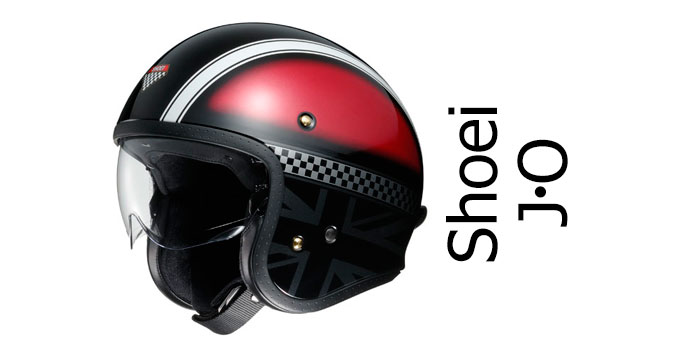
Shoei J.O – a super comfy, premium-quality 3/4 helmet.
Shoei’s latest open faced helmet is the Shoei JO.
It’s a very retro open faced helmet with an integral drop down shield, very much designed for folks with old bikes or slow bikes – or indeed those of us who are both old and slow and like taking our time over the ride and doing a bit of posing on the way. And hell, why not.
Obviously, it’s an 3/4 open face helmet, so don’t buy one if you’re after the best protection – either against the weather or the road.
But if you do buy one, here’s what you can expect from your Shoei JO.
Open face 3/4 helmet
Fiberglass composite helmet shell
Integral shield
Double D ring fastener
3 shell sizes
Removable lining
Sizes XS-XXL
Weighs around 2.2lbs (1Kg)
Expect to pay $360-$450
Looking to buy a Shoei JO?
Please click below to visit the Shoei JO helmets pages at our recommended stores – both checked for great online ratings. And if you buy from any store, we get a small sum from the sale at no extra cost to you – a massive THANKS! (it’s how we finance the site).
The shell on the JO is constructed in the same way many of Shoei’s full face helmets are – namely using their Advanced Integrated Matrix (AIM) technology, which is essentially five different layers of fiberglass and other fiber layers (which Shoei keep secret).
Shoei JO Hawker with main shield fully lowered
We might not know precisely what their organic and ‘high performance’ fibers are.
But what we do know is that they’re the same fibers used in the likes of the Neotech II and the RF-SR. And since the RF-SR has been Snell certified and Since UK versions of the same helmets scored four and five out of five (respectively) in their SHARP safety tests, it points to the helmet shell on the JO being equally well constructed and and should do its job equally well.
That tough helmet shell’s backed by Shoei’s multi-density shock absorbing liner too – which works as well as any EPS liner on the market.
So the helmet shell’s a particularly good ‘un. But that’s not to say the JO’s going to offer anything like the same protection overall as a full face helmet. Hit your head where the helmet is and it should give you decent protection – but if you don’t it won’t.
Which is why we score all open face helmets poorly in our rating system for safety.
If you’re in the market for one of these lids, presumably you know the risks you’re taking. If you don’t – buy a full face helmet instead!
OK, it’s an open face helmet so most of your face is gonna be exposed and there’s a ton of space for wind and noise to get inside.
So don’t expect it to be a quiet helmet because it ain’t.
Shoei do say they’ve sculpted the helmet and shield in a wind tunnel to reduce turbulance. And with all that nice soft padding inside coupled with a drop down shield, owners who are used to open face helmets reckon it’s quiet.
But if you’re used to full face lids, then you’re still going to find it noisy – especially at speed.
Having said that, bung in some quality ear plugs and you should be fine to ride for long periods without damaging your hearing and it shouldn’t feel too noisy either.
Same pretty well goes for ventilation. It’s a three quarter helmet so push up that shield and you’ll get in a ton of air to keep you cool. Mostly.
From the back – the Shoei JO Carburettor
I say mostly because there aren’t any vent holes in the helmet shell to let any air in and cool your scalp. Which according to quite a few owners means that it can get hot in there during summer rides.
Slightly bizarrely, Shoei has put ventilation channels inside the polystyrene EPS liner to help air circulate – and while there are a couple of tiny rear exhausts in the neck roll, there isn’t any real way for air to get into the channels in the first place.
All of which means if you’re in a state that doesn’t get too hot, you’ll probably be fine most of the time. And if you’re hard enough to ride wearing a JO in the winter, at least the lack of ventilation should keep your ears warm!
But if you do your open face riding when then sun’s out and the mercury’s high, then you might get very sweaty inside your JO.
It’s probably the JO’s shield that really caught your attention when you first saw it.
Front-on view of the Shoei JO Sequel
It’s still quite novel having a built-in shield on an open face helmet, and Shoei has gone to great lengths to make sure it works well. Seems like it’s not perfect, but most owners really like it.
The shield drops down from the top of the face port where it does a good job of tucking out of the way so it’s not distracting.
Some folks reckon the helmet sits higher on the head than many other open face helmets – and part of the reason may be that the front/top of the shell has to be slightly raised to accommodate the retracted shield.
The two opening tabs (both left and right – which is great) stick out slightly so you can easily find them to pull the shield quickly down.
Of course, we’ve all got different shapes of faces and sizes of noses. And many of us ride wearing glasses or shades.
So Shoei’s dealt with this by making the shield stick out a bit so there’s room behind for all manner of nose shapes and glasses (see comfort section below).
If you’ve got a wood-effect bike, then the wood-effect Shoei JO Waimea might be exactly the helmet you’re looking for!
They’ve also put adjusting tabs on each side of the shield which allows you to adjust how far down the shield drops.
There’s three positions, so if you find it drops onto the end of your nose, you can push the tabs up a notch and the shield won’t drop so far down. Great idea and it works well.
As does the shield when you’re going below motorway speeds. Above 60-70 you’ll start to encounter air whipping up behind the shield making your eyes water.
But drop the speed down to more dawdling speeds and it’s great.
If you want to go faster in a JO, you’ll probably need to stick in some shades behind the shield or invest in some goggles (there’s a ridge at the back of the helmet along with a loop to hold your goggles strap in place – UK/EU version only).
The shield’s clear out of the box (same as every helmet) but there are smoked and yellow replacements available too. And like every helmet it’s anti-scratch and gives UV protection.
Mid-grey Rat Grey JO. Note there’s no poppers to fit a sun shield on the Shoei JO
That UV figure’s usually somewhere over 95% – exact numbers are dependent on the type of polycarbonate used and differs slighly from maker to maker – but in the case of the JO, Shoei’s quoting 99%.
Owners mostly love the shield on the JO and it’s super easy to use – though the one downside is that it’s also quick to steam up when it’s cold/rainy. And there’s no Pinlock or similar available which is a bit of a bummer if you’re planning to use it as your daily helmet.
If you’re an open face helmet fan, you’ll know there’s some proper shonky lids out there.
Well, the good news with the Shoei JO is that Shoei hasn’t cut corners in- our outside the JO and they’ve thrown quality materials at the internals.
That includes using a synthetic nubuck above the shield port to stop reflections and fake leather at the bottom so it doesn’t absorb water and is easier to clean.
Rear of the Nostalgia graphics Shoei JO
Inside, it’s a super soft, moisture-wicking material that owners reckon makes for a really comfy helmet.
The cheek pads are sculpted to (hopefully) fit your face. But if they’re not quite right out of the box, there’s 4 other sizes available to buy to tailor the fit further. There’s also 3 other head linings too so you should be able to get everything bang on.
Couple all this with the fact the JO weighs about a Kilo so is super lightweight – at least compared to a helmet with a chin bar – and owners universally seem to find the JO a mega comfy and lightweight helmet to ride in.
If you order one and you find you’re between sizes slightly, the advice is to order the smaller size as it’s sizes just a tiny bit on the large side.
Looks & Graphics
Most owners are probably going to go for the plain versions of the JO – so you’ll find a matt and gloss plain black as well as an off-white that’s kinda like an aging enamel look as well as a mid grey (called Rat Grey) and a dark Matt Brown.
Shoei JO launch designs. For more, please click through to our recommended retailers
There’s also some subtle retro designs including the Hawker, Sequel, Carburettor, Nostalgia, Waimea as well as one with a big 59 on it called Gratte-Ciel which Google translate bizarrely reckons means Skyscraper.
They’re mostly very cool and very retro so you’re bound to find one that perfectly suits your retro hipster ride – or matches your outfit on the Distinguished Gentleman’s Ride.
To find the latest deals and designs – please check out our recommended stores using the links below (all fantastic retailers regularly checked for quality of service). Nice one.
Best places to buy a Shoei JO?
Please click below to visit the Shoei JO helmets pages at our recommended stores – both checked for great online ratings. And if you buy from any store, we get a small sum from the sale at no extra cost to you – a massive THANKS! (it’s how we finance the site).
Shoei JO Video
Here’s a useful 6m video taking you around the Shoei JO and looking at how it works on the road.
Other stuff – fasteners, audio, aero, build quality, warranty
The JO comes with a double-d ring fastener. Secure, work well and relatively simple to use. Fits in with the retro/open face theme too.
If you’re looking to use your Shoei JO with a bluetooth kit, unfortunately you’re gonna have to forget it. There aren’t any speaker pockets inside the JO for some reason – and don’t be tempted to buy one and hack at the liner either as that’ll massively compromise the safety of your lid.
Plain solid black’s probably gonna be the most popular. Also in matt
The JO’s been designed in a windtunnel to give decent aero performance and we didn’t find anyone complaining about buffeting or lifting, though I reckon there aren’t gonna be too many people riding fast in their JOs unless they’re beind a fairing.
Build quality is said to be outstanding – great materials, paint and finish and it’s all put together beautifully. Just what we’ve come to expect from a Shoei.
And to back that up, all Shoei helmets come with a 5 year warranty – or 7 from date of manufacture which you’ll find inside the helmet.
Overall/Summary
There’s no doubt about it, the Shoei JO is a great piece of kit. It shouts quality, it’s built well and it uses the helmet design expertise that Shoei’s built up over the decades to offer an outstanding open face helmet.
Shoei also does this cool matt brown JO
It’s got a great shield system, providing you’re not going too quickly, and it’s all day comfortable too. It can get a bit hot inside but it shouldn’t be a problem in all but the hottest weather.
It’s never going to give you the same protection from the weather or road that a full face or the best performing modular will – so we recommend you go and buy the safest full face helmet instead if you’re after quality protection.
But if you’re after a great performing open face helmet and value quality over price, the Shoei JO really won’t let you down and owners reckon it’s well worth the money.
Looking to buy a Shoei JO?
Please click below to visit the Shoei JO helmets pages at our recommended stores – both checked for great online ratings. And if you buy from any store, we get a small sum from the sale at no extra cost to you – a massive THANKS! (it’s how we finance the site).
Good Alternatives to the Shoei JO?
OK, here’s some other helmets to check out, whether you’re after a nice new retro helmet or an open face.
The Bell Moto 3 is modelled on their classic 70’s helmet and is a proper back to basics lid but one that gives full face protection too.
For a cheaper open face helmet that comes with a weather shield and goggles, the Shark Drak looks mean and comes with a 5 year warranty too.
Or for another open face option that uses the same helmet tech as the JO, there’s the Shoei J-Cruise that has both a drop down faceshield as well as a sun visor.
In fact there’s such an array of retro and open face helmet options out there – check out our dedicated Retro Helmets and Open Face Helmets pages to have a look through some of the best on offer.