BillysGear link
Home Blog Page 15

Suomy Apex motorcycle full face crash helmet review

suomy-apex-disc-featured

Suomy Apex full face street helmet review

The Apex is Suomy’s streetbike helmet that has a nod towards the track.

In their current line up, Suomy has the SR – it’s sports/track helmet, the Halo which is an all-rounder street helmet, and then there’s the Apex which is a bit of both.

Like the SR, the Apex has a shell made of a composite of carbon, fiberglass and aramid (Kevlar). Which is undoubtedly one of the reasons it’s so flipping light because it weighs in at around 3lbs (1.35Kg) and that makes it one of the lightest full face helmets around. But does that also mean Suomy have missed something out?

So, here’s a ton of information about the Suomy Apex, as we dig around and discover what owners think of theirs.

  • Sporty full face helmet
  • Made of carbon/aramid/fiberglass composite
  • Available in 3 shell sizes
  • 3lbs (1.35Kg) – it’s light
  • ECE and DOT certified
  • Sizes XS-XXXL
  • 2 year warranty
  • Expect to pay $310-$350

    suomy-apex-france-motorcycle-crash-helmet-side-view
    The Suomy Apex France

Safety

The shell of the Suomy Apex is made from a carbon, aramid (Kevlar) and fiberglass mix which, aside from meaning it’s super light weight, probably accounts for its moderately high price tag because creating super light weight composite fiber helmet shells doesn’t come cheap.

Suomy also produce the Apex in three different shell sizes. That’s a good number of shells and should make sure the helmet both looks in proportion and has the right ratio of shock absorbing liner for each fitment size. It’ll also make sure you’re not carrying more helmet on your head than necessary because light weight is a good thing when it comes to making an effective helmet.

suomy-apex-la-cocca-helmet-top-down-view
This model is the Suomy Apex La Cocca showing chin and forehead vents and rear spoiler

And the Suomy Apex sure is light. It weighs around 3Lbs (1.35 Kilos) give or take – and that’s light.

But sometimes making a helmet light can mean it doesn’t quite offer the same amount of protection as a heavier helmet. And that seems to be the case in the Apex.

Suomy don’t submit their helmets to Snell for testing, but it has been SHARP tested where the Apex scored three stars out of five. Which is far from the worst safety score in the world (in fact it’s pretty decent) but it’s not the best either.

It is of course both DOT and ECE approved – so you know it’ll offer at least a (pretty decent) minimum level of protection. But there are better helmets out there for safety (see our alternatives section at the bottom of the page).

Other safety features include a double-d ring fastener and clear main shield with anti-fog treatment. So it’s lacking some of the more recent safety innovations such as EQRS or optically-correct shield with Pinlock insert that you find in quite a few helmets these days.

Helmet Noise

suomy-apex-plain-white-motorbike-crash-helmet-side-view
Plain white Apex. Note side pods that need removing to take off the shield

Suomy do say that the Apex has been designed using wind tunnels – so that will hopefully make for a slippery helmet shape (which will help reduce noise). But as we’ve found many a time before, even the slipperiest helmets can be noisy – especially if they’re designed for the track where noise suppression is way down the list of priorities.

And while the Apex only gives a nod towards the circuit, it seems to have inherited some of a track helmet’s noisiness as owners seem to think it’s on the noisier side of average with comments ranging from OK to really noisy.

It might also be that in their search for reduced weight, Suomy’s also removed some of the helmet’s ability to keep the noise out. And of course, how noisy you find your helmet is very subjective and dependent on riding style, bike and lots of other factors. So look here if you do need a quiet helmet above all else.

Ventilation

There’s three front vents and four exhaust vents on the apex.

The chin vent has two positions and directs air onto the rear of the shield as well as around the mouth. The forehead vent has a single switch to open both vents and that directs air around the scalp via ventilation channels in the helmet lining. And then there’s two top rear exhausts underneath the spoiler and a couple further down near the collar.

suomy-apex-italy-motorcycle-crash-helmet-side-view
Suomy Apex Italy helmet. Note all helmets are supplied with a clear shield, not dark

It’s a fairly conventional layout but overwhelmingly owners seem to reckon it’s very effective on the Apex. The air channels are large and the inlets are effective meaning it should keep you cool on all but the hottest days/slowest rides.

Shield

The shield on the Suomy Apex is anti-scratch (obv) and they say it’s got an antifog coating on there – though we wouldn’t expect that to be much use in challenging rain/cold/humid conditions because we’ve yet to find a bog-standard manufacturer-applied antifog coating that’s any good (unless it’s an actual insert attached to the rear of the shield).

The shield uses friction not a ratchet to keep it open. Friction shields can be OK but can also be prone to wearing or need fairly regular adjustment to keep them working well, compared to a ratchet shield. Having said that, no one we could find was having a problem with wear or the shield slamming shut so it doesn’t look like it’s a problem with the Apex.

What might be a little more of a problem is that, unusually, the Apex doesn’t have a quick-release shield. There’s a couple of side pods that need popping open using the tool provided: insert the tool into a little groove on the side and it’ll pop off. Once off, you move a couple of sliders (toolless) and the shield pulls off. Apparently it’s a bit of a pain but doesn’t take too long to get the hang of it.

It’s not as quick and simple as much of the competition though. And there isn’t a Pinlock-ready shield available for the Apex either which is a bit of a shame.

suomy-apex-matt-black-helmet-rear-view
Double top exhaust vents and double lower vents help make for quality ventilation

Comfort & Sizing

Inside the Suomy Apex, the comfort lining is fully removable and washable and, if you find the fit isn’t quite bang-on, there are replacement cheek pads available to help you get the fit just right.

The materials inside are designed to be moisture-wicking and breathable. It uses a Coolmax fabric which is a polyester fabric that’s popular among lots of helmet makers because it makes for more breathable helmets (although one owner reckoned it doesn’t work very well in the Apex).

Suomy also use something called Interpower treatment. That’s a treatment that’s designed to reduce the contact points between the skin and fabric thereby reducing moisture build-up.

Word is that the helmet can be very comfy (as always, provided you get it to fit right in the first place) though a word of warning – most folks reckon Suomy’s size small, so if you’re thinking about buying one and you’re between sizes, or not sure, we suggest you go for a size larger than normal.

suomy-apex-pike-red-motorcycle-crash-helmet-side-view
This one’s the Apex Pike in red/black

Looks & Graphics

Suomy aren’t really known for their shy and retiring graphics! They do offer plain solid black and white versions but as you can see from their current line up on this page (in the form of the Rolling Thunder, Pike, Jap and both the France and Italy graphics) they prefer bright and in-your-face colors.

If none of these are your thing, then click through to our recommended retailers below to find out what back catalog graphics they’re selling – or any new graphics or deals they’re offering.

Suomy Apex video

Here’s a quick 4m video looking over the Suomy Apex.

Other stuff – build quality, warranty

suomy-apex-rolling-thunder-motorcycle-helmet-top-side-view
They don’t come much more ‘out there’ than the Apex Rolling Thunder!

Many owners say that the finishing and quality of materials on their Apex is really great. However, one or two do say that the build quality isn’t actually that good with things like the top vents being a bit too flimsy and breaking easily. We have to say however that most makers design vents to break off easily so they don’t compromise safety during an accident – or dig in and rotate the helmet – so it might not actually be a Suomy problem (even top of the range Arai’s suffer from ‘flimsy’ vents from time to time).

And finally, Suomy offers a 2 year warranty on all their helmets.

Overall/Summary

If you’re after a really light weight helmet at a reasonable price, then the Suomy Apex may well be the right helmet for you. And, as for all helmets, if it feels right and fits right, then that’s two massive plus points because correct fit and comfort contribute massively to safety.

However, there are alternatives on the market (below) which edge the Apex in terms of features and overall safety – and offer more bang for the buck.

Which is not to say the Suomy Apex isn’t a great helmet, because it is and many owners love theirs. But things like quick release shields, Pinlocks and EQRS along with higher marks for safety make some helmets that bit easier to live with and give you extra piece of mind that they’ll give you great protection in an accident.

suomy-apex-jap-black-gold-crash-helmet-top-down-view
The Apex Jap in black and gold

But like we said, if light weight is right up there for you and you fall in love with the design and graphics, then go for it because the Apex is a capable all-rounder.

[xyz-ihs snippet=”Link-to-guides-page”]

Good Alternatives to the Suomy Apex?

The HJC FG-ST costs around the same money as the Apex but it’s a SHARP 5 star rated full face fiberglass helmet with drop down sun visor and with a Pinlock antifog insert in the box.

Or if you’re definitely after something at the sportier end of the street, try the LS2 FF323 Arrow. That’s a SHARP 4 star safety rated fiberglass helmet (there’s a carbon version too if you’ve got the dosh) that comes with an optically-correct shield and Pinlock in the box. It’s about as light as the Apex too.

The X-Lite X-702-GT is quiet, comfortable and has great ventilation and it’s only a smidge heavier than the Apex. It has a maximum SHARP 5 star safety rating on it too.

suomy-apex-motorbike-helmet-matt-black-side-view
Plain matt black Apex

For more helmet suggestions, visit our smart filters, our gallery pages or our top 10 helmets to quickly find your next helmet.

[xyz-ihs snippet=”Alternatives—full-face-helmets”]

Star Ratings

MT Atom SV modular motorcycle crash helmet review

MT Atom SV – MT’s flip-up helmet aimed at long-distance riders

The Atom is MT’s touring flip-up helmet, designed to give all-day riding comfort for folks who love to spend the entire day crossing continents or dawdling along mountain passes.

Which means that MT is really playing on the big boy’s turf now, because that’s one hell of a demanding rider right there…

MT are known for making helmets at the more budget end of the price range of course. But long-distance types are more demanding of their helmets: they expect all-day comfort; They want great noise suppression; and they positively insist on quality aero that lets them cruise around without getting buffeted around like they’re in a Metallica mosh-pit (then again, don’t we all?).

MT really has their work cut out with the Atom, so here’s our first look around what the new MT Atom offers:

  • Polycarbonate modular helmet
  • Aimed at touring riders
  • SHARP 3 star safety tested (UK version)
  • 2 shell sizes
  • Pinlock Max Vision anti-fog insert included
  • Optically-correct quick-release shield
  • Drop down sun visor
  • Sizes XS – XXL
  • Weight 3.75lbs (1.7Kg)
  • Expect to pay $180-$200
MT-Atom-matt-Black-motorbike-helmet-side-view
Stealthy-cool solid matt black version of the MT Atom

[xyz-ihs snippet=”MT-generic-retailers-quick”]

Safety

There’s a load of safety features adorning the Atom that shows MT are serious about safety.

First off, that shield. It’s an optically correct shield that’s Pinlock anti-fog ready and comes with a Pinlock Max Vision insert in the box. It’s also nice and thick at 2.2mm. Which covers most of the safety features you want to see on a shield – namely there should be little to no vision distortion and, with a Pinlock fitted, it’s not going to fog up either.

And of course the Atom comes with an integrated drop down sun visor so you can quickly protect yourself from any dazzling when riding and means you won’t get caught out when the sun gets low.

Of course, key to having a helmet that’s going to work well for you day-in, day-out, is having it comfortable (see the comfort and sizing section below). If it’s not comfy, then it either you’re not going to wear it or you’ll be riding around distracted by it. The Atom weighs about 3.75lbs (1.7 Kg) which is about bang-on average weight for a modular and so, as long as you get the right fit in the first place, it shouldn’t feel too heavy when you’re wearing it.

MT-Atom-Tarmac-Black-White-motorcycle-crash-helmet-Front-view
MT Atom Tarmac in black, grey, white

The shell on the MT Atom is polycarbonate (see our Polycarbonate section for whitterings on why polycarbonate helmets are just fine) and it’s produced in 2 shell sizes – which should make it fine in terms of safety and looks (again, see the link for more info. on what all this means).

And underneath the shell, there’s a multi-density polystyrene shock-absorbing liner to soak up the impact. That’s pretty much the same type of EPS liner you find in all but the most cutting-edge helmets these days – including several SHARP 5 star helmets (and including MT’s own five star rated MT Revenge polycarbonate helmet).

So, onto helmet testing. MT don’t submit their helmets for Snell testing but they are both DOT and ECE certified and some have been SHARP testing too.

Well, the European version of the Atom was SHARP tested in Oct 19 where it scored 3/5 stars for safety. That means the last 3 MT helmets have scored 3 stars with an average of 3.9/5 across all their tested helmets.

MT atom SV 8_5ms impact test result 2
SHARP (UK) MT Atom SV 8.5 m/s impact test result showing average to poor side impact protection. Image courtesy of Sharp.dft.gov.uk

3 stars is an OK score. But what isn’t OK is that the chin bar became unlocked in 50% of the helmet tests. That doesn’t necessarily mean the chin bar flipped up (SHARP doesn’t go further than saying it became unlocked) but if it was me, I wouldn’t buy a flip up helmet that scored so badly.

Once it’s unlocked you don’t know what’ll happen and there’s modular helmets out there that score 100% for chin bar safety. You’ll find some of them in our top 10 modular helmets list and you can find more if you go to our smart(ish) filters page and choose flip-up/modular and safest boxes.

Again, that’s a score that came from SHARP in the UK and while we suspect it’ll be identical to the US Atom SV, we don’t know for sure.

Helmet Noise

MT has designed the Atom to be a quiet helmet. That’s not going to be easy though because modulars are notoriously noisier than full face helmets.

According to their bumf, there’s a four-way neck curtain system and lower liner flaps, all designed to reduce the amount of noise that gets into the helmet from below.

MT-Atom-Black-Fluo-yellow-flip-front-crash-helmet-side-view-open
Atom SV Tarmac in yellow showing full extent chin guard opens

Of course, there’s more to noise-ingress than just what gets in from around your neck, and good aero, clever vent design as well as a noise-suppressing interior lining all play a role in making a quiet helmet. So we’ll have to wait until our full review to find out if MT’s managed to make that rarest of beasts – a quiet modular helmet!

In the meantime, if you really want a quiet helmet – check out our quietest helmets page.

Ventilation

Onto the vents and the MTs vents look fine and fit for purpose.

There’s a single chin vent in the chin guard, operated by a toggle plate (push the bottom to open the top) and that directs air onto the back of the shield. See the gallery below for a close-up of the vents.

Up top, there’s a single crown vent, opened by a large, glove-friendly, slider. And at the back, there’s a large exhaust vent to help get all that fetid, stinky air to escape (or is that just me?), again, opened/closed by a large slider on top of the vent.

MT-Atom-Solid-Matt-Black-Back-view
Rear view of the matt black Atom showing rear sculpting and exhaust vent at top

The air from the crown vent is pushed through the helmet shell and channelled through the EPS lining inside the helmet and onto the scalp via the comfort lining.

It’s a method used in most helmets these days and should give decent ventilation around the top of the head.

Shield & Sun Visor

The shield on the MT Atom really ticks all the boxes. Quick Release – tick. Optically correct – tick. Pinlock ready – tick. Pinlock Max Vision insert in the box – tick. Drop down sun visor – tick.

In fact it does everything except perhaps have a super large shield opening – but then you only really get those (or arguably need those) on sportsbike helmets.

Nope, the shield mechanism – on paper at least – offers you pretty well everything you could want from a shield.

It operates on a ratchet, has the opening tab on the left and has a quick release mechanism on it so you can easily whip it off to give it a clean. It also comes with a Pinlock Max Vision anti-fog insert in the box. Fit that to the shield and you’ll never steam up again (OK, it’ll steam up if you go mountain climbing in it – but for most of us, it solves the problem).

Behind the main shield is a drop down sun visor. It’s a binary affair – meaning it’s either fully up or fully down – but that’s OK for most of us because that’s how we tend to use them.

Interestingly, it’s operated by a red/black switch on the bottom left hand side of the helmet; push the red switch forward to lower the visor, press back on the black one and the spring-loaded visor will pop back up, out of the way.

MT-Atom-Tarmac-Black-White-modular-motorcycle-helmet-Front-view-open
Helmet opens by a button hidden on the inside of the chin guard

Chin Guard

The chin guard on the MT Atom is operated, unusually, by a single button on the inside of the chin guard. Press it in and that releases the lock, allowing the chin guard (and shield) to swing up.

There’s a chin curtain ready installed on the Atom, but MT has cunningly made it in two pieces so you can easily slip your fingers in between them to reach the button. Good design MT.

Opening the chin guard is all very easy to do in one single action and with one hand, unlike some modulars I could mention. Once it’s fully open, there’s actually a small switch, almost hidden, that’ll lock the chin guard in place.

Which is not to say you can legally ride with the chin guard up on the Atom – you can’t. It’s not P/J approved (or dual homologated) so it’s only designed to protect you with the chin guard down.

Try one of these if you want a flip-up helmet that’s legal to ride in open-face mode.

The only fly in the ointment with the MT Atom is that they’ve a shaky record in producing chin guards that stay locked under impact testing – at least as far as SHARP’s concerned. SHARP has only tested two modular helmets to date, but they do record the percentage of impacts that the chin guard remains fully locked – and MT modulars have so far scored a 70% and a 40%.

Of course, this may not reflect how the Atom will do – hopefully MT has learned some lessons since the last MT modular was tested in 2015 – but it might not fill you full of confidence either!

Comfort & Sizing

The MT Atom is available in sizes XS – XXL.

I’ve no information about the fabrics used on the internals, but they seem fairly basic but comfortable. There’s a moisture-wicking fabric covering most of the inside, a waterproof section to the bottom to stop the helmet absorbing rain from below (and a reflective part to give a bit of added visibility); and there’s a ventilated fabric to the front to help bring air through the cheek pads.

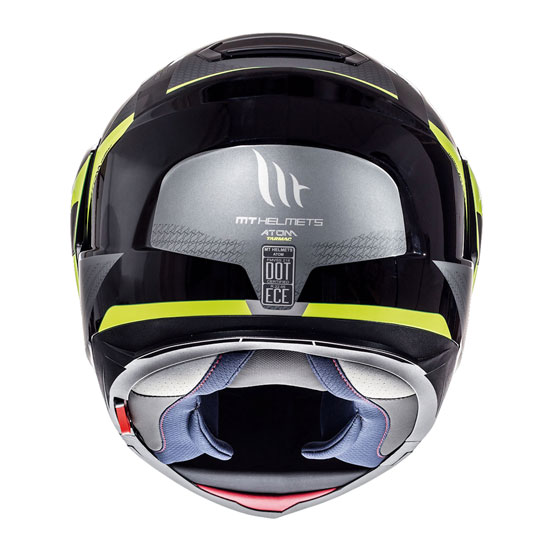
MT-Atom-Black-Fluo-yellow-rear-crash-helmet-view
Rear of the Atom Tarmac black/fluo yellow

There’s a generous neck roll and chin curtain to the bottom too to help reduce sound getting in the helmet, and there’s a decent length of padding over the chin straps so they don’t dig in.

Looks & Graphics

For a mid-priced modular, the MT Atom is something of a looker. It’s available in just two graphics at the time of writing – a solid matt black and the Tarmac graphics (in black fluo yellow or black/white) – though word has it there’s a white and full hi viz version coming soon.

To see the latest graphics available – and find deals on the MT Atom – please click our European recommended retailer links below. Nice one!

[xyz-ihs snippet=”MT-generic-snippet”]

MT-Atom-helmet-Solid-Matt-Black-front-view
Front view of MT Atom matt black

Other stuff – communicator, build quality, chin curtain, warranty

If you’re looking to fit a bluetooth headset to your next helmet, there’s room for some shallow speakers inside the Atom and they’re held in place by some nice firm plastic-rimmed speaker pockets so they should stay put.

Build quality seems to be very good – with paint and finishing particularly great.

The MT Atom comes with a chin curtain and breath guard built in.

Finally, all MT helmets come with a basic one year warranty. Many (granted, more pricey) helmets come with a five year warranty (click the link to find helmets with a 5 year warranty).

Overall/Summary

When you first look over the MT Atom, it looks like a well thought-out helmet and the build quality looks (and feels) great. It’s been designed to work well for touring types – and we’ll see in a few months time whether MT’s design goals of making a quiet helmet that’s all day comfortable – has worked (if you own an Atom, please let us know what you think in the comments section below).

In October 2019 the testing boys at SHARP put the European version of the Atom SV through its paces in the lab. And while it scored an OK 3 stars overall (out of a max 5), that chin bar only stayed locked during 50% of the tests – which is a big concern.

MT-Atom-tarmac-black-white-crash-helmet-side-view
MT Atom Tarmac in profile

Other than that, it’s got a shield system that delivers most of what’s on offer today – including Pinlock insert and optically correct-ness – along with a simple to use chin guard mechanism and decent quality internals, not to mention sleek, modern looks.

I wouldn’t buy one because of that chin bar test result (note: we can’t be 100% sure it’s an identical helmet to the US version). If that’s not a deal-breaker for you, then the MT Atom might well be shaping up to be a bit of bargain modular.

[xyz-ihs snippet=”Link-to-guides-page”]

Good Alternatives to the MT Atom?

OK so you’re after a modular helmet with all the bells and whistles but that’ll give you change from $200? That’s not an impossible ask…

First off, there’s the ever popular Caberg Duke. 5 Star SHARP rating, decent price, reasonably light (for a modular) plus it comes with a Pinlock in the box. What’s not to love?

The HJC IS-Max II can be had for around the same money as the MT, it’s SHARP 4 star tested, weighs in around the same as the Atom and has a glasses groove for folks who wear glasses (or shades).

MT-Atom-Black-Fluo-yellow-crash-helmet-side-view
Finally, side view of the Atom Tarmac yellow/grey/black

The AGV Compact has that AGV brand mark on it – but it’s also got a sun visor, SHARP 4 star rating and is comfy and well ventilated.

And finally, if you can stretch to a bit more, there’s the dual homologated Shark Evoline 3. That’s 5 star safety rated, has a drop down sun visor, and is great for riding round legally with a truly open-face helmet vibe going on. It’s a nice looking helmet too.

[xyz-ihs snippet=”MT-Cat-link”]

[xyz-ihs snippet=”mod-helmets”]

AGV Veloce S: AGV’s Mid Price Street/Sportsbike helmet

AGV Veloce S motorcycle crash helmet review.

AGVs GT Veloce was a great helmet. Designed to be their entry-level sports helmet with a look of all those track-developed beaky AGVs like the Corsa R and top of the range Pista GP-R, it delivered supreme safety and lots of useful features all finished off with a great low price tag.

Now, the GT Veloce has been replaced by the Veloce S. Apart from a new range of graphics and a slightly fatter price tag, you’ll be hard-pressed to tell the two apart. But with new internals, EQRS and with a Pinlock in the box, the Veloce S promises to be a major step forward over the old helmet.

  • Carbon/aramid/fiberglass shell
  • Full face sports/street helmet
  • Not Snell certified
  • SHARP 5 star safety rated (maximum)
  • Class one optical shield
  • Pinlock antifog in the box
  • EQRS
  • Double-D ring fastener
  • 3.1lbs (1.4Kg)
  • 5 Year warranty (*see ‘other stuff’ below)
  • Expect to pay $599-$749

[xyz-ihs snippet=”Text-AGV-Top”][xyz-ihs snippet=”Text-AGV-Top-2″][xyz-ihs snippet=”BTO-AGV-pic-sml”][xyz-ihs snippet=”Az-AGV-pic-sml”]

Safety

The AGV Veloce S has a ton of safety features, backed by AGVs fantastic reputation for making safe crash helmets.

So far, AGV is our joint second placed top safest helmet brand.

AGV doesn’t submit its helmets to Snell for testing, so we can’t get any results from there. However, the UK’s SHARP testing team buys in helmets independently for testing (without the nod from the manufacturer) so we can get independent safety data from them.

The Veloce S’ predecessor, the outgoing and excellent GT Veloce, scored top marks in the SHARP helmet test and because the Veloce S has the same helmet shell, we saw no reason that the Veloce S wouldn’t score just as well.

Well, after weeks in the SHARP testing labs, they’ve scored the Veloce S top marks again. Meaning, if you’re after a helmet that keeps you looking pretty as a priority (OK, it’s in the eye of the beholder, right!), then you can very much trust an AGV.

In fact, looking back over the years, you’ve gotta go back to an ancient AGV K-Series helmet to find one that scored less than four stars in SHARP testing.

Much of that will be down to those race-developed helmet shells. And while the Veloce S is more of a street/sports crossover helmet and not an out-and-out track helmet, the lessons learnt making helmets for the likes of Valentino, Pol Espargaro, Andrea Iannone and Jack Miller (actually, the list goes on and on) won’t have been put to waste on making helmets for the rest of us.

The shell’s a composite of carbon, aramid (i.e. kevlar) and fiberglass. It’s shaped in-line with many of their highly rated track helmets like the Corsa and Pista-GP and it’s backed by a multi-density shock absorbing lining. It also comes in four different shells sizes to make sure each fitment size is as close to optimal in terms of helmet size and lining. All these are GOOD THINGS.

AGV-Veloce-S-motorcycle-helmet-Rossi-Soleluna-side-view
It’s AGV so there’s always a Rossi Replica, right? This one’s the Soleluna.

There’s plenty of other features that will, hopefully, mean you make it round the track – or block – in one piece.

There’s a 3.3mm thick class 1 optically-correct shield for clear, distortion-free vision, backed by a Pinlock ready shield with Pinlock included to keep your vision fog-free from the get-go.

AGV also reckon they’ve redesigned to bottom of the helmet/neck roll to stop it hitting your collarbone in an impact (tbh, I kinda hoped all helmet makers would do this but now AGV’s raised it – maybe not!).

And should the worse happen and you do have a spill, the Veloce S is fitted with EQRS so paramedics can remove your helmet without upsetting your head and neck too much.

All in all, in terms of safety, that’s a stack of ways AGV has tried to make the Veloce S perform well. So in pure ‘check box’ terms, the Veloce should pretty well offer as much protection as you could hope for in a crash helmet.

Helmet Noise

(more about helmet noise)

Obviously, the Veloce S is a sportsbike helmet. And when it comes to designing a sportsbike helmet, quietness is usually very low on the list of priorities.

And that’s proven to be the case with the Veloce S. By far the majority of owners reckoned it’s noisy.

It’s probably not helped by all those great ventilation holes letting in a stack of air (see below) but if you get towards freeway speeds, the noise really ramps up and never stops building.

Of course, stick in a great pair of ear plugs and you should be OK. But don’t buy a Veloce S expecting it to be quiet and cosseting, because it ain’t.

Ventilation

Like most of the latest range of AGVs, the Veloce S is fitted with their IVS or Integrated Ventilation System.

All that really means is the Veloce S uses a system similar to most other modern helmets – i.e. vents in the shell allow air to pass through the shell where channels in the EPS polystyrene lining direct hair around the head. Air is then removed from the helmet by the two exhaust vents at the back of the helmet.

AGV-Veloce-S-motorcycle-helmet-multi-freccia-white-grey-rearview
Two rear exhausts – on the Freccia in white/grey

The configuration of the vents on the Veloce S looks similar to that on the outgoing GT Veloce – twin chin vents and triple forehead vents. On the previous GT Veloce helmet, owners seemed to think ventilation was OK though the switches on the vents were a bit fiddly.

But on the Veloce S, ventilation’s rated as excellent with the redesigned internals doing a fantastic job at circulating air around the helmet.

So if you’re planning to use your Veloce S doing lots of sweaty track days – or if you spend most of your days in the sunshine – then you should find yourself riding in a happy (and cool) place.

Shield

Like the GT Veloce, the Veloce S has AGVs Race 2 shield – that’s a nice large and wide shield that’s 3.3mm thick for added safety, and is optically class 1 correct for distortion-free vision. It’s also Pinlock and tear-off ready and, unlike the GT Veloce before it, the Veloce S comes with the Pinlock anti-fog insert in the box so you’ll never have your shield steam up (hurrah!).

The shield on the Veloce S is quick release and it operates without a ratchet. Fully closed, there’s a central locking mechanism which you have to disengage before opening the helmet.

The shield on the Veloce S is quick release and it operates without a ratchet. Fully closed, there’s a central locking mechanism which you have to disengage before opening the helmet.

That’s a safety feature to stop the shield opening during an accident or while on the track. A couple of riders found it fiddly at first, but once you get the hang of it the shield lock works pretty well.

The opening tab is in the middle of the shield which is a decent place for it and means you can open your shield with your right hand when you’re stationary and pulling in the clutch.

Once you open the shield, it cracks open to allow some air in and help reduce misting. But the next point up is fully-open because the Veloce S’s shield doesn’t work on a ratchet.

You’ll have to decide if that’s OK for you – some of us prefer a ratchet to keep the shield open at different stages, others don’t – it’s very much down to personal preference.

One great thing about the face shield on the Veloce S is that it’s mega wide and tall. A couple of riders said they’ve never had a helmet that’s so unobtrusive because you don’t see the sides at all. And because it’s so tall, forward vision in a tuck position is excellent.

Comfort & Sizing

The Veloce S – like most helmets on the market – is a slightly oval fitment. Most of us have heads that are longer than wider and that’s the head form the Veloce S works best with.

AGV-Veloce-S-motorcycle-helmet-prediatore-matt-black-front-view
Prediatore graphics are a popular scheme – also in black/red

Inside, AGV have gone to lengths to make a comfortable liner, using a few technical fabrics to keep things dry and fresh.

The cheek pads use an antibacterial fabric that’s moisture wicking and with a microsense treatment (apparently this makes it more comfortable). The neck roll is hydrophobic-lined to stop it absorbing water in rain and both neckroll and skull pad are lined with moisture-wicking/antimicrobial Shalimar fabric.

As you’d expect, all the internals are removable and washable and all AGV Veloce S’s come with an emergency quick removal system (EQRS) cheek pads as standard fitment.

Word is that this all adds up to a helmet that’s very comfortable indeed. The lining is particularly soft and is great for long days in the saddle.

The Veloce S is available in sizes XS-XL.

Looks & Graphics

To date, there’s only matt black and pearl white options if you want solid, plain colours. If you want funky graphics, there’s the Prediatore, Freccia and Fulmine and you can find examples of these up and down the page. And like all AGV sports helmets, there’s a Valentino Rossi version – in this case it’s the Soleluna.

[xyz-ihs snippet=”Text-AGV-Top”][xyz-ihs snippet=”Text-AGV-Top-2″][xyz-ihs snippet=”Logo-AGV-BTO”][xyz-ihs snippet=”Logo-AGV-Azcom”][xyz-ihs snippet=”Text-AGV-bottom-2″]

AGV Veloce S Video

Here’s a pretty comprehensive 9m look around the Veloce S from the fast talking dude at Revzilla.

Other stuff – fasteners, weight, chin curtain, warranty

The AGV Veloce comes with a tried-and-tested double-d ring fastener. They’re the fastener of choice among racing helmets – but they’re not strictly necessary to take on the track.

AGV-Veloce-S-motorcycle-helmet-Rossi-Soleluna-rear-view
Rear view of the Veloce S Soleluna Rossi Rep

As for weight, the Veloce S has been lightened from the old Veloce and now weighs around 3.1lbs (1.4Kg). The average weight of a composite fiber helmet is 3.2lbs (1.46Kg) so the Veloce S is a smidge lighter. If you’re after something lighter still, you’re best looking at one of these helmets instead.

As you’d expect, the Veloce S comes with both breath guard and chin curtain pre-fitted.

*And finally, AGV helmets come with a standard 2 year warranty. However, that’s extendable by an extra 3 years if you register your helmet on their website (within 60 days of purchase).

Overall/Summary

AGV’s range of sports/track helmets have a legendary status, not least because they have the blessing of the big man himself (not that big man – Valentino!). They also tend to score top marks – or near top marks – in SHARP safety testing too; and the Veloce S is no exception scoring a maximum 5 stars in the SHARP testing labs.

The Veloce S is a great looking helmet like the rest of AGVs sports helmet range – but it’s a little less extreme than the rest of the family. Which should make it a more usable street helmet and, importantly, cheaper. It’s not the lightest helmet on the block, but it comes with great stuff like an optically-correct shield, Pinlock antifog in the box and EQRS should things go wrong.

It’s not the cheapest helmet for road riding either, but it’s got that all important AGV pedigree and build quality, and it looks cool – with or without the Rossi graphics.

And owners love their Veloce S’s. Yup it’s noisy, but that’s pretty much a given for sportsbike helmets. But it’s comfortable, has great ventilation and an immense shield system.

If you’re looking for a quality sportsbike helmet that’s just as at home on the track as it is on your Sunday blast, then the AGV Veloce S should definitely make it onto your shortlist.

AGV-Veloce-S-motorcycle-crash-helmet-mono-pearl-white-side-view
Gloss white Veloce S in side profile view

[xyz-ihs snippet=”Link-to-guides-page”]

Good Alternatives to the AGV Veloce S?

If you’re quick, you’ll find some of the old GT Veloce’s on sale. They’re still a great helmet, cost less than the new Veloce S and they come with that maximum 5 star SHARP safety rating.

If you want something very sporty, that’s very light and has a maximum SHARP safety rating, then why not have a look at the Shark Race-R Pro.

For less money than both the AGV and the Shark, there’s the SHARP 4 star rated LS2 Arrow – that’s a sportsbike focused helmet that comes with both an optically correct shield and Pinlock antifog in the box. It’s light too.

Or for a helmet that’s more of an all-rounder, there’s the fiberglass HJC FG-ST. It’s SHARP 5 star safety rated, comes with a Pinlock Max Vision, has a drop down sun shield and is cheaper than the Veloce S too.

All these helmets are highly rated for safety and widely liked by their owners – and well worth checking out.

[xyz-ihs snippet=”Text-AGV-Top”][xyz-ihs snippet=”Text-AGV-Top-2″][xyz-ihs snippet=”BTO-AGV-pic-sml”][xyz-ihs snippet=”Az-AGV-pic-sml”]


[xyz-ihs snippet=”Alternatives—full-face-helmets”]

[xyz-ihs snippet=”AGV-Cat-link”]

MT Mugello budget motorcycle crash helmet

MT-Mugello-featured-2

MT Mugello: amazing value all-rounder budget helmet

Spanish helmet maker MT has built a solid reputation for making helmets that give excellent crash protection but don’t cost much.

Which means if you’re in a rush to buy a helmet and have a tight budget, then choose an MT and you’ll not go far wrong. You’ll not get the most sophisticated top-specced helmet around, but then you’ll also have saved a stack of cash. Which is always a good thing!

The Mugello is a polycarbonate-shelled full face crash helmet that’s one of the cheapest helmets on the market. So can it be any good?

  • Polcarbonate full face helmet
  • SHARP 4 star safety rated (out of 5)
  • One shell size
  • Pinlock-ready shield
  • DOT and ECE certified
  • Removable liner
  • 3.2lbs (1.45Kg) – lighter than average
  • Sizes XS-XXL
  • Micrometric fastener
  • Expect to pay $70-$80
mt-mugello-solid-titanium-crash-helmet-front-view
Titanium version of the Mugello

[xyz-ihs snippet=”MT-generic-retailers-quick”]

Safety

As mentioned in the intro, MT score pretty well when their helmets are tested by SHARP (note: MTs aren’t Snell tested yet).

To date, across all 6 helmets tested so far, they’ve scored an average of 4 stars across the range (out of 5) which is a spectacular result in anyone’s books – and even more so because MT’s helmets cost so little.

Like the Mugello, most of their helmets are made from polycarbonate. If you’re new to crash helmets, that’s essentially a shell made of thick plastic, which might sound a bit low-tech. But polycarbonate is actually a great material to make a helmet out of because it’s strong and durable, reasonably light weight – and cheap to form. And while it might lack the kudos of fancy carbon fiber or kevlar lids, some of the most effective helmets on the market are actually polycarbonate helmets.

The MT Mugello, like all helmets for sale in Europe has passed the rigorous ECE 22-05 test (and MT say it’s also US DOT certified) meaning it’s gonna give you a decent minimum level of protection anyway. But the UK SHARP testing lab has also independently tested the Mugello now and it scored a very respectable four out of a maximum five stars.

Obviously, it’s not quite top marks, but it’s very good. And if you want a maximum scoring helmet, you can find all the helmets we’ve reviewed that scored maximum marks for safety here.

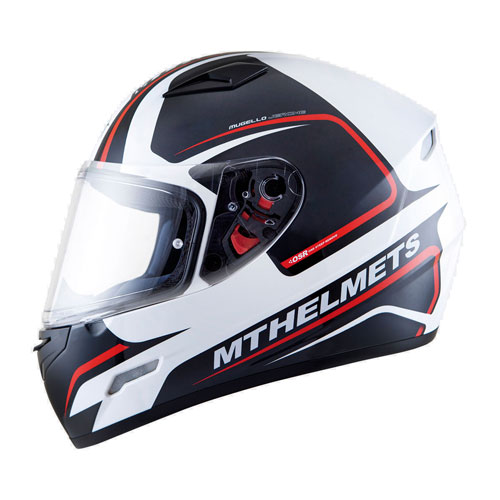
mt-mugello-jerome-white-red-motorcycle-helmet-front-view
MT Mugello Jerome – with Pinlock Max Vision ready shield (insert not included though)

Aside from this, the Mugello has a micrometric fastener (easy to use and nice and safe) and comes with a Pinlock Max Vision ready shield. Note: it doesn’t come with the actual insert though so you’ll have to buy that separately. We advise anyone riding anywhere that’s prone to cold and rainy weather (or hot and humid weather) to invest in a Pinlock to keep your vision fog free and safe.

There’s also a high-visibility version of the Mugello (see pic lower down). If you like to make sure you’re seen when riding, that’s the one to go for.

On the downside, the Mugello is only made in one helmet shell size. That’s not really great for optimizing safety or fit/looks – read more here.

Ventilation

In the chin bar there’s a central vent which can be opened/closed. That’ll bring air towards the mouth and onto the back of the shield. There’s also a pair of always-open exhaust vents on either side of the chin bar.

On the top of the head, there’s a pair of AGV-style sliding vents to bring air through the helmet and onto the scalp, and a pair of matching rear exhaust vents to create a path for the ventilation and draw the stale air out of the helmet. Both of these vents can be closed too.

To help with reducing fogging on the shield, the MT Mugello comes with a breath guard already fitted.

All in all, it’s a fairly standard arrangement of vents that you see on loads of helmets these days but it should do the job of keeping you cool and well ventilated. Though if you ride in cold weather a lot, it’ll not be enough to keep your shield fog-free.

mt-mugello-leopard-full-face-motorcycle-helmet-military-green-camo-rear-view
Cool looking Mugello Leopard in camo green

Shield

The shield is a 2mm thick Pinlock Max-Vision ready shield with a quick release system.

For a $70 helmet, that means you’re getting lots of bang for your buck and it looks like MT has put a good deal of attention into making an effective shield system.

The quick change shield means it’s easy to quickly remove your shield to give it a clean after a ride – just open the shield, pull on the red lugs on either side and wiggle it off.

Shields always fog in the right (wrong!) conditions. So the fact that the Mugello’s shield is Pinlock-ready is great – and the Max Vision version means that the Pinlock will cover all your vision and not get in the way. The only downside with the Mugello is that the Pinlock insert isn’t provided with the helmet, it’s an accessory you’re going to have to spend another $30 or so on top.

Having some form of anti-fog treatment or insert is important for most of us – so click the link if you want to see all our helmets that are either Pinlock ready or supplied with a Pinlock included in the price.

mt-mugello-solid-matt-black-full-face-motorcycle-helmet-solid-white-side-view
Always popular solid matt black version

Comfort & Sizing

The MT Mugello comes in sizes XS-XXL though it’s only produced in one shell size. So if you’re at either size extreme, you might find that it looks either very large or too small on your head.

It’s got a removable and washable comfort lining which is handy if you’re going to be using it daily so you can stick it in the washing machine from time to time.

Looks & Graphics

If you’re looking for a plain Mugello, there’s a gloss white version and a gloss and matt plain black version. There’s also a grey ‘titanium’ and a plain gloss fluo hi viz yellow version for added visibility.

For graphic versions there’s the Vapour and Maker ranges (all available in red, blue, green, yellow and black/white variants) and the Jerome. There’s also the excellent green camo Military version.

mt-mugello-maker-black-green-full-face-motorcycle-helmet-front-view
MT Mugello Maker (comes in loads of colours)

You’ll find all these designs up and down the page – but for the latest graphics and any deals, check out our recommended retailers using the links below.

[xyz-ihs snippet=”MT-generic-snippet”]

MT Mugello Video

A guy from the Philippines takes us round his new MT Mugello (note I think this particular design is now phased out).

Other stuff – fasteners, weight, warranty

The MT Mugello comes with the tried-and-tested micrometric fastener. It weighs in at around 3.2lbs (1.45Kg) which is just slightly lighter than the average full face helmet and way lighter than the average polycarbonate full face (3.5lbs/1.57Kg) so you shouldn’t have a problem with it being too heavy.

mt-mugello-vapour-black-white-motorbike-helmet-front-view
Front view of the Mugello Vapour

MT helmets come with a 1 year warranty only (check here for helmets with a 5 year warranty).

Overall/Summary

Because of its low price, the MT Mugello is probably going to appeal to those who are new to biking or commuters. Which is undoubtedly where MT reckon they’ll pick up most of their sales.

However there’s a lot of spec to be had for that low price point – especially when you consider it’s got a decent Pinlock-ready shield and lots of other bells and whistles that you’ll find on much more expensive helmets such as quick-release shield and channeled ventilation system.

Couple that with the Mugello’s excellent 4 star safety score from the SHARP safety helmet testing labs and the Mugello suddenly seems to be a lot of a bargain.

So if you’re on a tight budget but after decent protection and a very usable helmet, then at this amazing price point, the MT Mugello is practically a steal.

There are some cracking alternatives around though, so make sure you check them out below.

mt-mugello-vapour-black-fluo-yellow-full-face-motorcycle-helmet-front-view
Vapour in yellow

[xyz-ihs snippet=”Link-to-guides-page”]

Good Alternatives to the MT Mugello?

The best way to find alternatives for yourself is to use our Smart(ish) filters page where you can select a few features you’d like on a helmet and we’ll show you which helmets you should check out.

Other than that, take a look at our LS2 Rookie review. This full face is lighter than the Mugello, is SHARP 4 star safety rated and comes with an optically correct shield. It’s only tad more expensive too.

Shark’s S600 is their entry-level helmet. And while it’s a bit more expensive than the MT, you do get a Pinlock antifog in the box – and a SHARP 4 star safety rating.

mt-mugello-solid-gloss-fluo-yellow-full-face-motorcycle-helmet-front-view
There’s a couple of hi-viz versions knocking around too if that’s your thing

And of course if you’re willing to spend a bit more, there’s always MT’s own Revenge which is a maximum 5 star rated crash helmet that even looks cool (esp in the pricier carbon fibre version!)

For more alternatives, take a look at our budget crash helmets section.

[xyz-ihs snippet=”MT-Cat-link”]

Airoh GP 500 sportsbike helmet

airoh-gp-500-motorcycle-helmet-featured

Airoh GP 500: a carbon/kevlar racing motorcycle helmet

The Airoh GP 500 is a racetrack-developed sportsbike helmet designed for use on racebikes and track days.

It’s a reasonably no-compromise helmet that’s been designed alongside riders in some of the world’s toughest competitions including MotoGP, Superbikes and Supersports. They’re environments where features like noise-suppression and sun shields are dropped in favour of light weight and great aero.

So if on-track performance is only part of what’s you’re after in your next helmet, then you might want to look elsewhere (either see our alternatives section at the bottom of this page or click through to our sportsbike helmets page).

airoh-gp500-rockstar-crash-helmet-side-view
Airoh GP500 Rockstar

[xyz-ihs snippet=”Airoh-Quick”]

Safety

SHARP has tested the safety of the GP500 in their labs – where it scored three stars (out of a maximum 5).

That’s a middle of the road performance – and while it scored well for front to back impact protection, it was let down on the side impact tests.

As always, your priority when buying a new helmet is to get a helmet that fits well and is comfortable to use. After that, a Snell certified or decent SHARP score is what we look for. So three stars is a bit of a disappointment when there are plenty of SHARP 4 & 5 star helmets around. But that FIM score is a big thumbs up – for the XS helmet at least.

The GP 500 has Airoh’s most advanced helmet shell to date and it’s made in three different shell sizes – the more shell sizes the better for both comfort, sizing and, arguably, for safety too.

Another thing that contributes to safety is the overall weight of a helmet – not just making the helmet easier to live with but reducing pressure on the neck during an impact. And with the Airoh GP 500 coming in at a feather weight 2.65lbs (1.2 Kilos), that’s one of the lightest helmets we’ve seen to date.

Airoh-GP-500-Drive-black-white-motorcycle-helmet-side-view
The GP 500 Drive

Finally, Airoh have fitted their equivalent of an emergency quick release system (EQRS) that Airoh calls AEFR. A system like this on a track-focused motorbike helmet is pretty much a must these days, enabling emergency services to quickly remove the cheek pads from the bottom of the helmet and so helping remove the helmet without upsetting the neck.

Helmet Noise

Like most track-focused helmets, Airoh has designed the GP 500 to be as aerodynamic as possible to reduce wind resistance and cut down on rider fatigue – as well as make it a better helmet to use in a race where the last thing you need is lots of buffeting to kill your concentration.

Good aero qualities can also make for a quieter helmet as there’s less of the helmet sticking into the air flow to create turbulence.

However, that’s not what most race helmet designers are about. Their focus is operational efficiency, light weight and comfort before any real focus on noise suppression. And that’s especially true with the GP500 as the designers have added exhaust vents just by a rider’s ears. That’ll help with cooling and helping a racer hear other bikes approaching – but it’s pretty certain it’ll also mean it’s a noisy helmet.

We’ll not know for sure until we take a more in-depth review of the helmet, but don’t expect it to be quiet because race-bred helmets rarely are and we very much expect the same from the GP500.

airoh-gp-500-gloss-white-motorcycle-crash-helmet-rear-view
Exhaust vents at the rear of a solid gloss white GP500

Ventilation

The Airoh GP 500 has masses of inlet and exhaust vents. There’s four vents on the chin guard to direct air onto the face and rear of the shield with switches to open/close them on the inside of the chin guard.

There’s also a couple of brow vents set just above the shield in the shell of the helmet (again, these are closeable) and a couple of vents on the crown. These vents direct air through holes in the helmet shell, through channels in the lining and around the scalp. The warm air then exits the helmet via a pair of vents on the rear of the helmet underneath the spoilers, and a couple of side exhausts.

With this many vents, we’d expect the GP 500 to be a nice cool helmet for your track day.

Shield

The shield on the GP 500 is both Pinlock Max Vision-ready and tear-off ready. It has opening tabs on both sides of the shield and there’s a shield lock too to stop it opening while riding (or during an accident).

airoh-GP-500-50%-light-smoke-visor
50% tinted visor and Pinlock Max Vision ready

The shield itself operates on a ratchet – although there are only three positions and there’s no ‘cracked open’ or city mode which some riders might find a bit inconvenient. It’s not a quick release shield either – although it is toolless. Just rotate the large plastic panel near the shield pivot, remove both panels, then pull off the shield.

Most GP500s come with a 50% tinted shield.

Comfort & Sizing

Inside the GP 500 you’ll find a removable and washable lining that’s antimicrobial and breathable and it’s supplied with a breath guard as standard. It’s available in sizes XS-XL.

Looks & Graphics

The GP 500 has been out for a while now so you’ll find a wide variety of graphics on the market as Airoh continually update them. If you’re after a plain version in solid paint, then Airoh is currently listing a matt black version and gloss white. They used to support a few higher profile riders (such as Dovi) but their sponsored riders now only ride in smaller country-based championships so there’s no race rep versions on the books.

However they do produce the Sectors and Scrape graphics and you’ll find Cosmos, Rockstar, Drive and Check in stores too – and you’ll find examples of each of these up and down the page.

airoh-gp-500-sectors-motorcycle-crash-helmet-in-orange-grey-side-view
Sectors graphics also available in grey/white and grey/yellow

As always, to see the latest available graphics, please click the links to our recommended retailers below where you’ll find the latest deals too.

[xyz-ihs snippet=”Airoh-Multi”]

Airoh GP 500 Video

Here’s a pretty comprehensive 36m review by an owner of a GP500.

Other stuff – fastener, warranty

The Airoh GP500 comes with a double-d ring fastener (as do most track-focused helmets). It comes with a 2 year warranty.

airoh-gp-500-scrape-motorcycle-crash-helmet-in-gloss-yellow-side-view
Airoh GP500 Scrape

Overall/Summary

If you’re looking for a racebike helmet but don’t want to pay top dollar, then the Airoh GP500 is worth a look. It’s got a decent spec – including Pinlock Max Vision antifog insert ready, Airoh’s version of EQRS, a locking tear off-ready shield and loads of vents for long days at the circuit.

It might be lacking the brand of the big boys, but it’s lacking their big price ticket too. It’s also slightly let down by its SHARP safety rating too (3 stars out of max 5) but if you’re working on a tight budget but want a track helmet, then the GP500 might well do the job.

[xyz-ihs snippet=”Link-to-guides-page”]

airoh-gp-500-sectors-motorcycle-crash-helmet-in-orange-grey-rear-view
Rear view of the GP 500 Sectors

Good Alternatives to the Airoh GP500?

OK, so you’re looking for a track-focused helmet at a good price?

How about the LS2 FF323 Arrow? It’s a bargain-priced SHARP 4 star safety rated helmet with Pinlock and optically-correct shield included in the price.

Or there’s the Kabuto RT33: that’s slightly less track-focused but still a capable sportsbike helmet that’s SHARP 4 star rated with a Pinlock thrown in. And because it’s a little less extreme, it’s quiet on the road too and can be had for about the same money as the Airoh.

You could also think about X-Lite’s premium sports lid – the X-802R – that’s a comfortable composite helmet that’s SHARP 4 star rated too.

Finally, you might want to look at AGVs GT Veloce. Based on the same shell as AGVs Corsa and Pista GP top race helmets, it’s SHARP 5 star rated but at a price less than the other two as well. It’s less extreme too, yet has a large shield for maximum vision and comes Pinlock and tear off-ready.

[xyz-ihs snippet=”Airoh-cat-link”]

LS2 Vector FF397 helmet review

ls2-Vector-disc-featured

The LS2 Vector: a light weight, quality fiberglass full face motorcycle helmet at a decent price

The LS2 FF397 Vector (to give it its full title) is a fiberglass-shelled full face helmet that’s designed for your typical sports touring rider. Essentially, that’s someone who likes to do a varied bit of riding and who needs a decent amount of flexibility from their lid.

LS2 has tried to produce a helmet that’s light weight, safe, comfortable and with some of the nice touches that modern-day riders want in their helmet such as an integral sun visor and well thought out visor system.

They’ve also tried to design a helmet that’s aerodynamically sleek and stable.

So, here’s the lowdown on what riders and owners of the LS2 Vector think of their helmet – and we find out if LS2 have managed to make the helmet they set out to make.

NOTE: the Vector has now been discontinued by LS2. Why not check out our Top 10 Full Face Helmets or our Sports Touring Helmets pages for some great alternatives.

  • Fiberglass full face helmet
  • Drop down sun visor
  • Pinlock Max Vision included
  • Longer head fitment
  • 3 helmet shell sizes
  • SHARP 3 star safety rated
  • Class A optical shield
  • Light weight:
    • 2.9lbs (1.3Kg) fiberglass
    • 2.65lbs (1.2Kg) carbon
  • EQRS
  • Expect to pay:
    • $199-$220 fiberglass version
    • $299 carbon version
ls2-ff397-vector-titan-full-face-motorcycle-crash-helmet-side-view
Fiberglass LS2 Vector in titan graphics

Safety

The shell of the LS2 Vector is made from a fiberglass composite. They claim it’s around 2.9lbs (1.3Kgs) in weight too which is a decent chunk lighter than the average fiberglass helmet of around 3.3lbs (1.49Kg).

That can get alarm bells ringing slightly as a lighter helmet can mean there’s physically less of the helmet to give protection.

SHARP tested the European version of the Vector and awarded it 3 stars for safety, which is an OK score but not the best (you can see all our SHARP 4 and 5 star helmets here).

LS2 does produce the vector in three helmet shell sizes though – which is good for both safety levels and looks (as discussed here).

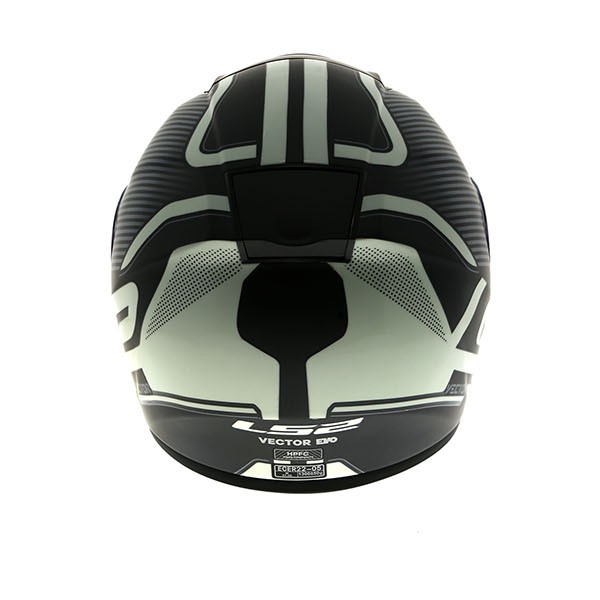
ls2-ff397-vector-razor-full-face-motorcycle-crash-helmet-rear-view
Rear view of the FF397 Vector Razor showing closeable rear exhaust vent

They also include a reasonably wide visor that’s class A optically correct meaning distortion should be reduced to an absolute minimum (but see below in the Shield section for more info on this). And fogging is controlled by the inclusion of LS2s own version of a Pinlock Max Vision called a Fog Fighter – though there are very mixed reports on how well the Fog Fighter performs with some owners complaining it doesn’t seat too well on the visor.

Of course, drop down sun visors aren’t optically correct or, usually, anti-fog coated. But still, having a sun visor can be damn useful and can be a real help with safety, especially if you get caught out riding into a low sun.

LS2 also include safety reflective stickers, a steel micrometric fastener and EQRS – all of which are useful safety features to have.

Overall then, the Vector offers a number of features to enhance safety coupled with a reasonable SHARP safety test score (though it hasn’t yet been Snell tested).

Helmet Noise

There’s quite a broad range of opinions out there on how noisy the LS2 Vector is. But overall, most owners think it’s a pretty quiet helmet.

Sure, you get some saying it’s loud but you always get a range of opinions on noise supression – and for good reason. That’s because we all have different levels of hearing, riding styles, types of motorbikes, and we ride at different speeds on motorcycles that offer different levels of wind protection – from nakeds to full tourers.

ls2 ff397 vector full face motorcycle crash helmet solid white side view
Plain gloss white Vector. Note sun visor slider on the bottom edge of the helmet

So I guess it’s not surprising there’d be a variety of opinions.

Having said that, the overwhelming view was that it’s quite a quiet helmet. So, if you buy one, hopefully you’ll be pleasantly surprised (though don’t expect it to replace a decent set of ear plugs – they’re still vital to protect your long-term hearing).

As always, if having a quiet helmet is important to you, you can view all our quietest-rated helmets by choosing ‘Quietest’ from the feature cloud to the right (bottom of the article for mobile users).

Ventilation

There’s a single chin vent with 2 position slider and a single crown vent. According to owners both are easy to use with gloves.

Air from the crown vent is channelled through the helmet’s shell and into channels in the liner to provide ventilation onto the scalp. There’s a single (closeable) rear exhaust port for the stale air to exit the helmet.

All that’s a fairly standard arrangement these days. But most owners say the ventilation is somewhere between good and excellent with some owners who regularly ride in hot summer weather saying it’s even good enough to keep their heads cool.

So the decent ventilation in combination with the anti-fog insert should keep you cool and your shield fog-free.

Shield

Like all LS2 motorcycle helmets, the FF397 Vector comes with a Class A optically-correct shield. That means the main clear shield should be distortion free – though a few owners have said that they found theirs to be a bit distorted towards the bottom, mainly because of the shape of the moulding.

ls2 ff397 vector carbon solid full face motorcycle crash helmet front view
Carbon Vector. Note iridium tinted sun visor on the carbon version, along with Pinlock Max vision on main visor

It comes with a decent quick removal system for the shield (just push a lever forward and out comes the shield) and it’s anti-fog insert ready. In Europe that means it comes with a Pinlock Max Vision 70 insert (Pinlock’s largest insert with mid-level of anti-fog) though with some US retailers it uses LS2’s own version of an anti-fog insert called Fog Fighter.

The Pinlock Max Vision is a nice large insert that should cover pretty well all of your vision and the ‘70’ version is great for all but the most extreme circumstances. Fog Fighters don’t seem to be well liked though so check with your retailer before ordering that there’s a genuine Pinlock included. Read more about Pinlocks here.

Sun Visor

The integrated sun visor is operated using a slider at the bottom left edge of the helmet.

A few folks complained that the sun visor doesn’t drop down far enough for their liking, leaving light to get in underneath the sun visor around their nose. One or two also reckoned that it needs pulling down manually for the last centimetre or so. But apart from a smattering of the usual complaints that the tinting is a little too light (that’s a legal thing so not something manufacturers can ignore) most said it’s great to have and really like the sun visor.

Comfort & Sizing

ls2-ff397-vector-vantage-full-face-motorcycle-crash-helmet-front-view
Vector in Vantage graphics

The LS2 FF397 Vector is designed to have a longer helmet fitment, suiting people with longer narrower heads rather than rounder heads (sometimes called long-oval though most folks seem to say it’s more medium oval).

Lots of folks with those shaped heads said they found it’s a massive relief to find the Vector because it fits where many helmets don’t. But as we’ve seen before on LS2 helmets, some also reckoned it sizes a bit small, so if you’re looking to order one and you’re between sizes, we suggest you go for the larger size.

The lining on the Vector is removable and washable and is both hypoallergenic and breathable. It’s secured in place with the usual poppers and slots but it also features LS2’s magna-tech system which uses small magnets to keep the neck roll in place.

Other than that, most owners say it’s a particularly comfortable helmet. Obviously, to gain that level of comfort, you need to ensure you’ve a longer narrower head and get your head measurements right in the first place – but if you do, you should find the Vector all-day-long comfortable.

Graphics

There’s a stack of different Vector designs for the fiberglass composite version of the helmet, plus a couple of carbon fiber helmets too.

If you’re interested in the fiberglass helmet, there’s solid gloss black and white plus a matt black version. But there’s also the Vantage, Wake, Wavy, Titan, Razor, Trident – plus there’s the glow in the dark Orion version which you can see in the second video below.

As always, you can find all the latest graphics and deals by clicking through to our recommended retailers using the links below.

Click above to drop onto their LS2 helmets pages or *quick view store T&Cs here.

LS2 FF397 Vector video

First off, here’s a look around the Vector by an LS2 rep. That’s followed by a 1m video showing you the glow-in-the-dark Vector Orion.

Other stuff – fasteners, audio, weight, build quality, chin curtain, warranty

The LS2 Vector has a micrometric fastener – they’re very easy to use but you need to keep an eye on strap adjustment to make sure everything’s tight. Having said that, LS2 have gone to extra lengths to ensure the strap is really safe by mounting it with a metal fitment right into the shell of the helmet (the triangular insert below the shield pivot).

ls2-ff397-vector-wake-full-face-motorcycle-crash-helmet-front-view
This design is the Vector Wake

It’s designed to integrate LS2’s Linkin Ride Pal bluetooth set. If you’ve a different bluetooth set, there’s mixed messages about how well the Vector will work with it though. A couple of owners said it’s tricky to mount because of the left-side sun visor slider that sits right where you’d want to mount your bluetooth. One owner with a Sena SMH10 found it tricky to mount, though a Sena 3 owner found it easy.

Lots of owners commented how light their Vector’s feel – that goes for both the fiberglass or carbon version (which is 100g lighter than the tri-composite fiberglass helmet). So no sore necks after a day’s riding with the Vector.

Build quality for the Vector is praised by lots of owners – especially at this price where many were surprised at the quality and value for money. So it’s kinda surprising that LS2 only sell the Vector with a 1 year warranty which is pretty much the minimum of any helmet maker – and many offer 5 year warranties with their helmets.

Finally, if you go for an LS2 vector, you’ll get a chin curtain, neck roll and breath guard included in the package, along with the antifog insert.

All in all that represents a great package for your money.

Overall/Summary

Value for money is the watchword when it comes to the LS2 Vector. That and a relief in finding a longer, narrower helmet that fits well.

ls2 ff397 vector orion full face motorcycle crash helmet rear view
Rear view of the glow-in-the-dark LS2 Vector Orion

Which kinda sums up where the vector sits. If you’re after a light weight full face helmet that’s comfortable and performs well in pretty well every respect, and you love getting lots of bang for your buck (and have the right shaped head) then the LS2 FF397 Vector is well worth trying out.

LS2 made a ‘thing’ over designing a helmet that’s both aerodynamic and stable. And while very few owners mentioned either, maybe that’s a good thing because if it was prone to buffeting, then folks certainly would mention it. Plus quite a few owners seem to think it’s a pretty quiet helmet and that’s often a side-benefit of making a smooth and slippery helmet. So that’s probably ‘job done’ on the aero I’d say.

Ventilation is great too, and so is comfort, and then there’s that optically-correct shield backed with a top quality Pinlock anti-fog insert (or Fog Fighter – see above) and decent sun visor. It also scored reasonably well when tested by SHARP (though far from the best).

All in all, the LS2 FF397 Vector is an excellent package and offers great value for money. If you’re in the market for a reasonably priced full face, then definitely check one out – or take a look at our recommended alternatives below.

[xyz-ihs snippet=”Link-to-guides-page”]

Good Alternatives to the LS2 Vector?

If you’re looking for a mid-priced full face helmet similar to the Vector, there’s a decent number of helmets to choose from. Here’s a few recommendations to have a look over before you take the plunge.

First up is the HJC FG-ST. That’s been tested and rated by SHARP as 5 stars (that’s maximum marks for safety). It also comes with an integral sun visor and Pinlock in the box, just like the Vector.

There’s also the AGV K5 and it’s later K5S variant. The carbon/fiberglass shelled K5 was SHARP 4 star safety rated and has a sun visor and Pinlock too.

Or you might want to check out the X-Lite X-702 GT. It’s more touring-oriented and it’s a composite-shelled helmet that scored maximum marks for safety when SHARP tested – and owners reckon it’s quiet, comfortable and well vented.

[xyz-ihs snippet=”Alternatives—full-face-helmets”]

[xyz-ihs snippet=”LS2-cat-link”]

Star Ratings

Which are the best motorcycle ear plugs?

motorcycle ear plugs

We always say that if you’re riding any distance, stick in some ear plugs to protect your hearing.

There’s loads of resources online to tell you exactly how noisy it gets when you ride your motorcycle – but the bottom line is that you can do permanent damage to your hearing if you ride without them: the higher the speed, the longer the time and the less sound-insulating your helmet, the quicker you’ll damage your hearing.

So always wear plugs when you ride. Simple.

But are all ear plugs made equal? And if not, which ones should I use?

Well, I’ve been riding for 40 years (OK I started riding when I was ten – I’m not THAT old!) and I had no idea. I bought a massive pack of standard foam ear plugs years ago and I’ve been slowly working my way through them, but I’d no idea if they’re really any good.

So, I decided to splash out on a wide selection of cheap ear plugs and road test them all to find out which work best.

I also bought a range of rubberized ‘musician’ style ear plugs. They’re designed to reduce noise more evenly across the frequency range without blocking up your hearing like foam plugs do. Which sounds great in principle though they’re much more expensive than foam plugs.

At the bottom of the article, we explain some of the ratings you’ll find on earplugs, how to fit them and how they work with bluetooth sets. But for now, on with the findings.

Note: all the Amazon links below are affiliate links so we earn money off them. But as always, it won’t cost you a penny extra. Read more here.

Control ear plugs

I’ve been wearing these plugs for years ever since I bought a gigantic bag from a long-forgotten dealer. I don’t think I’ve ever really looked at them in detail but turns out they’re called Max Lite and they’re from Howard Leight (SNR 34).

howard-leight-Max-Light-ear-plugs
My old ear plugs – Howard Leight Max Lights

I’ve had them for well over 10 years (might be closer to 20 even) and they seem to work well. Each pair were in a little bag that has kept them fresh for all that time with very little degradation – none that I’m aware of at least.

To fit them, I roll them up lengthways then push the tapered end in and let them expand. That’s the way you’re supposed to do it and they do stay in place and give a reasonable level of protection like that. I can hear people talk OK and get the impression that the worst of the noise is being cut out.

However, if I want more protection (which I do most of the time) I’ve also taken to rolling them up and fitting them with the big end first. I found this gives masses of noise protection – probably double the standard amount. The plugs seal my ear perfectly and hardly any noise gets in – to the point that, with my helmet on, I can barely hear anyone speak.

I suspect that folks with small ears probably won’t need/want to do this. But if you’ve got a larger head and larger ear canals, then you might want to give that a go too.

Motorcycle Ear Plugs Test – Foam Plugs

Anyhow onto the test. I tested out a couple of pairs of each of the following ear plugs over a number of rides and I’ve jotted down how they seemed to me. Obviously, the results are entirely my perception but I hope you find it all helpful.

Moldex 7600 Mellows (SNR 22)

Click pic to see details and buy on Amazon

The mellows look like your bog-standard foam ear plugs. Their 22 SNR rating means they should attenuate (i.e. cut out) 22 decibels of noise. (see bottom of the page for explanation). They were reasonably OK to fit, sealed well and I felt they gave a moderate amount of protection. They are flat-cut at the ends so not quite as comfortable for reverse fitting. Overall, I’m scoring these an average 5.

Average joe plugs that are easy to fit and cut out a reasonable amount of sound. Score – > You can buy Moldex Mellows here on Amazon.

3M E-A-R Classic (SNR 28)

Click pic to see details and buy on Amazon

These 3M Classics are yellow tubes – much bigger than your typical foam ear plug and a coarser foam which I thought might be rough on the ear. But they didn’t feel it, and, because they’re that much larger, they expanded really well in my ear to fully seal it and really cut out tons of noise. They score really highly on Amazon too (in fact all of these plugs seem to).

So far, these will be my 2nd go-to ear plugs and score a 9. > We found a good deal for a box of E-A-R Classics here on Amazon.

Moldex 7700 Pura-Fit (SNR 36)

moldex-7700Pura-Fit ear plugs
Click pic to see details and buy on Amazon

The Moldex look like your run of the mill ear plugs but they feel a bit firmer than most. Roll them up and stick em in and they fit nice and firmly. And crucially – as their higher SNR rating suggests – they cut out a decent amount of noise. They don’t feel quite as secure as the 3M Classics for me, and because they don’t pack your ear tubes tight in the same way, they let in more noise. But if you’ve smaller earholes or the 3Ms feel too tight and uncomfortable, then these feel comfy and put less pressure on your ears.

Good quality, fitting and noise reduction. Score – 7.5 > Here’s a link to 50 pairs of Moldex 7700s at Amazon.

Howard Leight Bilsom 303L (SNR 33)

Click pic to see details and buy on Amazon

Like most foam earplugs, these Bilsom 303L (the L stands for large but you can get them in M or S too) are made from polyurethane, and their SNR 33 rating means they should be good for medium to high noise environments. I found they fit compressed/expanded quickly and gave a similar level of noise suppression to the Moldex 7700s.

Decent noise suppression, good fit and comfortable. Score – 7 > Here’s an amazon page selling 200 pairs size L

3M 1100 (SNR 37)

Click pic to see details and buy on Amazon

Polyurethane foam plugs These come in one size only which is suitable for a larger adult. The foam on these plugs is pretty firm and I found them more difficult to get a decent tight seal. After adjusting them a few times (i.e. poking them in further) I got a decent seal and they really quietened things down. But because they took more adjusting to get it right, I’m going to mark them down a bit.

Firmer ear plugs that are tricky to put in right. Score – 6 > Here’s a very reasonably priced 10 pack on Amazon.

Howard Leight Laser Lites (SNR 35)

howard-leight-laser-lite-ear-plugs
Click to visit Amazon and buy

These are another set of polyurethane foam plugs. The foam on these Laser Lites is nice and soft and pliable, making them easy to roll up to insert in your ears and soft when they expand. I found them best if they’re reversed for my ears (see ear plug fitting below) and plugs like this with a T-shaped bottom end rather than flat-cut plugs like the rest on this test are best for a comfortable reverse fit. When they were in, they were really comfortable and cut out loads of noise.

Soft plugs that work well. My No.1s. Score – 9 > Here’s a great value 25 pack I found on Amazon.

Motorcycle Ear Plugs Test – Pinlock and Ear Peace

These plugs are rubberized – either silicon rubber or TPE (which is a plastic-based elastic polymer) – and have two or three lobes running along them. The lobes are designed to fit the ear canal and stop sound getting into your ear while the sound management is carried out by the central hollow section which has a noise-attenuating central filter.

Apparently, this type of ear plug was made popular by musicians who need to protect their hearing but still need to be able to hear a wide range of frequencies and talk to people in the studio or when playing live.

On your motorcycle, they’re made to reduce harmful frequencies but still allow you to hear a range of sounds – from the sound of your Akrapovic or induction roar to hearing Bob talk about his latest daring overtakes when you pull over for a cup of Java.

Pinlock Ear Plugs (SNR 24)

Pinlock are known for their excellent range of antifog inserts. But they also make ear plugs. Each pack comes in a nifty pocket-friendly foam box and include two pairs of earplugs – M and L.

Pinlock ear plugs
Click to visit Revzilla and see more details.

To insert these plugs, Pinlock suggests you reach around behind your head, pull the top of your ear up and out, then insert the plugs. It feels a bit like a yoga move and isn’t the easiest if you’re wearing your winter gear, but to be fair to Pinlock, most ear plug makers suggest the same because it opens up your ear canal so when you put the plug in and let go, it should form a nice tight seal.

Putting the plugs in, they’re very flexible and don’t really give you the same feedback that foam plugs do. But once seated, they felt reasonably comfortable.

Out on the road, they do cut wind noise and you can hear other noises too. But I found when I upped it to highway speeds, they didn’t cut out wind blast like a good pair of foam plugs do.

I tested them over several rides, back to back with the Ear Peace plugs (below) and never really felt like they were giving me the same protection as the foam plugs. I suspect if you tend to stay at lower speeds, they will be good but if you ride quickish, then they struggle to handle the increased wind blast.

TPE reusable plugs that don’t match the best foam plugs but let you hear more frequencies. Score – 5.0 > Here’s a pack on sale at Amazon.

Ear Peace High Fidelity Ear Plugs (SNR26)

Ear Peace actually sent me a couple of sets of these plugs out of the blue (thanks!). They come with 3 plugs in the pack, plus an aluminium holder and three filter sets. I always used the highest protecting black filters but there are high (SNR20) and medium (SNR17) included too.

Ear Peace motorcycle ear plugs
Click to visit Amazon and see more details.

Just like the Pinlock plugs, they were tricky to get in and seat right. But once I did, they worked about the same as the Pinlocks, attenuating some wind rush but not enough when I upped the pace. They sat comfortably in the ear though and if being able to chat to your buddies is important (or hearing the howl of your exhaust) then you might find them worth it.

I found the Ear Peace had the edge over the Pinlocks slightly, but only just. I guess that may reflect the fact their highest filter setting attenuates noise by 2db more, because in all other respects, they seemed more or less identical.

Silicon rubber plugs to cut out wind blast but are tricky to fit. Score – 5.5 > Here’s a pack with metal holder on Amazon.

So which are the best ear plugs for riding a motorcycle?

Well, after riding with the 3M E-A-R Classics and the Laser Lites, I’ve found both work amazingly well. But after using both for about 3 years now, the Laser Lites have edged it for me.

The E-A-R Classics might not have the highest noise cancelling rating (SNR rating) but they’re big, fit well and knocked off lots of noise when I tried them. Maybe it’s because they fit so easily and well that they seemed to cancel out just as much noise as higher rated ear plugs.

Click above for a good deal on 30 pairs at Amazon

But they were also slightly less comfortable over long term use for me so I switched to the Laser Lites and I’ve never looked back.

They roll up nice and small but expand comfortably in your ear. And a pair lasts and lasts so they’re amazing value for money too.

Click for a good price on 25 Pairs

So I’d recommend both of the above plugs. If you try both, I’m convinced you’ll find one or the other works great for you too.

And if you’ve smaller ears, you’ll find many of the plugs I tested available in smaller sizes too.

I also found some of the other soft polyurethane foam plugs worked well, especially if I reversed the fitting so the fat end was pushed in first. For me, they generally needed a bit more fiddling around with to get the fit just right, though having said that the Max Lites I’ve been using for about 20 years worked well and usually take me about 10 or so seconds to fit so they can’t be too much of a nuisance!

How to fit your ear plugs

They’re all designed to be rolled lengthways between the fingers so the foam is tightly compressed, then pushed in the ear canal, pointy end first (except for the 3M E-A-Rs where you can use either end).

Most folks I’ve spoken to reckon they pretty much ram them in and they might need pushing in a couple of times before the plugs expand adequately and deeply enough to seal the ear canal.

Personally, with the soft foam plugs I’ve tended to use, I push them in fat end first so there’s more plug to expand and fill the ear. It works for me but if your ears are small and/or you use firmer ear plugs, you might find that’s a bit uncomfortable. And I didn’t need to at all with the 3M EARs.

If you’ve got the right plugs and they’re in tightly, you should find it tricky to hear someone talk nearby.

Ear plugs and bluetooth communicators

You should be OK to wear ear plugs and hear your bluetooth at the same time. It sounds slightly counter-intuitive, but wearing ear plugs can actually make it easier to hear your headset at speed because you’re cutting out all the wind blast noise. At least, that’s what I’ve found.

My bluetooth is a very cheap set bought off Amazon (that’s the one, in the ad below) but as long as the headphones are positioned well inside the helmet, I can hear other riders up to about 70 mph while wearing ear plugs – which I’m happy with.

It’s very much an entry-level bluetooth set that sticks onto the outside of the helmet with sticky velcro – but it’s waterproof with good connectivity and I’ve found it a great starter kit for not very much money, especially if you’re wanting to experiment with bluetooth intercoms (or want to take an audio feed from your bluetooth GPS or Google Maps).

What are NRR & SNR ratings?

SNR stands for Single Number Rating and is an International ISO standard for noise reduction.

NRR is the US equivalent and stands for Noise Reduction Rating.

You’ll often find both numbers on the packaging of your ear plugs and the higher the number, the better the noise suppression.

SNR is an average figure because different ear plugs will reduce different frequencies at different levels. But the SNR rating shows the number of decibels the ear plugs will cut out.

NRR works the same. The NRR rating is the number of decibels (dbs) the ear plug attenuates (reduces the noise by). Because of the way sound attenuation is tested in the labs, some official bodies recommend dividing the NRR rating by two (and sometimes more) to get the true level of attenuation – but I’m not aware of any similar recommended calculation for motorcyclists.

As a biker you may well just want maximum protection – so in general, choose an ear plug with a high rating. In industry, folks carefully choose how much noise they want cutting out so they don’t damage their hearing but can still communicate- so may opt for some of the rubberized type of plugs like the Pinlock or Ear Peaces above. Personally, when riding my motorcycle, the more noise I cut out, the better.

What are H/M/L Ratings?

You’ll sometimes find an H, M or L rating on your ear plugs. This stands for High, Medium and Low frequency and gives a numerical rating to the amount of high, medium and low frequency sound they cut out.

OK, now grab yourself some of the best earplugs and go RIDE!

Shark Ridill motorcycle crash helmet review

Shark’s entry-level all-rounder – the Shark Ridill full face helmet

The Shark Ridill is the replacement for that good ole stalwart, the Shark S700S. The S700S was a great all-rounder: a SHARP 4 Star safety rated helmet that performed pretty well in every respect and didn’t cost a ton.

And the Ridill looks like a promising successor for those on a budget (that’s most of us, right?). So we scoured the web for tons of feedback on what the Ridill offers and what owners and riders think of their helmets. Here’s what we came up with…

Looking to buy a Shark Ridill?

Please click below to visit the Shark Ridill helmets pages at Amazon and our recommended store, Revzilla. And if you buy from either, we get a small sum from the sale at no extra cost to you – a massive THANKS! (it’s how we finance the site).

Shop for helmets at Amazon

shark-ridill-motorcycle-helmet-tika-front-view
Nice modern design and cool graphics: the Shark Ridill Tika

Helmet Safety

If you compare the Shark Ridill with the outgoing 700s, you can see the similarities in the overall helmet shell design. Both look pretty modern but the new Ridill’s definitely got the edge with lots of cut-outs and sculpted mouldings.

The Ridill’s been tested by the helmet testing gurus at SHARP where it scored a very solid four out of five stars. And it’s also DOT certified too and together they mean the Ridill should give an excellent level of rider protection.

One other thing worth mentioning is that Shark are our current fourth placed safest crash helmet brand. That’s based on SHARP test data so is only directly applicable to helmets on sale in the EU (sometimes helmets on sale in the US are slightly different). But of the 24 helmets tested by SHARP to date, their overall score is (a frankly amazing) 4.3 stars with their last four polycarbonate helmets scoring three four stars and one five.

Which is starting to make us think if you’re after excellent protection, you can pretty much always trust a Shark (go on, there’s a quote for you Shark 😉

shark-ridill-motorcycle-helmet-in-gloss-black-front-view
Gloss black Ridill

Test scores apart, the Shark Ridill comes with a Pinlock-ready shield and Pinlock antifog insert in the box. In pure safety terms, having a fog-free shield is essential and a Pinlock, while not perfect, is one of the best hands-off ways to keep your shield fog free.

The shield is also quick-release so there’s no excuse not to whip it off after a ride to clean the dirt and bugs off it and keep your forward vision in tip-top condition.

The Ridill comes with a micrometric fastener which are both easy to use and safe as houses (provided you occasionally check it’s adjusted correctly – see here for more details about micrometric fasteners or use the link above to see every helmet we’ve reviewed that comes with a micrometric fastener).

All in all, the Shark Ridill is a more entry-level helmet that’s made from polycarbonate. And while that’s probably the most conventional and unsexiest of the helmet materials, there’s many polycarb helmets that score maximum points in SHARP tests and at this stage, there’s no reason to doubt the Ridill won’t provide very good protection indeed (and every reason to suspect it will!).

Shark helmets are generally well-built and have decent aero properties – both helping keep in-helmet noise to a minimum.

And it seems to have worked pretty well with the Ridill. Despite the Ridill not coming with a chin curtain (which usually helps reduce wind and noise coming into the helmet from below), owners reckon noise-suppression is anywhere between OK and good.

Ventilation

One of the few things Shark say about the Ridill is that the ventilation is ‘optimized by means of numerical simulation (computational fluid dynamics)’. Well thanks for clearing that up!

For those among us lacking doctorates in fluid dynamics (!), there’s a single large chin vent that’s operated by a large flip-panel. On the crown there’s a couple of separate vents operated by small sliders that should be easy to find and use in gloves.

shark-ridill-motorcycle-helmet-blank-white-rear-view
Lovely clutter-free design. Only you’d expect some exhaust vents too…!

Unlike the outgoing S700S – and pretty well every other modern helmet out there at the moment – there aren’t any rear exhaust vents in the shell of the helmet to aid the air flow through the helmet and extraction of stale air out the back.

That does help with making a pleasantly clutter-free rear helmet design, but from a ventilation standpoint it’s pretty surprising.

Having said that, ventilation on the Ridill is decent – not good enough to stop the shield misting up if you don’t use a Pinlock, but gives a reasonable level of head ventilation according to owners.

If a helmet with lots of ventilation is important to you, you’re probably best taking a look at our helmets with great ventilation pages.

Shield

The Ridill has a quick-release main shield that’s Pinlock ready; and comes with a drop-down sun visor.

The main shield works on a ratchet mechanism and has the opening tab on the left hand side (rather than the middle – or even top). Both of those are broadly preferred by most people so ‘good one’ Shark.

All Ridill’s come with a Pinlock-ready shield and some stores include the Pinlock in the box. A Pinlock is a must if you ride in cool weather, or even somewhere it’s often humid, so check with the retailer first before you buy to make sure yours comes with a Pinlock. If it’s not, it’s going to cost you about $30 so well worth asking first.

The sun visor is operated using the slider on the top of the crown. It’s not the best place for the sun visor slider but most folks get used to it pretty quickly and if you’ve not had an integrated sun visor in your helmet before, they’re well worth it. Personally, I’m unlikely to buy a helmet without one these days (so speaks the voice of someone who’s just spent an hour squinting into the sun riding in the hills!).

shark-ridill-motorcycle-helmet-oxyd-front-view
This one’s the Ridill Oxyd in black, grey and pink

Overall, for a helmet towards the budget end of the price range, the Ridill covers all the bases and offers most of the functionality you’ll need from your shield system – ratchet clear main shield, Pinlock antifog and drop down sun visor: all present and correct.

Comfort & Sizing

The Ridill is available in sizes XS-XL. Inside there’s a removable/washable liner and there’s glasses grooves in the sides to make it easier to insert your glasses’ stems and stop them digging into the side of your head while riding.

Shark is known for creating decent quality, comfortable linings on their helmets and that’s reflected in owner’s opinions.

Sizing of the Ridill is reported to be about spot on and, providing you get the correct sized helmet in the first place, gives a snug and comfortable fit. Comments like ‘love the fit,’ and ‘comfortable and lightweight,’ and ‘found it comfortable in summer and winter,’ are typical.

Looks & Graphics

At the time of writing, there’s six different designs available with a few different color schemes in each. We’ve put examples of the plain/solid versions along with the Kengal, Skyd, Finks, Tika and Oxyd. But as usual there’s new designs and color options coming out reasonably regularly through the year so it’s worth clicking through to our recommended retailers below to see the latest designs and check out any offers going on.

shark-ridill-motorcycle-helmet-kengal-orange-red-rear-view
Kengal graphics – also in black/white/red and white/black/silver

Looking to buy a Shark Ridill?

Please click below to visit the Shark Ridill helmets pages at Amazon and our recommended store, Revzilla. And if you buy from either, we get a small sum from the sale at no extra cost to you – a massive THANKS! (it’s how we finance the site).

Shop for helmets at Amazon

Shark Ridill Video

Here’s a very quick video rotating a Shark Ridill Skyd so you can have a 360 degree look around it.

Other stuff: weight, build quality, warranty

Weight

Because the Ridill is a polycarbonate helmet, it was never going to be the lightest helmet in the world. Shark quote figures of around 3.44lbs (1.55Kg) which is very much the average weight for a polycarbonate full face helmet so you shouldn’t have a problem with weight.

shark-ridill-motorcycle-helmet-skyd-mat-black-front-view
Shark Ridill Skyd in moody blacks and greys. Sun visor slider’s on the top of the helmet

Build quality and warranty

The Ridill hasn’t been out very long, but reports are coming back that the build quality is fine with decent quality materials and components used throughout: just don’t expect the world as this is one of Shark’s entry-level helmets.

And don’t forget, every Shark helmet is supported by their outstanding 5 year warranty which is as long as the helmet’s designed to last.

Overall/Summary

Shark has an excellent reputation for producing some great helmets. Their top-of-the range helmets adorn pretty much every racing grid in the world and they’re consistently at the sharp end of our safest helmets brands list.

And, true to form, the Ridill scored four stars in the SHARP safety test meaning it should offer excellent protection in an accident. And with its cool looks, wide range of funky designs, as well as drop down sun visor and Pinlock-ready shield, we reckon the Ridill will provide pretty much everything most riders will need in a helmet – at a pretty competitive price point.

That’s all backed by owners who rate the helmet highly in pretty well every respect. Sure, it’s built to the price and you won’t get quite the same build quality from a helmet at twice the price, but the majority of owners seem very happy with the balance between value for money and helmet performance from the Ridill.

If you think the Ridill is the helmet you want, we say go for it. Or alternatively, check out some of our suggested tried, tested and recommended helmets below.

[xyz-ihs snippet=”Link-to-guides-page”]

shark-ridill-motorcycle-helmet-finks-white-green-black-rear-view
This one’s the Ridill Finks in white/green/black

Alternatives to the Shark Ridill?

So you’re after a helmet that’s going to give you great protection in an accident but not break the bank? Here’s some helmets we suggest having a look at…

How about the AGV K3 SV or the Scorpion Exo-R410? The AGV is SHARP 4 star safety rated, has a drop down internal sun visor and it comes with a Pinlock antifog insert in the box. It’s from well-respected maker AGV (they make Valentino Rossi’s helmet no less) and it’s a smidge lighter than the Ridill.

The Scorpion Exo-R410 is a bit cheaper than the AGV or the Shark and comes with an optically-correct shield along with its innovative air pump system to get the fit just right and a SHARP 4 star safety rating too. There’s no drop down sun visor with the Scorpion though.

Shark Ridill Tika in blue/black

Finally, the HJC IS-17. It’s another budget polycarbonate helmet with an integral sun visor but one that does everything very well – plus it offers great value for money and was SHARP tested at a maximum 5 stars.

[xyz-ihs snippet=”Shark-Cat-link”]

Looking to buy a Shark Ridill?

Please click below to visit the Shark Ridill helmets pages at Amazon and our recommended store, Revzilla. And if you buy from either, we get a small sum from the sale at no extra cost to you – a massive THANKS! (it’s how we finance the site).

Shop for helmets at Amazon

Star Ratings

Schuberth E1 Flip-up/Adventure helmet review

Schuberth E1 Adventure/modular crash helmet – full review

Just when you thought you’d seen every helmet design going, Schuberth have created the E1 – a combination of a flip-up and dual-sport helmet.

schuberth E1 Guardian helmet
E1 in Guardian graphics

Their goal for the E1 was to produce a versatile lid that’ll give the utility of a full face (good protection plus sound and wind insulation), the freedom of a flip-up (easy to get on and freedom to use in open-face mode with the chin guard up) yet with the characteristics of an adventure helmet.

Which sounds like a great idea to us.

Like all Schuberth helmets, they’re designed in the wind tunnel to reduce buffeting and noise. And you also get great attention to detail and Schuberth’s outstanding build quality as part of the package too. But then, so you should at this price point.

And the design’s been thought through too. You don’t need to move the peak to open the chin guard, and the peak itself is adjustable too. Also, the main shield is class one optically clear, meaning you shouldn’t get any distortion through it.

And if it gets too sunny, the E1 also features a drop down sun visor. Nice.

Looking to buy a Schuberth E1?

Please click below to visit the Schuberth E1 helmets page at our recommended store – checked for great online ratings. And if you buy from them, we get a small sum from the sale at no extra cost to you – a massive THANKS! (it’s how we finance the site).

schuberth-e1-motorbike-helmet-in-radiant-white-side-view
Schuberth E1 in Radiant graphics

Safety

Schuberth have a reasonable reputation for producing safe helmets.

The E1 is both DOT and ECE certified, though it hasn’t been Snell tested (no Schuberths have to date).

Of the seven ECE helmets they’ve had tested at the SHARP helmet testing labs in the UK so far, they’ve scored an average of 3 out of a maximum of 5 stars.

And because the E1 is essentially the same helmet as the C3 Pro but with a different chin bar and sun peak, it’s no real surprise that when SHARP tested the E1, it scored the same 3 star rating.

Schuberth E1 SHARP test result
Copyright SHARP gov.uk. 8.5m/s test data – for ECE helmet (not DOT)

You can get an idea from the graphic of where it dropped marks – but note that’s for just one of the tests (the 8.5 m/s test) so doesn’t give the whole picture.

By the way, SHARP doesn’t just test the helmet. When they test modular helmets, they record how often their chin guards come unlocked (see our guide to SHARP testing for more information on that) – and Schuberth has a history of doing very well in this respect.

But the E1 did drop a few percentage points here, with the chin bar staying locked and closed in 93% of the tests. Which is actually a pretty good score if you look across all tested system helmets; though whether that’s a good enough score for you, I’ll leave for you to decide.

It’s worth underlining that SHARP tested the ECE version of the Schuberth E1 because they buy helmets in the UK. We’re not aware if there’s a difference between the ECE and DOT versions of the helmet so these results may or may not be relevant to DOT E1s.

The E1 also features Schuberth’s AROS chin strap – designed to reduce the possibility of your helmet coming off during an accident. That’s a real problem in bike accidents so it’s good that Schuberth are doing their bit to reduce the chances of helmet roll-off.

Other safety features include a micrometric fastener and drop down sun visor – that’s not just there for comfort but can be a real god send, along with the peak/roost guard, if a low sun catches you out unexpectedly!

Schuberth-E1-modular-helmet-in-guardian-yellow-side-view
Guardian E1s also come in red/black/white

Helmet Noise

Schuberth uses a lot of wind tunnel testing in the design of their helmets to try and make helmets that are as slippery as possible. A slippery helmet equals a helmet that’s less prone to buffeting and is quieter as there are fewer corners for the air to ‘catch’ on.

To give you an idea of just how far they go, they’ve even put tiny triangluar ‘turbulators’ on the top of their shields to break up the wind flow and remove the chance of the edge of the shield catching air and creating noise.

Of course, like all dual-sports and offroad helmets, the E1 has a huge sun peak/roost guard slapped onto the top of the helmet, so you’d expect that at least to make a bit of a racket, right?

Well, by massive agreement of folks who own an E1, they reckon it’s a very quiet helmet indeed. Even with that huge peak, most owners say that the E1 is one of – if not THE quietest helmet they’ve ever owned.

Part of that is undoubtedly down to the careful wind-tunnel designed helmet shell. But other factors like the removable neck roll, clever ventilation routing and internal comfort padding all play their part.

But whatever the reason, most folks who own a Schuberth E1 are very impressed with how quiet it is.

schuberth-E1-chin-guard-and-vent
Large chin vent on the E1 – with washable foam filter behind

Ventilation

Similarly, owners say that the ventilation’s great.

Schuberth have created a chin guard with a nice large vent in the front. And there’s a single crown vent that pulls air into the helmet through channels in the shock absorbing lining and around the scalp.

That chin guard vent especially lets in lots of air, and both vents are easy to open in gloves. That chin vent also has a washable foam filter behind it for when it gets clogged by off road dirt.

Pretty well all owners said that the ventilation is great. Even riders who regularly ride in temperatures around 100 degrees (I wish!) reckoned it pulls in enough air to keep them (relatively) cool. The only time it seems to struggle is if you’re riding off-road in the sun when it could do with a larger opening to fit goggles and give more ventilation.

Other than that – and for most of us road warriors – the ventilation on the Schuberth E1 should be just fine.

Shield

Like the shields on all Schuberth helmets, the shield on the E1 is class 1 optically correct, meaning there shouldn’t be any distortion. The shield’s also Pinlock anti-fog ready and a Pinlock insert should come in the box – but always double-check with your retailer before you buy.

schuberth-e1-motorcycle-helmet-crossfire-in-orange-side-view
Sun peak on the E1 Crossfire is locked with the orange locking tab – and removed using the circular finger screw

The shield on the E1 is the same shield as the C3 pro, so they’re interchangeable if you need to order a new one.

Most owners say the field of view is nice and wide too and also that the quick release shield mechanism is one of the best. So all good with the shield on the E1.

Peak/Roost Guard

The peak/roost guard has been well designed too.

It’s 3 way adjustable by just moving the peak up or down with one hand. And when you’ve got it at the right position, there’s a locking switch that’ll hold it in that position. Simple.

If you have it in the lowest position, a few owners commented that it’s great at shielding your eyes from a low sun. In that position, it doesn’t even get in the way if you decide you want to open the chin guard. Because whatever the position the peak is in, the peak rotates back when the chin guard’s raised. Then when you drop the chin guard down, it rotates back down to the original position. Great design.

A few owners were worried that the sun peak might wobble or vibrate when they’re riding along on the road (quite a few do). But must owners agree that it’s pretty much as solid as a rock. Yes, one or two owners did say it vibrates a bit, but more say it doesn’t. We reckon that’s going to be a bit dependent on the type of bike you ride and things like whether you’ve got a screen up or not – so it’s impossible to say that you won’t have a problem at all.

But like one owner said – if you have a problem, you can usually rotate the peak out of sight or out of the airflow so it doesn’t bother you. And if it’s still a problem, with the quick removal system, it takes just a couple of seconds to take it off entirely. Job done.

Sun Visor

The E1 has a drop down sun visor too. That’s not class-one optically correct and neither is it anti-fog (which to be fair, most sun visor’s aren’t!)

It operates using the slider on the bottom of the left side of the helmet (one of the best places for it) and while a couple of owners said it’s probably a bit too lightly tinted, that’s not really the fault of Schuberth as it’s a legal thing in most countries to ensure vision’s not impared too much.

It’s also something lots of us moan about from time to time, so far from just a Schuberth problem.

Other than that, we reckon it’s well worth having a sun visor on your helmet these days, and the sun visor on the E1 works as good as any.

schuberth-e1-flip-up-helmet-hunter-blue-black-side-view
The Hunter E1 – available in blue and red

Off Road performance

Of course, a dual sport helmet needs to be good for off as well as on-road performance.

The Schuberth E1 has the ability to remove the shield so you can wear goggles, and it has that large roost guard to protect your face from flying rocks and dirt.

There’s also a removable and washable foam filter on the vent in the chin guard. It’s there to stop dirt and dust getting through and it’s something we see on lots of motocross helmets, so that’s useful.

However, all’s not rosy on the off-road front.

A few owners said that shield opening isn’t large enough to fit most goggles. And that also means there’s not as much area to let in the tons of ventilation serious off roaders need – especially if you’re riding in the sun.

There’s no groove around the back of the helmet to hold the goggle’s strap in place either. And of course if you want to open up the chin guard while you’ve got goggles on, you’re gonna come unstuck.

So while it’s OK for some off roading, the E1 is no real replacement for a motocross helmet. Which I’m guessing is probably not that much of a surprise – or problem – for most folks looking for a dual sports helmet, who’ll mostly use it on the road anyway.

schuberth_e1_gloss-white
Gloss white E1

Chin Guard

The chin guard on the Schuberth E1 is opened by a single button underneath the guard.

Press the button and move the chin guard up and the shield and sun peak move up too. Drop the guard down and they both move down again to their original position.

As we mentioned in the safety section above, Schuberth chin guards do very well when tested by helmet safety people SHARP.

The chin guard on the E1 is different from the C3 Pro helmet it’s based on, and when SHARP tested an ECE version of the helmet, the chin guard stayed locked and closed in 93% of impact tests.

That’s actually a reasonable score but you’ll have to decide whether it’s good enough for you.

Comfort and Sizing

The Schuberth E1 is available in a wide range of sizes, from XS all the way up to XXXL.

Inside the helmet, aside from comfort, Schuberth has designed the lining to be cooling and moisture-wicking and also antibacterial.

They use CoolMax materials (same as used across their current range of helmets) which are designed to quickly move moisture away from the head.

They’re also Öko-Tex 100 certified. Which means they’re made with materials that don’t contain harmful substances and so shouldn’t irritate human skin.

schuberth e1 flip front helmet antracite side view
Classy looking solid antracite grey version

The lining is of course fully removable and washable too (as you find on all but the most budget of budget helmets these days).

But most importantly, owners say their E1 is very comfortable. A couple said they found it’s better for rounder heads (though most said it’s more suited to slightly longer rather than wider heads) and a few said that the removable neck roll was particularly impressive – stopping pretty much all noise and wind entering up inside the helmet.

Looks and Graphics

As usual, we’ve tried to put examples of all the currently available graphics available for the E1 at the time of writing. But there’s usually more variants for each design that we’ve room to put on the page, and helmet makers push out new graphics all the time.

So take a look at the links to our recommended retailers below. They’ll drop you on their Schuberth helmets pages where you should be able to quickly find the latest designs and any deals that are going on.

Best places to buy a Schuberth E1?

Please click below to visit the Schuberth E1 helmets pages at our recommended store – checked for great online ratings. And if you buy from them, we get a small sum from the sale at no extra cost to you – a massive THANKS! (it’s how we finance the site).

Schuberth E1 Video

Here’s a 4m look around the E1 by WebBikeWorld.

Other Stuff – audio/communicator, weight, build quality, warranty

Like a number of other helmets in the Schuberth range, the E1 is designed to seamlessly integrate with Schuberth’s own bluetooth sets. In the case of the E1, it’s the Schuberth SRC System Pro, which is a kit made by bluetooth specialists, Cardo. The SRC System is a collar that buttons on the bottom of the helmet and has the controls and cabling included. But you can use other aftermarket kits with the E1, though of course they won’t have the same level of integration. Word is that owners with Sena 20s and 10u have both been easily installed – though using sticky pads rather than any sort of integration.

schuberth-c3-with-src-system-pro-attached
SRC System is Schuberth’s bluetooth collar that attaches to the bottom of the helmet (in this case a C3)

As to weight, the Schuberth E1 isn’t the lightest helmet, weighing in at around 4lbs (1.8Kgs). That’s only 3 or 4 ounces heavier than your average modular helmet though so shouldn’t be a problem.

Build quality of the E1 is universally praised though. The fitting and finishing and the quality of the parts used is widely said to be outstanding and the design well thought out.

And finally, the Schuberth E1 comes with Schuberth’s five year warranty, though you need to register the helmet on Schuberth’s website to get the extra three years on top of the standard two year warranty.

Overall/Summary

The Schuberth E1 is a lovely helmet. OK, so it’s not the best off-road helmet in the world, but a helmet like this is always going to be something of a compromise. And given that the E1 can be used as a street helmet (without peak) dual sports (with peak) and is a quality modular helmet that performs very well in all guises, that’s no mean feat.

Looking at safety, we can only really go off the UK’s SHARP test data (on an ECE helmet which is not necessarily the same as the DOT helmet on sale in the US) where it scored 3 stars out of 5 and a 93% score on the chin bar.

While that might not be the best score arouind, with its decent drop down sun visor, great noise suppression, pinlock anti-fog, integrated communications and excellent ventilation, it excels in so many other areas.

Because the E1 has been out a couple of years or so, its price has been dropping. So if you’re after a modular helmet or a dual sports helmet, that means you can now get a lot of lid for your money. And if you buy one, based on what owners think of theirs, we’re pretty sure you won’t regret it.

Alternatives to the Schuberth E1?

There aren’t many dual-sports modular helmets on the market to challenge the E1.

In fact, there is the excellent Caberg Tourmax which is a SHARP five star rated dual sport flip-up helmet that’s also one of our top rated helmets. That’s only available in Europe, although you can click through to our review on our UK site where you’ll find some quality retailers who’ll ship you one over (though it’s not DOT certified so not legal to use in helmet law states).

And that’s about it for dual-sports modulars!

So to cast your net a bit wider, we suggest checking out our top 10 modular helmets or our adventure bike helmet reviews.

Looking to buy a Schuberth E1?

Please click below to visit the Schuberth E1 helmets page at our recommended store – checked for great online ratings. And if you buy from them, we get a small sum from the sale at no extra cost to you – a massive THANKS! (it’s how we finance the site).

[xyz-ihs snippet=”Schuberth-Cat-link”]

Star Ratings

Arai XD4 adventure motorcycle crash helmet review

Arai XD4 Dual Sport Motorcycle Helmet review – Arai’s most verstaile helmet ever?

Arai has designed the Arai XD4 to be probably the most versatile helmet in their range.

Out of the box, it looks like a regular adventure helmet, with sun/roost peak and large shield giving it the look of a helmet that should work nicely off road. But, like many adventure helmets, you can remove the peak entirely to make what looks like a more-or-less regular full face helmet. Or you can remove the shield, push on some goggles and you’re in a motocross helmet. Which makes the Arai XD4 one of the most versatile helmets on the market.

And as usual with Arai helmets, their design goal – alongside making a helmet that’s as safe as possible – has been to produce a nice round helmet with any vents or spoilers being as low and close to the helmet as possible to increase ‘roll-off’ during an accident and reduce noise created when air flows over the helmet.

Worthy aims indeed. But have they pulled it off?

  • Adventure helmet
  • Fiberglass shell
  • 3 configurations:
    • adventure
    • full face
    • motocross
  • D-ring fastener
  • Snell m2015 certified
  • DOT and ECE certified
  • Great ventilation and comfort
  • EQRS
  • Sizes XS-XXL
  • 5 year warranty
  • Expect to pay $550-$690

    arai xd4 detour motorcyle helmet side view
    Arai XD4 in Detour graphics

The Arai XD4 is, like most new Arai models, very much an evolution of what’s gone before. Check it out alongside the XD3 and you’ll be hard-pressed to spot much difference. But that can very much be a good thing as it means Arai have taken their well-regarded adventure helmet and improved its performance where they (and their customers) think it needs it.

Looking to buy an Arai XD-4?

Please click below to visit the Arai XD-4 helmets pages at our recommended stores – all checked for great online ratings. And if you buy from any store, we get a small sum from the sale at no extra cost to you – a massive THANKS! (it’s how we finance the site).

BTO SportsShop for helmets at Amazon

Helmet Configs

As we mentioned, the XD4 is a hyper versatile adventure helmet. As you can see below, that means you can wear it in regular dual-sports mode with shield and peak (which is how it comes in the box), or you can pull off the shield and re-fit the roost guard/peak and you’ve now got a full-on motocross helmet which will even fit goggles inside that nice wide shield opening.

Of course, if you’re intending doing some serious highway miles, you might want to use it in conventional mode. That means, pulling off the peak, transforming it into a more regular full-face helmet.

arai-xd4-tour-x-4-different-motorcycle-helmet-configurations

All you need to do to make the transformation, is unscrew the peak by taking out a couple of nylon screws on either side. If you’re happy with that, you can bung up the holes using the replacement side-pieces that come in the box, so you don’t have unsightly holes in the side of the helmet. Or you can remove the shield and screw the peak back on to make the motocross version.

All of which makes the XD4 one incredibly useful helmet. Did we mention it’s versatile yet?!

Safety

Arai goes to massive lengths to make helmets that are as safe as possible. The Arai XD4 is both DOT certified and ECE 22-05 tested/approved (Europe), and the version sold in the States has been tested/certified by the Snell Foundation. All of which is very good and exactly what you want to hear when you’re buying a helmet.

arai xd4 Tour X4 route black white crash helmet rear view
Peak and vent guards are all designed to break off on impact (shown on XD4 Route in black/white)

Arai has also designed the XD4 to share its R75 helmet form which is supposed to improve ‘glancing off’ performance so the helmet skids rather than grips during an impact (though as we’ve previously found on this site, there doesn’t appear to be much actual science to back this up) and they use one-piece multi-density polystyrene linings inside the helmet to give improved shock absorption at different speeds. This last point is something you find in the best performing helmets.

Unfortunately, all this careful safety design isn’t always reflected in great SHARP safety ratings. You can read all about SHARP here, but in a nutshell, even though Arai obviously works its little socks off to make amazing, premium helmets, that doesn’t always translate into the safest helmets – at least as far as SHARP safety test results are concerned.

Over the years, 12 Arai helmets have been tested and their average score is 3.4/5 (at the time of writing). Not poor by any standards, but not the best either – which is kinda what you’d expect from expensive helmets like Arais!

The ECE version of the Arai XD4 hasn’t been tested by SHARP yet so it’s impossible to say how well it’ll perform in an accident (so we’ve given it our default safety score of 3 stars until we know for sure).

That said, if you want to make sure any helmet is going to give you maximum protection, when you buy your next helmet, first-off, make sure it fits right. According to experts – including Snell and the SHARP testing labs – a great fit is the number 1 factor in getting a helmet that’ll give you the best protection.

Test scores aside, there’s a few other things we can look at which contribute to safety.

arai-xd4-black-frost-adventure-helmet-top-side-view
Frost (matt) black version of the Arai XD4

That Shell is made of what Arai call their CLC complex laminate construction – including materials Arai calls ‘superfibers’, which are essentially high-grade fiberglass layers designed to offer more strength and bending resistance. All of which points to a more rigid shell – something that’s not necessarily a great feature in a crash helmet that needs to absorb and dissipate energy rather than simply repel it, and may point to why Arai doesn’t score top marks in SHARP helmet tests (but scores well in Snell tests which have a penetration test)?

On the flip side, Arai produces five different helmet shell sizes for the XD4, which we reckon will contribute to improved safety compared to helmets made with fewer shells. It’ll also make for a helmet that looks better and more in proportion to body size for the wearer. So that’s good.

A few final points on safety is that, like all other Arai helmets, the XD4 uses a traditional double-d ring fastener (absolutely fine though can be a bit fiddly compared to micrometric fasteners) and comes with EQRS built in – for quick helmet removal in an emergency. Again, that’s very good for a helmet that might see a bit more offroad use.

Helmet Noise

The new Arai XD4 has more ventilation holes than the outgoing XD3. More vents can mean more ways for sound to penetrate the helmet; but it also has a redesigned interior which was designed to keep more noise out. So has it worked?

arai xd4 Tour X4 hi viz neon yellow crash helmet side view
Hi vis Neon yellow XD4

Well, there’s a wide variety of opinions out there. A couple of owners reckoned it’s easily the quietest adventure/dual-sports helmet they’ve ever used and another said it’s on-par with Arai’s road helmets.

On the flip-side, a couple of people said it’s really noisy. Also, a few have said they’ve suffered from a whistle or hum that seems to be coming from the peak – possibly from vibrations somewhere on the peak. It’s not an insurmountable problem – one guy cured it by adding lots of tape and weights to the bottom of the peak and another used lollipop sticks – but it can be really irritating while it’s there.

Other than that, the bottom line – as is usual with nearly all helmets – is that how noisy you find the XD4 depends on lots of factors like how fast you ride, your riding style, what bike you ride, whether you ride a naked or fairing bike – and how quiet your last helmet was (i.e. if it was a real old bucket, then the XD4 will probably feel really quiet).

Plus, if you’re taking your XD4 off-road, you might want a bit of noise coming through to hear the revs and chat with other riders. It all depends.

And if you’ll be using your XD4 mostly on the road mostly, then stick in some decent ear plugs and you’ll find it a nice quite helmet anyway!

arai-xd4-mesh-red-motorcycle-helmet-top-side-view
XD4 Mesh design – also available in sand, yellow and orange

Ventilation

Ventilation on the XD4 has been increased from the old XD3. You’ll find vents aplenty – 3 in the chin, two brow vents in the shield itself and a couple of large scoops up top. All these aren’t going to be much use unless the air can escape the helmet too, so there’s four large exhaust vents in the shell to the rear, plus there’s a large collar exhaust in the padding at the back.

All input vents on the front can be closed off (the bottom chin vents with the gauze over them can be opened/closed/directed from inside the helmet) and the two large top exhausts can be opened/closed too.

So far, so many numbers. But do they work?

As it turns out, yes they do!

Lots of folks say they’re outstanding or very good, offering lots of air to keep shields (relatively) fog free and your head cool. They can be a bit tricky to locate and operate, but then that goes for most helmets (so stick it on and practice before you go out) but they’re decent to use in gloves and some of the vents give a nice positive ‘click’ so you know you’ve just used them.

One person said the vents can be a bit fragile, but that’s more a design feature for Arais – all the external bits and pieces are designed to break off easily so they don’t dig in and rotate the helmet during an accident. Usefully, most of these external vent covers are available to buy should you drop your helmet or if they snap off.

arai-xd4-flare-blue-adventure-crash-helmet-rear-view
Shell shape is Arai’s R75 designed for better ‘glancing-off’ performance

Shield & Goggles

The shield is large and contoured to the shape of the helmet and has integral venting in the form of brow vents directly in the shield. It also has Arai’s usual shield lock to keep the shield locked and closed (though there’s no cracked-open position on the lock like you find in some Arais).

It isn’t a quick-change shield either and it doesn’t ship with a Pinlock-ready shield. If you do find you’re suffering with steaming on cold/rainy/humid days then you’ve the option of either buying Arai’s own fog resistant replacement shield at a cost of around $80. Or you can buy a Pinlock-ready shield and Pinlock anti-fog insert for around $90 – though you’d hope for such a premium price, Arai would include one or the other in the box.

As for using a pair of goggles with the XD-4, because the shield aperture is so large, if you do take the shield off there is room in there for a pair of goggles. By the sounds of it, not many people actually bother, but one guy who did said they took his Scott OTG goggles, though it was pretty tight.

Peak/Roost Guard

That Peak works as both a sun shield and, if you take the helmet off-road, as a roost-guard to stop dirt and stones thrown up from other bikes from hitting your goggles/shield.

Like most external bits on an Arai helmet, the peak is designed to break off in an accident and so it’s only secured by a couple of nylon screws on either side. And according to one or two owners, that can mean it’s a bit wobbly.

If you’re not used to dual-sports helmets, you’d be forgiven for thinking that peak will act as a sail when you’re riding – particularly in a cross-wind or looking back over your shoulder. And truth be told, you will notice it’s there and it can take some getting used to. However, reports are that the peak on the Arai XD4 is very aerodynamic, with a couple of owners saying it’s OK for up to about 90 MPH before the drag gets really noticeable.

arai-xd4-distance-orange-dual-sport-helmet-side-view
Arai XD4 in Distance orange/black colours

It also gives great shade, especially if your shield’s a bit scratched where one owner said it’s great for stopping sunlight whiting-out the shield by casting shade over it.

And apart from the possible whistling noise mentioned in the noise section above, both shield and peak are reported to work very well.

Comfort & Sizing

Like many Arai helmets, the overall internal shape of the XD4 is medium oval – which should suit all but the roundest head shapes.

That’s helped by an innovative fitting system that Arai uses to help owners tailor the fit.

First off, there’s Arai’s FCS or facial contouring system – which is essentially a pair of carefully sculpted cheek pads with additional springing to gently push the cheek pads towards your face to give a nice firm fit.

Inside the helmet, the comfort lining has several removable panels – one in each cheek pad and another couple for either side of the head. These 5mm foam panels can be removed to give more room if required. And, like all Arais, you’ve always got the option of buying replacement internals and larger/smaller cheek pad sizes to more fundamentally adjust the fit still further.

The foam pads are covered by Dry Cool material which is essentially a nice and comfortable moisture-wicking fabric. And of course everything is removable and washable.

arai-xd4-vision-black-frost-dual-sport-helmet-rear-view
Rear view of the XD4 Vision

You’ll also find Arai’s usual pull-down chin curtain on the inside of the chin guard. There’s mixed reviews on how effective it is – for some it’s useful, for others it gets in the way when you put your helmet on.

But all in all, the internals of Arais are usually very plush and very comfortable – and the XD4 is no different. As long as the fit’s right for your head in the first place, most owners find their XD4s are extremely comfortable helmets.

Looks & Graphics

Like most helmets, the plain solid colour designs are the cheapest – so if you’re after a plain gloss white or black (Diamond white/black in Arai-speak) or matt (Frost) black, you’ll find these versions cheaper than the rest.

If you’re after a choice of graphics, then there’s heaps of options for the Arai XD4. There’s the Vision, Move, Mesh, Desert, Detour and Route designs available – all coming in a range of different colours. That’s a lot of helmet designs to choose from – plus there’s new ones coming out all the time (and some being withdrawn) – so to see the latest range of designs and the latest XD4 deals, please click through to the Arai helmets pages of our recommended stores below.

Best places to buy an Arai XD-4?

Please click below to visit the Arai XD-4 helmets pages at our recommended stores – all checked for great online ratings. And if you buy from any store, we get a small sum from the sale at no extra cost to you – a massive THANKS! (it’s how we finance the site).

BTO SportsShop for helmets at Amazon

Arai XD4 Videos

Here’s a couple of Arai XD4 videos (the second one is for the same helmet in European spec – called the Tour-X 4 over there).

Other stuff – audio, weight, glasses, aero & buffeting, build quality, warranty

Word is that the Arai XD4 should be great for most bluetooth communicators. There are large ear pockets inside the helmet and one owner said his Scala Rider Q3 fitted well, as did another owner with a Sena SMH-10.

arai-xd4-solid-white-adventure-crash-helmet-side-view
This one’s the solid gloss white Arai XD4 – what Arai call diamond white

The Arai XD4 isn’t the lightest helmet in the world, but then it wasn’t designed to be. It weighs around 3.6lbs (1.65 Kg) so is pretty hefty compared to your average full face helmet at 3.2lbs (1.47Kg) (though about average for a dual sport helmet). But no owners commented on it feeling too heavy – just that it’s very comfortable – so I guess it’s not an issue. Either that or most owners don’t expect an adventure helmet to be featherweight.

A couple of owners said that the Arai XD4 is comfortable if you’re a glasses wearer and it’s easy to slide glasses on while wearing the helmet. As for aero, Arai has carefully designed the Arai XD4 to keep the shape as slippery and quiet as possible. And on the ‘slippery’ front at least, they seem to have done well because, while you will notice that peak in the air if you’re not used to a dual-sport helmet, it’s good for stability and lack of buffeting.

All round build quality on the Arai XD4 is universally praised. Much of an Arai helmet is hand made and, together with their five-stage QC inspection process, one of the main reasons we buy Arais is because we expect that amazing Arai build quality. With the Arai XD4, a few things can feel a bit wobbly or plasticky, but that’s probably because some parts are designed to break off during an accident. All the rest feels well put together with quality materials.

One slight quibble with the Arai XD4 is that the double-d ring fastener, while it works well, it could be longer (and so could the padding on the strap). It’s a very little quibble for most folks and just makes it a bit more fiddly to tie up the helmet.

And finally, all Arais come with a 5 year warranty as standard. That’s as long as motorcycle helmet warranties come so far and should last the suggested lifetime of the helmet.

arai-tour x 4-diamond gloss black-dual-sport-helmet-side-view
Classy gloss ‘Diamond’ black Tour XD4

Overall/Summary

The Arai XD4 has a legion of faithful followers – and it’s not hard to see why.

It’s got Arai’s legendary build quality, coupled with tremendous versatility that delivers a full face, motocross and dual-sports helmet all in one package.

OK it’s not the lightest helmet around but it is both DOT and Snell certified so should offer decent protection. So if you’re after a ‘go anywhere, do anything’ type of helmet that’ll be comfortable for all day riding and with superb ventilation, then the Arai XD4 has to be toward the top of your dual-sports helmet list. Owners love it and we think it’s great.

[xyz-ihs snippet=”Link-to-guides-page”]

arai-tour-x-4-move-red-dual-sport-helmet-side-view
XD4 Move in red and black

Alternatives to the Arai XD4?

It might be a great adventure bike helmet, but the Arai XD4 has lots of worthy competitors.

Of the big-hitting brands, there’s the Shoei Hornet ADV; that’s another versatile fiberglass helmet with big shield and EQRS that’s around the same price as the XD4.

Or for a smidge less money, you could buy an AGV AX-8 Dual Evo, which is a cool-looking dual sports helmet that’s lighter than the XD4; though if you’re planning on using goggles you should check it’ll work with yours before you buy (read the review for more info).

If you’re on a much tighter budget, the Bell MX-9 dual sport is a cheaper polycarbonate helmet, but still offers great ventilation and lots of comfort, plus it comes with Bell’s 5 year guarantee – so it’s well worth a look.

Looking to buy an Arai XD-4?

Please click below to visit the Arai XD-4 helmets pages at our recommended stores – all checked for great online ratings. And if you buy from any store, we get a small sum from the sale at no extra cost to you – a massive THANKS! (it’s how we finance the site).

BTO SportsShop for helmets at Amazon

[xyz-ihs snippet=”Arai-Cat-link”]

[xyz-ihs snippet=”Adventure-helmets”]

Star Ratings