BillysGear link
Home Blog Page 16

Nolan N40 crossover and jet motorcycle crash helmet

Preview of the Nolan N40-5 family of motorcycle helmets (40-5 jet and 40-5 GT crossover)

The Nolan N40 range has always been interesting and unusual. They’re a range of helmets that’s dominated by that massive shield and sun peak, giving the whole family of helmets a distinctly, well, adventure-helmet kind of vibe – but without the off-road ruggedness.

Think of it like the Multistrada of the motorcycle helmet world and you won’t go far wrong – it kinda looks like it should be useful off road but it’s very much designed to stay on tarmac.

Now though, the N40 has been updated and has returned as the N40-5. Like the old N40, it comes in both jet and modular configurations – with the jet targeting your scooter riders and the GT modular more serious riders who probably do a few more miles and usually wear either a full face or conventional modular helmet.

Looking to buy a Nolan N40-5?

Please click below to visit the Nolan N40-5 helmets pages at one of our recommended stores and Amazon. And if you buy from any store, we get a small sum from the sale at no extra cost to you – a massive THANKS! (it’s how we finance the site).

Shop for helmets at Amazon

Safety

The N40-5 range are a flexible bunch of helmets. Both models can be used in a variety of configs, which essentially means you can use them with the visor or sun peak on or off; or for the GT with the chin guard removed.

But I think it’s fair to say if you’re after the safer option, then the Nolan N40-5 GT is your best bet, given that it’s got a chin guard to give face protection.

And not just any old chin guard, because while it might look a little puny, it’s allowed the N40-5 GT to become dual-homologated in Europe. Which means, as far as ECE testing is concerned, it still offers a decent amount of protection.

At the time of writing, it’s uncertain whether the N40-5 will be launched in the US (though you can still grab one via our UK website).

But in Europe, it means you can legally ride with the chin guard in place or removed – and that’s not the case with all modulars (check our dual-homologated page for all the modulars you can use with the chin guard up).

The shell on both N40-5s are exactly the same – that’s a polycarbonate shell that’s made in only one shell size (which is a bit disappointing).

That said, Nolan do have an excellent reputation for making some of the safest helmets out there. And while the new N40-5s haven’t been Snell or SHARP tested yet, lots of Nolan polycarbonate helmets have been tested by SHARP. In fact over the years, eleven Nolan polycarb helmets have been put through their paces in the SHARP labs and every one – yep, every single one – has scored four out of five stars.

OK it’s not perfect, but it’s a damn good score nevertheless. And given that consistency, if you were to push me to predict a score should SHARP turn their attentions towards the N40-5, I’ll stick my neck out and say somewhere between three and five sounds about right!

Rear view of the GT in Fade design

Moving on from the helmet shell, there’s other stuff about the Nolan N40-5 that will help make it a safer helmet.

First off, that massive shield. It’s massive horizontally and it’s massive vertically, giving you, well, massive all-round vision (so you’ve no excuses with the N40-5 – none of your ‘it crept up on me’ excuses are going to cut it any more!).

In fact, the size of the visor, giving great vision all round – including when looking down towards your clocks – is one of the best things about the 40-5 according to owners. Scooter riders or some cruiser riders with clocks in unconventional places said they found the GT a revelation – no more taking their eyes off the road to check the taco because you can just glance down with the Nolan N40-5.

It’s also anti-everything; scratch, fog and UV 400 (the best standard). It’s Pinlock-ready too, so stick one in and it shouldn’t fog up. Yep, I did just hint the shield comes with an antifog treatment as standard, but I also forgot to mention that factory anti-fog treatments are always – ALWAYS – terrible.

Finally, Nolan have made the N40-5 ESS or emergency stop signal-ready. That is their stop light system that you can attach to the rear of some of their helmets to give a bit of extra oomph to your brake lighting. It uses its own in-built accelerometer to detect braking, so works entirely independently of your bike’s circuit. It can also be switched to always-on or flashing, much like you see with cyclists. I’m not sure how many of us will want this or be bothered with yet another thing to charge up – but it’s there if it’s the kind of feature you’ll use.

[xyz-ihs snippet=”Nolan-SBS-MI-Quick”]

Helmet Noise

Of course, if you’re wearing the Jet, then you’re going to get more noise in your helmet than if you’re using the GT version.

But overall, owners seem to reckon their N40-5s are anywhere between average to quiet helmets.

Nolan-n40-5-GT-N-com-helmet-vents
Nolan’s Air Booster – essentially a big air scoop and big exhaust

Ventilation

If you use an N40-5 Jet, then you’ll have as much ventilation as you can twist your throttle at. But it’s a different story for the N40-5 GT.

Which is why Nolan have uprated the ventilation from the old N40 with what they call their Air Booster Technology.

That means both helmets have a nice large top vent and a correspondingly huge rear exhaust vent allowing lots of air to circulate around the scalp. For the N40-5 GT modular, there’s also a small chin vent to drive air up onto the rear of the visor to aid defogging and give a bit more ventilation when it’s hot.

They’re both a nice touch – it’s better to have the vents there; and if you don’t to use them, just keep them closed.

Overall, owners reckon the ventilation on the N40-5 is fine. However, if you ride the GT version of the N40-5, then the visor will steam up, especially if it’s raining. And if you find yourself in the rain quite a bit, then expect to end up investing in a Pinlock.

Of course, the great thing with the the Nolan N40-5 is if things are really heating up, you can always pull off the chin guard and open the visor.
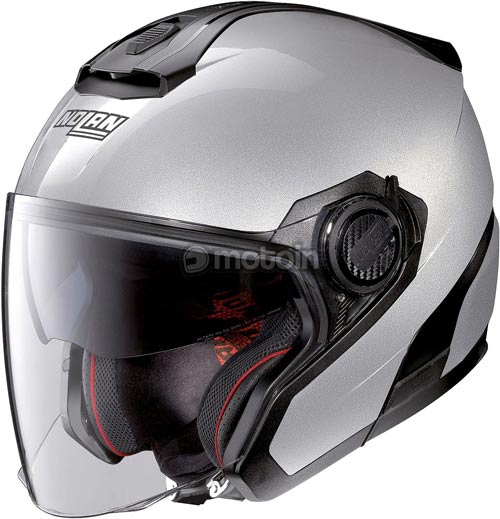
Nolan n40-5 GT N-com silver motorcycle crash helmet side view
The Nolan N40-5 (no GT) is the open face, jet style helmet

Shield

There’s both that massive clear main shield and a drop down sun visor.

You don’t need me to tell you just how massive that main shield is. It’s massive in both horizontal and vertical planes so you’re going to have pretty amazing vision with either helmet. That’s great for peripheral vision and shoulder-checks as well as forward vision.

In fact, that’s one of the best things owners find about the Nolan N40-5. Comments include that there’s an amazing field of view and that it gives a whole new feeling to riding a motorcycle!

Nolan say that aside from being anti-scratch, it’s anti-fog too (but expect it to be poor because they all are) and it’s UV400 – that’s the most protective of the UV standards. It’s also Pinlock-antifog ready, though unfortunately there’s no Pinlock insert included in the box.

Finally, the main shield is quick-release – useful so you can quickly give your shield a wipe after a ride or if you fancy whipping it off completely to go cruising in your RayBans.

Sun Visor and Peak

An interesting feature about the peak is that it moves with the shield. If you open the shield to the max open position, the peak moves up slightly to accommodate it – presumably to move both shield and peak out of your line of sight. Conversely, close the shield and the peak will drop down to its original position.

Nolan-n40-5-GT-N-com-solid-matt-black-motorcycle-helmet-front-view
Front view showing peak, sun visor and chin guard

In addition to the peak, there’s also a drop down integral sun visor too. It’s difficult to see in the photos, but there’s a small slider to the rear of the left hand visor pivot that drops/raises the sun visor.

Chin Guard

The chin guard on the GT version of the N40-5 is both protective and removable. Press down the two buttons on the inside of the chin guard and it unlatches and pulls away.

To make it legally protective in the ECE 22.05 zone (that’s Europe and Oz mostly), Nolan had to get the chin guard tested and approved by the ECE testers, and that means the helmet’s dual-homologated (or P/J homologated if you prefer). And given that it’s just an extra $20 to get the full face protective GT version of the N40-5, I’m guessing this is probably the model most of us will opt for.

While the chin guard is a little different to most of the chin guards you’ll find on conventional modular helmets, Nolan does have a great reputation for making chin guards that do exactly what they should do in an impact – i.e. stay locked and in place to protect us. So far, the chin guards on all five SHARP-tested Nolan modulars have stayed closed and locked 100% of the time during testing.

No other manufacturer who’s had more than one helmet tested by SHARP so far has managed that. Most come unlocked a few times, so very well done Nolan. Note whenever we review a modular helmet that’s been SHARP tested, we add in the locking percentage score.

Nolan-n40-5-GT-N-com-solid-matt-black-motorcycle-helmet-inside-view
Clima Comfort interior with micrometric fastener

Comfort & Sizing

Inside both N40-5s is what Nolan calls their Clima Comfort lining. Clima Comfort is used across many Nolan helmets and is a breathable and moisture-wicking material that generally makes for a good, comfortable helmet.

And that’s the case for the N40-5s. As long as you get the sizing right in the first place, we’d expect you to find the N40-5 comfortable hours in the saddle.

Looks & Graphics

At the time of writing, the Nolan N40-5 helmets have only just been launched so the range of designs in pretty limited. Aside from the usual matt and gloss black and solid gloss white, there’s also a solid silver and graphite grey version along with a hi-viz fluo yellow version. If you’re after fancy graphics, you’ll have to make do with the Fade designs which come in cherry red and silver – or click the links below and find our European recommended retailers to see if any other designs have been launched (and check out the latest prices).

Best places to buy a Nolan N40-5?

Please click below to visit the Nolan N40-5 helmets pages at one of our recommended stores and Amazon. And if you buy from any store, we get a small sum from the sale at no extra cost to you – a massive THANKS! (it’s how we finance the site).

Shop for helmets at Amazon

Nolan-n40-5-GT-N-com-fade-motorcycle-helmet-side-view
Another N40-5 GT in Fade graphics, this time in silver

Other stuff – audio, warranty

Both the N40-5 Jet and GT come ready to fit Nolan’s N-com bluetooth communicators. Nolan N-com systems that’ll work with the N40-5 are the B5L, B5, B1.4 and MCSII.

Both helmets come with Nolan’s outstanding 5 year warranty.

Overall/Summary

Italian maker Nolan has an excellent reputation for building safe helmets that are easy to live with. We’re not sure how well it’ll score if it gets SHARP safety tested, but if you’re after something that’s a bit different and like the idea of that massive visor giving unimpeded vision then you should check out the Nolan N40-5.

But it’s not just a one-trick pony. It’s a comfortable helmet that owners say is well-built too. And the flexibility that it offers – whether you want to ride as an open face or stick on the chin bar when you up the pace (for the GT version), then the Nolan N40-5 offers a range of options like few other helmets.

The Nolan N40 range of helmets had a mass of loyal followers and this N40-5 update looks to be bang on the money for those of us who are already convinced.

[xyz-ihs snippet=”Link-to-guides-page”]

Nolan n40-5 GT N-com hi viz yellow motorcycle helmet side view
Also available as a hi-viz yellow version

Alternatives to the Nolan N40-5?

The first helmet that comes to mind is that other quirky Nolan – the N44. With even more helmet configs than the N40-5, a similarly massive shield and integral sun visor – all for slightly less than the N40-5, that’s gotta be worth a look too.

There’s also the Nolan N104’s which is a SHARP 4 star modular whose chin guard stayed locked and closed 100% of the time during testing – that’s  well worth a look.

If you’ve a little more to spend, AGVs Numo Evo is their top of the range flip-front helmet. The UK version was SHARP 4 star safety rated, has great ventilation and has a drop down sun visor too.

Other than these suggested helmets, you can find lots more by checking out our top 10 rated flip-up helmets list.

Looking to buy a Nolan N40-5?

Please click below to visit the Nolan N40-5 helmets pages at one of our recommended stores and Amazon. And if you buy from any store, we get a small sum from the sale at no extra cost to you – a massive THANKS! (it’s how we finance the site).

Shop for helmets at Amazon
[xyz-ihs snippet=”Nolan-Cat-link”]

Star Ratings

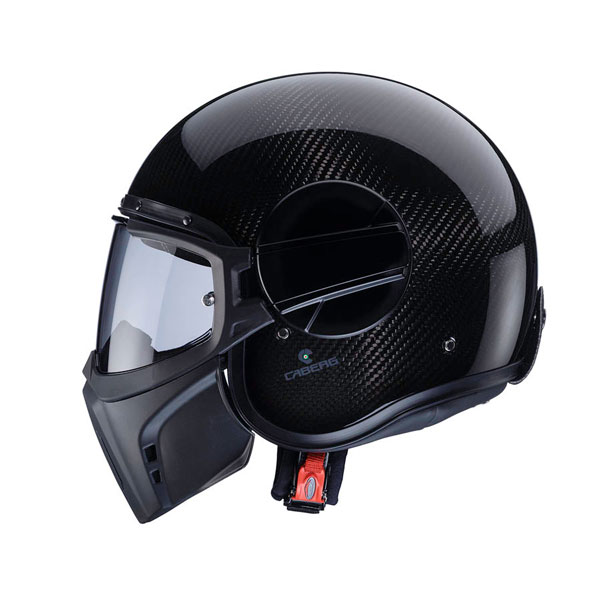
Caberg Ghost street fighter/jet motorcycle helmet

Caberg Ghost: a lightweight streetfighter motorcycle helmet

Yes, the Caberg Ghost looks like a full face or even a flip-up helmet. But don’t be fooled. Okay, it’s got a shield and chin guard and yes you can flip them up, but it’s not fixed in place and it’s not protective.

So, now we’ve got that out of the way, the bottom line is if you’re after a mean-looking open-face/Jet helmet that’ll scare kids and grannies – while giving you a bit of protection from the rain, then you might well have found the right helmet.

Because the Caberg Ghost, like the Shark Drak before it, is here to make you look cooler, meaner and altogether more ‘tie-fighter’ on your morning commute.

It’s available in both tri-composite and carbon fiber versions (just like Caberg’s Drift helmet) comes with a Pinlock anti fog shield* and is here at a price that won’t drain your bank account.

  • Open face/Jet helmet with face guard
  • Non-protective face shield
  • Available in composite and carbon fiber
  • Pinlock shield (see shield section)
  • Micrometric buckle
  • 2.55lbs (1.15Kg) – that’s very light
  • Sizes XS-XXL
  • Expect to pay $250-$300

    caberg-ghost-white-crash-helmet-open-view
    Chin guard and shield fully raised. But remember, this isn’t a modular. That guard gives no protection.

Safety

Well, the first thing to say is that the Ghost isn’t DOT certified for use the US, thought it has been ECE tested for use/sale in Europe. But that ECE rating does mean it’s been tested and is gonna give a decent level of protection.

The second thing to say is you should view it as an open face helmet: i.e. assume that face shield is not going to offer any protection in an accident because a)It’s not been designed to protect you from anything other than a bit of rain or road dirt and b) It’ll probably flip up or fall off as soon as it even things about hitting anything!

All that said, Caberg has a great reputation in Europe for making safe helmets – particularly polycarb helmets which have become a bit of a speciality for Caberg.

These days, they’re moving up in the world and producing more composite and carbon fiber helmets, like the Ghost. However, as SHARP (the helmet safety testers) haven’t tested any carbon fiber Cabergs (since the old V2X carbon) or composite Cabergs (like, ever) then it’s difficult to know how well their latest generation of up market helmets like the Ghost will perform.

Of course, SHARP won’t touch the Ghost with a barge-pole because it’s an open face helmet; and to helmet safety experts the world over that means it’s the work of the Devil. So of course, if you value your face, then we’d suggest getting one of our top 10 best full face helmets or flip-ups.

caberg-ghost-legend-crash-helmet-side-view
Ghost Legend. Note, that white stripe’s on one side only

But if you simply can’t resist just how damn cool the Ghost looks and have to have one, then the Ghost has a micrometric fastener which are easy to use and should keep the helmet on your head in an accident (as long as you tighten it up correctly) and a good quality Pinlock-ready shield. That’s well worth having to keep rain and filth out of your eyes.

Looking to buy a Caberg Ghost?

Well it’s not legal to wear a Caberg Ghost in mandatory helmet law states, because it hasn’t been DOT certified. That said, if you want one, you can find our recommended European retailers over on our UK site – all will happily ship a Ghost over to the US.

Ventilation

Well, it’s an open face helmet, so if you want lots of air, you can always push the face piece up and out of the way and that’ll let lots of air in.

But while your face is cool, you might still find your head stays a bit hot and sweaty, because there’s no ventilation inlets in the actual helmet shell itself, which is a bit of a shame.

And if you like to ride with the face guard down for the full Mad Max effect, there are always-open vent holes in the face guard, so even with it down, some draft will get in there. That should also help with defogging the shield a bit too.

Shield

Front view of the solid matt black version. Soo black it’s almost stealth!

The Ghost is fairly unusual being an open face helmet with a built in shield. But it’s not unique.

What is very rare is that it’s Pinlock-ready, which means if you fit the Pinlock, the shield shouldn’t fog up. Now that is a pretty cool and a pretty rare feature for an open face helmet.

At the time of typing, it’s unclear whether a Pinlock will be included at most retailers. The Caberg website says one’s included, but a couple of stores have told me it’s not, so best check before you buy.

The shield itself is firmly attached to the helmet (unlike something like the Shark Raw/Drak) and can be easily moved up and open by pulling forward slightly then pushing up. It’s spring loaded too so when you pull it down, the shield is pulled tight against the helmet. Caberg advertise that the shield’s been designed so it can be closed with just one hand, which shows how effective the mechanism is.

One of the cool things about the shield and chin guard is that both can be removed, so you can wear the Ghost as either a traditional open face helmet, with just the shield in place, or with both shield and chin guard.

The chin guard is made from flexible plastic/rubber and clips onto the bottom of the shield so it’s easy to remove. Removing the shield involves fiddling about with phillips screws and springs – but it’s more than doable.

caberg-ghost-fluo-crash-helmet-side-view
Want a bit of hi-viz with your black? No problem. This one’s the Ghost Fluo

Comfort & Sizing

The Caberg Ghost has a removable and washable lining that’s both breathable and anti-microbial.

It’s produced in two helmet shell sizes, which should make for a helmet that’s not too over- or under-padded the extreme ends of the range of sizes. The smaller shell is used in the XS-L sizes and the larger for XL and XXL.

Looks & Graphics

I guess with the style of helmet the Ghost is, they’ve limited the graphics options to designs that suit the streetfighter look. Which means you can expect lots of blacks, matt finishes and, of course, that lovely carbon fiber weave version. We’ve posted copies of all the designs that are available at the time of writing but if you want to see the latest prices and designs, they’re available via our recommended UK retailers over on our UK site. Just click the link.

Want to buy a Caberg Ghost?

It’s not legal to wear a Caberg Ghost in mandatory helmet law states, because it hasn’t been DOT certified. That said, if you want one, you can find our recommended European retailers on the review over at our UK site – all will happily ship a Ghost over to the US.

Caberg Ghost Video

Take a quick look around the Ghost in this 1m video.

Other stuff – fasteners, bluetooth, warranty

caberg-ghost-carbon-crash-helmet-side-view
Full carbon fiber Caberg Ghost

The Caberg Ghost comes with a quick and easy micrometric fastener. It’s also been designed to be Just Speak bluetooth ready, so it may well fit 3rd party bluetooth sets too.

As always, Cabergs only come with a one year warranty. Which is awful – click to see helmets that come with a 5 year warranty.

Overall/Summary

You’re probably thinking of buying a Caberg Ghost because it looks so damn cool. Which is fair enough.

But it’s also a well thought out helmet, with a Pinlock-ready shield, nice shield/bug shield opening system and good build quality and finish. Obviously, it’s an open face helmet in reality, so it’s never going to protect you as well as a full face helmet. But if you’re after the streetfighter look to go with your urban warrior bike, then the Ghost is bang on. Just don’t crash in it!

[xyz-ihs snippet=”Link-to-guides-page”]

caberg-ghost-gloss-solid-black-motorcycle-crash-helmet-side-view
Gloss black version with shield/shield raised fully

Alternatives to the Caberg Ghost

If you’re looking for something that’s a bit of a retro statement or looks a bit ‘edgy’, then there’s a few alternatives you might want to check out.

First off, you’ve gotta take a look at the Shark Drak (or Raw as it was known). The Drak looks very similar to the Ghost, albeit a bit less refined. But it’s also cheaper than the Ghost and comes with a 5 year warranty.

Or how about the Shark Vancore. That’s a proper full face helmet but with goggles and tons of attitude. It’s really light too.

If it’s more of a retro vibe you’re after, then the full face Bell Bullitt is the real deal – cool as you like, great build quality, lots of retro accessories and a SHARP 3 star rating to boot.

And finally, Portugese maker Nexx has their X.G100; a composite fiber full face helmet that’s a smidge cheaper than the Ghost (as is the Bullitt) that’s both ECE and DOT certified and mega light weight.

[xyz-ihs snippet=”Caberg-Cat-link”]

Caberg Stunt full face polycarbonate helmet review

There’s no doubt that Caberg’s Stunt looks very cool. It’s a polycarbonate full face helmet that’s aimed at folks who like a more aggressive-looking lid but don’t want to pay through the nose to get it. But is it all show?

Here’s what you can expect if you buy a Caberg Stunt (including what owners think of their Stunts).

  • Polycarbonate shell
  • Full face helmet
  • SHARP 2 star rating (poor)
  • ECE 22.05 approved but not DOT certified
  • 2 shell sizes
  • Fitment XS-XXL
  • Sun visor
  • Pinlock-ready main shield (not included)
  • Micrometric fastener
  • Expect to pay around $150-$175

Safety

Most folks are probably going to buy the Stunt because a) it looks mean and b) it’s pretty cheap.

caberg-stunt-matt-black-motorcycle-crash-helmet-front-view
Front view of the plain solid matt black Caberg Stunt.

In my book, they’re both valid reasons to buy. But it’s also a Caberg polycarbonate which usually means it’s gonna be very safe too (click the link to see more about polycarbonate helmets and see our guides for lots more information on expensive v cheap helmets and other analysis of what makes for a safe motorcycle helmet).

The Caberg Stunt is only ECE 22.05 certified for use in the EU/Oz, but isn’t DOT certified for use in the US (wonder when Caberg are gonna start importing?) but to date, Caberg have shown they’re one of the safest helmet makers out there. However; the bad news. SHARP tested the Caberg Stunt in Feb 2017 and reported it only scored 2 stars (out of 5) which is Caberg’s lowest score yet.

So far, most of their helmets have scored maximum points in the SHARP test – including their last three polycarbonate helmets. Which just goes to show the past isn’t always a good indicator of future performance!

As always, when you’re buying a new helmet, the most important feature to consider is making sure it fits right. As SHARP themselves say, you’re better off with a one star helmet that fits perfectly than a five star helmet that doesn’t. Still, not sure I’d want to be buying a SHARP two star helmet myself – might as well go for a really safe helmet in the first place right? Even if it looks as cool as the Stunt. Looking for a helmet that stands out from the crowd – try one of these coolest crash helmets.

caberg-stunt-blade-white-black-full-face-motorcycle-helmet-rear-view
Rear view of the Caberg Stunt blade.

The helmet comes in 2 shell sizes so it shouldn’t look too massive on your head and it’s fastened in place with a micrometric fastener. They’re nice and easy to use – but do keep checking they’re still tight as chin straps do stretch over time so you’ll probably have to slightly readjust the fastener every few months or so.

Wanna buy a Caberg Stunt?

(Note it’s not legal for use in US DOT states)

Then head on over to our UK site where you can find links to some excellent retailers who’ll ship you a Stunt.

Helmet Noise

So, it’s not the safest helmet according to SHARP. But is it any good to live with?

Well, as far as helmet noise is concerned, the answer’s a resounding… nope.

It seems the fact that there’s tons of air vents in the shell of the Stunt means there’s lots of holes for road noise to get in too.

Comments from owners are that if you get any kind of a lick on, the Stunt gets really noisy. Some folks say anything above 30, others anything above 70mph and it gets noisy.

caberg-stunt-motorbike-helmet-blizzard-black-green-fluo
Stunt Bizzard in black and green

Close the vents, I hear you shout. Well, you can close some but not all. So the only solution when riding with a Caberg Stunt is to stick in a good pair of ear plugs. Which, by the way, is what you should do with most helmets if you’re riding for any distance.

Do that, and you shouldn’t have a problem. Prefer to ride without ear plugs? Then, you’re probably best walking away from the Stunt and trying one of these quieter helmets.

Ventilation

As we said, the Caberg Stunt has lots of ventilation holes. There’s a single multi-point chin vent that’s opened by pressing in the whole chin panel and pressing a slider to close it. There’s three top crown vents with sliders to open/close plus there’s a couple of always-open side vents.

To the rear, there’s a single huge exhaust, plus a few other smaller exhausts towards the side and rear.

All of which makes for a helmet that vents very, very well. The chin vent channels air up onto the inside of the shield and the top vents pull it through channels in the lining through to the scalp. So good is the venting that the fact that there’s loads of air whooshing through the helmet is one of the biggest comments made by owners. All of which means it should be a great summer helmet but not so much of a good winter helmet!

caberg-stunt-motorbike-helmet-blizzard-black-yellow-fluo
Caberg Stunt Blizzard with fluo yellow panels showing main shield and sun shield

If you’re a summer rider, then read on. If you’re all seasons, then move on (and check some of our suggested alternatives towards the bottom of the page).

Shield

Lots of ventilation should mean that there’s lots of air inside the helmet to stop the shield fogging up, right? But that’s not necessarily the case. As with most helmets, if things get cold and damp (or warm and humid) the shield will tend to fog up, and quickly.

Thankfully, the shield on the Stunt comes Pinlock-ready. Unfortunately, there’s no Pinlock anti-fog insert included in the box. Boo. Lots of helmets, even at this price point, do include a free Pinlock in the box. Check our Pinlock helmets, and if one’s included in the box, we’ll mention it in the bullets heading up each review.

Other than the fogging, Stunt owners like the shield, It works well and gives a nice wide field of view. It works on a ratchet and has a nice positive movement.

If you decide to buy a Pinlock, you’ll need to pull off that shield. And while it’s not exactly a traditional quick-change shield, it’s still pretty simple and quick.

caberg-stunt-motorbike-helmet-blizzard-black-anthracite-rear-view
Rear view of the Caberg Stunt Blizzard in anthracite

You’ll find a screw-off plastic bolt at each shield pivot. Unscrew both and the shield pulls off – easy.

Sun Visor

The Caberg Stunt has a built-in drop down sun visor. It works from a slider on the left hand side of the helmet under the shield pivot point.

It slides the visor down and means you can drop it down as far down as you like. Owners say it works well and, while it’s not massively dark (most aren’t) it’s good enough to stop all but the strongest glares.

Comfort and Sizing

Owners reckon their Stunts are really comfy helmets. Comments are that it’s very comfy and has nice, plush feeling materials inside. The word snug was used more than once!

A few folks reckoned the sizing is true (so if you’re a size M, go for a size M!) but they can feel a bit tight when new. Though wear it for a few days and it’ll break in nicely – still feeling nice and tight but not too tight, just like a helmet should be.

A couple of other comments are that the Stunt is nice and high at the back, meaning it doesn’t interfere with collars at the back like some helmets do. Also, that elongated, adventure style front means there’s lots of room for your snout.

caberg-stunt-blade-motorcycle-helmet-matt-black-pink-side-view
This one’s a Stunt Blade in black and pink

The interior of the Stunt is hypoallergenic and fully removable/washable. A couple of folks said it’s good for glasses wearers and they found it easy to put them on in the Stunt.

Finally, lots of people said their Caberg Stunts feel really nice and light, especially for a lower-priced polycarbonate helmet. The official weight is about 3.2lbs (1.45Kg) for the smaller shelled helmet (that’s for sizes XS-L) and 3.3lbs (1.5Kg) for XL-XXL. However one owner said he weighed his M at 2.9lbs (1.3Kg).

Whatever the truth of the weight, lots of owners said their Stunt feels really light, especially for a helmet with a sun visor. So maybe you’ll feel the same way if you buy one (let us know!).

Looks and Graphics

There’s new graphics coming out all the time for the Caberg Stunt – so check out our recommended UK retailers (on the link below) to find the absolute latest designs.

As to those all-time favourite colors, there’s a matt black and gloss white (called Metal White). There’s also a rather attractive black anthracite version that’s matt black with some very subtle designs over it which looks very cool. If you’re after a bit of hi-viz, there’s the Stunt Steez and Stunt Blizzard which are available with hi-viz green flashes all over them.

Other than that, we’ve included various Stunt Blades and all the other designs up and down this page.

Looking to buy a Caberg?

(Note Cabergs aren’t legal for use in US DOT states)

Then head on over to our UK site where you can find links to some excellent retailers who’ll ship you a Stunt.

Video of the Stunt

These are the only two English language videos I could find on YouTube. First off, Caberg Italia dude Andrea showing you round the Stunt on its release. Secondly a short video from MotoFire giving a quick overview.

Other stuff – fasteners, aero, build quality, warranty

The Caberg Stunt comes with a micrometric fastener and it also comes with a removable chin curtain and breath deflector.

Aero on the Stunt is apparently very good. Caberg themselves say it’s been wind-tunnel designed and a couple of owners say it’s really effective – including one who said even at 150 you can feel the aero working and there’s very little buffeting!

For a helmet at this low price point, a few owners said the finish and build quality is very good. Unfortunately there’s only a 1 year manufacturers warranty to back this up though which is particularly poor; lots of makers these days give a 5 year warranty.

Overall/Summary

caberg-stunt-blade-matt-black-red-motorcycle-helmet-side-view
Caberg Stunt Blade in matt black and red design.

The Stunt’s a cool-looking helmet that’s got everything you need to look mean and moody on your bike and has enough features on it that should make it easy to live with even on a daily commute. Ventilation’s great in the summer (but a bit drafty in the winter) and it’s available for a fraction over the ton – just a shame it’s not as safe as it could be and it’s a bit noisy.

If pressed, because of the low safety score, we’d have to say, read on to find a better alternative helmet for your money – one that scores higher for safety.

But if you’ve fallen for the look and style of the Stunt and just have to have one, click the link through to our recommended retailers (and read our fitting guide to make sure you get one that fits perfectly!).

Alternatives to the Caberg Stunt?

The Stunt might be a really attractive proposition, but it’s not alone. There’s some great helmets available for this price (and less) – including some that’ve been SHARP tested and scored great marks, so we know they’re safe.

The Shark S600 is available for less than the stunt, scores 4/5 stars in the SHARP test and comes with a Pinlock anti-fog in the box – and it comes with a 5 year warranty (Cabergs have a 1 year warranty).

Also have a look at AGVs K3-SV – that’s a SHARP 4 star polycarbonate full face helmet with sun visor and weighs about the same as the Stunt. And if you’re thinking of buying a Stunt and a Pinlock, then it’s worth knowing that the AGV comes with a Pinlock in the box – so it’ll probably end up costing you about the same in the long-run.

Star Ratings

About composite fiber crash helmets

composite-fiber-motorcycle-crash-helmets-featured-image
HJCs PIM or Premium Integrated Matrix shows the complexity of some modern day composite helmets

What’s a composite motorcycle helmet?

Motorcycle crash helmets are made in a wide variety of materials – but often they’re created using a mixture of different materials laid down in layers to form what’s called a composite helmet shell.

Nexx-XG-100-helmet-composite-fiber-diagram
This one shows the layers that go to make up the Nexx X.B 100

Technically, when you get more than one material involved, it becomes a composite fiber helmet: the helmet is made from a composite, or mix, of materials to create a new material that has the best characteristics from all its component parts.

As an aside, that does of course mean that fiberglass, carbon fiber and lots of other materials are technically composites. In these cases either glass fibers or woven carbon fibers are mixed with a resin (usually epoxy or polyester) to produce a new material.

Don’t worry, that’s as deep as I’m going to go!

Usually, though, if it’s not plastic (thermoplastic or polycarbonate), fiberglass or carbon fiber, and includes more than one of these materials, helmet makers will sell it as a composite helmet.

Are composite crash helmets any good?

Short answer – yep, they’re great.

Longer answer – composite fiber helmets are some of the best motorbike helmets on the market. They’re usually constructed from a combination of fiberglass, carbon fiber sheets or aramid (Kevlar).

[table id=6 /]

As you can see from the table, carbon fiber helmets are generally the best – the lightest and safest around if you look at SHARP testing stats. But composite fiber helmets are close behind, ranking next highest in terms of both weight and impact resistance.

Across all the helmets tested by SHARP, composite fiber helmets score 3.76 out of 5 for safety with an average weight of 3.2lbs (1.46Kg). That makes composite helmets the second best for safety and weight, but they’re also the second most expensive type of helmet.

Should I buy a composite crash helmet?

Yes – composite fiber crash helmets can be great and some manufacturers like Arai, Nexx and X-Lite specialise in making helmets from composite materials.

But like any helmet, there’s good ones and bad ones. So use the following links to find the best composite fiber helmets on the market today:

Check out all our composite fiber motorcycle helmets.

Or visit our Smart Filter pages, choose composite and whatever other helmet features you’re interested in.

Alternatively, view our top 10 Safest Helmets, Budget Helmets, Flip-up and Modular Helmets, Full Face Helmets, or top 10 All Helmets sections.

All about dual-homologation for motorcycle crash helmets

What is a dual-homologated or P/J homologated motorcycle helmet?

Good question.

The first thing to say is that it’s a term coined by the European ECE 22.05 motorcycle helmet testing legislation so doesn’t have any legal standing here in the US and relates to modular/flip-up helmets only.

It means a modular crash helmet that’s been tested and approved to offer protection (and be used) with both the chin guard down as well as up. And while it’s not legally-relevant in the US, it’s probably worth checking out because we all want our modular helmets to give decent protection in both configurations right?

It’s your call of course, but read on if you want more information on dual homologated helmets – plus we’ve tagged all helmets we’ve looked at that are dual homlogated here.

Some Caberg dual-homologated helmets have a slider to lock the chin guard up in J mode

P/J helmets

Most flip-front helmets are designed to offer protection with their chin guards down, so they act as a full face helmet.

If it does, it’s given type P certification for protective face covering.

But some are also tested and approved to be worn with the chin guard up, worn like an open face or jet style helmet. That’s J certification.

If they have both, it’s called P/J approved or dual homologated.

It’s legally relevant for EU and ECE 22-05 countries only

Non-protective chin guards

Note, the very occasional modular is approved without P certification – in which case they should be clearly marked that the chin guard doesn’t offer protection and labelled NP (for non protective). But they’re rare. Much more common are modulars that are designed and approved to give protection only when used in full face mode, with the chin guard lowered.

roof-boxer-v8-dual-homologated-crash-helmet
The Roof Boxer V8, dual homologated with a chin guard that flips round to the rear of the helmet

So if you’re buying a motorcycle crash helmet outside of the EU or ECE 22-05 zone, you don’t legally have to concern yourself about dual homologation.

However, we’d say if you do buy a modular, you might as well go for one that the manufacturer is happy will work in both configurations – and are willing to put to the test.

What’s the best dual-homologated flip-up helmet?

You can find all our dual-homologated P/J helmets here.

There’s plenty to choose from but at the time of writing, we’d say the ones to watch are the AGV Numo Evo and Shark Evoline 3. They all score well for safety and are great, usable helmets from trusted manufacturers.

about emergency quick release EQRS motorcycle crash helmets

What is EQRS or Emergency Quick Release System?

EQRS is a system designed to help remove a motorcycle helmet without damaging a rider’s neck and spine.

When a rider has an accident, at some stage it’s going to be necessary to remove their crash helmet. Whether that’s at the scene to assess head injuries or at the emergency room to get the rider comfortable and do further investigation into any injuries – they’re going to have to get that helmet off.

As we all know, that’s sometimes easier said than done; even when we’re fully fit and doing it ourselves there can be a fair bit of tugging and wrestling involved!

So, for emergency staff removing an unfamiliar helmet from someone else, possibly in an awkward position at a highly-charged accident scene – that can mean there’s masses of potential for causing further complications to neck and spine.

Which led some helmet makers to add something called EQRS or emergency quick removal system into their helmets – to help making removing helmets easier and putting less strain on the neck.

How does EQRS work?

Essentially, it’s a system to make pulling-out some of the pads inside the helmet easier – and to do it while the helmet’s still being worn. Usually, that means pulling the cheek pads out of the bottom of the helmet without removing the helmet first.

Removing the cheek pads means there’s more space available to carefully remove the helmet, minimising the need to move the head around too much and cause injuries.

You can see if a helmet has EQRS by looking at the bottom of the helmet. There’s usually a couple of red tabs at the bottom of the lining which can be grabbed to pull the cheek pads out of the helmet. There’s also usually small notices stickered on the outside of the helmet to notify emergency staff and paramedics, pointing out that EQRS is fitted.

Here’s a video from Shoei showing how EQRS works.

Which helmets have EQRS?

There’s an increasing number of helmets with EQRS – especially sportsbike and motocross helmets where injuries are most likely.

Some makers don’t call it EQRS and have their own name for it. But here you can find all the helmets that feature EQRS or their equivalents that we’ve looked at so far.

All you need to know about micrometric or micro-ratchet helmet fasteners

What is a micrometric motorcycle helmet fastener?

The micrometric (or micro ratchet, or plain ratchet) fastener is a relative newcomer to motorcycle crash helmets. It might be new, but it’s a real goodie.

It’s uses a small hard plastic or metal curved strip with teeth on it on one side of the strap. On the other, there’s a corresponding slot with a spring-loaded ratchet mechanism. Insert the strip into the slot and the ratchet grabs onto the teeth, securing the strap.

micrometric-motorcycle-crash-helmet-fastener
Couldn’t be easier. Insert the ratchet strip to auto-lock, pull the red tab to release

That means it’s really simple to close and lock micrometric straps; but it’s also easy to open them too. Just pull the red tab connected to the ratchet and it releases the mechanism, unlocking the fastener. Couldn’t be easier.

The strength of a micrometric fastener is in its simplicity to use and, within limits, means that you re-tighten the strap every time. Oh, and in its cheapness to produce.

But it does have a weakness. And that’s in the fact that you only have an inch or so adjustment – the length of the ratchet strip in fact. That’s fine when the strap’s adjusted correctly, but when the strap stretches over time (which it probably will) it’s all too easy to have a micrometric fastener that’s not quite tightened enough.

And that, dear friends, could give you a chance of being one of the 8% of fatal motorcycle accidents where it’s reckoned the helmet comes off!

So, if you ride with a helmet fastened with a micrometric or ratchet strap, if it doesn’t feel tight enough, take a moment to adjust the buckle on the strap itself and not just the micrometric fastener.

Other than that, micrometric’s are great.

Pros of micrometric fasteners

  • Really easy to fasten & release
  • Safe as houses if adjusted correctly

Cons of micrometric fasteners

  • Limited amount of adjustment
  • Need periodical strap adjustment

If you’re wanting a micrometric fastener on your new helmet, you can find all our helmets with micrometric fasteners here.

all about fiberglass motorcycle crash helmets

Fiberglass was the wonder material of its age. Originally developed in the 1930’s it was their carbon fiber moment.

It’s a cheap, light weight, strong and mouldable material that’s very suited to making into motorcycle crash helmets and has been the go-to material for heaps of manufacturers over the years in their quest to make the best helmet.

First stage of making an Arai helmet – creating a superfiber fiberglass shell

Indeed, many older dudes (like me!) still equate fiberglass helmets with top-of-the-range lids.

And with good reason – because in many cases it still does. Arai still uses it, so does Shoei and Scorpion, for example. But mostly, fiberglass is used as one of a number of components in a composite fiber helmet. These usually include other materials such as carbon fiber and kevlar in the mix.

In the picture, you can see an early stage of making an Arai helmet – creating a ‘straw hat’ of high-grade fiberglass (what Arai call superfibers) to form into the helmet shell before layering in other materials.

Fiberglass can be used as ‘ordered’ mats similar to carbon fiber weave. But, as you can see in the picture, it also has multi-directional strength when used in the ‘chopped strand’ method where fibers are chopped then laid down in random directions before being set in resin. This gives it great stability and multi-directional strength.

So don’t let fiberglass put you off – it’s an excellent material that displays lots of the properties we like to see in a helmet – light weight, strength with tunable flexibility and abrasion-resistance being but four.

And as you can see from our helmet materials table, fiberglass helmets are only a smidge heavier on average, and a tiny bit poorer SHARP safety performing, than composite helmets.

[table id=6 /]

Visit our fiberglass crash helmets section to see the wide variety of top-performing helmets that are sold as fiberglass helmets (or as composites containing fiberglass).

All about carbon fiber motorcycle crash helmets

Carbon fiber is a composite material usually made up of a carbon fiber weaved fabric set in a resin – usually plastic.

The great thing about carbon fiber, as far as we’re concerned, is that it looks cool when you make a crash helmet out of it. Oh, and it’s very strong for its weight!

This last part is why helmet manufacturers have been keen to use carbon fiber in the construction of their top-end crash helmets for the last ten years of course. But it does have a downside.

bell-pro-star-crash-helmet-tracer-black-silver-side-view
Carbon fiber Bell Pro Star – Tracer design

That’s because crash helmet shells need to have a certain amount of flex in them to try and absorb energy and stop it passing through to the brain. And carbon fiber is very strong and stiff so very resistant to flexing.

Which can present a challenge to a helmet maker.

Having said that, they mostly seem to have overcome this problem because, as you can see from our comparison of helmet shell material versus SHARP helmet safety score in the table below, carbon fiber helmets overall perform superbly well. They seem to manage to be lighter, stronger and offer fantastic shock-absorption qualities all at the same time.

That’s probably because most helmets that use carbon fiber include it as part of a composite – often including layers of fiberglass, kevlar, plastic and other custom-designed materials working alongside carbon fiber. This allows helmet makers to tune the performance of the shell to give as close to the right set of characteristics they’re looking for. Even many ‘pure carbon’ helmets on sale today are actually composites. Which is no surprise really because carbon fiber itself is a composite material.

[table id=6 /]


nexx-xr2-carbon-pure-crash-helmet-rear-view
Carbon fiber ‘Carbon Pure’ Nexx XR2 – one of the lightest helmets around at 1.27Kg

The way carbon fiber is made is by creating a carbon thread then weaving it into a material. Doing this gives it strength in two planes. This is then set into a binder – usually a thermoplastic resin (the stuff that thermoplastic helmets are made out of) which gives it three dimensional strength. Using multiple layers together multiplies that strength further.

It’s not quite so straightforward though because there are lots of different grades of thread quality, weaves and binders, all offering a multitude of material characteristics and available at exotic and startling price points!

For example, the Bell Pro Star race helmet, uses a special flatter, stronger carbon fiber called TeXtreme which partly accounts for it’s higher price. Its sister helmet, the slightly cheaper Bell Race Star uses a 3K carbon fiber weave which is slightly bulkier and has a different finish.

You’ll often hear terms like 3K and 6K carbon fiber. This refers to the number of carbon fiber filaments in each carbon thread. So 3K carbon fiber has 3000 filaments and is the ‘workhorse’ good all rounder type of carbon fiber, whereas the 6000 filament 6K carbon fiber is slightly cheaper and with a thicker weave.

Of course, because carbon fiber is expensive to buy and use, helmet makers tend to use it mostly in their top of the range helmets. And those helmets tend to have more care and attention and better quality materials lavished on them anyway – hence their better overall performance.

However, the fact of the matter is that if you were wanting to buy a safe crash helmet and are going to base your buying decision on helmet shell material alone, then you’re probably best going for a carbon fiber helmet.

So there you go. Carbon fiber isn’t just pretty, it’s strong (and pricey) too. And it allows helmet manufacturers make some great looking, great performing and lightweight motorcycle helmets to keep our heads safely cossetted doing what we love most.

So if you’re in the market for a carbon fiber helmet, then visit our carbon fiber crash helmets page where you can read all our carbon fiber helmet reviews and previews.

About photochromic shields

What are photochromic shields?

Photochromic means something that changes colour in response to light. So, in the case of shields, that means a shield that will darken in response to UV light.

Which means it’ll stay light when indoors (indoor lights don’t transmit much UV apparently) or when it’s dark or a dull day. But when it gets sunny, then the shield will start to darken. And when it gets really sunny, it’ll do it quickly and get really dark – Lazer quotes an 80% tint for its Lumino shields.

How quickly do they change?

Well, photochromic shields are known to darken more quickly than they lighten and the speed it takes is slightly temperature dependent too. But, if it’s a really bright and sunny day, they’ll typically reach max darkness in about 20s – or about the time it takes to get on your bike, put your helmet on and set off. Which is pretty cool.

How do they work?

Most of the photochromic shields on the market today use technology developed by a company called Transitions – including those available from Shoei, Bell and Lazer (see below).

Transitions lenses use a light-sensitive dye to either impregnate or coat the surface (depending on the material). When exposed to UV light, the molecules in the dye change structure, causing the shield to darken.

For more info on how it all works, here’s a link to Transition’s technology page.

We’re great fans of photochromic shields – especially when helmets come with them in the box like the very reasonably priced Bell Qualifier DLX full face and Lazer Monaco flip-up (that’s SHARP 4 star rated too).

You’ll find helmets that come with photochromic shields in the box here on our photochromic shield page. Or read on…

Which helmets come with Photochromic shields?

At the time of writing, the following manufacturers either offer their helmets with a photochromic shield as standard fitment, or have one available to buy separately.

lazer-kite-lumino-photochromic-shield
Lazer’s Lumino active photochromic shields are available for the Kite, Falcon, Osprey and Kestrel

Bell

Bell produces what it calls their Trinsitions SOLFX ClickRelease shield. The following helmets have one available to fit:

Bell Qualifier DLX – comes as standard with one in the box.

Bell Star, Vortex, RS-1 and Revolver – all ClickRelease compatible but not included.

Lazer

Lazer’s Lumino shield system is their photochromic shield brand that also uses Transitions technology. Lazer say that at it’s maximum it is 80% tinted (i.e. gives 20% light transmission). It blocks 100% of UV and is anti-fog coated too.

The Lazer Monaco comes with a Lumino photochromic shield in the box. However Lazer also say you can also buy photochromic shields for the Kite, Falcon, Osprey and Kestrel helmets.

Shoei

Shoei produces a Transitions adaptive shield for their CWR-1 shield shape which means it should be available for the X-Fourteen, RF-1200 and RF-SR helmets. Note none of these helmets come with a transitions shield in the box.

To read reviews and previews of all the helmets that either come with a photochromic shield or have one available to buy separately, visit our helmets with photochromic shields page.