BillysGear link
Home Blog Page 14

What to look for in a motorcycle crash helmet shield

motorcycle-helmet-shields-featured

Everything you need to know about shields

There’s little more important on a motorbike helmet that its shield.

Of course, they keep all the dirt, rain, wind and bugs out of your eyes when you’re steaming along. But they also have limitations. They restrict your view, they can scratch and dazzle and and they can fog up so bad you can’t see your hand in front of your face.

So to stop all these nasties from happening, what should you look out for in your next shield?

Large Opening

A shield hole is a shield hole, right? Actually nope, because like most things in life, some are bigger and better than others.

You see, some helmets have nice and wide shields, designed to maximize your peripheral vision; which is particularly important on a motorcycle because you need to be especially vigilant and that means you need all the forward and peripheral vision you can get. So it’s always best to get a helmet with a wide shield.

See all our helmets with wide shields here.

Also, if you ride a sportsbike, your tucked-in riding position will be chin-down and looking up through towards the top of the shield much of the time. So, you need a crash helmet with a tall shield opening so the top of your view isn’t obscured by helmet.

So you’re probably best looking for a helmet that’s designed for sportsbike riders. You can find all our sportsbike helmets here.

Opening Tab

Opening tabs on your shield come in all sorts of locations. Left, right, left and right, bottom centre – even top centre. A tab in the bottom middle is probably best for most people – or some shields have a tab bottom right and left which is even better.

That way you can easily open your helmet with your left hand when riding along, but also open it when you’re sat at the traffic lights and your left hand’s pulling in the clutch.

Anti-Fog

For most of us who ride in cold climates – or really hot and humid climates – a decent anti-fog system is a must. Riding with a murky, foggy helmet is both annoying and dangerous and you really don’t need to increase the potential for mishaps when you’re riding any more than absolutely necessary.

You can of course get sprays and liquids that coat the inside of your shield that try to prevent fogging. But in my experience, they work with varying degrees of ineffectiveness (but if you’ve got one that absolutely, totally, 100% works for you, then I’d love to know and we’ll put it to the test).

But the best and most consistently great anti-fog solutions are the Pinlock-type insert that attaches to the rear of the shield. I say ‘Pinlock-type’ because some makers – notably LS2 – offer their own versions of an anti-fog insert, but Pinlock are the most high-profile system out there. They’re made for most helmets too.

You can read much, much more about what Pinlocks do here. But suffice to say, we suggest you buy a helmet with a Pinlock-ready shield (meaning that it’s designed to work with a Pinlock insert).

Many helmets come with a Pinlock insert in the box too and most these days use the Max Vision Pinlock. That’s the biggest and best Pinlock and the one to go for.

Click the link to see all the helmets we’ve come across that either have Pinlock-ready shields and/or come with a Pinlock free in the box.

Ultra-Violet (UV) Protection

Good news! Standard clear polycarbonate shields protect your eyesight from UV light damage. That’s because polycarbonate naturally absorbs UV radiation.

How much? Well, that depends on the shield, but usually somewhere between 90-99%. The thicker the shield, the more is absorbed.

Absorbing UV light actually structurally changes the polycarbonate material over time – which is one of the reasons polycarbonate helmets lose their effectiveness over the years.

Quick Release System

Shields used to be hard to remove and involve things like screwdrivers and know-how.

Nowadays, most makers have tool-less shield removal systems that allow you to whip the shield off, clean all the crap off it, and get it back on your helmet in moments. That means there’s no excuse to ride with a filthy shield.

Ok, in reality, some still need a bit of know-how to figure them out, but you’ll get a hang of the best systems in a jiffy (and we always try and tell you how good their systems are in all our reviews).

See all our helmets that come with quick release systems here.

Optically Correct Shield

If you keep your shield clean and have a decent anti-fog insert, there’s no reason you won’t have great forward vision all the time.

However, most aren’t guaranteed to be entirely distortion free. To be honest, we’ve never found much distortion on standard shields, but if you’re worried or bugged by a bit of a warped shield, you can opt for one of these helmets that come with optically-correct shields which should keep things clearer still.

Read here for more information on optically correct shields.

Sun Shield System

Lots of helmets these days come with drop-down sun shields. They’re a second, tinted shield that you can operate with a switch or slider that drops it down behind your main, clear shield to stop you getting dazzled by the sun.

We think they’re a great idea and while they’re not always a substitute for some good shades or a dedicated tinted shield on the sunniest of days, they’re great to have available to stop you getting dazzled when the sun’s low in the sky or you forget your shades.

Here’s all the helmets we’ve seen that offer a drop down sun shield.

Photochromic Shield

An unusual alternative to an integral drop-down sun shield is having a main shield that’s photochromic – i.e. it dynamically tints according to how bright it is.

Lazer was the first to offer them (we think) but Bell and one or two other companies now offer a photochromic shield with some of their helmets.

You can also buy after market photochromic shields for some helmets, though they tend to be very expensive. So if you’re after a helmet with a photochromic shield, you’re probably best getting it as part of the package with the helmet.

See all of the helmets we’ve found that come with a photochromic shield in the box or read more about photochromic shields here.

Tear-offs

Finally, you can get some sportsbike or track-focused helmets that are either tear-off shield ready or come with tear-offs in the box. They’re used mid-race when you urgently need a clean shield but don’t have the time to stop.

If you need any more information on what tear-offs are, then you probably don’t actually need one! But if it’s something you need in your life, check out our helmets that are tear off ready (or come with a tear off shield in the box).

LS2 FF390 Breaker full face motorcycle helmet review

LS2’s all-rounder thermoplastic full-face helmet – the LS2 FF390 Breaker

The LS2 FF390 Breaker is a thermoplastic-shelled all-rounder full face motorcycle helmet, designed to work for most road-riders in most conditions.

Interesting features include a built-in drop down sun visor, a Pinlock Max Vision main shield – plus it comes in a wider range of sizes than most helmets (up to XXXL).

So here’s the low-down on the LS2 Breaker – including a look at all its main features and research on what owners think of their helmets.

Looking to buy an LS2 Breaker?

Please click below to visit the LS2 Breaker helmets pages at one of our recommended stores and Amazon. And if you buy from either store, we get a small sum from the sale at no extra cost to you – a massive THANKS! (it’s how we finance the site).

Shop for helmets at Amazon

Safety

(more about helmet safety)
ls2-ff390-breaker-classic-union-jack-motorcycle-helmet-side-view
LS2 Breaker classic

LS2 says the helmet shell of the Breaker is produced using something called KPA or Kinetic Polymer Alloy. There’s no more information out there about what this actually is and reading between the lines, we think it’s probably a fancy name for a thermoplastic shell (though we’re more than willing to be proven wrong).

There’s no issue with thermoplastic helmets of course. Many of the best scoring helmets are thermoplastic – but we’d prefer it if helmet makers came clean with exactly how their helmets are constructed.

Thankfully, we can get an idea of how well we’d expect the Breaker to perform in an accident because the UK’s SHARP helmet testing labs have put a batch of ECE Breaker helmets through it’s rigorous testing where it scored a relatively lowly 2 stars out of 5 for safety.

That’s a lower score than LS2’s average (before this test) of 3.1/5 across all helmets tested.

ls2-breaker-matt-black-solid-motorcycle-helmet
Solid matt black Breaker

So if safety is your number one concern, we’d suggest you check out helmets in our ‘safest helmets‘ pages.

Of course, all helmets on sale have to stick to certain minimum standards, and the LS2 breaker is both ECE 22.05 (Europe) and DOT certified (US). Which gives us at least a certain level of peace of mind that it’s not going to fall apart as soon as it hits the road.

OK, so that’s helmet testing. But there’s other stuff that contributes to helmet safety. And in the case of the Breaker, there’s that Pinlock-ready shield with a Pinlock max vision coming in the box; meaning you’re gonna have a helmet with a fog-free shield, which is excellent news.

The Breaker also has an integral sun visor; important for making sure you don’t get too dazzled and can spot obstacles in the road, even when the sun’s low.

The Breaker is also made in 3 helmet shell sizes – that’s great for optimal fitting/safety – and it has multi-density shock absorbing lining in there, designed to give progressive shock absorption during an impact.

ls2-ff390-breaker-splits-helmet-titanium-hi-viz-yellow-rear-view
This one’s the Breaker ‘Splits’ in hi viz and titanium

And if you do have an accident, the Breaker is fitted with LS2’s version of EQRS. That’s a system where medics can remove the cheek pads from underneath the helmet to make it easier to remove the helmet without damaging the neck or spine. That’s a great feature (that you’ll hopefully never need!).

And finally on the safety front, the helmet’s secured onto your head using a second generation micrometric fastener – that’s the convenience of a micrometric but using a metal ratchet strip instead of plastic.

We all want a helmet that’s going to suppress noise, but they’re few and far between (find some of the quietest helmets here).

Unfortunately, the LS2 FF390 Breaker isn’t going to join our illustrious list. Because the word is – and this is from riders and owners remember – that the Breaker’s noisy.

As usual, some owners say it’s fine. But others say it’s particularly noisy in cross-winds, even at lower speeds. One owner pointed to it being the poorly seated main shield being the cause of the problem – even though folks all-round praise the build quality of the Breaker.

So if you do buy one and find the shield doesn’t seal well enough, you can take a screwdriver to the shield base plate (where the pivot point meets the shield), loosen it off a little and push the base plate towards the rear of the helmet before tightening it up again. One owner who did this said it made the seal really tight and solved much of the noise problem.

ls2-ff390-breaker-motorcycle-helmet-top-view
Top view of the solid matt black Breaker showing crown vent

Ventilation

(more about helmet ventilation)

Ventilation on the Breaker is reported to be decent.

There’s a nice large slider covering the chin vent. That’s reported to be easy to find and use in gloves and brings a delivers a good amount of air up behind the shield and around the chin area.

Similarly, a decent amount of air finds its way around the scalp courtesy of the crown vents. There’s a single smaller sliding-switch up top and the dual vent delivers quite a bit of air around the head, venting out of the back of the helmet through the exhaust set in the rear spoiler.

Shield

The LS2 Breaker has both a Pinlock-ready main shield that comes with a Pinlock Max Vision insert in the box. The shield’s also optically-correct and has a quick-removal system.

Here’s some more information about Pinlock shield inserts – but suffice to say that the main shield on the Breaker has everything you need from a ‘do-it-all’ helmet – it has a decent size aperture and that Pinlock should keep things fog free in pretty well all conditions.

See the noise section for information about possible shield seating problems (and how to fix them).

ls2-ff390-breaker-sergent-white-red-orange-motorbike-helmet-side-view
FF390 Breaker in Sergent graphics – showing Pinlock shield and quick release mechanism

Other than that potential issue, the shield system on the Breaker seems to do everything well.

It opens using a tab in the middle of the shield (great for opening with either hand). And the quick-release shield mechanism is one of the best. Just open the shield, pull the triggers forward on each side of the shield and out it comes. Simple.

It’s also Class A optically correct, meaning that it shouldn’t have any distortion: though in practice we’ve rarely found standard shields give much cause for concern.

The shield mechanism itself has two positions – fully open or closed – rather than working on the more conventional ratchet mechanism. It can be opened to any number of intermediate positions of course, so it’s down to preference whether you prefer a ratchet system or this friction-type system.

Finally on the main shield, it’s nice and thick – about 3mm – which is something normally seen in race shields.

Sun Visor

The sun visor is lowered using a slider to the left hand side of the helmet – which is arguably the best place to put it.

Like many sun visors, it doesn’t drop down entirely, meaning it can accommodate lots of shapes and sizes of noses without hitting the bridge of the nose. On the downside, it does mean one or two owners complained about it not dropping down low enough, leaving a stripe of bright light towards the bottom of your vision.

Similarly, one or two owners complained it’s a little too light – though generally that’s from people who live in hotter/sunnier states. So if you’re reading this in Washington state, I shouldn’t worry too much.

And besides you’ll find nearly all sun visors can be too light in full-on summer sun. Legally, they’re not allowed to cut out too much sun so they’re only allowed to make them so dark.

Comfort & Sizing

ls2-ff390-breaker-motorcycle-helmet-underneath-view
Underneath of the matt black Breaker showing micrometric fastener and neck roll

Sizing of the LS2 Breaker seems to be about right, so check our fitting guide, order the correct size and you should be good to go. That’s as long as you’ve an oval shaped head – if you’ve a rounder shaped head, you’re probably best to look elsewhere.

Inside the Breaker, the lining is removable/washable, it’s also breathable and hypo-allergenic.

Interestingly, if you do remove the lining, unlike most manufacturers, LS2 likes to use magnets to clip everything in place (what it calls a magna-tech liner) which should also help the EQRS system work more easily.

And is it comfortable? Well, it seems so because every owner we read an opinion from said it feels snug and comfy. It also has glasses grooves inside and a couple of owners said they work well, so might be a helmet worth considering if you need to wear glasses (or like to wear sunglasses).

Looks & Graphics

The LS2 Breaker is a decent looking helmet, with a modern angular design accompanied by the usual range of solid plain colors and some interesting graphic versions.

There’s a gloss and matt Breaker Solid in black and a gloss white version – along with a classy ‘titanium’ solid version too. And of course, there’s also that amazing chrome version (see picture down the page).

If you’re after graphics on your helmet, you’ll find the Breaker Sergent as well as the Split graphics shown up and down this page. Though to find more graphic options and check out any discounts available on the Breaker, please click the links to our recommended retailers below.

Looking to buy an LS2 Breaker?

Please click below to visit the LS2 Breaker helmets pages at one of our recommended stores and Amazon. And if you buy from either store, we get a small sum from the sale at no extra cost to you – a massive THANKS! (it’s how we finance the site).

Shop for helmets at Amazon

LS2 FF390 Breaker Video

Other stuff – weight, audio, buffeting, build quality, warranty

The LS2 Breaker is a pretty light weight helmet – weighing in around 3.1lbs (1.4Kg) (give or take a few ounces, depending on size). That’s on the very edge of what we’d consider a light weight helmet so for the money, that’s great going.

We don’t have word on how well the FF290 Breaker fits bluetooth systems. All we know is that it’s designed to fit the LINKIN Ride Pal communicator which is LS2’s own system. So we’d assume there’s space for phones/mic in there but expect to have to stick your system to the outside of the shell.

Onto aero and owners seem to reckon that the aero on the Breaker is very good – with little buffeting even when looking over the shoulder at motorway speeds.

For such a low-priced helmet, owners reckon the Breaker is very well built. Obviously we’ve mentioned a potential problem with the fitting of the shield (see Noise section) but that aside, finish and quality of materials is high.

Finally, all LS2 helmets come with a one year warranty.

Overall/Summary

You need to balance up the price of any helmet with the features it offers when you’re buying any helmet. And on balance, the LS2 FF390 Breaker definitely seems to offer more than it takes.

ls2-ff390-breaker-chrome-motorcycle-helmet-side-view
Eye-catching chrome version of the LS2 Breaker

The price is very competitive and if you’re after an all-rounder helmet, then it offers you quite a bit in return. That shield is a quality optically correct shield with a great quick release system and coming with a Pinlock Max Vision anti-fog in the box.

It’s also got EQRS, the usual quick-and-easy to use micrometric fastener and the inside is both comfortable and easy to clean.

Of course, when you buy a helmet, you want to protect you in an accident, and the only way to really know how well it’ll do – aside from throwing yourself down the road – is by independent testing. The LS2 Breaker is both ECE and DOT certified so should offer at least a minimum level of protection, but performed below average in the UK’s SHARP helmet tests where it scored just 2/5 stars.

Shame it’s only got a 1 year warranty too.

Aside from those blots in the copy book, from what we’ve seen and owners tell us, you’ll get a good value for money full face helmet with the LS2 Breaker and it’s a helmet that owners say gives good riding performance and is easy to live with.

Unfortunately, because of its low SHARP test score, we can’t recommend buying a Breaker. So for some recommended alternatives, please check out the helmet links below.

[xyz-ihs snippet=”Link-to-guides-page”]

Good Alternatives to the LS2 FF390 Breaker?

First off, there’s the HJC FG-ST, that’s a SHARP 5 star safety rated fiberglass full face helmet with a Pinlock Max Vision and internal sun visor that costs about the same as the Breaker.

If you’re interested in an LS2, there’s the FF323 Arrow which is a SHARP 4 star rated full face helmet with all the usual LS2 goodies (Pinlock Max vision, optically correct shield) that’s even lighter than the Breaker and only costs a few quid more.

Or if you’re thinking about a flip-up helmet, how about that perennial favourite the AGV Compact? That’s a SHARP 4 star safety rated modular that’s slightly heavier than the Breaker but has a sun visor and is well liked because it’s comfortable and well ventilated.

Or finally there’s the Shark Skwal. That’s a polycarb helmet with Pinlock that’s pretty light, has a sun visor and is SHARP 4 star rated. It’s available for about the same money as the Breaker (and some come with built-in rechargable LEDs!)

Looking to buy an LS2 Breaker?

Please click below to visit the LS2 Breaker helmets pages at one of our recommended stores and Amazon. And if you buy from either store, we get a small sum from the sale at no extra cost to you – a massive THANKS! (it’s how we finance the site).

Shop for helmets at Amazon

[xyz-ihs snippet=”LS2-cat-link”]

Star Ratings

Shark Drak Crash Helmet review

The Shark Drak: Shark’s stormtrooper open face crash helmet

Shark launched the Raw crash helmet range in 2013, squarely aimed at the inner urban warrior in all of us.

It then changed the name to the Shark Drak – though it’s the same helmet.

The Raw/Drak looks very mean of course, but it’s actually a souped-up open faced helmet with a pair of goggles and face mask; though I have to admit, as far as open faced helmets go, it rocks.

It’s been on the market a while now, so it’s time to see what you get for your money and what owners think of their Shark Drak helmets.

  • Several different versions (see below)
  • Thermoplastic, fiberglass and carbon shells
  • DOT and ECE certified
  • Comes with goggles & face mask
  • Double-glazed Zeiss lenses
  • 2 shell sizes
  • D-Ring fastener (Micrometric in Eu)
  • 5 year warranty
  • Expect to pay around $260-$370

Looking to buy a Shark Drak?

Please click below to visit the Shark Drak helmets pages at Amazon and our recommended store, Revzilla. And if you buy from either, we get a small sum from the sale at no extra cost to you – a massive THANKS! (it’s how we finance the site).

Shop for helmets at Amazon

Shark Drak Helmet Versions

At the time of writing, there’s 5 main models available, though it wouldn’t be surprising if Shark drop a few more variants as I guess the Drak must be a good seller. The main review below is covering the original Drak though we’ll mention other helmets where appropriate.

shark drak matt neon fluo red front viewShark Drak (original)

This Drak – originally launched as the Shark Raw – is the thermoplastic helmet. It’s got the removable (non protective) face shield and anti-scratch anti-fog treated goggles. It also has a top vent which was dropped for the S Draks. Later versions had a slightly redesigned mask.

shark-s-drak-2-blank-gloss-grey-helmet-side-view
Fiberglass Shark S Drak 2 in gloss grey

Shark S Drak

The S Drak was launched with a fiberglass shell that made for a slightly lighter weight helmet, weighing in at around 1Kg. The face mask and side panel was reworked too and the visor’s now a pull down internal visor.

shark s drak cup carbon gold motorcycle helmet front view
Carbon fiber S Drak

Carbon S Drak

Shark then launched a range of carbon fiber shelled S Draks. Not much changed from the fiberglass version and Shark claims a similar weight too.

shark-street-drak-motorcycle-crash-helmet-front-view
Shark Street Drak in matt green

Shark Street Drak

This helmet’s very similar to the original Drak but targeting the urban rider, with a range of reworked colorways. It’s still a thermoplastic helmet and the same spec as the original helmet though.

shark x drak 1.2 thrust-r in black side view
Shark X Drak

Shark X Drak

The X Drak is a very reworked S Drak. It features a removable peak, ventilation inlets on the top and optimized ear pads, designed to help you hear external sounds better. It’s also got a pull down internal visor like the S Drak. There’s also an ATV Drak that’s a very similar helmet to the X Drak but targeting quad riders.

shark-drak-sanctus-koo-helmet-front-view
The Shark Drak Sanctus is available in three color schemes

Safety

Well, the Shark Raw/Drak is essentially a 3/4 open face helmet so it’s never going to provide the same level of all-round protection as a full face helmet.

That face mask is made from a flexible rubber/plastic so while it does give decent protection from road grit and flying nasties, it’s probably not going to give much protection if you have an ‘off’ and your face hits the road. Not only is it not fixed to the helmet, but it’s attached to the bottom of the goggles which are designed to be flipped up onto the top of the helmet if you want them out of the way.

So, if you buy a helmet like the Drak, then you’ve gotta be aware of its limitations.

Limitations aside, the Raw/Drak is reasonably well built and its thermoplastic shell should give decent protection as far as it goes (Shark Thermoplastic full face lids do well in SHARP tests) and it is both ECE (Europe) and DOT (US) certified.

It’s made in two shell sizes and was designed to have a compact shell form – so it shouldn’t look too big when you wear it.

It mostly comes with a Double-D ring fastener in the US (micrometric fastener in Eu) though both work well – just that the D-ring can be a bit fiddlier if you’re not used to them.

shark-drak-tribute-rm-black-red-crash-helmet-top-view
It looks mean from every angle. This one’s the Drak Tribute

Finally on the subject of safety, those goggles are double-glazed and are great for keeping the fog at bay (see Goggles section below).

All in all, even though we don’t know precisely how well it’ll protect you in an accident (SHARP don’t test open face helmets) it’s an open face and so won’t give you the same facial protection as a full face helmet will. So understand the risks before you buy one.

Helmet Noise

The Shark Drak/Raw is noisier than most full faces but quieter that most open-face helmets – at least according to most owners.

That face mask and the googles seem to smooth the airflow a bit and reduce the amount of turbulence made by the wind.

Most owners reckon it’s fine around town and for cruising – but things can get really noisy when you hit the motorway. But stick to A-roads and cruising around town in it and it’s not too bad.

shark-drak-soyoiuz-mat-black-silver-motorcycle-crash-helmet-side-view
Drak Soyouz comes in three color schemes

Ventilation

Ventilation on the Raw/Drak is provided by holes in the face mask and a single large forehead vent that’s stoppered up with a removable rubber bung.

The top vent provides air into the helmet and channels it around the head and through the vented lining, giving reasonable levels of ventilation to the scalp.

Of course, it’s an open face helmet so you can remove the goggles and face mask if you want – and get as much face ventilation as you want!

But assuming you’re wearing the Drak with the goggles and facemask down, most owners say the ventilation is still surprisingly good.

You’d expect it to be decent when you’re riding along but even when stopped, there’s a surprising amount of fresh air gets in there – so you’re not breathing stale air back in. If you live somewhere hot though, it can get pretty hot behind there if you’re stationary for long.

It’s also worth noting the goggles have vent holes underneath and that helps with keeping your eyes fresh and the inside of the goggles fog free.

shark streetfighter raw helmet
Goggles and facemask lift up in one piece

Goggles & Face Mask

The face mask attaches straight to the bottom of the goggles but can be unclipped if you want to use the helmet without the mask.

You can even remove the side pods and pull off the goggles entirely if you want – to use it like a proper open face helmet.

Again, assuming you keep both goggles and mask attached for the full stormtrooper effect, the goggles and mask can be pulled up and positioned at the top of the helmet as a unit, which is quite a good feature and makes the lid easier to use. The face mask is mostly there to catch flies and road muck rather than give protection in a crash.

shark-drak-raw-goggles
There’s a range of goggles available after-market

In fact the Shark Raw is only approved for use as an open faced helmet rather than full face too (called dual-homologation) so don’t get lulled into thinking it’s safer than it actually is. Neither has it been SHARP safety tested, though it is DOT certified like all motorcycle crash helmets legally sold in the US.

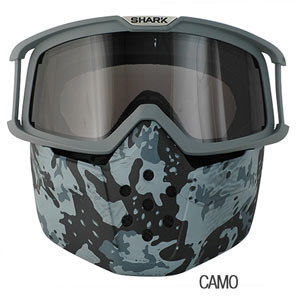
shark-drak-goggles and mask camo
There’s also a range of after-market customised masks and goggles available

The goggles are double glazed, anti-scratch and have an anti-fog coating on the rear too. The lenses are by Cark Zeiss and owners reckon they’re good quality. And it appears that the double-glazing, ventilation and anti-fog coating all conspire to make for goggles that don’t fog up. At least no-one in the reviews we found could get them to fog up – so if you know different, please comment below and tell us!

Of course, there’s quite a bit of goggle and frame there, and it does have some impact on peripheral vision. A few owners say they do find themselves doing lots more head movements to check their blind spots than in their full face helmets.

Comfort and Sizing

The inside of the Shark Drak is moisture wicking and hypoallergenic and it’s made of natural fibers. It’s also removable and washable and has a glasses groove in the lining so the stems of glasses shouldn’t dig in to your head.

The sizing can run a smidge small – though owners who bought one that was a tad on the small size did say it will wear-in, so as long as it’s not too small, you might be OK.

shark-drak-kurtz-green-crash-helmet-front-view
It looks especially cool in camo. The range is called Kurtz

If you’re looking to fit a bluetooth set, the Drak is Shark’s Sharktooth communicator-ready and there are speaker pockets in there so it may work for 3rd party bluetooths too, depending on which one you have.

Looks & Graphics

There’s no doubt the Drak/Raw is a striking helmet. And because it looks so menacing and cool is the number one reason most of us seem to buy one. You see it and just have to have it.

That’s helped by the stack of suitably moody, urban and militaristic graphics available. From the straight forward Blank range of plain blacks and whites through to the Tributes, 72s, Sanctus, Dogtags and Sououz – we’ve put a only a fraction of the designs and color options available up and down the page. So, as usual, if you want to see the very latest designs for the Shark Raw/Drak, then please click the links through to our recommended retailers. The links will drop you onto their Shark pages – though you might need to use their site search to quickly find the Raw/Draks.

Looking to buy a Shark Drak?

Please click below to visit the Shark Drak helmets pages at Amazon and our recommended store, Revzilla. And if you buy from either, we get a small sum from the sale at no extra cost to you – a massive THANKS! (it’s how we finance the site).

Shop for helmets at Amazon

Shark Drak/Raw Video

First off, a 7 minute look over the Raw, then a 2 minute unboxing video…

Overall/Summary

shark-drak-72-mat-black-orange-crash-helmet-rear-view
Rear of the Drak 72

If you’re interested in a Shark Drak/Raw, then you’re going to be wanting one because of its looks. Pretty much all of us who want one (me included) like it because it’ll make us look mean and scary on the bike.

And while it’s not the best made helmet on the market, at this price it’s really not bad either. Those Carl Zeiss non-fog goggles; a mask that keeps off the worst of what the outside wants to throw at you; and even the thermoplastic helmet should give a decent amount of protection – as long as you don’t scrape your face! That facemask isn’t going to offer any protection so don’t fool yourself it will.

But if you can live with that and only intend to use it for low-speed urban cruising – and understand the limits of open helmets – then the Shark Drak/Raw is rated highly by owners and is surprisingly easy to live with.

Looking to buy a Shark Drak?

Please click below to visit the Shark Drak helmets pages at Amazon and our recommended store, Revzilla. And if you buy from either, we get a small sum from the sale at no extra cost to you – a massive THANKS! (it’s how we finance the site).

Shop for helmets at Amazon

Star Ratings

X-Lite X-661 Motorcycle helmet review

x-lite-x-661-disc-featured

The X-661, X-Lite’s entry-level touring motorcycle helmet

The X-Lite X-661 is X-lite’s entry-level touring full face helmet.

Note: the X-Lite X-661 is now discontiuned in the US. Please check out our Top 10 Full Face Helmets page for some great alternatives.

That means it’s designed to work best in a more upright riding position and should be suitable for long distances in all conditions – as well as working well with your bluetooth. Nolan’s also said it’s made to be simple and versatile to use – so don’t expect too many bells and whistles or advanced features to come with the X-661.

With that in mind, here’s a ton of information about the X-Lite X-661 including what owners think of theirs, all to help you decide if it’s worth adding one to your shortlist of helmets when you’re in the market for a new helmet.

x-lite-x-661-slipstream-flat-black-red-front-view
X-661 in Slipstream graphics

Safety

(more about helmet safety)

The X-Lite X-661 has been tested by the helmet testing labs at SHARP and scored an impressive 4 stars (out of 5). Which means it should give you excellent protection if you have an off. Read how SHARP tests its helmets here.

It’s got a composite fiber shell, which should mean it’s reasonably light yet strong – and indeed it is a smidge lighter than your typical full face helmet, weighing in at around 3.2lbs (1.4Kg).

It’s secured to your head using an old-style double-d ring fastener. They’re not as simple to use as a micrometric fastener until you get used to them, but they’re safe as houses and if done up correctly, should keep the helmet secure on your head whatever happens on the road.

The X-Lite X-661 also has a drop down sun visor and the visor itself is Pinlock-ready and comes with a Pinlock insert in the box – which is great because it’s one of the best ways to keep your shield mist-free and your vision clear.

That composite helmet shell is manufactured in three different shell sizes too. That’s great for both fitment and for safety (click the link to find out more).

All in all, while it’s not the absolute best in terms of safety (go for a SHARP 5 star helmet if you want to be sure of that) the X-Lite X-661 has a stack of features that mean it’ll should give you great protection on the road – all backed by the comfort of knowing you’re wearing a helmet that’s done well in the SHARP helmet test.

x-lite-x-661-honeycomb-black-yellow-motorbike-helmet-rear-view
rear view of the X-Lite X-661 Honeycomb showing rear spoiler and exhaust vents

Helmet Noise

(more about helmet noise)

Making a motorcycle helmet that’s quiet seems to be a bit of a black art – read the link above to find out why.

Stuff like quality aero, well designed vents and comfort liner all contribute to making a helmet that’s quiet.

All of which are something the X-Lite seemingly does well, because all the reviewers we came across said the X-Lite X-661 is a pretty quiet helmet.

The X-661 has a single chin vent in the chin bar and two separate vents up on top of the helmet. They’re all closeable with sliders/switches and reportedly easy to use in gloves.

At the back of the helmet, there’s a small spoiler with exhaust vents underneath to extract air out of the back of the helmet.

It’s a reasonably standard configuration of vents that you’ll find on most helmets these days and it works pretty well by all accounts.

Shield

x-lite-x-661-start-n-com-matt-black-side-view
Matt black X-661 Start showing wide, Pinlock main shield and sun visor

The shield on the X-661 is what X-Lite calls its dual-action shield.

This simply means that rather than the shield just moving up and down, the closing mechanism pulls the shield back towards the shield seal at the same time, making a tight seal at the gasket and stopping water/air ingress.

It’s also a quick-release shield and is wider than the average shield to help improve peripheral vision. That quick release system is reportedly one of the best – just open the shield, press the button in the centre of the pivot and out pops the shield. A quick release shield is a must on a helmet these days to let you whip it off quickly for cleaning or swapping out.

And to keep it from misting, X-Lite has also made it Pinlock anti-fog ready and include a Pinlock insert in the box. That’s $20-$30’s worth of Pinlock free in the box which is great and something I look for in any helmet I buy these days.

The X-661 also has a drop down internal sun visor – operated from a slider on the left hand side of the helmet. It’s a friction-based system which means you can lower the sun visor to any point you like – not just fully up or fully down like some systems. Nolan claim it’s UV400 too (that’s the best UV protection standard) and it’s also scratch/fog resistant.

Comfort & Sizing

x-lite-x-661-crash-helmet-underneath-inside-view
Inside view of the X-661 showing neck roll and chin curtain

The X-Lite X-661 is available in fitment sizes XXS – XXL with the three different helmet shell sizes covering XXS-S, M-L, then XL-XXL. That should give you just the right size helmet and correct proportion of padding to make the helmet fit right, look right and work right. Word is that the sizing of the X-661 is about right, so follow our helmet fitting guide then order the correct size.

Inside, there’s a removable/washable interior with removable pockets in the polystyrene lining for bluetooth speakers.

Like most X-Lite helmets, comfort is supposed to be excellent with lots of owners saying it’s fine to do a full day’s tour wearing an X-661 (obviously providing you get the right fit in the first place).

Looks & Graphics

There’s a range of graphics available for the X-Lite X-661.

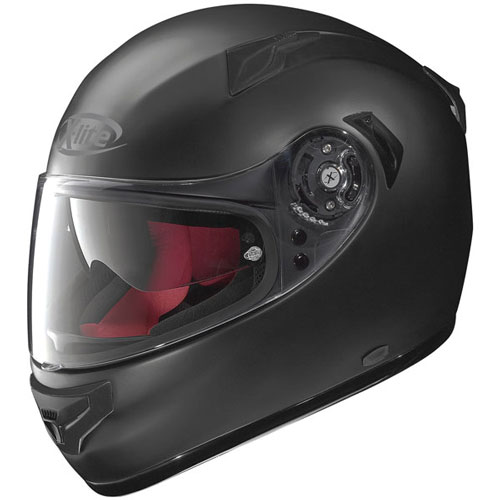
Apart from the usual plain solid designs which X-Lite calls its Start range that comes in gloss black or metal white (white gloss) or Flat black (matt black version) there’s a super cool weave/titanium version called the Extreme Titantech (see top image and below). That’s the usual composite helmet with a layer of carbon fiber which has then been treated to a titanium coat to make what I’m sure you’ll agree is a pretty eye-catching helmet.

If you like that titanium effect, there’s four options of the Titantech to choose from.

x-lite-x-661-titantech-extreme-helmet-rear-view
Rear view of the stunning Titantech X-661

Other than that, there’s the Slipstream (in blue, grey, red or green) the Honeycomb (in white, pink or or yellow).

And as always, makers are always bringing out new designs so to check them out and to see their latest X-Lite deals, please click through the links below to our recommended retailers (the links will take you to their X-Lite helmets pages). Nice one.

X-Lite X-661 helmet video

Here’s a quick look around the X-661 with MotoGP rider Danilo Petrucci.

Other stuff – audio, build quality, warranty

All X-661s are X-Lite N-Com bluetooth communicator ready (you’ll notice when you’re looking at X-Lite helmets in stores that they’re sometimes called N-Com which simply denotes that they’re N-Com system-ready). That means there’s space to take all the N-Com gear – speakers, mic and electronics – and fit it neatly onto the helmet. Having said that, the helmet also works pretty well with 3rd party communicators with owners of a Sena SMH10 and a Sena 20S both saying it fitted just fine.

Build quality of the X-661 is reported to be very good and the helmet comes with a full 5 years warranty (which is about as good as they come at the moment).

x-lite-x-661-honeycomb-black-white-helmet
This one’s the Honeycomb X-661 in black and white

Overall/Summary

X-Lite bill the X-661 as their entry-level touring helmet. That means you shouldn’t expect too many of the latest bells and whistles if you buy one. But what it does manage to do is cover all the essentials very well.

The shield system has everything you’ll need; including a Pinlock, a quick-release mechanism – and it’s nice and wide which is great for improved peripheral vision. There’s also a drop down sun visor (that’s a must for many of us these days) – the ventilation’s good and the internals are comfy. It’s even regarded as pretty quiet and has a very good SHARP 4 star safety rating (it’s made by X-Lite (part of the Nolan Group) who are our 3rd safest helmet brand at the time of writing so it’s kinda what we’d expect).

So, if you ride a more upright sort of bike (it’ll work with anything bar sportsbikes really as the shield opening won’t be tall enough) then the X-Lite X-661 is well trying out.

[xyz-ihs snippet=”Link-to-guides-page”]

Good Alternatives to the X-Lite X-661?

First off, take a look at the excellent HJC FG-ST. That’s a SHARP 5 star safety rated fiberglass full face lid with sun visor and Pinlock in the box, just like the X-Lite. It’s cheaper than the X-661 too.

If you’re on a (very) tight budget, then the LS2 Rookie is an amazing buy – a SHARP 4 star safety rated thermoplastic-shelled full face helmet with an optically-correct shield, all for less than a quarter of the X-Lite’s price.

Back towards the same price point as the X-661 is the AGV K5S – that’s a 4 star safety rated helmet made from a carbon/fiberglass composite, with a drop down sun visor. It’s loved for its great ventilation and comfort.

Finally, there’s another HJC – the good ole HJC IS-17. It might have been around a while but it’s a lovely SHARP 5 star rated polycarbonate helmet with Pinlock included that owners say packs a real punch in terms of features – all for much less than the X-661.

[xyz-ihs snippet=”Xlite-Cat-link”]

[xyz-ihs snippet=”Alternatives—full-face-helmets”]

Star Ratings

All about modular/flip-up helmet chin guards

You buy a modular helmet and you probably like the convenience of an open face helmet when you want it – but with the option of turning it into a full face when you need it.

Best of both worlds, right?

So, what do you need to look out for when you’re in the market for a new modular helmet – and do their chin guards give you the same levels of protection as a full face?

Here’s what you need to consider when you’re buying a modular helmet.

Designed for protection?

The chin guards on most modular helmets are designed to give protection – but not all. And while most modulars are designed to give protection with the chin guard down, some aren’t designed to give protection in open face mode.

When that’s the case, we’ll always mention it in our reviews. We’ll also mention when a helmet’s dual homologated. That’s a European thing mostly, but when a helmet’s been designed to give protection both when it’s in open-face mode as well as full face, it’s called dual-homologated.

Here’s more information on dual-homologated helmets.

And here’s our reviews of dual-homologated modular helmets.

Is it a real modular?

It’s worth quickly mentioning that some helmets that look like modulars, actually aren’t. They’re usually the streetfighter type helmets like the Shark Drak which are really open face helmets with a bit of a face cover to look mean and keep flies/road dirt off you – but they won’t give protection in an accident. So, if you want decent protection, you should probably avoid these helmets.

Half-up or up-and-over?

Some modular helmets let you flip the chin guard up to about forehead height. Others are designed so the chin guard goes right around to the back of the helmet, nicely out of the way. Modulars from Roof and Shark tend to do this and work better in open-face mode.

Will the chin guard stay locked and closed?

All modular helmets are designed to have chin guards that lock closed (see below). However, the locking methods makers use are different – some use a single button action while others need two buttons to be pressed to unlock the guard. Also, some use plastic mechanisms and others, metal.

So how do we know which to trust?

Short of throwing your modular helmet up the road then having a look to see if your helmet’s in one piece, it’s undoubtedly tricky.

Or at least, it was.

Thankfully, when the dudes at SHARP test modular helmets, they jot down if the chin guard on the helmet has stayed locked. They then translate that into a percentage and publish it for us to see.

So whenever we review a flip-front helmet that’s been tested by SHARP, we’ll always let you know how well its chin guard did (and therefore what chance it has to protect you in a accident).

Which are the best modulars?

It’s easy. You can find our top ten best modular helmets list here. Or you can view all our modular helmet reviews here. Or you can even visit our Smart Filters page and choose things like ‘Safest helmets’ and ‘Flip-up/Modular’ to find the safest modulars.

All about motorcycle helmet ventilation…

all about motorcycle helmet ventilation

(…or how to find a helmet that vents well)

Why do you need good helmet ventilation?

First off, a crash helmet with great ventilation keeps your head cool in the summer or if you’re riding for long hours. No shit, Sherlock.

But that’s not all. It also slows down how quickly your helmet lining gets stinky (meaning you don’t have to wash it that often). And, of course, ventilation to the front of the helmet helps keep your shield fog-free and reduces misting – though if you live somewhere cold/rainy/humid, we advise you to stick a Pinlock on your shield too.

Of course, most helmets have sliders over the vent holes so you can open or close them at will – buy a helmet with good venting and you’re not committing yourself to spending the winter months with icicles hanging from your ears!

So, how do you find a helmet with great ventilation?

Well, to be honest, it’s not easy.

As we’ve discovered in our helmet reviews, some helmets that have a zillion vents on them get slammed by owners for crappy ventilation. Others only have one or two small vents but owners say they’re great.

Most helmets employ a similar system these days. They have one or more vent holes on the front or top of the helmet crown which allows air to pass through the helmet shell into the helmet. From there, air’s usually directed through channels in the polystyrene shock absorbing liner and onto the head. Of course, helmets have a fabric comfort liner inside, but these are usually perforated to allow air to circulate directly onto the head.

From there, most helmets have an exhaust vent or two on the back of the helmet to allow the stale warmer air out of the helmet – or so the theory goes: though we’ve actually seen one or two helmets without any obvious exhaust vents that get highly rated for ventilation by owners.

Helmets usually have a vent or two on the chin bar too. These route air onto the back of the shield to help stop the shield misting up – and sometimes route air to the chin for extra ventilation around the jaw.

So, given most helmets have a similar venting system, how do you find a good venting helmet?

Well, that’s why we review helmets and put all the helmets that owners say vent really well onto one page.

– You can find all our helmets with great ventilation here – 

How to buy the safest motorcycle crash helmet you can…

helmet-safety-featured
all you need to know about motorcycle helmet safety

(…and other stuff to think about when buying a helmet)


At Billy’s Crash Helmets, we’ve made it our business to find out as much as we can about motorcycle helmet safety so we can offer as much advice to you when you’re looking for that new helmet. We’re not saying we’re the last word, but in the world of protective gear, we’ve picked our way through as many tests/papers/studies as we can so we can help you get the best.

So, if you’re after buying a helmet that’ll give you maximum protection, here’s what we advise you to do.

Buy a full face helmet

Full face helmets offer the best protection. End of. So if you want maximum protection, buy a full face.

They cover all the head – including the chin and face – so not only give you weather protection but protection to all the head in an accident.

See all our full face helmet reviews here.

Why not a modular or open face?

Modular helmets feature removable chin guards – and because they’re removable, they’re always a potential weak point.

At the time of writing, Snell hasn’t certified a single modular helmet – though they say they’re not averse to testing flip-up helmets so maybe we’ll see some Snell modulars in the not too distant future.

Some flip-up helmets have been tested by SHARP in the UK (see below) and given maximum marks for safety. But even so, there’s still always potential for their chin bars to unlock and open in an accident.

Indeed of all the modular helmets that have been SHARP 5 star rated (the maximum score) only one has ever managed to keep their chin guards closed and locked through all tests. And that helmet (the BMW System 5) is now discontinued.

See all our modular helmet reviews here.

Buy a Snell Certified or SHARP five star helmet

The Snell Foundation tests US helmets to a demanding level – though with Snell, manufacturers have to submit and pay for Snell testing, which isn’t ideal. Snell covers only DOT certified helmets.

In the UK, Government testing agency SHARP (short for Safety Helmet Assessment and Rating Program) is an independent testing organization whose testing regime is directly drawn from the most comprehensive real-world study on helmet safety. Helmet makers don’t have a say whether their helmets are tested nor do they provide the helmets – they buy ECE helmets straight from the distributor.

SHARP helmets are graded 1-5 stars, with 5 stars being their maximum safety rating.

Snell helmets either pass or fail – Snell certified helmets come with a Snell sticker.

So if you want a helmet you can rely on, it’s best to go for one of these helmets.

Here’s a link to all our Snell approved helmet reviews.

Here’s a link to all our five star helmet reviews.

Buy a helmet that’s DOT or ECE certified

If you wear your helmet in mandatory helmet law states, they must be DOT certified to be legal – so always make sure your helmet carries the relevant DOT approval sticker on the back.

In the UK or Europe (and some other places like Oz), any helmet on sale should be the equivalent which is ECE 22.05 approved.

With DOT, manufacturers have to certify that their helmets are compliant to the standard and random helmet testing takes place to uphold the standard. Whereas all ECE helmets all have to go through mandatory and independent testing before getting approved, at which point they can then go on sale.

Either way, ensure your helmet has the appropriate (and genuine!) DOT sticker on it so you know it’ll meet at least minimum safety standards.

Buy a helmet with other safety features

There’s always new features being added to helmets which all help with safety. Here’s a few to look out for…

EQRS

Stands for Emergency Quick Release System – basically a helmet with a couple of tabs at the bottom that paramedics can pull to extract the cheek pads safely and without disturbing your neck after an accident. Get a helmet with these if you can – esp if you take your bike on the track or dirt.

Here’s all our helmet reviews of helmets with EQRS.

Wide shield

Quite a few helmets are designed with really wide faceshields to give you better peripheral vision, so you don’t get caught out with cyclists and the like sneaking up on you.

Here’s all our reviews of helmets with wide shields.

Pinlock antifog

Stands to reason you need a nice clear shield to keep your vision clear. But things like rain, cold or humid weather can cause your shield to fog up. Stick in a Pinlock anti-fog (preferably a Max Vision that covers all the shield) and your vision will stay clear in all but the most extreme circumstances.

Here’s all our reviews of helmets that are Pinlock ready or come with Pinlocks in the box.

Sun visor

Riding into a low sun can be really dangerous, so a helmet with an integral sun visor is always there to flip down and give you some protection.

Here’s all our reviews of helmets with sun visors.

Buy a helmet that covers some or all these features and you’ll be well protected when you ride your bike.

At the time of writing, no single helmet ticks all these boxes – but talking of ticking boxes, use our Smart Filters to identify two or three features that you really want from your next helmet and quickly zoom in on the best helmets for you.

All about motorcycle crash helmet noise: and quiet helmets

motorcycle helmet noise guide

All about Helmet Noise

Most of us probably want to wear a quiet helmet, but finding one isn’t that easy (which is actually one of the reasons I set up this website in the first place!).

You can try and go on what the manufacturers say – but that often turns out to be BS.

You can look at the helmet specs – stuff like nice and thick comfort liners and smooth aero design. But again, that’s often misleading.

Ultimately, you can visit our quietest helmet review pages – and probably buy some of our best buy ear plugs to wear with it.

But read on for how we rate our helmets for quietness, and other things to consider when you’re looking to buy a quiet motorcycle helmet.

So how do you find a nice quiet helmet?

You’d probably think that the best way of finding out which helmets are quiet and which are noisy would be to ask owners. Which is entirely right and exactly what we do at Billy’s Crash Helmets of course – because we take as many people’s views as possible and, where we can, work out which are the noisy and which are the quiet helmets.

The only problem with that is it’s amazing how many people find the same helmet massively different when it comes to assessing helmet noise.

All too often we find one person’s noisiest helmet in the whole world ever is the next person’s whisper-quiet dream helmet. Which, if you’re looking for a new, quiet helmet – doesn’t really help.

Why do opinions vary soooo much?

It’s complicated, but there’s a few reasons:

The motorcycle you ride

If you ride a Goldwing with a massive screen up front, you’re probably going to – broadly – find a helmet quieter than someone on a naked. Stands to reason; when there’s less wind blast on the helmet, then it’s going to create less noise for the rider.

Only, that’s not the entire story because some screens can do strange things to air flow; blasting air at different points of the helmet (if the rider’s taller or smaller) or even directing air towards the rear of the helmet through weird turbulence shenanegans.

Plus, some helmets are actually designed to work better in the wind flow (which the designers can simulate in the wind tunnel and therefore design-around) so they may well work better on a naked than a fully faired touring bike.

Told you it’s complicated…

The position you ride

If you ride upright or tucked in, then different helmets will react differently to the windflow. And some are designed for use on sportsbikes so have better aero when in a racing tuck. Conversely, street helmets are more geared towards a more upright riding position so their aero is designed to work better with the chin-up rather than head-down.

Ride your naked street bike with a sportsbike helmet and it’ll attack the air at a different angle than it was designed for, create more turbulence, and probably end up noisier as a result.

Your hearing

Obv one this so doesn’t need much explaining.

Younger hearing = more sensitive hearing = noisier helmet. Older person’s hearing = less sensitive = quieter helmet.

So a young person saying it’s a noisy helmet might not equate to an older person feeling the same way about it.

The last helmet you owned

If the last helmet you owned happened to be massively well sound-insulated and you change to a new one that’s less so, you might well shout from the rooftops that you’d rather put your head in a tumble dryer than wear your new lid. When in actual fact, in the overall scheme of things, it’s a pretty quiet helmet.

But if you’re used to riding around ton-up in an open face helmet then stick on a pretty poor $10 helmet from Walmart, it might feel like the last word in serenity.

So opinions are ALWAYS colored by what you’ve worn before.

Expectations

How often have you gone to watch a film that your mate’s been banging on about for the last week at work – only to find it’s another Boys in Blue?

Well, if we hype up a helmet as being like wearing an isolation tank on your head, chances are you’ll be disappointed when you take your new helmet on its first ride. Matching – or beating – expectations, is often very tricky. So try and manage your own expectations.

Helmets operate in a pretty hostile and noisy environment, so if you’re expecting silence, that’s probably not realistic and you’ll be disappointed.

The helmet

Obviously, some helmets are better designed, sleeker, with better sound insulation and with less bits projecting up into the air flow and fewer vent holes to conduct sound into your lug holes than others.

Not all helmets are created equal.

And while some folks will still say they’d be better off riding with a paper bag on their heads for all the sound attenuation their helmet offers, we look for a helmets with a very high proportion of owners who comment that their helmet is nice and quiet before we award a helmet with a place on our Quietest Helmets Pages.

But if you’re just scouring websites looking for a new helmet, it’s not easy to spot this sort of helmet from just looking at it, because it’s usually not obvious from the specs or from the look of a helmet which are going to perform best.

There is one rule of thumb to follow if you’re after a quiet helmet – and that’s 90% of full face helmets are quieter than modulars

They just are – probably to do with the chin guard gubbins meaning less padding around the ears.

So, how do you work out the quietest helmets?

When we’re reviewing a helmet, we get as many owner’s opinions on the noise levels of a helmet as possible. And only where the vast majority are positive will we add it to our quietest helmets pages. If it’s a 50/50 split or mixed review, it’ll never make it in.

Which is not to say that if you bought that helmet, you’ll not find it acceptably quiet – for all the reasons listed above. But hopefully if you buy one of our quietest helmets, then you’ll stand the highest chance of getting a helmet that’ll work for you.

Oh, and of course, if a helmet is goddawful noisy, we’ll always put that in the review too.

Happy (quiet) biking 🙂

Scorpion Exo-GT3000 motorcycle helmet review

scorpion-exo-gt3000-featured
Scorpion Exo-GT3000 Sync

Scorpion’s top of the range modular helmet review- the Scorpion Exo-GT3000

The Scorpion Exo-GT3000 is Scorpion’s top-dog modular helmet, designed to be quiet, light and aerodynamically-stable and to offer all the bells and whistles we demand from our flip-up helmets.

You’ll find every bit of information we can find about the Exo-GT3000 below – including what owners and riders think of theirs, taken from comments and views expressed around the web.

Looking to buy a Scorpion Exo GT3000?

Please click below to visit the Scorpion Exo GT3000 helmets pages at our recommended stores – all checked for great online ratings. And if you buy from any store, we get a small sum from the sale at no extra cost to you – a massive THANKS! (it’s how we finance the site).

BTO SportsShop for helmets at Amazon

Safety

If you’re looking to buy a modular helmet, then you should be after a helmet shell that’s gonna offer decent protection as well as a chin guard that you can rely on.

Fortunately, SHARP tests both.

In the case of the Scorpion Exo-GT3000, SHARP has rated it a slightly above average three stars (out of a maximum 5). Also, during their comprehensive testing, the chin guard stayed locked and closed in 97% of tests – which, while not perfect, is pretty damn close and well above average.

Of course, it’s also certified DOT in the US (and ECE certified in Europe) meaning it’s also undergone the rigorous ECE testing all European helmets have to undergo before hitting the shelves (DOT certification only requires the helmet makers to say it meets the standard, although that’s backed up with some testing).

Make of all this information what you will – but we’d ideally suggest you opt for a four or five star rated helmet (click the link to find those).

Of course, impact protection isn’t the whole story. You want a helmet that’s going to do its best to keep you out of trouble in the first place.

Thankfully, it’s got a nice wide shield which is great for max peripheral vision and reducing stuff creeping up on you unnoticed. And while it goes without saying that having fog-free vision is important for safety – the GT3000’s visor is EverClear coated. That’s probably not as good as a Pinlock (which is one of the best ways for keeping things clear) but word is that it’s a pretty good coating and lasts for about a year.

Scorpion_exo-3000-tct-composite-shell-layers
Make up of the TCT composite shell found on the Exo-GT3000

The Scorpion’s also made in 3 helmet shell sizes (good for safety and fitment) and is well below average weight for a modular. That’s good for reducing impact pressure on the head and neck during an impact.

So, for safety, it’s swings and roundabouts with the Exo-GT3000. There’s lots of features that the Scorpion does well, but it just falls down a notch on the SHARP safety rating.

Helmet Noise

We all want a quiet helmet if we can. And so did Scorpion because they set out to make a helmet that’s aerodynamically sleek (to reduce wind noise) and has decent internal padding (to reduce wind noise) as well have inflatable bits inside (to reduce wind noise even more).

But did it work?

Unfortunately, nope.

While there’s a couple of dissenting voices out there saying it’s quieter than their last helmets (which doesn’t really help anyone I guess) the vast majority reckon the Scorpion Exo-GT3000 is really noisy. It seems to be particularly noisy on nakeds with one or two owners reporting a mind-frazzling whistling as well – possibly-maybe coming from the sun visor slider.

Of course, flip-front helmets aren’t known for their noise-attenuating capabilities, though you can check out our quietest helmets to find the ones that do (or choose modulars/quietest in our smart filters to quickly zoom in on the quietest modulars around).

But if you’re looking for a quiet modular lid – then you should probably bypass the Exo-GT3000. Though saying that, you should always wear the best ear plugs you can whenever you ride any distance, in which case the noise shouldn’t really bother you too much.

scorpion-exo-3000_air_serenity_matt_black_white-helmet-side-view
The Serenity graphics are available as white-on-black and black-on-black

Ventilation

In contrast, ventilation on the Exo-GT3000 is generally rated as outstanding.

That’s surprising given that the vents on the GT3000 look pretty standard, with a single chin vent and single forehead vent routing air through into helmet, with a small double exhaust vent on the back.

Not only do owners say – almost without exception – that the Exo-GT3000 vents very well, but they also say the switches are easy to use in gloves.

We’d say that’s job done.

Shield

The shield on the Scorpion Exo-GT3000 seems to tick all the right boxes – bar one.

It works on a ratchet, and has the opening tab to the bottom left – which, along with bottom centre, is probably the most convenient place. It’s also a quick-release shield, meaning you can whip it off easily to clean it. And quite a number of owners said the shield is nice and wide, giving a great field of vision. These are all VERY GOOD THINGS.

The shield on the European version of the helmet is Pinlock Max Vision ready. Unfortunately though, the US version isn’t, though it does come with an EverClear coating on both visors – which is apparently pretty good (you can find vendors of the European version of the helmet on our UK Scorpion Exo 3000 Air review – and benefit from the $-£ exchange rate).

And if you do want a Pinlock, visit our Pinlock helmets pages to find other helmets that are either Pinlock-ready or come with a Pinlock insert in the box.

Other than that, all’s well with the Scorpion’s shield.

Sun Visor

The Scorpion Exo-GT3000 has an integral drop-down sun visor, operated by a slider along the bottom left hand side of the helmet.

scorpion-exo-3000-air-gloss-white-chin-bar-up
Chin bar up, sun visor down on the gloss white Exo-GT3000

That position for the slider is a bit more difficult to achieve for the manufacturers but is a good position for riders when compared to some makers who put the slider on the top of the helmet.

The sun visor is UV400 (the highest rating) and EverClear anti-fog treated: and owners say it works well – coming down nice and low and covering most of your vision.

Chin Guard

Because the Scorpion Exo-GT3000 is a flip-up helmet, you might be forgiven thinking that the chin guard might be a bit of a weak link.

And you’d (often) be right.

Most of us buy a modular helmet because we like the idea/convenience of being able to use the helmet like an open face from time to time. But we also want the protection that a full face helmet offers. And while most modulars are designed to give full face style protection, not all manage it very well.

So, how do we tell which will?

Fortunately for us, SHARP measures how often the chin guard stays closed and locked during their helmet safety testing, giving us an idea of how trustworthy each chin guard is.

In the case of the Scorpion, the chin guard unlocked in just 3% of impacts. That equates to opening just once during all 32 impact tests. And while we’d all like it to stay closed and locked 100% of the time, 97% is actually a very respectable score.

All this safety business aside, owners reckon it’s very easy to open the polycarbonate chin guard (it’s not composite fiber like the rest of the helmet shell), and say it closes with a nice positive clunk – so you know it’s closed OK.

Comfort & Sizing

Like most of the Scorpion range, the Exo-GT3000 has some internal air bladders and a small rubber pump. Scorpion calls this its AirFit concept, but to us it’s just a rubber bulb you can squeeze to inflate air pockets in the cheek pads. So if you buy a GT3000 and you think it should fit your face a bit tighter, then you can inflate the cheek pads a bit to get it to fit just right.

And the Exo-GT3000 takes things a bit further than other Scorpion helmets because it has, for the first time, a neck air pocket – designed to tighten things up around the neck as well as keep the draft and noise out.

scorpion-exo-gt3000_matt-black_motorcycle-helmet-side-view-open
Matt black version of the Scorpion Exo-GT3000

Is it all any good?

Well, some owners reckon so, others not so much. I guess if you find things get a bit loose over time, then you might start to experiment. But we’d suggest if you do buy a new AirFit helmet, make sure the helmet is nice and tight without the AirFit inflated in the first place and don’t rely on the AirFit sorting things out. Then, as the helmet loosens over time, you can choose to use the air if needed.

Other than the AirFit, the Exo-GT3000 features Scorpion’s highly-rated Kwickwick3 liner – that’s a nice and soft moisture-wicking fabric that’s also hypoallergenic and machine washable.

Most owners say it’s really comfy with good padding. Though note, a few did say the GT 3000 sizes a bit small so while we recommend you follow our fitting guide and buy the correct size, it’s just possible you might find it a bit of a tight squeeze and have to return it for a size up.

Obviously, as long as you don’t strip the helmet of its tags and stickers – and buy from one of our recommended retailers – you’ll not have a problem with swapping sizes (and some of our recommended stores even cover the cost of the returns).

Looks & Graphics

Most of the Scorpion Exo-GT3000s are in the usual plain/solid colors – with gloss white/black, a matt black and silver (or hypersilver – wow!) being available. There’s also a single neon yellow hi-viz version and one graphic option called Serenity.

If they do release any other graphics, you’re best clicking through to our recommended retailers below to discover them and see any helmet offers that are going on.

Best places to buy a Scorpion Exo GT3000?

Please click below to visit the Scorpion Exo GT3000 helmets pages at our recommended stores – all checked for great online ratings. And if you buy from any store, we get a small sum from the sale at no extra cost to you – a massive THANKS! (it’s how we finance the site).

BTO SportsShop for helmets at Amazon

Scorpion Exo-GT3000 Video

Here’s an 11m video from Revzilla showing you around the Exo-GT3000.

Other stuff – fasteners, audio, weight, glasses, buffeting, build quality, warranty

The Exo-GT3000 comes with a traditional double-d ring fastener (the Eu version has a quick/convenient micrometric fastener).

It has speaker pockets so you can use it with your bluetooth; though there’s mixed reception as to how deep the pockets are. A couple of owners with Sena headsets said it works just fine while one owner with a UClear HBC said it was too tight for a comfortable fit.

Weight – or lack of it – is one thing owners love about the GT3000. And while it’s about average weight if you look at all full-size helmets, if you take modulars – which way an average of just under 3.75lbs (1.7Kgs) – the Scorpion Exo-GT3000 weighs in around 3.4lbs (1.55Kg) so is nice and light for a modular.

scorpion-exo-3000-air-anthracite-chin-bar-up
Classy anthracite version

It also has glasses grooves so should take the stems of your glasses without them pressing into the side of your head, and one owner said he could even put the helmet on without taking his glasses off first.

Build quality and finishing is said to be very good and the GT3000 – like all Scorpion helmets – is backed by an excellent 5 year warranty.

Overall/Summary

Apart from the noise, there’s very little that owners moan about – and there’s lots they love about the Scorpion GT 3000.

It’s a very competent modular with a great shield system, wonderful ventilation and it’s nice and light and comfy to wear all day. OK there’s no Pinlock included in the box – though at this price, you can arguably afford to buy one and still end up with a great helmet at a very good price.

It’s not as highly rated for safety as some, but if you’re after a light weight composite flip-up helmet that’s well built and backed by a 5 year warranty (that covers the expected lifetime of the helmet) then the top of their range Scorpion Exo-GT3000 is well worth your money.

[xyz-ihs snippet=”Link-to-guides-page”]

Good Alternatives to the Scorpion Exo-GT3000?

First up, there’s the SHARP 4 star rated Shark Evo One. That’s a dual homologated modular where the chin guard flips right to the back of the helmet so you can really use it as an open face. It comes with a Pinlock Max Vision insert in the box too. So too does the Shark Evoline 3, and that one’s SHARP 5 star safety rated. Both helmets have drop down sun visors too and can be had for about the same price as the Scorpion.

The AGV Compact is a great helmet. OK so it’s noisy too, but it’s cheaper than the Scorpion, has a sun visor and it’s SHARP 4 star safety rated.

Or how about the HJC IS Max II – that’s another 4 star safety rated modular that scores well in every area – though it’s about average for noise.

Looking to buy a Scorpion Exo GT3000?

Please click below to visit the Scorpion Exo GT3000 helmets pages at our recommended stores – all checked for great online ratings. And if you buy from any store, we get a small sum from the sale at no extra cost to you – a massive THANKS! (it’s how we finance the site).

BTO SportsShop for helmets at Amazon

[xyz-ihs snippet=”Scorpion-Cat-link”]

Star Ratings

Arai DT-X full face crash helmet review

Arai-DT-X-discontinued-featured

Arai DT-X: Arai’s mid-level all-rounder motorcycle helmet.

Note: The DT-X is now discontinued, so you might want to check out some of our Top 10 Helmets lists to find your next helmet instead?

top-10-full-face-motorcycle-helmetstop-10-flipup-modular-helmetssportsbike-and-track-motorcycle-helmets-top-10top-10-safest-motorcycle-helmetstop-10-budget-motorcycle-helmetsall-helmet-types-top-10safest-motorcycle-helmet-brands-top-10

Arai’s DT-X motorcycle helmet is designed to offer a more entry-level helmet that’ll work on a range of sports-touring motorcycles and is suitable for everyone from commuters to tourers.

It’s a key helmet for Arai as it’s a (relatively) cheap way into Arai ownership yet it offers many features found in their more expensive helmets.

On the surface, it’s unmistakably Arai. But have they cut corners with the DT-X?

arai_chaser-x_edwards_legend_yellow-helmet-side-view
The DT-X Colin Edwards Legend race replica

Safety

It’s fair to say that Arai has applied all their latest construction and design expertise to the DT-X to make it as safe a helmet as they know how.

As with all Arai helmets, it uses what Arai call ‘super fibers’ in the construction of the shell which are essentially high-grade glass fibers set into their latest resin mix – termed ‘Z Mixture’ by Arai (sounds like Dr. Nefario works at Arai!?).

They also focus on making the helmet particularly strong in a ring around the helmet to help it better absorb impacts – imagine a pudding basin helmet around your head going above the ears and above the brow, and that pretty much covers where this strengthened ring goes.

And like all Arai’s, the DT-X is designed to be externally as round as possible to help with aerodynamics and ‘glance off’ – the idea that a rounder helmet is less likely to dig-in and rotate during an accident, causing further head and neck injuries.

And once all that’s done, they produce the DT-X in three shell sizes so you should get just about the right amount of helmet shell and padding for your head size.

That’s all fine and dandy. But does it all work?

The answer is a resounding… yup.

In recent times, when independently tested by SHARP, their cheaper helmets (a relative term!) haven’t scored so well. However, over the last couple of years, they’ve done much better with their last four helmets scoring an average of 4.5 out of 5 stars.

So it was no surprise that the European version of the DT-X (called the Chaser-X over there) – which shares the same helmet shape and construction with the latest crop of helmets – scored a very respectable four stars (out of five) when tested by SHARP in the UK.

And as well as being both DOT and ECE (European) certified, the DT-X it’s also Snell M2015 tested/approved too.

All of which means you should be putting your head in a very safe place if you decide to buy an Arai DT-X. Just make sure you get the fitting bang on because that’s the number one way to ensure you’re getting the best out of your head protection, whatever the helmet.

Helmet Noise

Arai’s designed the DT-X to be relatively quiet, with its rounder helmet form and an aerodynamically designed chin curtain, made to keep noise ingress to a minimum.

It seems to work reasonably well too. One owner said opening the chin vent can create a bit of noise, but most owners seem to think it’s quieter than average helmet.

Ventilation

arai-chaser-x-diamond-white-rear-view
The DT-X Diamond White showing the large rear inlet/exhaust vent

The DT-X has masses of inlet and exhaust vents.

The chin vent is two-position allowing you to direct air around the chin area or onto the back of the shield to help with demisting.

And as usual – and uniquely with Arai helmets – there’s a couple of brow vents to take air around the temple area.

Both the crown and rear vent are new to the DT-X though in that both act as inlet and exhaust vents – even when the inlet vent is closed.

They channel air through the EPS liner and, unlike most systems that use a network of channels in the EPS lining to circulate air, the DT-X pushes the air out through holes in the lining leaving it to circulate round via the channels in the removable comfort lining instead.

Once it’s done its job, the air exits the helmet via any one of five exhaust vents.

The word from owners is that the vents are easy to find in gloves and that ventilation is effective.

Shield

Like most Arais, the DT-X uses Arai’s VAS or variable axis system shield. Essentially, that means rather than pivoting at one point, the shield pivot point moves as the shield is opened or closed. They did this mainly to allow them to lower the shield mechanism so it doesn’t interfere with the peripheral belting system used to construct the helmet, so isn’t really any benefit for the shield mechanism itself.

As usual for Arai helmets, the DT-X has removable side panels covering the shield pivots and quick release system. That quick release is a bit more fiddly than many systems but, according to owners, it’s something you’ll get the hang of pretty quickly.

arai_chaser-x-finish-red-crash-helmet-side-view
DT-X in Finish graphics

To remove the shield, you open up the shield and there’s a couple of small levers in front of the side panels. Push those back and the panels pop off – don’t worry, they’re tethered to the helmet so you don’t lose them. You then push down on the shield and it pops out of each side.

Unlike many shields that are just a shaped piece of polycarbonate, the DT-X shield itself is a complex thing.

First off, it’s Pinlock Max Vision ready and comes with a Max Vision insert in the box. That’s got your antifog sorted.

It’s also got those two-position brow vents actually as part of the shield. They mate up with the brow vent channels above the shield aperture to take air into the temples.

And it’s a nice wide shield too with some owners saying it’s the widest shield aperture they’ve come across.

And finally, there’s the latest incarnation of Arai’s shield lock to the bottom left – close the shield with a push and it’ll auto-lock; push the lever up and it’ll unlock and open the shield.

Again, quite a few owners commented that the lock takes time to get the hang of, but after a while and a bit of practice, it works OK.

Comfort & Sizing

The fitment of the DT-X is medium-oval which means it should suit most people. Arai’s have traditionally been long and thin so this medium oval shape should mean it fits more riders.

arai_helmet_chaser-x-tough-yellow-crash-helmet-side-view
The DT-X Tough range are available in hi viz yellow (above) white, red and blue

It’s made in three shell sizes and fitment sizes XS-XXL.

The lining is removable and washable and made from antimicrobial and moisture wicking materials.

But it’s the ability to tailor the fit that really grabs your attention.

Obviously, having a comfortable helmet is important. No one likes to ride for hours with a seam digging in or a pressure point giving you a headache. But it’s also important for safety – a well fitting helmet that’s reasonably tight but without pressure points is also a helmet that’ll work well during an accident.

So Arai has made the padding in their latest helmets very customizable indeed. If you buy a DT-X but find it’s a little tight in some areas, there are 5mm ‘peel away’ panels you can remove in the cheek pads and around the temples to help create the best fit for your head. And if that doesn’t quite do it for you, then you can buy replacement cheek pads in a range of thicknesses so you can get the fit just right.

And, according to loads of owners, the whole system works a treat. It feels plush and soft and, providing you’ve got the right head shape (and get the right fit), it should be all-day comfortable.

That includes for riders with glasses. The DT-X has a glasses groove in the lining and it works very well, making it easy to put your glasses on while you’re wearing the helmet and riding without pressure points.

The helmet isn’t the lightest helmet around – in fact it’s above average weight for a full face helmet (and about 3-4oz heavier than a typical fiberglass helmet) – but none of the owners we saw comments from complained that it feels heavy while a couple said it feels light – so I guess it’s all relative!

Looks & Graphics

Arai helmets are often fairly muted in their design options, but the DT-X is slightly different, available in a large range of solid and graphic designs as well as race reps.

arai_helmet_chaser-x-shaped-blue-red-helmet-rear-view
Arai DT-X in Shaped graphics

As per most Arai crash helmets, there’s a diamond (gloss) white and black and a frost (matt) black. There’s also their Shaped, Tough, Competition and Finish graphics which are more conventional Arai designs as well as the swirly Style graphics in either black or pink.

As for the race replicas, there’s a nice pair of Colin Edwards designs and a classic Schwantz 95 design.

To find even more designs as they come out – and the latest deals – please click through to our recommended retailers where you’ll find the latest helmets from retailers who’ll really look after you.

Arai DT-X Video

First off, a 4m video from the official Arai channel introducing you to the DT-X (called the Chaser-X in Europe), followed by a 3m test ride video from Rider’s Domain (now rebranded to Rocky Mountain ATV/MC) giving you a look round its features.

Other stuff – fasteners, audio, weight, warranty, build quality

The DT-X is secured with a double-d ring fastener.

There’s speaker pockets inside the lining and space on the side for the control unit, so it should work with most universal-fit bluetooth communicators.

arai_chaser-x-competition-black-motorcycle-helmet-side-view
DT-X Competition in black/white

It weighs a little above the average weight of a full face helmet at around 3.6lbs (or 1.6kg) and it comes with a lengthy 5 year warranty. However, given most Arai’s have legendary build quality, hopefully you’ll never need it.

Overall/Summary

Looking at the checklist of features the DT-X shares with its (even more) expensive stablemates, there’s very little indeed been left out with the DT-X.

OK, an Arai is probably never going to be the best value helmet in the world; a hand made helmet never will be. But with Arai, you’re paying for exclusivity and build quality as well as a helmet where no expense has been spared.

So, it’s expensive – but the DT-X really delivers as a helmet. It’s both DOT certified and Snell/SHARP 4 star safety rated, meaning it should give you excellent protection when it matters.

And as a helmet to live with, it offers excellent levels of comfort and great ventilation. And that shield – once you’ve got the hang of the lock and quick release – gives lots of vision along with a Pinlock anti-fog in the box. Plus it’s even quieter than the average helmet.

All in all, if you’re looking for a more exclusive all-rounder helmet, then the DT-X really delivers and is well worth checking out.

[xyz-ihs snippet=”Link-to-guides-page”]

arai_chaser-x-frost-black-motorcycle-helmet-rear-view
Ever popular Frost black version of the DT-X

Good Alternatives to the Arai DT-X?

There’s plenty of alternatives to the DT-X because it’s a quality all-rounder helmet. Unless of course you’re only after an Arai in which case take a look at the Arai Axces III which is a tad cheaper still than the DT-X but more suited to longer, narrower heads. You can check out all our Arai helmet reviews here.

First off, there’s the SHARP 5 star HJC FG-ST; that’s a lot cheaper than the Arai, has a sun shield, Pinlock Max Vision included and is an all-round great helmet.

You should also check out the AGV K5S – a cracker of a helmet that’s SHARP 4 star safety rated, has a sun shield and again is loads cheaper than the DT-X.

Or if you want to look at a helmet from another of the big boys, how about the Shoei NXR? SHARP 4 star safety rated, low noise and with great ventilation, it’s a lovely helmet with a five year warranty.

[xyz-ihs snippet=”Arai-Cat-link”]