BillysGear link
Home Blog Page 18

HJC RPHA 70 full face motorcycle crash helmet review

HJC-RPHA-70-ST-Featured

HJC RPHA 70 ST: Style, safety and comfort- does the RPHA 70 ST have it all?

South Korean helmet maker, HJC, has been producing motorcycle helmets for about 45 years now, and are known for providing decent quality, affordable crash helmets.

So, for their latest helmet, the HJC RPHA 70 ST, to be selling for around the $450 mark, we’re expecting something pretty special. Not only is it their joint most expensive helmet (OK their range-topping RPHA 11 Carbon costs a bit more, but the 70’s the same price as the standard composite RPHA 11), so it’s properly treading on the toes of the big boys – the Arais, Shoeis and Schuberths of this world. And to do that, it needs to pack a real punch.

Note, in Europe the RPHA 70 ST drops the ST (Sports Touring) and is sold as the plain RPHA 70, though it’s the same helmet.

So what does the RPHA 70 ST offer?

We’ll, it’s a full faced helmet aimed at the sports-touring market – which really means anyone this side of track racer – though it should be more than happy on the track too.

hjc-rpha-70-motorcycle-crash-helmet-semi-flat-black-front-view
RPHA 70 ST ‘Semi Flat’ matt black

But there’s quite a few innovations that HJC reckon they’ve thrown at the RPHA 70 ST – more than pretty well any new crash helmet launch we can remember. So, if you’re sitting comfortably, here’s the main features of the new HJC RPHA 70 ST full face.

  • Composite-fiber shell (carbon, aramid & fiberglass)
  • SHARP 3 Star rated (Eu version)
  • Full carbon version also available
  • Drop down sun visor
  • EQRS (emergency quick release)
  • Double-D ring fastener
  • HJC anti-fog insert included
  • Wicking, anti-bac interior
  • Glasses groove
  • Sizes XXS-XXL
  • 5 year warranty
  • Expect to pay:
    • $400-$420 composite
    • $580-$630 carbon

Looking to buy an HJC RPHA70 ST?

Please click below to visit the HJC RPHA70 ST helmets pages at our recommended stores – all checked for great online ratings. And if you buy from any store, we get a small sum from the sale at no extra cost to you – a massive THANKS! (it’s how we finance the site).

BTO SportsShop for helmets at Amazon

Safety

There’s a full carbon fiber version of the RPHA available. But most of the RPHA 70 ST range are made from what HJC call their Premium Integrated Matrix plus or PIM for short. That’s a complex 6 layer composite laminate, including layers of carbon, glass fiber and aramid (kevlar) designed to offer good impact resistance while being light weight.

Of course, impact resistance is only one half of the equation when it comes to an effective crash helmet (with energy absorption being the other half) and if you look at the SHARP safety tests covering HJCs you can see they’ve a mixed bag of results.

Their average score across all tested HJC helmets is just over 3 out of 5. And while the composite-shelled FG-ST scored a maximum five, their top of the range RPHA 11 only managed a modest 3/5.

hjc-rpha-70-motorcycle-crash-helmet-grandal-rear-view
Rear view of the RPHA 70 ST Grandal showing red EQRS tabs.

Similarly, the European version of the RPHA 70 ST (just called the RPHA 70) was SHARP tested and given a 3 star safety rating; which isn’t the best. However, it’s worth remembering that the most important thing with any helmet is to get one that fits right – a SHARP one star helmet that fits perfectly will protect you better than a five star helmet that’s a poor fit. Check our fitting guide here.

Moving on from helmet shell and shock absorption performance, the RPHA 70 ST does have some other useful safety features.

Foremost among these are the emergency quick removal cheek pads (EQRS) – designed to help removing the helmet by emergency staff.

There’s also good ole double-d ring fasteners – it might be an old style way to fasten a helmet but they’re safe as houses and a must if you want to take your helmet on the track.

The RPHA 70 will also come with both an anti-fog insert (though it’s not a Pinlock) and anti-fog coated drop down sun visor.

Of course, having an integral sun visor can be very useful. And having it anti-fog coated should be really useful too, though we’ll have to wait and see if the coating’s actually any good: it’s one thing saying it’s anti-fog coated but entirely another whether it works well or not!

hjc-rpha-70-motorcycle-crash-helmet-octar-red-black-side-view
Another cool design – this time it’s the Octar in red & black

Obviously, it’d be great to see a top SHARP test result so we know it’s gonna protect your noggin.

Helmet Noise

It’s rare that we come across a particularly quiet helmet. Usually, one person’s quiet helmet is another’s noisiest helmet they’ve ever used!

But the word on the RPHA 70 ST seems to be pretty unanimous. This is one helluva quiet helmet. it sounds like HJC has worked some kind of alchemy with the aero and padding because not only is it reportedly one of the quietest helmets around, but that noise doesn’t seem to increase even when the vents are open.

Now, we don’t want to over-promise here and you should still expect to wear ear plugs if you buy an RPHA 70 ST, but we didn’t find a single opinion other than along the lines of ‘damn, that’s a quiet helmet’.

Ventilation

HJC reckon they’ve done a lot of work on making the RPHA 70 ST one of the best venting helmets on the market – and owners seem to agree.

There’s a couple of chin vents; the top main vent directs air up onto the back of the shield and around the chin area too. The upper vent is easy to operate using a slider in the usual position on the outside of the helmet.

The lower vent is smaller and a bit more fiddly to operate as its slider’s on the inside of the helmet, which is never ideal.

hjc-rpha-70-motorcycle-crash-helmet-octar-black-yellow-top-view
This one’s the RPHA 70 Octar yellow/black. Unique top vents visible

With the RPHA 70 ST, these top vents are actually both intake AND exhaust vents. Bizarre. The switches on the top/size vents are also there to help regulate, not only the amount of cold air entering the helmet but the amount of warm air exiting it too.

We were initially pretty cynical about the venting arrangement – thinking could well be a cost-saving exercise (easier and cheaper to manufacture/fit intake and exhaust vents at the same time).

But now the RPHA 70 ST has been on the market for a while, owners give the ventilation nothing but praise – saying you can really feel the ventilation on your head, really keeping your head cool on hot days.

And because the RPHA 70 ST is designed to work for both sports and touring riders, they’ve made special effort to make vents that work in a sportsbike tuck as well as more upright position.

All in all, it’s difficult to fault the venting on the RPHA 70 ST.

Shield and Sun Visor

The clear shield that comes as standard has both HJCs rapid fire II quick release system and is Pinlock antifog-ready.

The rapid fire system works pretty well to whip off the visor with little fuss.

However, it was initially thought that the anti-fog insert would be a Pinlock – which are great. As it turns out, HJC supplies their own version which isn’t quite as good, according to several owners.

hjc-rpha-70-motorcycle-crash-helmet-metal-pearl-white-side-view
‘Metal’ pearl white 70 ST (sun visor down with optional tinted shield)

A new thing that we’ve not come across before is a two position shield-lock. Close the shield as normal, and the shield locks in position. That’s not new and lots of helmets do that – and you just have to push the shield up at the catch and it opens in one action.

However, with the RPHA 70 ST you can also slide the lock to the left and it’ll lock the shield closed – so even in an accident where the catch is knocked, the shield shouldn’t open.

It seems a bit over-kill for a road helmet but might come in useful if you spend a lot of time on the track? You’ll have to decide for yourself.

HJC also reckon they’ve redesigned the shield gasket to give an even better fit, reducing water/dust ingress and sealing out more road noise. This is possibly a welcome improvement as we do occasionally hear folks moaning about poor sealing on HJCs so hopefully this will improve things.

hjc-rpha-70-motorcycle-crash-helmet-grandal-top-view
HJC RPHA 70 Grandal

Finally, on the main shield, it does have a ‘cracked open’ position which many riders like; it’s good as a defogging position letting in a bit of ventilation while still protecting the face. So that’s (always) welcome.

Onto the sun visor.

HJC call it a ‘wire type’ sun visor meaning (I think) it’s more controllable – not just giving the options of either fully up or fully down but allowing you to drop it down as much as you like.

They’ve also designed it so the switch is further forwards and easier to reach (much better than on the top/rear of the helmet) and made the slider nice and ridged so it’s easy to operate in gloves.

Nice one HJC.

The sun visor is also anti-fog coated. Again, that’s good (lots of sun visors aren’t) though we’ll have to wait and see if it actually works!

Comfort and sizing

The HJC RPHA 70 sizing goes from XXS through to XXL (that’s size 52/3 through to 62/3).

On the inside, you’ll find the usual removable/washable lining that you find in all but the cheapest helmets (and increasingly even in the cheapest of the cheap helmets!) and you’ll also find a glasses groove to help riding in shades and glasses more comfortable.

hjc-rpha-70-motorcycle-crash-helmet-grandal-green-side-view
Same Grandal design as above but this time in green.

Check out the RPHA 70 spec sheet and it looks like it’ll cover all the bases in terms of active fabrics too. It’s moisture wicking, it’s anti-bacterial, odor-reducing and quick-drying. HJCs usually make very good internals and there’s no reason to suspect the RPHA 70 will be any different.

It doesn’t contain some of the swanky materials of some of the competition (see the HJC FG-ST’s SilverCool lining or the Bell Star range’s X-static silver or Cool Jade materials!) but it ticks all the boxes and owners reckon that it’s a very comfortable helmet. One or two thought it was a bit too tight at first, but said that it breaks in quickly and, now it has, they love the comfort even on long rides.

Looks and Graphics

With its chunky mouldings and and aero-influenced spoilers, the HJC RPHA 70 looks about as modern and purposeful as any helmet on the market today.

Of course, much of that is about making a helmet that works; about reducing buffeting and improving stability. And it’s also been shaped to create a pressure differential that’ll help draw air through the helmet for ventilation.

hjc-rpha-70-motorcycle-crash-helmet-semi-flat-black-side-view
Side view of the matt black ‘Semi Flat’

But it’s not just about the aero. That complicated shape’s also been designed to make the helmet look visually compact too – to trick the eye into thinking it’s smaller than it actually is.

And all that design work is accentuated by some really quite striking graphics.

There’s no hi-viz version (yet) but most of us want either a plain black or white lid and you’ve the usual choice of matt or gloss in there (they’re the Metal or Semi-Flat range).

There’s also the Octar, the Dipol, Grandal and Lif graphics – most available in at least two or three different color combos.

You’ll find many RPHA 70 ST helmet designs up and down this page, but there are a lots more available. So, for the latest designs and prices, please click our recommended retailer links below.

Best places to buy an HJC RPHA70 ST ?

Please click below to visit the HJC RPHA70 ST helmets pages at our recommended stores – all checked for great online ratings. And if you buy from any store, we get a small sum from the sale at no extra cost to you – a massive THANKS! (it’s how we finance the site).

BTO SportsShop for helmets at Amazon

HJC RPHA 70 Video

Overall/Summary

The HJC RPHA 70 ST is a well thought-out and carefully designed helmet. And it looks pretty cool too!

It’s not the cheapest, but with that complex laminate shell, a carefully designed shield and sun visor system and features like the EQRS and anti-fog shield insert (not a Pinlock), it offers lots of features and technology for the money.

It scored just above average when the European version of the RPHA 70 ST was tested by the UK SHARP testing labs (see here for 4 & 5 star rated helmets) but it is universally praised for its comfort and quietness.

And because it’s been designed as a sports touring helmet, it should be at home whether you’re sat laid back on your Harley or tucked in on your Duke.

It’s also light weight too – though if you want an even lighter weight version, there’s a full carbon RPHA 70 ST available. And a carbon ECE version of the RPHA 70 was a UK Ride Magazine recommended helmet when they covered high end sports touring helmets in 2021.

All in all, the RPHA 70 ST is a great all-rounder that owners seem to be very well pleased with.

Alternatives to the RPHA 70?

There’s loads of options if you’re looking for a ‘do everything’ full face helmet. We’ve chosen a few great helmets here to check out, but if you want more options, maybe have a look at our more expensive priced helmets where you’ll find other helmets in the same price range (and more) as the RPHA70 ST; or our great value helmets pages – or even our top 10 full face helmets lists.

But if you’re after some other suggestions, take a look at the AGV GT Veloce – a SHARP five star rated full face helmet that has a nice wide Pinlock-equipped shield and is slightly cheaper than the RPHA 70 ST.

hjc-rpha-70-motorcycle-crash-helmet-lif-side-view
Here’s the HJC RPHA 70 in Lif graphics

If you want a great brand, you could try the Shoei Ryd (only available after Spring 17) – or for something more tried and tested, how about the Shoei GT Air – it’s a great helmet with some excellent features, only let down by a SHARP 3 star test result.

For a helmet that scores maximum results for safety, try the five star rated HJC FG-ST – that’s a fiberglass helmet that’s loads cheaper than the RPHA 70 ST but comes with $30 of Pinlock Max Vision in the box. Great value that helmet.

Looking to buy an HJC RPHA70 ST?

Please click below to visit the HJC RPHA70 ST helmets pages at our recommended stores – all checked for great online ratings. And if you buy from any store, we get a small sum from the sale at no extra cost to you – a massive THANKS! (it’s how we finance the site).

BTO SportsShop for helmets at Amazon

[xyz-ihs snippet=”HJC-link-to-Category-Page”]

Shark Vancore 1 and 2 (Road Warrior) crash helmet review

shark-vancore

Shark Vancore: mean-looking urban full face helmet.

Note: The Vancore is now discontinued in the US, so you might want to check out some of our Top 10 Helmets lists to find your next helmet instead?

top-10-full-face-motorcycle-helmetstop-10-flipup-modular-helmetssportsbike-and-track-motorcycle-helmets-top-10top-10-safest-motorcycle-helmetstop-10-budget-motorcycle-helmetsall-helmet-types-top-10safest-motorcycle-helmet-brands-top-10

Hats off to Shark. Not only have they consistently been in the top half of our Top 10 Safest Helmet Brands list, but they’re always trying to bring innovation into the crash helmet market.

shark vancore 2 helmet neon fluo yellow top view
Top view of the Shark Vancore 2 in neon yellow

First it was the Shark Drak/Raw, an open faced lid with a distinctly lean/mean urban streetfighter look. And then they launched the Shark Vancore – again targeting the hidden urban warrior in us but with with the added safety of being a full faced helmet (hey, I’m as much an urban warrior as the next man, but you’ve got to be sensible haven’t you 🙂 )

They’ve since uprated the Vancore a little and released it as the Vancore 2 – so here’s all you need to know about Shark’s Vancore helmets.

  • Full face crash helmet
  • Integral goggles with Carl Zeiss lens
  • SHARP 4 Star safety rated (Vancore 2 ECE helmet)
  • 2.75lbs/1.25Kg (light)
  • Thermoplastic shell
  • XS (53cm) to XL (62cm)
  • Typical price range: $310-$320

Looking to buy a Shark Vancore 2?

It’s not widely available but you can find it at Amazon. And if you buy from them, we get a small sum from the sale at no extra cost to you – a massive THANKS! (it’s how we finance the site).

Shop for helmets at AmazonShell and Designs

Shark Vancore Wipeout Mat EAO
Here it is – the Shark Vancore Wipeout Mat EAO

The Vancore is a thermoplastic lid and comes in five helmet sizes – from XS (53/4 cms) to XL (61/2 cms) but with just one shell size (two for Vancore 2).

It comes in your usual range of suitably grimy, urban, camo designs that wouldn’t look out of place in Advance Warfare. We’ve put our favourites on the page – including the matt and dual black, the RYU matt with it’s stricking red sun design on one side – and the camo Shark Vancore Matt Wipeout Mat EAO (nice and catchy naming guys!) as shown to the right. There’s space for the SharkTooth bluetooth communicator in the shell – with cutouts for speakers and enough room for a mic.

Vancore 2

shark vancore 2 kanhji orange helmet front view
Vancore 2 Kanhji

Shark updated the Vancore with a few changes and renamed it Vancore 2. There’s a slightly redesigned chin bar, the goggles have been reworked – they work the same but have a different strap, thinner frame and offer more space and a better fit for improved aero.


When you look at the helmet from the side, don’t be fooled by the chin guard that looks as if it’ll pivot up. It won’t. It’s fixed. It comes with the goggles in place, fastened to each side with a quick release catch and the helmet’s secured to your bonce by way of a mirometric fastener – whack the lid on your head, insert the ratcheted bar into the holder and it clicks in place. Pull a little tab to release it – all nice and simple to use.

Safety

Shark Vancore 2 8.5 ms impact test results
Courtesy of sharp.dft.gov.uk Shark Vancore 2 8.5 m/s Impact test results.

SHARP – they’re the guys who independently safety test UK ECE helmets – didn’t test Vancore 1 but they have tested Vancore 2. Of course, all Vancore helmets in the US should pass DOT standards, meaning – at the very least – it’ll give a decent minimum level of protection.

But when SHARP tested the Vancore 2 they awarded it 4 stars (out of 5) which is a very good rating. Remember, that’s for an ECE helmet and we don’t know if that’s any different to the DOT US helmet. But as you can see from the graphic which offers a snapshot of their highest speed 8.5 m/s test, it only dropped a point or two on the side impact tests.

Before we come onto goggles in detail, it’s worth noting that the googles do reduce your field of view compared to a conventional full face helmet. Even though the Vancore 2’s goggles have been pushed further forward and have a thin bezel surrounding them, they’re still pretty deeply set into the helmet – meaning that you need to look left/right a bit more energetically than normal for your head check – not ideal from a safety perspective.

shark-vancore-matt-green-front-view
Goggles fit snugly into the Vancore Blank Mat GMA. Or Mat Green to the rest of us.

Goggles

The goggles are fixed to the helmet by elastic straps that connect to a pin on the sides. They can be quickly released by simply pulling on the tab to one side and they goggles will come away. If you want to lift the goggles up when you’re riding, you can do that too. However they’re fiddly to pull out – they sit deep within the helmet and the elastic needs to be pretty tight to keep them sitting snug on your face. You can pull them up and they’ll sit on your forhead ok – however, it doesn’t take long for the elastic to start going baggy if you do this lots. Which is not so bad because you can tighten the elastic – it’s just another fiddle and if you’re anything like me, reducing the amount of fiddling and faffing about you do with a helmet is pretty high up on your priority list when you’re riding!

The goggles themselves do work nicely though – they sit nice and close to your face and are lined with foam and are by all counts pretty comfy. They are anti fog coated and feature a dual Carl Zeiss lens which gives a nice and clear view of the road ahead. And while they do fit well, they are still goggles and not a flush-fitting visor, so there is a gap around that’ll let air/water/road crap into the helmet. So if you’ll be riding all year round and in dodgy conditions, you have been warned!

shark-vancore-dual-black-top-view
Top view of the Vancore in dual black color scheme

Comfort & sizing

The lining of the Vancore uses bamboo which, rather counter-intuitively, makes for a really soft, plush place to put your noggin. It’s also got deep recesses in it to allow the top-vent to do it’s job and pass air over your head to let it breathe. Owners say it’s a comfortable helmet – as long as you get the sizing right.  A couple of people suggested going for a size up when ordering a Vancore as they tend to be a wee bit undersized. The lining is fully removable and washable.

shark-vancore-black-side-view
Vancore in plain gloss black

Ventilation and Noise

The Vancore has a single vent on the top of the helmet which does the job nicely. Air does get in through the front around the goggles so, by all accounts, the single top vent is all the Vancore needs. It’s easy to operate with gloves and simply slides forwards or back to open/close. It’s not the quietest helmet, but it’s not the noisiest either. Owners reckon it’s probably similar to a decent modular helmet. So if you come to a Vancore from a particularly quiet full face helmet, you’ll think it’s noisy but if you come to it from an open face lid and riding a naked bike, it’ll be the last word in peace and tranquility!

Best places to buy an Shark Vancore 2?

It’s not widely available but you can find it at Amazon. And if you buy from them, we get a small sum from the sale at no extra cost to you – a massive THANKS! (it’s how we finance the site).

Shop for helmets at Amazon
Video

Here’s Soundslikeaplan994‘s video on his new Vancore (looks enamored doesn’t he?)


Overall

shark vancore 2 helmet overnight black slilver rear view
Rear of the Vancore 2 Overnight

The Shark Vancore will sell on its looks – it’s that simple. Any why not. It’s probably not the most practical helmet – but you probably don’t walk around in a sensible lightweight spring jacket and sneakers for the same reason. Who needs practical?

But the thing is, it’s also a serious helmet – as shown by its excellent SHARP safety rating. OK that’s on the ECE helmet but as evidenced by Shark’s excellent rankings in our Safest Brands Top 10, we expect it’ll give you some of the best protection out there.

Sure you might only really want to wear it on dry days (us urban warriors tend to stay indoors when it’s wet anyhow) but if you do, we reckon you’ll be happy with the Vancore.

Looking to buy a Shark Vancore 2?

It’s not widely available but you can find it at Amazon. And if you buy from them, we get a small sum from the sale at no extra cost to you – a massive THANKS! (it’s how we finance the site).

Shop for helmets at Amazon
[xyz-ihs snippet=”Shark-Cat-link”]

Schuberth C3 helmet review

Schuberth-C3-pro-featured-disc

Summary: The Schuberth C3 is a flip-up fiberglass helmet that’s generally considered well built, pretty quiet, comfortable and widely liked by owners. It doesn’t score particularly well in the SHARP safety tests though.

Note: the Schuberth C3 is no longer available, so check out its replacement, the Schuberth C3 Pro.

  • Fibreglass construction
  • SHARP 3 star safety rating (out of 5)
  • Comes with Pinlock Antifog as standard
  • Integral sun visor
  • Around 3.5lbs/1.5-1.6Kg
  • Expect to may around $400 depending on model/retailer

Looking to buy a Schuberth C3?

Please click below to visit the Schuberth C3 helmets page at our recommended store – checked for great online ratings. And if you buy from them, we get a small sum from the sale at no extra cost to you – a massive THANKS! (it’s how we finance the site).

People Like them Because: Great build quality and finish; quiet and light (for a flip-up);  integral sun visor and Pinlock anti-fog insert; comfortable.

People Don’t Like them Because: they’re pricey and not as quiet as some of the best full-faced helmets (though quiet for a modular helmet). Also some problems reported of too much air flow over the eyes (only really problematic in really cold conditions).

The C3 is a fiberglass flip-up helmet made in Germany by Schuberth. Their stated aim is to produce high quality, aerodynamic helmets with a wide range of features. At this premium price point, there’s a good deal of competition so the Schuberth really has to deliver on all counts.

Page Contents

Safety

Straight on to safety – in the SHARP safety test, the C3 only scored 3 out of 5 stars. It’s DOT and ECE approved (meaning it passed the mandatory range of standard safety tests) but only scored average in the SHARP tests. When testing flip up helmets, SHARP report how often the chin guard stays down. In the case of the Schuberth C3, it stayed down a pretty admirable 97% of the time, however scored badly on side impact tests. If you’re going to have an accident in the Schuberth C3, try and make sure you have an impact on the forehead or rear, not the sides!

Lots of folks who buy the C3 are after the benefits of a flip up and like the idea of buying a German helmet (perception of good quality engineering and reliability). And I have to say people do reckon they’re put together very well. Build quality is reported as being great – including metal parts on the shield closing mechanism, a high quality interior and generally a great finish. However, there are some mentions of leaky shields – leaking cold air onto the face (rather than water). It’s not a universal problem but probably worth being aware of.

Shield

schuberth c3 silver helmet
C3 looking cool in plain silver

Quite a few people note that the standard shield is particularly optically correct – very clear and of high quality. Schuberth shield have something called ‘Turbulators’ on them which are a little row of diamond shapes cast into the top of the shield which are designed to smooth the air flow off the top of the shield. It’s debatable that they actually work but shows how much work Schuberth put into making their crash helmets as aerodynamic and slippery as possible. Doing this should reduce wind noise as well as buffeting so makes quite a bit of sense. On the subject of shields, the C3 also comes with a Pinlock antifog insert as standard and has a built-in sun visor. Both of these work really well – folks saying they’re amazed at the quality of the sun visor and that they don’t know how they managed without a Pinlock!

Ventilation

It always helps having a Pinlock, especially if you’re riding in cold or wet weather a lot. However, you still need good ventilation to make it work at its best. The Schuberth has good ventilation. The forehead switch can be fiddly to operate but Schuberth have made a great deal of effort to make the ventilation work and users reckon it does a great job keeping you cool in the heat and demisted in the cold. The only slight problem is if you’ve got the chin/neck guard in place it can make the helmet it bit stuffy – but generally it’s well fit for purpose.

The neck/chin guard is there to reduce the amount of air that seeps into the helmet, but of course it also helps in reducing noise too. The C3 is pretty quiet in general – not as quiet as the best full-faced helmets but quiet for a flip up. It’s also fairly light at around 3.5Lbs/1.6Kg (depending on shell size) which considering it has to have extra mechanics in place for the flip-up front, is good going.

Making a helmet as light as possible obviously helps with the comfort when riding and owners reckon the C3 is broadly very comfortable. One or two people say that flip-ups, and the C3 in particular, can take a long time to wear in. But once it’s worn in, it’s a comfortable place to be. The lining is good quality and fully removable and washable.

Best places to buy a Schuberth C3?

Please click below to visit the Schuberth C3 helmets pages at our recommended store – checked for great online ratings. And if you buy from them, we get a small sum from the sale at no extra cost to you – a massive THANKS! (it’s how we finance the site).

Flip-up

Overall, owners are very happy with the Schuberth. The flip-up front is constructed with tight tolerances meaning that when it’s closed, it fits snugly, and it’s easily unlocked and opened using either of the buttons on the chin guard. It also has an ‘unlocked’ City mode which allows more air in and the sun visor is easily operated using a slider on the left hand side of the helmet. The chin strap is fitted with Schuberth’s anti roll-off system (designed to stop the helmet moving around and coming off in an accident) and has a microlock mechanism rather than D rings – both highly rated by owners.

All in all, the Schuberth C3 is a well featured helmet (there’s even a C3W that’s designed specifically for ladies’ heads). And, while there’s the occasional fault reported, it’s well made, comfortable, and has a great shield system. The interior has also been designed with plenty of space in there for the Schuberth Rider Communication System (a Scala G4) which works well by all accounts (getting boring how everyone seems to like everything isn’t it?!?) If you don’t use a bluetooth headset, the extra space is also useful for glasses-wearers. The only real fly in the ointment is the lowish score in the SHARP safety tests (and safety is, after all, probably the main consideration when buying a motorcycle crash helmet). However, if you can overlook this, the Schuberth C3 helmet seems to have lots of happy owners.

If you’ve ever owned a Schuberth C3, we’d love to hear what you thought about it – please let us know in the Comments area below. For other motorcycle crash helmet reviews, visit our All Crash Helmet Reviews section or our Only SHARP 4 or 5 Star Helmet Reviews section.

And to finish, here’s a short video on the Schuberth C3 helmet I found on YouTube.

We’ll take a look at some of these in future articles.

[xyz-ihs snippet=”Schuberth-Cat-link”]

Caberg Modus flip-up motorcycle crash helmet review

A look at the Caberg Modus modular/flip-up motorcycle helmet

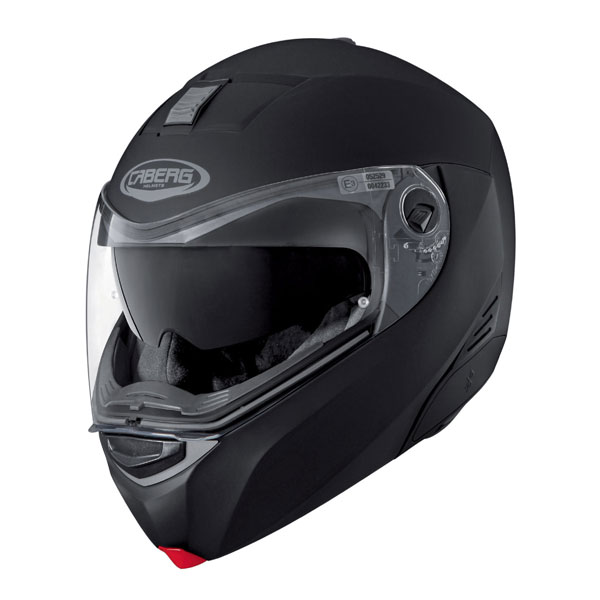
Caberg Modus is a polycarbonate modular/flip-up helmet from Italian crash helmet maker Caberg. In fact, it’s a single helmet but with three versions available (not in all countries).

First there’s the Caberg Modus Easy – that’s the same as the standard Modus but has a removable Caberg sticker and doesn’t come with a Pinlock.

Next there’s the Caberg Modus CPL – that stands for ‘Caberg Pump Lining’. This one has an inflatable internal lining (similar to those found in quite a few Scorpion Air helmets) where you can pump air into small bladders – in this case placed behind the cheek pads and inside the neck roll – which squeezes the lining towards your cheeks and neck to make the fit a bit tighter.

Finally, there’s the standard Caberg Modus which comes with the Pinlock anti-fog insert as standard but without the CPL inflatable lining.

Note, if you’re in the US and interesting buying a Modus, flip over to our European site where you’ll be able to find retailers. But note, the Modus isn’t DOT certified so not legal to use on the roads in the US.

All clear? Then let’s see what the Caberg Modus has to offer and what owners think of it.

caberg-modus-motorcycle-helmet-metal-black-side-view-chin-down
Caberg Modus Metal in black
  • Polycarbonate Flip-front helmet
  • ECE Dual homologated
  • Not DOT certified or available in the US
  • Micrometric fastener
  • Quick release shield
  • Drop down sun visor
  • Pinlock anti-fog in the box (except for Easy version)
  • Weight – 3.8lbs (1.7Kg) – about average
  • Sizes XS-XL
  • Expect to pay $250-$299
  • CPL version about $50 more

Overall/Summary

The Caberg Modus ticks a lot of boxes if you’re looking for a fully-featured flip-up helmet.

It’s got a great chin bar mechanism, it’s dual homologated P/J, has a quick release visor with Pinlock insert included – and it’s all backed by Caberg’s second-to-none reputation for safety.

There’s really not much information online about how well the Caberg Modus performs though. But from scouring the web (including lots of non-English language forums!) we’ve found it’s a well-liked helmet. It’s not the quietest (but then, which modulars are?!) but it’s comfy, has a useful sun visor – and owners get on well with them with few niggles reported.

caberg-modus-cpl-motorcycle-helmet-metal-white-side-view
A Modus Metal in white showing the maximum height the chin bar raises and the sun visor drops

At this mid-price point, there’s lots of competition (see our alternatives section at the bottom of the page) but even so, the Caberg Modus is a great flip up helmet and well worth considering.

[xyz-ihs snippet=”Caberg-Oct-16-quick”]

Safety

The Caberg Modus is ECE 22-05 approved for sale in Europe – and means it’s undergone some thorough impact testing and has a met a number of other safety standards to make sure it’ll offer a decent level of protection when you wear it on your bike.

That’s all very similar to the DOT system in the US – though note the Carberg Modus isn’t DOT certified so isn’t legal for use on roads in the US.

Unfortunately, it hasn’t been Snell certified either, or safety tested by SHARP, so we don’t know quite how well the Modus will perform beyond that standard or in comparison to other helmets.

But looking at the data (as we do!) Caberg has a great track record – and at the time of writing are our joint first placed helmet maker for safety.

There’s been four polycarbonate ‘system’ helmets tested by SHARP over the years and, overall, they’ve scored three maximum (five) star ratings and one four star safety rating. That’s pretty amazing going.

caberg-modus-motorcycle-helmet-duale-hi-vision-side-view-chin-up
Side view of the Modus Duale Hi Vision

If you’ve read our flip-up helmet reviews before, you’ll know we also like to see a decent (high) percentage for the number of test impacts the flip-up chin guard stays locked too.

Well, Caberg do very well here too. They’re not scoring the 100% the likes of Nolan Group helmets manage, but they scored an average of 89% across all their tested system helmets, which is pretty good.

Another tick in the box for the Modus is that it’s dual homologated.

That means it’s approved in Europe to be used (and give protection) whether you’re riding with the chin guard up or down. Not all modular helmets are dual homologated and therefore legal to be worn like this, so that’s worth having.

Other bits and bobs that add to improved safety?

Well, there’s a Pinlock anti-fog insert in the box (not the Easy version) – that speaks for itself why that contributes to safety on your bike!

There’s also a nice and easy to use micrometric fastener – and as long as the strap’s set up right in the first place, micrometrics allow you to tighten up the strap just right for every trip, to make sure your helmet won’t come off in an accident.

Somewhere between 5-10% of motorcycle accidents see the rider lose their helmet so make sure you get a helmet that fits well and tighten your strap up tightly every trip!

caberg-modus-motorcycle-helmet-metal-white-side-view
This is the Modus Metal white. You can see the removable panel for the Caberg Just Speak bluetooth too

Helmet Noise

Overall, the Caberg Modus offers about average noise suppression for a modular helmet. That means if you go at a decent lick, it’ll get noisy and you’ll need ear plugs – but it’s OK at lower speeds.

A couple of owners said it’s an improvement on previous Caberg modulars they’d tried and another said he thought it was pretty quiet.

One also commented that using the air pump on the CPL version quietened things up a bit more.

Bottom line is that it’s probably about average for a flip-up but is very dependent on how fast you go, whether you’re behind a screen or not, and a few other factors that all contribute to making a helmet noisier and your perception of noise.

Ventilation

Generally, owners say the Caberg Modus gives decent ventilation.

Both front vents are pretty easy to operate with nice big sliders opening both the front chin vent and the forehead vent.

The top vent brings air into the helmet which is then circulated around the scalp via channels cut into the EPS shock absorbing liner. It then exits via the two rear exhaust ports.

However, 0ne owner commented that he found the top vent didn’t bring much air into the helmet because the holes in the interior lining weren’t lined up correctly with the vent holes in the helmet shell. That’s something we’ve come across before and prevents any air ventilating the scalp. Not good.

It’s not a widely reported problem though.

caberg-modus-motorcycle-helmet-matt-black-side-view
Matt black Caberg Modus showing chin vent and top vent slider (in grey) and Pinlock post on shield

Shield and Sun Visor

The Caberg Modus has what Caberg call Double Visor Tech. Not sure if that’s referring to the standard clear shield having a Pinlock anti-fog insert on it or the fact that there’s a main clear shield and secondary drop-down sun visor too.

Either way, the Modus is very well equipped in the shield dept.

As mentioned, the main shield is Pinlock ready and comes with a Pinlock anti-fog insert in the box (except for the Modus Easy model). Pinlocks are pretty good and are probably the easiest way to stop your main shield steaming up.

The main shield’s also quick release – which is still pretty rare for a modular helmet. Caberg’s quick release mechanism isn’t the slickest on the market; but once you’ve got the hang of it, it only takes a few seconds to remove the shield (and a bit longer to refit).

The Modus’ sun visor is operated by a big slider on the top/rear of the helmet. It’s not spring-loaded so you can easily drop the sun visor to any point you want and gives infinite adjustment.

We’ve not come across any problems reported with either visor system so all seems good there.

caberg-modus-motorcycle-helmet-hi-vision-side-view-chin-up
Caberg Modus Hi-Vision. Chin guard unlock button can be seen in red above removable chin curtain

Chin Guard

As mentioned in the safety section above, the Caberg Modus is P/J dual homologated.

What does that mouthful mean? Well it’s an ECE (European) testing certification essentially meaning you can legally ride with the chin bar up or down.

And while it’s unlikely you’ll get stopped riding with any modular helmet with the chin bar up, it does mean it should, theoretically, be safer to do so while riding with a dual homologated helmet if you have an accident.

To open the chin bar, you pull the red tab at the bottom-centre of the chin guard which releases the lock. Owners report that it’s very easy to open the chin guard and the action is nice and smooth.

If you watch the video (around 2 mins in) you’ll see how the chin guard raises then is pulled back towards the helmet to secure the helmet in place.

Owners who ride with the chin guard up reckon it’s quite well designed so it’s aerodynamic and doesn’t act as a sail until you get up to motorway speeds.

caberg-modus-cpl-motorcycle-helmet-matt-black-inside-view
Internal view of the Modus CPL showing buttons for air pump on the left.

To lower the chin guard, you pull the chin guard forwards and it drops down – again easily and smoothly.

Again, as we mentioned in the safety section, Caberg have a decent (though not perfect) record of their chin guards remaining locked during an accident – as well as a great overall SHARP safety record.

Comfort & Sizing

The Caberg Modus is made in just one shell size.

Read here why that’s not so good. If you’re looking for one of the smaller sizes, it may mean the helmet looks a bit big for your body size too (the lollipop effect).

Other than that, the Modus comes in sizes XS-XL. It comes with a removable chin curtain which does a good job at reducing wind entering the helmet and cutting out a bit of noise caused by turbulence.

The interior comfort lining is removable and washable and – as long as the helmet fits correctly in the first place – is reported as comfortable.

Note the CPL version has Caberg’s Pump Lining fitted – that’s small air pockets fitted behind the cheek pads and neck roll, that can be inflated by pressing the pump bladder (see picture) and deflated by pressing the reset button.

caberg-modus-cpl-motorcycle-helmet-matt-black-inside-rear-view
Bottom view of the Modus CPL in matt black

We’ve seen this sort of system before and, generally, it seems to be a matter of personal preference whether you’ll get on with it or not.

Inflating it does give a tighter fit and it’s also been said that because it presses the liner in a bit more, it can quieten helmet noise down a bit. And there’s no doubt that getting a good firm fit is an important factor in making a helmet usable and safe in an impact.

However, making sure you get a well fitting helmet in the first place should achieve this; and not everyone can be bothered pumping up their helmet each time they ride.

The Modus CPL is also a bit more expensive than the standard Modus.

Finally, the Modus has glasses grooves in the comfort lining to accommodate glasses’ stems. Reports are that you can also open/close the chin bar with glasses on with no problem and no interference.

Check here if getting a helmet that works with glasses is important to you.

Looks & Graphics

There’s not a massive range of graphics available for the Caberg Modus. There’s a few plain blacks and whites and a couple of hi viz versions (the Hi Viz Vision and Duale Hi Vis) and that’s about it.

You’ll find pictures of all these up and down the page – but to find the latest graphics and prices, click this link through to our European site where you’ll find links to our UK and European recommended helmet retailers.

[xyz-ihs snippet=”Caberg-Oct-16-full”]

Caberg Modus Video

Here you go, some lady from the two wheel centre in UK takes you round the standard Caberg Modus.

Other stuff – audio, weight, build quality, warranty

The Caberg Modus is designed to take the Caberg Just Speak bluetooth communicator. The little pull-away section you can see on the left hand side of the helmet can be popped out to accommodate the unit.

Onto weight – the Modus is about 3.8lbs (1.7Kgs) which is a tad heavier than the average modular crash helmet (after a light weight helmet?)

Build quality is reported as very good by most owners and the Modus, like all other Cabergs, comes with a weeny one year warranty only (if that’s a deal breaker for you, check out which helmets come with a five year warranty).

[xyz-ihs snippet=”Link-to-guides-page”]

Alternatives to the Caberg Modus?

There’s tons of helmets to choose from if you’re after a competitively priced flip-up helmet.

First off, have a look at the HJC IS-Max II – that’s SHARP 4 star rated with most of the features of the Modus but for considerably less money – same goes for the AGV Numo Evo and the Lazer Paname which are both 4 star safety rated with sun visors too.

Going up the price scale from the Caberg Modus, there’s the 4 star Shark Evo One with its chin guard that rotates to the back of the head – it’s dual homologated too and includes a Pinlock Max Vision.

And finally, another SHARP 4 star rated helmet – the Shoei Neotech. It’s well liked with a wide visor aperture and that legendary Shoei build quality – though you’ve to pay a hefty sum over the price of the Caberg Modus to get it.

[xyz-ihs snippet=”Caberg-Cat-link”]

Star Ratings

Shark Skwal Review

Shark Skwal crash helmet. A polycarb full face helmet with in-built LED lights

The Skwal is Shark‘s middle of the range, do anything at a reasonable price, helmet. Only this time it’s got some added bling in the form of built-in LED lights front and rear. But is it just a novelty or does the helmet really deliver?

Overall/Summary

The Shark Skwal is a nice helmet. It’s feature-packed, comfortable and has decent build quality. It’s not the quietest helmet around (actually it’s quite noisy) but the visor systems work well and, as long as you don’t mind having yet another thing to charge up after a ride (or can deal with the frustration of putting your helmet on to find the lights don’t work!) then it should be a good helmet. It’s also been safety tested by SHARP and scored a very respectable 4/5 stars. Well worth a look.

  • SHARP 4 star safety rated (out of 5)
  • 3.25lbs/1.47Kg (about average)
  • Rechargeable LED lighting strips
  • Injected thermoplastic shell (polycarb)
  • Pinlock anti-fog insert included
  • Integral sun visor
  • Sizes XS – XL
  • Prices from around $160-$200
  • Note: Shark Skwal has now been updated to the Shark Skwal 2 – so there are now great deals to be found. Check store links below.

[xyz-ihs snippet=”Shark-UK-quick”]

Shark-skwal-Ellipse-black-white-helmet
Shark Skwal in Ellipse design

Safety

The Shark Skwal hasn’t been Snell tested (Shark don’t seem to submit any helmets to Snell for testing). However, as of Sept 2015, it was SHARP safety tested and scored four stars out of five, which means it’s a safe lid which should give you good protection in an accident.

Shark have one of the best reputations for crash helmet safety around – with all but one of their thermoplastic helmets having scored four stars or above – and also being our joint 3rd safest helmet brand. So we’re pretty confident you’ll be well protected if you go for a Shark.

We understand that the Skwal is manufactured in two shell sizes (with five fitment sizes) which is about par for the course for a middle of the range thermoplastic lid.

Shark skwal blank black helmet
You can just about see the rear green LED strips on this Skwal Blank black

Other things that contribute to safety are anti-fog and a drop down sun visor and the Skwal has both (see shield section below).

And of course it also has its LED lighting system – which you’ll probably either think looks kinda cool and contributes to safety or are a complete waste of time and a gimmick. Jury’s out of course as they’re not massively bright though they do have both a continuously-on and a flashing mode which is probably going to catch other driver’s attention the most. Shark reckon you’ll get 5-8 hours between charges (remove the battery and charge with a USB cable) though I guess that’ll be affected by temperature and will drop with battery age.

We struggled to get a good photo showing how bright the strips are at night – and in fact Shark’s own videos and pics are enhanced so I guess they did too! But if you go to around 45 seconds into the, frankly, bonkers helmet launch video in the videos section below, you might get an idea (after that they seem intent on turning into a Tron video).

You can spot the green lighting strips around the bottom of the front vents and above the rear exhaust vent.

Helmet Noise

The Skwal has what Shark call their Autoseal system, where the visor adheres to the gasket slightly to help suppress more noise as well as stop wind/rain better. It also comes with a chin guard to stop noise from below. But it’s only partially successful with owners saying it’s anywhere from about average to quite noisy. Of course, if you use ear plugs (which you should) you’ll be fine, just don’t expect the Skwal to be the quietest because it’s not.

Ventilation

Shark skwal blank white helmet front view
Skwal ‘Blank’ white showing front vents & LEDs

On the ventilation front, the Skwal doesn’t have anything fancy or innovative going on – and consequently, ventilation is about average. There’s a single chin vent (easy to operate) and a single forehead vent (slightly less so via a small slider on the top) which takes air into the helmet, through the air channels around the scalp and out of the exhaust vent below the spoiler to the rear. Owners reckon it’s adequate and, coupled with the Pinlock, has enough ventilation to keep your shield mist-free.

If good ventilation is important to you, then check out our page of helmets with great ventilation.

Shield/sun visor

There’s a clear main shield plus an integral anti-scratch and anti-UV sun visor on the Skwal.

Useful features on the main shield are that the seal is particularly good, the aperture is slightly wider than most; there’s an easy to find shield opening tab to the left hand side and it comes Pinlock-ready and with a Max Vision Pinlock in the box. The Max Visions are larger than the standard Pinlocks so they obscure your shield less so are well worth going for and work really well in keeping the shield fog-free.

Shark-skwal-instinct-green-motorcycle-helmet
Drop down visor is clearly visible on this Shark Skwal Instinct

Also worth noting is Shark’s quick release visor system which is simplicity itself and really quick to operate (tilt the visor and pull). So all good on the main visor.

Owners reckon the sun visor works well too (even the ones who don’t really like sun visors!). It’s operated by a slider on the left hand side and there are no problems reported.

Comfort

Like all helmets, to get a comfortable helmet, you need to ensure you get the right size for your head. That done, the Skwal’s a comfortable helmet and owners love em. The liner is removable, washable and breathable – like most helmets these days – and many owners reckon it’s as comfortable – if not more – than their previous expensive Shoei’s or up-market Sharks. High praise indeed.

Looks & Graphics

At the time of reviewing, Shark produce a range of six designs (including plain) with multiple color combinations in each. Their plain colors (Blank) come in plain white and matt/gloss black and silver. We’ve dotted pictures of the Ellipse, Sticking, Spinax, Instinct and Matador designs around the page – but click the retailer links to see the latest designs and color variants.

[xyz-ihs snippet=”Shark-UK-big”]

Video

Bit of info about the helmet from Visordown.

And here’s Shark’s own video. Skip to about 45s to see them switch on the lights.

Shark-skwal-Sticking-black-red-helmet
Shark Skwal Sticking in black/white/red

Other stuff – fasteners, audio, glasses, warranty

The Skwal comes with a micrometric fastener (quick and easy to use and safe as they come). It also comes Sharktooth communicator-ready with spaces for earphones set into the side of the helmet which, of course, can be used by 3rd party communicators too. Also set into the side of the helmet is Shark’s usual glasses-groove – indents for the arms of glasses or shades that allow you to insert/remove glasses easily and means that the arms don’t press into the side of your head when riding; always a great feature to see.

Finally, you get Shark’s 5 year warranty which has gotta be good for peace of mind.

[xyz-ihs snippet=”Link-to-guides-page”]

Alternatives

Shark-skwal-Matador-black-red-helmet
Shark Skwal Matador (click to enlarge)

If you want another mid-priced helmet with LEDs, you’ll not find one (yet). However, there are other great helmets around for similar money or less.

Slightly more expensive is the X-Lite X-702 GT, a composite fiber shelled helmet that’s about the same weight and SHARP 5 star tested that’s well rated for noise and comfort. It’s got a sun visor too.

If you’re after something slightly sportier (but without a sun visor) the SHARP 4 star rated HJC FG17 is about the same price and weight as the Shark and a solid performer all round.

[xyz-ihs snippet=”Shark-UK-quick”]

[xyz-ihs snippet=”Shark-Cat-link”]

Bell MX-9 and MX-9 Adventure motorcycle crash helmets

Bell MX-9 and MX-9 Adventure – polycarbonate motocross and dual sports helmets

The Bell MX-9 comes in two versions – either the standard motocross helmet or the dual sports/adventure helmet, which is essentially the same as the motocross version but with a shield. Because the two models are basically the same, we’ll cover both helmets in this review.

The MX-9 is a polycarbonate crash helmet with a removable sun visor, lots of ventilation and double-d ring fastener. In this review, we’ll cover all the features you’ll find on the MX-9 together with what owners think of their helmets, warts and all.

  • Motocross and Adventure versions
  • Polycarbonate shell
  • DOT and ECE certified
  • Not Snell or SHARP tested
  • Removable sun peak
  • Double-d ring fastener
  • 5 year warranty
  • 3.5lbs (1.59Kg)
  • Expect to pay about $230-$370

Looking to buy a Bell MX-9?

Please click below to visit the Bell MX-9 pages at our recommended stores – all checked for great online ratings. And if you buy from any store, we get a small sum from the sale at no extra cost to you – a massive THANKS! (it’s how we finance the site).

BTO SportsShop for helmets at Amazon

Overall/Summary

It’s important to remember that the Bell MX-9 is a lower-priced motocross or adventure helmet. So you’re not gonna get all the bells, whistles and sophistication of some of its higher-end and higher-priced counterparts.

bell mx9 blockade motocross motorcycle crash helmet front view
Front view of the MX-9 Blockade motocross helmet

But despite this, it’s still a very capable helmet; one that its owners seem to rate highly and say that performs well in all the important areas. Sure, we can’t tell how safe it’ll be in a collision – we’ll have to wait for Snell (or SHARP) to test it and let us know. But with Bell’s excellent reputation for safety, coupled with the type of features off roaders and adventure riders are looking for – like space for goggles, good ventilation, integrated roost guard – all backed up with a 5 year warranty, you sure are getting a lot of bang for your buck.

And at this price, it’s really hard to fault the Bell MX-9.

Read on for more details…

Safety

The Bell MX-9 is both DOT and ECE certified which means it should give a decent level of protection. However, it hasn’t been either SHARP or Snell tested yet so we can’t really tell just how safe it is.

bell-mx-9-adventure-raid-helmet-orange-white-front-view
Bell MX-9 Adventure in Raid orange graphics. Note Adventure comes with clear shield only.

If we look back at how well Bell helmets perform when they’ve been SHARP tested though, they have historically scored incredibly well and are joint first place in our list of the safest crash helmet brands.

But having said that, their crown has slipped a little lately, and their latest (only) tested polycarbonate helmet – the Bell Qualifier DLX – scored three stars when SHARP tested. That’s still a decent score but possibly points to the MX-9 scoring something similar?

Even though it’s a cheaper helmet, the Bell MX-9 is manufactured in three shell sizes, which is a really good thing and should improve safety and fitment levels – and also make the helmet look better when you’re wearing it. Many lower priced helmets only come in one shell size so well done Bell for that.

The strap is secured by a good ole double-d ring fastener which are about as safe as they come and especially good – if you’re the diligent type – because they make you adjust the tightness every time you put the helmet on.

bell mx9 blockade orange motocross motorcycle crash helmet rear view
Rear view of the MX-9 Blockade in orange

Helmet Noise

Helmet noise is a tricky one to judge at the best of times because it’s so personal (what’s quiet for one person is noisy for another).

And true to form, there’s a wide range of opinions from owners to whether the MX-9 is loud or quiet.

What does come through though is that it’s generally noisier than a road helmet but seems to be about average for your typical motocross or adventure bike helmet; with some folks saying it’s pretty noisy and others, fairly quiet.

I think the bottom line is it depends how you ride, but don’t expect something that’s whisper quiet as you’ll be sorely disappointed. And if you do ride lots of road miles, wear earplugs.

Ventilation

Ventilation seems to be a strong point of the Bell MX-9.

It’s got loads of vents – from the three chin vents (only the central one is closeable) and two forehead vents (both always open) to the four exhaust vents – again all open all the time.

The chin vents let in a load of air and most people seem to think the head vents work well too, pulling in air which is then circulated through channels in the polystyrene lining and through to your head. That includes some folks who ride in very hot weather and one guy who regularly rides in 30+ degrees C and humidity who reckoned the ventilation does a fine job.

There’s always the occasional dissenter who reckons it can get a bit hot, but the overwhelming opinion online is that ventilation’s very good all round.

bell mx9 adventure barricade motorcycle crash helmet front view
Front vents visible on the MX-9 Adventure Barricade

Shield (MX-9 Adventure only)

The MX-9 Adventure comes with a fully-functioning, removable, clear shield. It operates on a four-position ratchet and has a ridge at the bottom to allow for easy opening as well as helping make a good seal against the shield gasket.

MX-9 owners reckon the shield’s good – with just one niggle.

First, the good. There’s a few reports that the quality of the shield is good, with very little distortion. The ratchet works well too with the first ‘cracked’ position ideal for letting in a bit more ventilation and is good for staying open in that position to around 70 mph.

It’s not a quick-removal shield in the usual sense, but it’s not too tricky – just remove a couple of thumb screws, one on either side, and the shield comes off.

The niggle is that the moulded-in ridge in the bottom of the shield is quite large so can get in the line of sight a bit when the shield’s in more than the cracked-open position. A couple of owners had a little moan about that.

On the flip side though, one owner said he liked the way the shield, when fully open, is protected by the sun visor. Drop the helmet and the peak will stop the shield from getting gravel rash. Cool.

Best places to buy a Bell MX-9?

Please click below to visit the Bell MX-9 helmets pages at our recommended stores – all checked for great online ratings. And if you buy from any store, we get a small sum from the sale at no extra cost to you – a massive THANKS! (it’s how we finance the site).

BTO SportsShop for helmets at Amazon

Goggles

You can use goggles with either the motocross or adventure versions of the Bell MX-9.

Bell-mx-9-scrub-pink-side-view
Motocross (shield-less) version of the MX-9, this one in Scrub design

Reports are that the shield aperture is nice and wide and owners have used Builtwell and Fox goggles with no problems.

On the Adventure, we’ve had reports that you can close the main shield while wearing goggles with few problems, though I guess that depends on the model of goggles you’re wearing.

Sun Peak

That sun peak is fixed to the helmet and not adjustable in the ‘slide forward/back’ sense. It does have two positions though, but you’ll have to: remove a screw, remove a bung, move the peak, screw in place, replace the bung, to adjust it. Not arduous to do of course and one of the slight corners Bell probably cut to get the MX-9 out at this low price.

Instead of adjusting it, you can of course fully remove the peak if you’re going to be doing lots of street riding in the helmet and want to make it a bit more aerodynamic.

It’s not too bad on the road with the peak fitted though. Owners reckon that up to 70 MPH you’ll know it’s there but it’s not too bad. Above that though and it starts to buffet a little – and you can feel it tugging during head checks.

bell-mx-9-motocross-replica-camo-green-top-viewComfort & Sizing

Both versions of the MX-9 share the same internals. That’s a fully removable and washable comfort liner that’s both moisture wicking and anti-microbial.

A few owners said they were surprised at the quality of the lining and more than a few have said that, overall, it’s a very comfortable helmet.

Sizing sounds like it’s bang on – so no need to go a size smaller/larger. Just use our helmet fitting guide and you should be good to order the right size.

And if you do find your new helmet could do with a little adjustment, you can order different size cheek pads to tailor the fit still more closely.

Talking about cheek pads – you can usually find the join between cheek pads and the rest of the lining acting as a glasses groove to stop the stems of your glasses pressing into the side of your head. Unfortunately the MX-9s don’t work like that. And while we did hear from one guy saying he wears his shades in the MX9 with no problem, many owners reckon it’s not very comfortable with glasses and the lining does press them into your head.

bell-mx9-pinned-white-motocross-motorcycle-crash-helmet-side-view
This one’s the Bell MX-9 in Pinned graphics

That’s a shame because the MX-9 offers great value as a mx or adventure helmet. So, if you’re still not put off and want to try it for yourself, make sure you order from a retailer with a good returns policy (such as one of our recommended retailers). Or check out our pages showing helmets that work great with glasses.

Looks & Graphics

The Bell MX-9 is a great looking helmet and there’s a wide range of cool graphics to go with it.

On this page you’ll find pictures of the Pinned, Airtrix, Blockade, Barracade, Scrub, Camo, Raid and Adventure designs. But to see the latest designs and for up to date prices, we recommend you click through to our recommended retailers using the links below.

Bell MX-9 helmet video

Here’s a couple of videos showing you the Bell MX-9 Adventure (top) and Motocross (bottom).

bell-mx-9-motocross-replica-camo-green-side-view
Cool looking – especially in Monster replica ‘camo’ design

[xyz-ihs snippet=”Link-to-guides-page”]

Other Stuff – communicators

The MX-9 isn’t really built for bluetooth headsets, but that’s not to say a few owners haven’t successfully fitted them. You’re probably going to need to stick them on rather than clamping, but owners of both Sena SMH5s and Cardo Scala Riders have said they’ve successfully fitted them with no problem.

Alternatives to the Bell MX-9

mx-9-adventure_hi-viz
Here’s a hi-viz version of the MX-9 Adventure

There’s lots of alternatives to both the MX-9 motocross and the MX-9 Adventure helmets. Check our motocross and adventure sections to see what’s on offer.

Looking to buy a Bell MX-9?

Please click below to visit the Bell MX-9 pages at our recommended stores – all checked for great online ratings. And if you buy from any store, we get a small sum from the sale at no extra cost to you – a massive THANKS! (it’s how we finance the site).

BTO SportsShop for helmets at Amazon
[xyz-ihs snippet=”Bell-Cat-link”]


Star Ratings

Review of the Nexx XG100 retro full face motorcycle helmet

The Nexx X.G100: a composite fiber retro full face helmet

The Nexx X.G100 is a proudly retro full face helmet, harking back to the good ole days when every biker had greasy fingers and even greasier biking gear.

Nowadays, most of us take our bikes into the garage to get em fixed and you’re more likely to see snazzy textile jackets and carefully sculpted leather body suits than a greasy jacket. But it’s tempting to look back on those days with affection and kitting yourself out with a retro helmet is just one more way to relive those halcyon hipster days.

The XG100 might look very retro, but some of the tech is anything but. It’s got a hi-tech carbon/aramid composite shell that’s super light weight and it ticks all the relevant statutory boxes such as DOT and ECE.

But what do Nexx XG100 owners think of their retro crash hats?

Overall/Summary

The Nexx XG100 is a retro-looker, and that’s why most folks are gonna buy one.

nexx-xg100-muddy-hog-full-face-motorcycle-helmet-side-view
Muddy Hog in blue with sun peak attached

And because it’s based on the look of helmets in the 70’s, that’s probably how you should go into buying one. Don’t expect it to work amazingly well in comparison to today’s helmets because it’s a pretty faithful re-imagining of yesterday’s helmets, warts and all.

But if you go into buying an XG100 expecting leaks and draughts and a hot head – the whole retro biking experience – then you’ll probably not be disappointed. Buy one and expect all the sophistication and utility you get from a modern helmet, and you’ll likely be left with a sad face.

So, most owners understand that it’s a bit compromised and if you’re OK to fiddle about with goggles and elasticated shields and to have a bit more wind on your face than you’d like – but can revel in the 70’s coolness the XG100 brings, then it’ll be worth all you paid for it and more.

Just maybe, have a backup modern helmet somewhere around the house too eh?

nexx-xg100-devon-motorcycle-helmet-front-view
Retro helmet with even retro-er design – the Nexx XG100 Devon
  • Composite aramid/organic fiber/carbon/fiberglass shell
  • DOT and ECE certified
  • Not Snell or SHARP tested
  • 2 shell sizes
  • Double D-ring fastener
  • Sizes S-XL
  • 2 year warranty
  • 2.65lbs (1.2Kg) very light
  • $360-$420 depending on design

Looking to buy a Nexx X.G100?

Please click below to visit the Nexx X.G100 helmets pages at Amazon and one of our recommended stores. And if you buy from either store, we get a small sum from the sale at no extra cost to you – a massive THANKS! (it’s how we finance the site).

Shop for helmets at Amazon

Safety

The Nexx X.G100 is both DOT and ECE 22.05 certified  and which means it meets a certain minimum safety and performance standard. Click the links for details.

It hasn’t been either SHARP or Snell safety tested though so that’s about as far as we can go to see if they’re safe or not. Except we can say that SHARP has tested three Nexx helmets over the years – with the last one being the Nexx XR2 in 2016 – and all three have scored 3/5 stars. That includes carbon and composite helmets too. So I guess we could perhaps expect something similar?

nexx-xg100-bad-loser-full-face-motorcycle-helmet
This one’s the Nexx XG100 Bad Loser

Other than having a nice smooth and round shell (always preferable in safety terms) that’s light weight (reduced inertia in an accident) and a good ole double-d ring fastener (safe as houses if you do em up diligently), there’s not many other safety features going.

Helmet Noise

Interestingly, even though the X.G100 is a retro helmet, that nice round shape, lack of vents and protruberences and some nice soft padding that covers the ears – the few owners’ comments on helmet noise points to the Nexx being a reasonably quiet helmet.

As always, helmet noise is subjective and dependent on things like your riding style, type of bike, speed you ride, previous helmet noise etc. etc. so take this assessment with a pinch of salt: everyone’s perception of a quiet helmet is slightly different.

nexx-xg100-tokko-full-face-motorcycle-helmet
Tokko black, white, red design – showing small ventilation slit

Ventilation

You can see the ventilation on the XG100 from the photos – or lack of it. There’s a single vertical slit in the chin guard, and that’s it!

Or rather, that’s all the ‘official’ ventilation, though of course if you’re riding with goggles, you’ll get lots more ventilation through the eye port. Even if you’re riding with the elastic shield, reports are you’ll still get some air in around it.

But as for scalp ventilation, you’ll not find much. And if you’re riding in hot weather for any length of time, owners reckon it can get a bit hot in there. But I guess that’s all part of the old-time riding experience right?

As for the chin vent, that’s covered by mesh to stop the bigger airborne nasties getting through and apparently it offers decent venting too, letting in a reasonable amount of air around the mouth area. It also directs some air onto the back of the shield if you’ve got one fitted, but it’s not going to be enough to stop it fogging.

nexx-xg100-purist-full-face-motorcycle-helmet
Matt black XG100 Purist with smoked goggles fitted

Shield & Peak

The Nexx XG100 does accommodate a shield and in fact comes with a 60% smoked shield in the box.

That shield’s unlike any shield you may have experienced in the past though. It’s a soft plastic shield that snaps onto the helmet on either side of the eye port and pulls tightish to the eye gasket.

Accounts are that the shield works OK but it’s not tight enough to stop all the rain getting in if it tips it down and it does leak air a bit (but hey, it is the 1970s, what do you expect – Dennis Hopper wouldn’t have moaned!).

nexx-xg100-purist-white-full-face-motorcycle-helmet-side-view
Purist white version with black sun peak

You can push the shield up a bit to crack it and stop fogging – or push it up to the bottom of the brow studs for a bit more ventilation still. You can push it up further still but be careful you don’t scratch the shield with the studs – and keep your eyes on the road (or pull over) because it’s not the easy-to-use shield we’re used to these days.

You can of course bin off the shield and use sun glasses or goggles – but it’s not been specifically designed to accommodate either and a few owners reckon the eye port is pretty small.

Because it’s passed both ECE and DOT, that means the shield opening meets minimum requirements, but a couple of users did say it feels a bit restricted in the peripheral vision stakes.

The Nexx X.G100 does come with a sun peak too that fits on the three studs over the brow. It seems to do its job OK, though one owner reckoned it can contribute to lift at speed.

nexx-xg100-muddy-hog-full-face-motorcycle-helmet
Rear view of the XG100 muddy hog – no vents, spoilers, nothing!

Comfort & Sizing

Despite being a retro helmet, the XG100 does have reasonably modern internals that are wicking and are anti-allergenic. It’s removable and washable too, though it’s attached to the helmet by velcro (so might be tricky to put back in in exactly the right place).

It is produced in two shell sizes and fitment sizes run from XS-XXL – and word is that it fits pretty true – check our fitment guide if you’re not sure what size helmet you take.

As mentioned, there’s no glasses groove in the XG but some people do use shades and glasses with it sounds like it’s not too much of a problem.

There’s no ear pockets though so it’s not ideal if you’re wanting to fit a communicator. But then the XG100 is a retro helmet so, possibly not a massive issue for most?

nexx-xg100-drake-full-face-motorcycle-helmet-front-view
This one’s the Nexx XG100 Drake. See below for side view

Looks & Graphics

There’s a wealth of graphics available for the Nexx XG100. There’s solid gloss white and matt black – but there’s also a few that are near-plain colors such as the Bolt with its orange stripes and the Devon with a classy yellow piping. There’s also some more way-out designs such as the Muddy Hog and the Bad Loser.

As usual, you’ll find most of the currently available designs dotted around this page – but for the absolute latest designs and prices, click through to our recommended retailer links below where you’ll be dropped on their Nexx helmets pages.

Best places to buy a Nexx X.G100 crash helmet?

Please click below to visit the Nexx X.G100 helmets pages at Amazon and one of our recommended stores. And if you buy from either store, we get a small sum from the sale at no extra cost to you – a massive THANKS! (it’s how we finance the site).

Shop for helmets at Amazon

Nexx XG100 Video

[xyz-ihs snippet=”Link-to-guides-page”]

Other stuff – warranty, build quality

nexx-xg100-drake-full-face-motorcycle-helmet-side-view
Side view of the Drake

The Nexx X.G100 comes with a 2 year manufacturer’s warranty (many helmets these days come with a 5 year warranty).

That said, many owners said they were pleasantly surprised at the build quality of the XG100 – with colors and finish being vibrant – and the whole thing seems well put together. So hopefully that’ll mean you won’t have cause to put that warranty to the test.

Alternatives to the Nexx XG100

There’s only one real alternative that we’ve come across and that’s the good ole Bell Bullet – another full face retro helmet but that’s a bit more expensive than the Nexx.

Looking to buy a Nexx X.G100?

Please click below to visit the Nexx X.G100 helmets pages at Amazon and one of our recommended stores. And if you buy from either store, we get a small sum from the sale at no extra cost to you – a massive THANKS! (it’s how we finance the site).

Shop for helmets at Amazon

Star Ratings

Full review of the Schuberth SR2 full face sports motorcycle helmet

schuberth-SR2-featured-disc

Schuberth SR2 – Schuberth’s top of the range sportsbike and track helmet

Schuberth scored a bit of a hit with its first superdouper-supersports helmet, the fiberglass-carbon composite helmet, the Schuberth SR1. As we found in our SR1 review, it was light, sleek, scored a solid 4 stars when SHARP tested it, and was well-regarded by racers and sportsbike riders.

But now, Schuberth obviously think they can do better because they’ve released an updated version in the form of the Schuberth SR2. Schuberth reckon this version will have better aero, meaning less buffeting and more stability as well as being quieter for the rider.

It also has a back-hump cut out at the rear of the helmets to accommodate racing suits, and they’ve also updated the shield making it better for tear-offs and giving improved ventilation and antifog.

Note: the Schuberth SR2 has now been discontinued.

  • Schuberth’s new track focused sports helmet
  • Fiberglass shell
  • SHARP 3 star safety rated (out of 5)
  • 2.9lbs (1.3Kg) – that’s light (medium version)
  • Optically correct shield
  • Double-d ring fastener
  • Great aero stability
  • Good ventilation
  • Sizes XS-XXL
  • Expect to pay $800-$900

Looking to buy a Schuberth SR2?

Please click below to visit the Schuberth SR2 helmets page at our recommended store – checked for great online ratings. And if you buy from them, we get a small sum from the sale at no extra cost to you – a massive THANKS! (it’s how we finance the site).

Safety

(more about helmet safety)

The Schuberth SR2 has been ECE tested/approved and was SHARP tested in Feb 2017 where it scored a disappointing 3 stars (out of five). That’s one less than its predecessor the SR1 which scored four stars.

schuberth SR2 crash helmet pilot-grey
The SR2 in Pilot grey

Most serious track helmets – such as the Shoei X-Fourteen or Shark Race R Pro Carbon – have so much careful design and technology thrown at them, they seem to breeze through the SHARP test with five stars. And when you’re after a helmet that you’re planning on taking to the track, that’s the kind of protection you may well need. So a three star rating for the SR2 might well put lots of owners off buying one – and we can’t say we blame them.

Having said that, getting a good fit is more important than a SHARP rating – for any helmet according to SHARP – so that’s gotta be your number one priority.

The SR2 has a double-d ring fastener which are old-school fasteners but reasonably easy to use and safe as long as they’re tightened correctly. Unfortunately, if you do have a serious off at the track, there’s no EQRS system to help medics get your SR2 off – which is a pretty big omission in a modern track-ready helmet in our books.

Aero and Helmet Noise

(more about helmet noise)

Aero is one of the areas Schuberth reckon they’ve lavished most attention. They say they’ve spent untold hours in their wind tunnel to make sure the SR2 is the sleekest, stablest shape possible. They also claim the SR2 doesn’t produce upwards lift and the rear spoiler helps make it directionally-stable so the helmet doesn’t shake around and gives a clear view of the track/road ahead.

schuberth-SR2-motorcycle-helmet-in-lightning-yellow-side-view
SR2 Lightning yellow

All of this wind tunnel work should help make the SR2 a slippery blighter which in turn should help make it a quiet helmet.

Track-focused helmets aren’t usually very quiet but Schuberth has been trying to make a name for itself in the quiet-helmet stakes (with mixed success) and Schuberth reckon that the SR2 is really quiet, quoting decibel figures that look impressive.

Well, the jury’s in and it seems the SR2 is somewhere between average to quiet. Which is, of course, massively subjective, but probably means it’s quiet for a sportsbike helmet (which are usually noisy beasts) but less quiet than some all-rounder or touring helmets.

As for aero, the SR2 now has a fixed rear spoiler as opposed to the adjustable spoiler of the SR1 (which by all accounts didn’t really achieve much). But the SR2 does carry on the good aero work of the SR1 with owners reckoning that there’s very little buffeting, even at speed, and that it’s a particularly stable helmet.

schuberth-SR2-motorcycle-helmet-in-formula-red-side-view
Formula red version

Ventilation

While you might not want much air getting in from below, you will want good ventilation around the shield and scalp and the SR2 has a two-way chin vent and double brow vent to pull air over the head, exiting via the rear exhaust vent and collar vent.

Like we saw with the SR1, the chin vent has a double-action. The upper section (controlled by a large movable panel) directs air to the rear of the shield while the lower gridded section is there to let air into the chin area where some is diverted towards the cheek pads. That lower section is opened/closed using a controller tucked under the chin guard.

According to SR2 owners, ventilation is great. In fact it’s one of the universally-agreed strong points of the SR2 with the vast majority of owners commenting how good it is.

Shield

Schuberth reckon they’ve updated the shield to be more tear-off friendly. But like the SR1, it’s still a class-one optical shield that owners say gives a really clear distortion-free view right across your view, with a quick-release system for tool-less shield removal.

schuberth-SR2-motorcycle-helmet-inside-viewThat shield is what’s called a 2D shield meaning it’s actually a flat piece of polycarbonate that fits flat across the helmet. That’s the kind of shield you find on most sportsbike helmets and allows tear-offs to be fitted.

The SR2 is also Pinlock anti-fog ready, and this time it’s ready to fit the larger Pinlock Max Vision which should cover pretty well all your vision.

Inside the SR2 you’ll find a fully washable/removable Coolmax lining which is moisture-wicking and breathable (click the link above for lots of information about materials you’ll find inside a helmet).

All’s good with the comfort of the SR2, with several owners saying because it’s so light and because the quality of the internals are so good, it’s all-day comfortable.

Having said that, sizing on the SR2 is on the small size so make sure you go a size larger if you normally find yourself between sizes. Oh, and check out our helmet fitting guide to measure your head before buying.

And if you do find your helmet too slightly too snug, even after your breaking-in period, Schuberth do sell different-sized internals so you should be able to customize fit to get things just right.

Looks & Graphics

As usual, Schuberth graphics are understated. The only solid plain version is the matt black SR2 and, at the time of writing, the rest come in two different designs – the Lightning and the Pilot.

We’ve put examples of all these around this page – but to see the latest designs and graphics, you should click the links below that will drop you on the Schuberth pages at our recommended retailers.

Best places to buy a Schuberth SR2?

Please click below to visit the Schuberth SR2 helmets pages at our recommended store – checked for great online ratings. And if you buy from them, we get a small sum from the sale at no extra cost to you – a massive THANKS! (it’s how we finance the site).

Schuberth SR2 video

Here’s a video where a dude shows you around his newly bought SR2 along with initial impressions.

Other stuff – fasteners, weight, & warranty

Like every other racing-focused motorcycle helmet, The Schuberth SR2 has a double-d ring fastener. They can be a bit fiddly compared to something like a micrometric, but if fastened right, they’re about as safe as they come.

One of the most-liked features of the SR2 by owners is that it feels really light. It weighs in at just 1.3Kg (2.9lbs) which is well under the average weight of the typical full face helmet.

Finally, the SR2 also comes with a five year warranty (2 year standard extendable to 5 years via the Schuberth website).

Schuberth SR2 motorcycle helmet lightning red side view
Side view of the SR2 Lighting helmet

[xyz-ihs snippet=”Link-to-guides-page”]

Alternatives to the Schuberth SR2?

If you’re after an out-and-out sportsbike or track helmet (and you’re willing to spend the money) there’s loads of choice out there.

Obviously, now the SR2’s launched, that means there are deals to be found on the very capable Schuberth SR1 – that’s a fiberglass/carbon composite, SHARP 4 star rated helmet that sportsbike riders rate highly.

If we’re talking track helmets, we’ve gotta mention Arai and Shoei. Shoei’s distinctive X Fourteen can be seen on grids everywhere. It’s SHARP 5 star safety rated and Snell approved and is really popular with racers. Arai’s Corsair X hasn’t been SHARP safety tested but it’s popular with racers and road riders alike.

Lower priced alternatives

HJCs latest sportsbike lid, the RPHA 11, only scored 3 stars with SHARP but it’s a well featured helmet with free Pinlock in the box. It’s also considerably cheaper than the Schuberth, Arai and Shoei.

Other, lower priced alternatives to the SR2 are the Kabuto RT-33 and the LS2 FF 323 Arrow. The Kabuto is 4 star safety rated, comes with a Pinlock in the box and is broadly thought of as a pretty quiet helmet. The LS2 is also SHARP 4 star rated, has an optically correct shield with Pinlock included and is almost as light as the SR2.

Finally, we’ve got to list AGV. The AGV Corsa is their second-in-line sports helmet (the first is the Pista GP) – that’s a SHARP 5 star rated helmet that’s light and comes with an optically correct shield as well.

All these are all great alternatives to the SR2 – but if you want to see even more, check out our sports bike helmets pages.

Looking to buy a Schuberth SR2?

Please click below to visit the Schuberth SR2 helmets page at our recommended store – checked for great online ratings. And if you buy from them, we get a small sum from the sale at no extra cost to you – a massive THANKS! (it’s how we finance the site).


[xyz-ihs snippet=”Schuberth-Cat-link”]

A visit to the SHARP motorcycle helmet testing labs

As you probably know, we’re big fans of the SHARP helmet testing scheme here at BCH. How else can you have the foggiest idea of how safe your helmet is without those nice people at SHARP being here to tell us?

So we were delighted to be invited along to one of the SHARP contracted testing labs to see a helmet or two being dropped, plunged and hurled in a variety of rigorously-controlled and scientifically-measured ways.

If you’re unsure what SHARP is (that’s the Safety Helmet Assessment and Rating Programme), then you might want to read this article.

You might also find our definitive guide to crash helmet safety useful too which analyses SHARP data to find lots of interesting info about helmet weights and which are the safest crash helmets.

SHARP-helmet-testing-rig-setup
Stage 1 – setting up the headform

This particular contracted lab was in Manchester, England, and when we rocked up, they’d set up a few ‘test’ drops for us to check out because, as I found out, security and impartiality is taken exceedingly seriously when testing helmets. Meaning, they couldn’t/shouldn’t/don’t do live helmet testing with unnecessary interlopers, such as myself, in attendance.

And rightly so.

The other thing that quickly became apparent is that they’re mega serious about exacting standards and data integrity.

That was exemplified straight away when they demonstrated how they set up and mark each helmet for testing.

One of the key things with SHARP is that EVERY crash helmet is tested in EXACTLY the same way – so all results are directly comparable.

sharp-helmet-test---helmet-on-headform
EVERY helmet is positioned in EXACTLY the same way.

So they mark the points where every impact test is going to hit directly on the surface of the helmet using Lazers and with inert markers. To do that, they insert a (strictly controlled) head form into a helmet, then take an absolute age making sure it’s precisely placed onto that head form in the same way as every other helmet has been placed since SHARP began in 2007.

By the way, the black thing on the top of the helmet is a weight – the same weight as used in European ECE testing in fact – to make sure every helmet is seated on the head form in precisely the same way. There’s lots of references to the ECE test through this article because that’s the safety standard used in the UK and Europe – but there are many shared similarities between that test and DOT and Snell in the US too.

Once each of seven test helmets has been accurately marked – and once the test rig has been calibrated and the calibrated accellerometer added to the mix – and after the headform with helmet has been precisely loaded onto the rig (using a mixture of highly trained lab expert, patience and lazers – they love their lazers at SHARP) then everything was ready to begin.

They use two testing rigs – one for the front, rear and side impact tests. And another for the crown impact test.

Marking-the-impact-points-using-LAZERS
Once the helmet’s correctly positioned on the headform, the impact points are marked using Lazers

Which is awfully decent of them because that’s a lot of extra effort to test just the crown (top of the head) when the stats say only around 2% of impacts occur there.

ECE 22.05 and SHARP

SHARP builds on and supplements the basic statutory ECE testing.

That’s because the ECE regulation tests stuff like chin strap, field of vision and conditioning (heating up helmets, cooling them down, humidifying them etc. etc.) which means SHARP doesn’t have to. They can then take only ECE 22.05 approved helmets knowing they’ve all passed that ‘base level’ of testing – then build on it with their own testing.

While it’s great that all helmets on sale in Europe (and now Australia) must pass this particular test – it’s kinda similar to the US DOT certification (except of course, DOT doesn’t test helmets before they go on sale – read more here), SHARP was built upon the finding that there’s still a massive variety of performance difference between these ECE approved helmets.

And while ECE testing impact tests at hot and cold temperatures – to ensure helmets provide a minimum level of protection through the different seasons – SHARP testing is only carried out at ambient temperature. Though of course, that’s precisely the same ambient temperature for each helmet tested.

Full-height-of-the-SHARP-motorcycle-helmet-testing-rig
Here’s a look up to the full height of the test rig. The lab had to specially extend the roof to fit the rig in!

They also incorporated one or two improvements to the ECE testing to further increase accuracy and repeatability of their tests.

For example, when helmets are dropped during an ECE test, they’re not held entirely firmly in the rig, so they can and do fly off in different directions after impact – and that reduces the amount of force applied directly to the helmet by a random amount each time.

SHARP, on the other hand, not only checks that the exact same point on the surface of the helmet is impacted each time (yup, you guessed it, using more lazers!) but it holds the helmet firm on the rig too so it can’t bounce around.

That means the same amount of testing force goes through the helmet, every time. And that leads to more consistently comparable results. Job done.

While ECE testing isn’t based on the Cost 327 findings (which SHARP is) both systems do share similar methodologies (SHARP incorporated the best bits of ECE testing. So things like the headform shape and weight, the helmet positioning, the anvils used etc. etc. are all common between SHARP and UN ECE.

The massive attention the guys at SHARP give to accurate and repeatable testing is what makes it so meaningful and useful.

Back onto the testing of the crown impact (top of the helmet).

While our dedicated SHARP team use a separate testing rig to test it, apparently the ECE test takes a short cut.

What do you do when you want to test the crown but your testing rig doesn’t really let you? Why, you saw the chin guard off first of course!

Yeah, sounds a bit odd to us too, but that’s exactly what ECE 22.05 testing does.

It does seem a little bizarre for all manner of reasons – not least in compromising the integrity of the helmet as a whole. But there you go, I’m sure they have their reasons (surely the Eurozone can’t be THAT broke they can’t afford a different testing rig?!?)

setting-up-the-oblique-helmet-test-at-the-SHARP-helmet-testing-labs
Helmet all set up and ready to be dropped for the oblique friction test. Note wooden catch box to the left.

Oblique testing

Meanwhile, back at the lab we went through a front impact test, a rear and a side impact test. SHARP impacts both sides of the helmet whereas ECE only does one side – the one that appears to be the weakest such as where you find sun shield sliders and other such gubbins.

They also carried out an oblique test.

60ish % of real-world helmet impacts are oblique according to Europe’s most comprehensive analysis of real-world motorcycle accidents – Cost 327. That means rather than a straight-on impact (like headbutting a wall) most involve an angled impact.

So SHARP simulates that too. They take a helmet, stick a (bloody heavy!) headform in it, place the helmet on a testing rig, then drop the helmet onto a solid angled metal anvil that’s covered in an abrasive material (see a photo of the result at the bottom).

In this test, the helmet is free to move after the impact and they use the same abrasive impact material for each and every oblique test so the helmets will dig in a bit and cause rotation in a similar way you’d find if you hit the surface of the road at speed.

This test makes a right old racket and because the helmet is free to fly off after the test, they’ve a padded ‘catch box’ that’s pushed up to the rig to catch the helmet.

SHARP testing and Flip-up helmets

I know quite a few people have questions about how they test flip-up helmets – I know I have – so now was a great time to ask the team and find some answers.

The first one is about the figure SHARP reports on its website showing how many times a modular helmet’s ‘faceguard remained fully locked’.

That wording and what the figure actually means always has always needed a bit of clarification for me and for many people on the various forums I check out.

SHARP 100% rating
The modular helmet rating they’re all after – 100% chin guards locked during testing

When SHARP impact tests a modular helmet, the face guard is always down, closed and locked. They never test with the guard up and open.

After each impact test, they check to see if the guard is still locked. That’s it. They don’t look to see if the guard has opened – they check if there’s any unlocking gone on – that’s all. It could be one of the two locks has opened or it could be both. The chin guard could be fully open or just cracked open a little bit. They’re all a lock-fail and reduce that 100% perfect score.

So of the 30 impacts each helmet model undergoes, if the chin guard unlocks, say, 15 times; the little padlock graphic on the SHARP website would show a figure of 50% – whether the chin guard flew off or it was unlocked on one side only but still looked closed.

Modulars – and ECE P/J ratings?

The second question was more about ECE 22.05 approval than SHARP.

ECE-2205-p-rating
Check your chin strap. If it’s a modular with just a /P rating, then it’s not designed to be ridden with the chin guard up.

We always report when a helmet has been ECE dual-homologated (or scored both P & J ratings – same thing). But there is a rating of NP meaning the chin guard is non protective.

I wanted to know how often SHARP see modulars that are NP rated.

The answer – just once. And that was a long time ago. Many flip-ups aren’t J rated meaning they can’t legally be used with the chin guard up – but pretty well all that are on the market today are approved to be used with their chin guard down.

So, you’re OK wearing your modular like a full face helmet on the road, but if you want a flip-up helmet that’s good to go with the chin guard up, then check out our dual-homologated modulars and you’ll be fine.

SHARP test cheaters?

Another thing we chatted about is manufacturers building helmets just to pass a standard.

If they want to pass the SHARP test with flying colours, won’t they just reinforce their helmets at the points they know are going to be tested – maybe leaving other parts less well performing?

Well, SHARP cover that too. They dismantle each helmet model and check that there’s nothing dodgy going on – no extra padding or reinforcement or other subterfuge being employed.

Just like DOT and Snell do, they also check that helmets continue to be built the same way throughout the manufacturing run by testing samples of the helmet sometimes years down the line, to ensure standards are being maintained.

Thankfully, they’ve pretty well always found helmets carry on achieving the same ratings, so helmet makers don’t seem to be trying to cheat the system.

SHARP are bikers too

Finally, it was great to hear that the main guy at SHARP – the one who’s spearheaded the initiative for the last 6 years – is a biker too. Not only does he ride a Ducati 750ss, but he’s an off-roader and general bike fiddler and bolt twiddler too.

And I just had to ask about the helmet he wears! While he wouldn’t divulge the brand – understandably – he did confirm that it’s a SHARP 5 star rated helmet. Good to hear (and mine is too by the way – today turning up in a Caberg Duke).

End results

Helmet-crack-caused-by-side-testing-impact
Helmet’s done its job during the side-impact test.

Here’s a couple of pictures of the dummy tests the guys ran while I was there. As you can see from the cracks and scuffs – these tests don’t mess about.

The first shows the helmet after the side impact test. A crack doesn’t necessarily mean a fail at all. What it does mean is that the helmet shell has absorbed the impact load up to and past the point of failure. If that’s stopped the impact being transmitted to the rider’s skull and brain, then it’s job done (well). But only the accelerometer readings will show the truth of the matter.

The second picture shows the end results of the oblique friction test. Many of you will know just how close to a real world impact/scuff mark this looks – which is the objective. The helmet hits the surface, the friction between the two surfaces tries to spin the helmet, and the forces that go through the helmet to the rider are measured.

Results-of-SHARP-oblique-impact-crash-helmet-test
If you’ve ever had an off, you’ll know these scuffs look pretty real-world!

At the end of the day, I’m convinced.

Not only are the SHARP team a very nice bunch of people – who also ride bikes like the rest of us. But the SHARP process seems to be based on the best real-world accident data, the best available methodology, underpinned by a team that’s committed to incredibly careful testing using the best testing rigs around. And it continues – in our humble evaluation – to be the best way for us to compare how well a range of crash helmets will protect us in a survivable accident.

Long may it continue (and thanks guys!)

Billy

SHARP uncovers a new five star rated crash helmet

It’s not often that we can report on a new 5 star crash helmet being revealed. But hot on the heels of the five star results for the Shoei X Fourteen, SHARP have announced that the Viper RS1010 has achieved five star status too.

That means it joins a very select bunch of helmets to achieve SHARP’s maximum safety rating – 53 helmets to be exact – with only a small number of those still on sale.

So the Viper’s a real find.

  • Full face helmet
  • SHARP 5 star rated
  • Carbon fiber shell
  • 2.9lbs (1.3Kg) – that’s light
  • On sale for around $250

The Viper RS1010 is a carbon fiber full face helmet that weighs in at a lightweight 2.9lbs. It has all the usual features you’d expect in a top-rated crash helmet in terms of multi-point ventilation, removable lining, double-d ring fastener – but no real bells and whistles beyond that.

Thing is, you’ll be getting a SHARP 5 star, carbon fiber, lightweight helmet that is being retailed for under $250. That’s a steal.

We’ll bring you more on the Viper RS 1010 as and when we hear what owners think about it.