All motorcycle helmets – and that includes their shields – are subject to rigorous standards and thorough testing before they go on sale in the US and elsewhere.
And if you’ve been a biker for some time, you’ll know shields generally work pretty damn well. OK, some can be slightly better than others, but I’ve never bought a helmet with a shield that distorts so much that I’ve been tempted to replace it. You can certainly notice distortion if you look for it – especially at the edges or when looking through it at an oblique angle – but most modern shields seem OK.
So is making an optically-correct shield a solution to a problem that never really existed?
What is an optically-correct or class 1 shield?
They’re shields that are designed to minimise distortion so your vision is clear and unhindered.
LS2 FF323 Arrow-R black/white Matrix with optically correct shield
The term Class 1 comes from a standards for eye and face protection, where optical quality is graded in three classes – 1 to 3 – with class 1 being the best and suitable for prolonged use.
Schuberth say all their helmets come with optical class 1 shields as standard. Bell too produce helmets with optically correct shields – as do AGV, Shoei and LS2.
If the helmet you like comes with one in the box, then great. It goes without saying that clear vision is imperative when riding a motorcycle so having a shield that’s distortion-free is ideal.
But most modern shields are very good anyhow and for most of us should be totally adequate for day to day riding. Our priorities should probably be more focused on keeping our shield in good condition – regularly cleaned and fog-free – rather than worrying about having the perfect optics.
The only exception to that rule may be racers, whose finely-tuned peripheral vision and millimetre perfect judgements could potentially be affected by the slightly sub-standard optics found in regular shields.
However, for the rest of us, we’d say it’s probably more of a ‘would be nice’ than a ‘must have’ feature.
HJC are known for producing lower-priced motorcycle helmets that offer good value for money. And as we’ve seen with lots of their releases in the past (such as their awesome IS-17 and FG-ST), they often do a pretty good job of delivering!
The CS-15 is their entry-level full face. On the face of it, it’s another low-price polycarb helmet. And looking at the spec sheet, it’s very no-frills – meaning it’s not got many of the latest features on many of the latest features.
So, if you’re in the market for a new full face helmet with a hundred dollar bill burning a hole in your pocket, this is what the HJC CS-15 will give you for your money.
3.2lbs (1.45Kg) weight (slightly lighter than avg)
Expect to pay around $100
[xyz-ihs snippet=”HJC-quick-SBS-FCM-MI”]
Solid matt black version of the HJC CS-15
Safety
As usual, to be on sale in the US, it will have to be DOT certified (so far, it’s only ECE 22.05 certified for sale in the EU) but we’re hopeful it’ll be released here soon.
Even though lots of HJC helmets have been Snell certified (there’s 10 M2015 certified HJCs at the time of writing – though no CS-15 as yet) their polycarbonate helmets have a mixed history when it comes to a SHARP safety rating.
Of their last three tested polycarbonate helmets, one scored four, another five (maximum) and another two stars. So we were struggling to second guess where the CS-15 will come in.
Well, second guess no more, because the testing bods at SHARP did get their paws on the CS-15 and they scored it an excellent 4 stars for safety (remember the max is 5 stars).
That’s an awesome score for an entry level, low-tech helmet and means it should give you excellent levels of protection. And let’s face it, that’s numero-uno requirement for a helmet, right?
There’s not a mass of other safety features incorporated into the HJC CS-15. But you’ll find it has a micrometric fastener (fabulously easy to use and safe as long as it feels nice and tight) and the helmet’s being produced in two shell sizes.
Micrometric fasteners are great while just two shell sizes aren’t ideal but are what you’d expect from a lower-priced helmet. Click the link to find out more info on why more shell sizes = better.
This one’s the CS-15 Space – also available in black versions
Ventilation
HJC do make a bit of a ‘thing’ about the ventilation on the CS-15.
It has a single chin vent and a pair of crown vents – all operated with a single (slightly small for gloved hands?) slider.
HJC call this ACS or Advanced Channeling Ventilation System – meaning the crown ventilation will channel air through the channels in the inner EPS lining, around the scalp, then out of the twin rear exhaust vents.
But even though the HJC blurb makes something of this ventilation config, this type of system is actually very common on most full face helmets these days, mainly because it’s an effective solution.
There’s not much information around the web on how well the ventilation of the CS-15 works; suffice to say we’ve yet to find an HJC helmet that isn’t somewhere from average to great when it comes to keeping your head cool and well vented, so there’s no reason to suspect the CS-15 won’t provide decent ventilation too.
Rear view of the CS15 Sebka in blue
Shield
The shield of the of the CS-15 is quick-release, Pinlock anti-fog ready (though there’s no Pinlock in the box) and is anti-fog treated. The fact that it comes already anti-fog treated but Pinlock-ready possibly points to HJC not being over-confident in the ability of the anti-fog treatment! A Pinlock will typically set you back around $40.
HJC shields are usually decent quality and work well. This one has the opening tab on the left hand side – which is just where you want it.
Comfort & Sizing
The CS-15 is made in two shell sizes with the smaller shell size covering fitment sizes XS-M and the larger shell sizes L-XXL.
It has a Nylax removable and washable lining. Nylax is a soft-touch brushed polyester which HJC have been using in quite a few of their helmets (such as the IS-Max II and CL-Y) for a few years now. It’s washable, comfortable and wears well.
The CS-15 also has glasses grooves in the sides of the lining to accommodate the stems of glasses and stopping them pressing into the side of the head.
Like any helmet, the key to getting a helmet that’s both comfortable and safe is buying one that fits correctly in the first place. Check our fitment guide to make sure you order the correct helmet – and always buy from a retailer that offers no-quibble returns.
Looks & Graphics
The HJC CS-15 comes in six graphics options as well as solid/plain gloss/matt black and gloss white.
Of the fancy graphics versions, there’s the Songton, Treague, Space, Sebka, Rafu and Velenta – and you can find examples of most of these up and down the page, though there’s usually at least a couple of color options available.
[xyz-ihs snippet=”HJC-mix-SBS-FCM-MI”]
HJC CS-15 Video
Here’s a quick 1m look around a solid matt black CS-15.
Other stuff – weight, glasses, chin curtain, warranty
This one’s the same as in the video – the HJC CS-15 Songtan
The HJC CS-15 comes with a breath guard & chin curtain in the box.
HJC advertise that the size medium weighs in at 3.2lbs (1.45Kg) which is a good weight – especially for a polycarbonate full face helmet. In fact, it’s way lighter than the average polycarbonate helmet and just a smidge heavier than the average carbon fiber helmet (!) – so you shouldn’t have a problem with the helmet feeling heavy when riding.
The HJC CS-15 looks a decent – if basic – package. But then again, you can have one sitting in your garage for a reasonably basic amount of money!
When you buy an HJC, you typically get a good quality helmet at a low price. The CS-15 is aimed at riders who’re looking for an ‘all rounder’ helmet – one that’ll work if you’re head-down and going for it on the twisties or bimbling through town on your way to work. It doesn’t have anything fancy like a sun shield or Pinlock, but we’d expect the HJC CS-15 to be a decent helmet to live with, helped by that attractive buy price.
CS-15 Rafu
One particularly great feature of the CS-15 is that SHARP 4 star safety rating. As we always say, if you’ve gotta wear a helmet, you might as well one that’s going to give you the best protection.
And since it’s now been verified by SHARP that the CS-15 will do just that, then that makes it a much more desirable helmet in our eyes.
All in all, it’s a basic helmet but it covers those basic features well and is a great value full face helmet for anyone looking for a lower priced all-rounder helmet.
D-ring or Double-D ring fasteners are one of the main – and best – types of helmet fasteners you’ll find on modern motorcycle helmets.
They’re pretty low-tech but by using solid components that won’t break and masses of friction between them, they make for great helmet fasteners.
Step 1. Push the end of the strap through both D-rings
They consist of two metal D-rings on one side of the fastener and a simple strap on the other. Pass the strap through both D-rings, then round and through the centre of the first D ring and pull it tight to fasten. This forms a tight slip-knot around the D rings which is infinitely adjustable and very resistant to pulling: pull the helmet away from the head and the strap tightens against the D rings.
If you’ve not come across a D-ring fastener before, here’s a step-by-step guide of how to fasten them.
Double-D rings are a simple but effective way to secure a helmet and because they use few movable parts, they’re cheap to make and reliable in use.
Step 2. Open up the D-rings, loop the strap end round and push back through the first D-ring
They’re also easy to open too. Older D rings are opened by pushing the D rings away from the neck which loosens the mechanism and allows the strap to slide free.
Most modern Double-D rings also come with an attached red removal tab. Pull down on the strap and it’ll release the D ring.
Many also come with either a stud or magnetic strap end to secure the loose end of the strap and stop it flapping about.
Pros of D Ring fasteners
Strong & reliable components
Infinitely and easily adjustable
Encourage correct tightening with every use
Step 3. Now pull the strap. This causes the D-rings to pull together and the strap’s fastened
Cons of D Ring fasteners
Fiddly to tie in the first place
Fiddly to loosen (until you’ve got the hang of it)
Need user to ensure correct adjustment – with every trip
Not as easy to use as a micrometric fastener
Double-D rings and Micrometric fasteners (sometimes called ratchet fasteners) are the most popular fasteners on crash helmets today. Whichever you opt for, they’ve both passed either DOT (US) or ECE (European) testing and offer good levels of safety. So, it’s really down to personal preference.
Step 4. All that’s left to do is secure the end of the strap (optional)
However, if you’re new to buying a crash helmet, we’d suggest that a micrometric fastener is probably easier to get the hang of. But make sure you read our micrometric fastener page to check out all pros and cons.
For all our motorcycle helmet reviews and previews featuring helmets with double-D ring fasteners, visit our D-Ring fastener page.
Caberg Droid review – one of the best protecting flip-front helmets around.
It’s pretty easy to see why Caberg called their new modular helmet the Droid: with it’s modern, angular design, it could’ve come straight off a Lucas Arts set.
But, if you take a look at the spec sheet below, there’s more to this helmet than it’s cool looks.
Sure, it’s a polycarbonate flip-up – which might put you off a bit because polycarb helmets are generally cheaper helmets. But in the case of the Droid, it just means it’s on sale at a very affordable price point but also has a few features that’re more usually associated with moreexpensive helmets.
So, if you’re in the market for a new modular helmet, here’s our full review covering what the Caberg Droid offers and how well it performs in the real world, taken from owner comments from around the web.
Droid is P/J homologated – meaning it’s legal to ride like this (not all are)!
Overall/Summary
The Caberg Droid is a real contender. It’s not expensive and with features like dual homologation, Pinlock, quick release visor – not to mention that excellent SHARP 4 star safety rating (and 100% chin guard!), we say if you’re in the market for a reasonably-priced flip-up helmet, you should definitely take a look at a Droid.
OK, it’s not the best venting helmet in the world – and it is noisy. But owners say it feels really well built and is a particularly comfortable helmet. Plus the shield system – that includes a Pinlock Max Vision antifog insert – works really well. That includes the integral sun visor that most owners find very useful.
Overall, the Caberg Droid is a great helmet that’s well liked by owners and is excellent value for money. Highly recommended.
Having said that, there’s some great alternatives out there too (see our alternatives section at the bottom of the page).
Safety
If you’re a regular reader of our reviews, you’ll know that Caberg historically do incredibly well on safety.
They’re consistently in the top 10 of our safest crash helmets brands because their helmets have scored an average of 4.6 out of 5 across all their helmets tested by SHARP, the UK safety helmet testing people.
That’s an amazing score and better than many of the premium brands.
As for their modular helmets, their movable chin guards score pretty well for staying locked and closed during those tests too – not as good as our top scorer, Nolan, who’ve scored 100% to date. But Caberg have an average score of their modular’s chin guards staying closed and locked in 89% of impacts, which is still very good.
The Droid is of course not DOT certified – so that means it’s not legal to wear in mandatory helmet states in the US.
But the good news with the Caberg Droid is that when the SHARP helmet testing team got hold an ECE Caberg Droid, they awarded it four stars (max five) for safety – and that chin guard stayed firmly locked and closed during every single test!
That’s an excellent result and puts the Caberg Droid up there among the safest (SHARP tested) modular helmets you can buy!
But in the EU and other ECE zones (Oz included) it’s been dual-homologated. That’s an ECE 22-05 speak meaning it can be worn both with the chin guard down (as you’d expect) but also with the chin bar up too. Push the chin bar all the way up and there’s a locking slider that you can use to lock the chin guard up in place so it doesn’t accidentally come down while you’re riding.
This one’s the Caberg Droid Blaze in black/red fluo
But if you buy a Droid, it’s great to know you’re riding in one of the safest modulars on the market.
Helmet Noise
If you’re after a quiet helmet, the advice is to stay away from a modular as they’re broadly quite a bit noisier than a full face helmet.
Of course, stick in a decent pair of plugs and you’ll be fine wearing a modular, but if a low noise helmet is a priority, then you’re best going for one of these helmets which owners universally say are quiet.
Back to the Caberg Droid, and owners generally rate it as a noisy helmet. A couple of riders, who’ve obviously come to the Droid via open face helmets or tend to ride slowly commuting, reckon it’s nice and quiet. Which just goes to show how subjective helmet noise is.
But if you’re used to full face helmets, you’ll probably find it a noisy lid. And it’s even quite noisy if you’re coming at it from another modular helmet. It’ll probably be fine if you stick in a decent pair of ear plugs, but helmet noise is the single biggest bugbear mentioned by Droid owners.
Ventilation
Looking at the Droid, you’d think it’s got ventilation covered.
Those two round ‘turbine-style’ chin vents take air to the rear of the chin bar and onto the back of the face shield.
The top vent is closeable too and routes air through the helmet shell and around the scalp using channels cut into the helmet liner.
Unfortunately, there aren’t any rear exhausts to help air flow through the helmet, and that gives you the first hint about how well the Droid vents.
The best comments we found say that venting’s okay – not great but adequate. The chin bar vents do pull some air onto the shield, but a few owners reckoned that you can’t really feel air through the vents.
Which is not the end of the world, because many flip-front helmet owners don’t mind a bit of bimbling along with the chin bar up, and that’ll keep you properly cool. Just don’t expect the Droid to keep you really cool in the summer with the helmet in full face mode, because it probably won’t.
Thankfully, because there’s a Pinlock Max Vision included in the box, you don’t need to rely on air being pushed onto the back of the shield to keep it fog free.
Shield
The face shield on the Caberg Droid works on a ratchet and it comes with a Pinlock Max Vision anti-fog insert in the box. That’s their largest size of Pinlock which covers most of the inside of the shield and will sort out all but the most extreme fogging problems.
Look like Boba Fett (a bit!) big front vents, sun visor down – Droid in moody matt black Metal
It’s also quick-release to help with cleaning. Just open the shield with the chin bar down and pull the lever at either side of the shield pivot to pop the visor out.
There’s a shield-opening tab on either side of the shield. That’s handy for opening the shield while you’re riding, or opening with your right hand when you’re stopped.
We’ve not heard of any problems with the Droid’s shield at all so it sounds like they’ve got everything sorted here.
Sun Visor
As usual with most Cabergs, the sun visor is operated with a slider right on the crown of the helmet.
It feels like a bit of a weird position at first, but allows more direct routing of the sun visor controller than at the side of the helmet – plus you get used to it after a while.
According to Droid owners, the sun visor’s easy to flip down, though a couple of people complained that it could do with dropping down a bit lower (a common complaint with many sun visors).
Also, we found a couple of owners saying it sometimes doesn’t quite retract fully, leaving a centimetre of sun visor sticking down at the top, which can be distracting (see video below to see what it looks like).
Other than that, most owners seem very happy with how the sun visor operates and find it a really useful addition.
Chin Guard
The chin guard is opened by a single button at the bottom. The guard is raised until it hits the guard-stopper at the top of the helmet at which point the P/J slider can be used to lock the guard in place so you can ride in open face mode.
Metal White version of the Caberg Droid – with chin guard in max-up position against the stops on the top
That’s well worth having if you think you’ll ride in jet mode much of the time – the last thing you want is your chin guard accidentally dropping down while you’re riding!
If riding with the guard up is something you want, we recommend buying a modular that’s dual-homologated (this is an Europe-only standard but we think it’s useful for us in the US too) as that means it’s safer and legal to ride with your helmet in open-face config. Click the link above for a look at all the dual homologated lids we’ve reviewed or previewed.
Conversely, if you do have an accident while riding with your helmet in full face mode, you want to be pretty sure the chin guard’s gonna stay locked and closed.
Thankfully, that’s something that SHARP test for with modulars and, while we don’t know how well the Droid is going to do yet, we might be able to get an idea by looking back at the testing history of Caberg flip-front helmets over time.
Thankfully, that’s something that SHARP test for with modulars and when they tested the Caberg Droid, the chin bar stayed locked and closed 100% of the time – making it one of the select few flip-front helmets where you should be able rely on the chin guard to give a decent amount of protection.
Droid owners seem happy with how the chin bar on the Droid works. Several owners said it closes and locks with a nice positive ‘clunk’ which helps them know it’s full locked and is reassuring.
They also reckon it feels like it’s a good quality chin bar and most find it reasonably easy to find the opening button, even in gloves.
It’s worth mentioning that you’ll have to open the chin bar up before putting the helmet on as it seems quite a few people who bought a Droid were surprised they couldn’t put it on while in full face mode.
Comfort & Sizing
The internals of the Droid are removable and washable, moisture-wicking and hypoallergenic.
There’s also glasses grooves cut in the sides to stop the stems of glasses digging in while riding – and while a couple of owners comment that the glasses groove doesn’t work as well as they’d hoped, other said they work fine. So I guess it’ll be a bit of a ‘suck it and see’ with your own glasses.
Rear view of the Droid Hi Vizion
Caberg have designed the Droid to work with their Just Speak bluetooth communicator so that’ll mean speaker pockets plus space for your microphone to sit in too.
And if you’re looking for a helmet to fit your own bluetooth headset, we found several owners who said fitting their kits was easy – with plenty of space for speakers and mic.
Overall, sizing seems to be true, so use our fitment guide to work out how to measure your bonce and get the right sizing). Oh, and buy from a retailer who accepts no-quibble returns in case it doesn’t fit quite right – like one of our recommended retailers using the links below.
But if you get the right size, Droid owners overwhelmingly say it’s a lovely, comfortable helmet.
The Droid will come with a chin curtain in the box and has a micrometric fastener.
Looks & Graphics
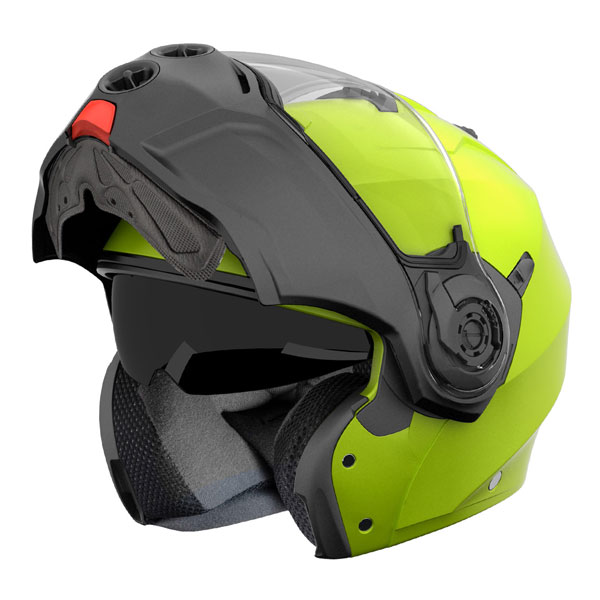
At the time of writing, there’s a matt black/white version of the droid – called Metal black or white, and a classy gun metal matt version. They also do a hi-viz green version called Hi Vizion. Aside from those plain colors, there’s three color schemes using the Blaze design. They’re all shown on this page.
If you’re looking to buy a Droid, feel free to click through to the Caberg Droid helmets pages of our trusted retailers below to see any new designs and get the latest prices for the Droid. Click here to find out more about our recommended retailers and why you should trust your hard earned money with them.
[xyz-ihs snippet=”Caberg-SBS-GG-GB”]
This one’s the Caber Droid Blaze in yellow/black
Other stuff – fasteners, weight, warranty
The Droid comes with a micrometric fastener. If you’re not familiar with them, they’re really easy to use and safe as houses.
It weighs around 3.4lbs (1.55Kg) (depending on size) which is surprisingly light for a polycarbonate modular.
Finally, warranty. Caberg only give a one year warranty on all their helmets. Which isn’t great because lots of makers now give a five year warranty which covers their helmets up to the point at which most makers agree it’ll need renewing. Come on Caberg, time to up the length of your warranty!
Side view of the matt white Metal Droid
Alternatives to the Caberg Droid?
We’d say have a look at the HJC IS-Max II – that’s SHARP 4 star rated with most of the features of the Droid but for less money – same goes for the AGV Compact and the Lazer Paname which are both 4 star safety rated with sun visors too.
Going up the price scale from the Caberg Droid, there’s the X-Lite X-1003 – SHARP 4 star, 100% chin guard locked, Pinlock, a wee bit heavier than the Droid and a bit more expensive too.
And if we’re looking at modular helmets then we’ve got to include a Shark – in this case the 4 star Shark Evo One with its chin guard that rotates to the back of the head – it’s dual homologated too and includes a Pinlock Max Vision.
And of course, there’s the hugely well rated duo of the Caberg Duke and Tourmax – they’re both cheaper than the Droid and both are SHARP 5 star safety rated (that’s the maximum!) though the Tourmax is more a dual-sports style modular and a bit heavier.
Bell Moto-9 and Moto-9 Flex Motocross helmet review
Along with the cheaper Bell MX-9, the Bell Moto-9 range of helmets has been the mainstay of Bell‘s motocross crash helmet range for some time now.
But there’s a couple of different helmet technologies going on within the Bell Moto-9 range, because there’s both the ‘standard’ Moto-9 and then there’s the Moto-9 Flex.
The Flex is their top-of-the-range pro-level dirt bike helmet featuring their ‘Flex’ multi-density and flexible helmet liner that’s designed to mould slightly to the wearer’s head shape as well as give improved control of shock-absorption. The first layer of the liner is also designed to move slightly under impact to absorb some of the rotational forces which can cause brain injury (for more, see the Safety section below).
So there’s the Flex, but there’s also the more conventional range of standard Moto-9’s. These non-Flex Moto-9s are composite fiber helmets with a more standard polystyrene shock-absorbing liner without the rotational absorption. They’re still great helmets (read on to find out why), but it means they’re getting on for a couple of hundred less than the Flex version.
A great performing dirt bike helmet. This one’s the Bell Moto-9 Flex in Seven Yellow design
Please click below to visit the Bell Moto-9 pages at our recommended stores – all checked for great online ratings. And if you buy from any store, we get a small sum from the sale at no extra cost to you – a massive THANKS! (it’s how we finance the site).
Safety
First off, Bell have an excellent reputation for making helmets that give great protection. They’ve been either our top-rated or joint top-rated best brand for safety for a few years now. That’s based on how well the helmets have performed in the comparative SHARP helmet safety testing – so we’re pretty confident that most Bell helmets on the market today will give you at least a good level of protection.
Having said that, the Bell Moto-9 hasn’t been tested by SHARP. It is DOT certified – and because it’s on sale all over the EU we’re assuming it’s also ECE 22-05 certified (though none of their websites actually say it is!) and it’s also been Snell tested/approved in the US.
So, there’s lots of stickers and certifications that tell you the Moto-9 should be a safe helmet. But lets have a look at the features it offers.
First off, when comparing the standard Moto-9 over the Moto-9 flex, they use different helmet shell materials as well as shock-absorbing technologies.
The non-Flex Bell Moto-9 looks identical to the Flex version. Here’s a standard Moto-9 in Spark red design
Bell Moto-9 – standard version & MIPS
The Bell Moto-9 (non-Flex version) comes in two different helmet shell materials. The basic Moto-9 is a tri-composite shell but there’s also a carbon-composite version that incorporates a layer of carbon fiber. Carbon helmets are usually the lightest helmets, though Bell don’t make any claims that the carbon composite version is any lighter than the tri-composite. So we’re assuming here that the inclusion of carbon is probably mostly there for cosmetic and marketing purposes – i.e. we love a bit of carbon on our lids.
The standard Moto-9 also has a more conventional type of shock-absorption technology. That’s the type of EPS or expanded polystyrene liner that’s used on most helmets today – and very effective it is too.
This standard version has mostly been replaced in store by the Moto-9 MIPS. MIPS is similar to the Flex system below – in that the shock absorbing liner inside the helmet allows a certain amount of movement of the helmet independently of your head to reduce rotational forces during an impact. Read more about MIPS in our Bell Star review.
Bell Moto-9 – Flex version
The Flex Moto-9 is a very different beast though because Bell have put a lot of R&D into developing an alternative type of shock absorbing here.
The Flex Moto-9s all have a carbon-composite shell. Carbon shells are tough and they’re typically lighter than other helmet shell materials although, again, Bell claim the same weight for both the Flex and standard helmets.
The Bell Moto-9 Flex has a trick lining designed to improve shock absorption and reduce rotation
Inside the helmet, Bell have used three layers of material to help absorb energy at different speeds. Usually, makers use different densities of polystyrene, but Bell use a layer of expanded polyolefin, another of expanded polypropylene alongside the more usual expanded polystyrene to try and target specific impact velocities.
Whether it’s an improvement on polystyrene or more of a marketing angle is hard to say, but using multiple densities is a tried-and-tested formula that has worked very well over the years.
The layers in the Moto-9s lining aren’t bonded together but are separate. That’s because the lining in the Flex is designed to rotate independently of the head during an impact to try and reduce the rotational forces passed to the rider.
Rotation is a massive issue during an accident as it can cause neck injuries and brain injuries.
Without getting too gruesome, during an impact where a helmet hits the road at speed, it starts rotating. The instant this happens, the head inside the helmet rotates, potentially causing neck damage. At the same time, the brain doesn’t rotate at the same speed as the rest of the head, causing potential damage as the irregular surface inside the skull moves against the surface of the brain.
So it’s great to see Bell and a few others making real attempt to minimise impact rotation.
In the case of the Moto-9 Flex, the inner lining that’s in contact with the head can rotate freely (to a point) against the second polyolefin layer. This means the helmet removes some of the rotational force from the impact. And that’s gotta be a good thing!
You can also get the Moto-9 (non Flex version) in carbon composite. This is the Tagger carbon
Other Safety Measures
Other than these differences between the models, there’s a range of other safety measures all Moto-9 helmets share.
They’ve all got EPS behind the chin guard – that’s unusual to find on a helmet but a welcome addition that we’d like to see on more helmets.
They all come with a double-d ring fastener – a bit fiddly but safe as houses if you tighten them up correctly each trip.
They’ve all got EQRS or emergency quick removal system cheek guards. That means emergency services can easily pull cheek pads out of the helmet to help removal of the helmet and avoid neck injuries while doing so.
Not only that, but all Moto-9’s are Eject Helmet Removal System ready. That’s an innovative little expandable plastic bag that’s fitted inside the helmet at the crown of the head linked to a rubber tube. A paramedic can then pump air into the tube, expanding the bag and thereby pushing the helmet off the head, again minimising the risk of neck injuries. A great inclusion that. If you’ve never seen it before, here’s a quick video showing how it works.
Flex version of the Moto-9 in Syndrome solid matt black
Helmet Noise
Bell don’t say they’ve tried anything special to reduce noise on the Moto-9s. And other than talk of thick, plush comfort linings, there’s nothing to suggest that it’ll be any good.
However, a couple of owners commented that it’s a really quiet helmet with one in particular saying he found it unnerving how much quieter he found it that his previous dirt helmets.
Which is pretty much what we always find: we tend to judge helmet noise in relation to how noisy our previous helmets have been. So I guess that guy was probably used to wearing really noisy helmets.
Also, it’s very much dependent on your riding style and type of bike you ride.
Having said that, no one we came across reckoned it was noisy either (which we usually find). So either motocross guys don’t give a hoot about helmet noise – I’m guessing that’s broadly about right – or the Bell Moto-9 seems to be quiet for a motocross helmet. So we’re opting for a bit of both in our review score below.
Ventilation
Rear of the Moto-9 Flex Vice showing rear exhaust vents
The Moto-9 has what Bell call their Velocity Flow Ventilation System. That’s essentially a load of vents in the front and a load of exhausts – and the faster you go, the more air is channeled into the lining of the helmet and out of the back.
Nothing new there then. It’s what most helmets do.
What is new is that the segmented shock absorbing lining of the Moto-9 Flex means there’s a lot more spaces to let air through onto your head.
There’s 9 vents on the front of the helmet, and the chin vent features a filter that’s removable and washable.
Overall, owners of all versions of the Moto-9 seem to think theirs is a great venting helmet. Obviously, like any helmet, the amount of air that’s going to get in and circulate is very dependent on how fast you ride. And of course most motocross riders are riding slower than road riders. But that said, owners agree that it gives good ventilation at track speeds and, while it’s not the best on the market, it’s well rated.
Visor & Goggles
Top down view of the peak on the Moto-9 Flex Vice in black
The Moto-9 has Bell’s Flying Bridge Visor – that’s an adjustable visor with air intakes. It’s been designed so you can adjust it without tools and in gloves and there’s quite a lot of up/down adjustment to be had.
In addition, the Moto-9 has a nice large face opening that’ll accommodate pretty well any google you throw at it. Reports are that owners with Dragon NFX, Oakley Air Brake, Pro Grip and Hustle goggles all found them to fit well inside the Moto-9.
Comfort & Sizing
Inside all Moto-9’s, there’s a moisture-wicking and removable/washable lining. With the Moto-9 Flex, you also get their X-Static XT2 silver liner – essentially that’s an anti-bacterial silver thread woven into the liner to keep the helmet fresher for longer.
The lining on all Moto-9s is particularly easy to remove. That’s largely down to the EQRS cheek pad removal system which in Bell’s case doesn’t use studs like most manufacturers, but uses super-strong magnets. That means pulling them out and replacing them is very easy and quick. That’s what Bell term their Magnetfusion system which is also used on the end of the chin strap to stop it flapping around – though a couple of owners we came across say it’s too weak for use here and doesn’t work very well.
Owners agree that it’s a very comfortable helmet though. It’s designed to fit the usual intermediate oval head because that’s the shape of head most North Americans and Europeans have. And as long as that’s your head shape, you should find the shaping and the lining of the Moto-9 a good place to put your head.
Standard Moto-9 in yellow camo design
Note however that some owners reckon Bell’s sizing runs about half a size small – so if you’re usually a medium, Bell’s version might be about a medium/small. We suggest if you’re between helmet sizes (learn how to measure your head here) then opt for the larger size. And if you’re unsure, maybe order a couple of sizes with a view to sending one back (our recommended retailers all offer no-quibble refunds with no restocking fee).
Looks & Graphics
Motocross helmets are all about form over function. Even so, the Moto-9 is a bit of a looker, helped by the wide range of funky graphics available.
To see the latest range of designs and their latest offers, please click the links through to our recommended retailers below. For more information on why you should buy from our recommended retailers and to see some of their key terms and conditions at-a-glance, click here.
Best places to buy a Bell Moto-9?
Please click below to visit the Bell Moto-9 helmets pages at our recommended stores – all checked for great online ratings. And if you buy from any store, we get a small sum from the sale at no extra cost to you – a massive THANKS! (it’s how we finance the site).
Bell Moto-9 Videos
Here’s a look over the Moto-9 Flex by MX Action magazine (skip to 30s to get to the meat).
Other stuff – weight, build quality, warranty
The Moto-9 is advertised as weighing in at 3.2lbs (1.45Kgs) which is about average for a motocross helmet. Interestingly, Bell claim the same weight for their carbon-composite helmets as they do for their tri-composite standard helmets. Which possibly points to them swapping out a layer in the tri-composite to add in a carbon fiber layer mostly for the looks?
The Moto-9 flex Day in the Dirt helmet
Build quality on Bell helmets has always been excellent and the Moto-9 is similarly well built with several owners commenting that the fit and overall finish is great.
Finally, all Bell helmets come with a 5 year warranty. That’s a great warranty and lasts as long as most manufacturers say a helmet should last before replacement.
Overall/Summary
Bell Moto-9s are great motocross helmets. Developed alongside pro motocross riders, it’s well built and offers all the features you’d hope for in a modern motocross helmet. That includes good ventilation, noise suppression and comfort which are all rated highly by owners. Couple that with Bell’s reputation for making safe helmets – along with the Snell certification and the innovative Flex system on the Moto-9 Flex – and we’d expect it to offer as much safety as is possible with current helmet technology. And with the standard Moto-9 in the line-up alongside the Flex version, there’s a model to suit most pockets too. If you’re in the hunt for your next dirt bike helmet, then you really should check out the Bell Moto-9.
[xyz-ihs snippet=”Link-to-guides-page”]
Front view of the Moto-9 Flex Vice
Alternatives to the Bell Moto-9?
First off, if you’re getting the feeling the Moto-9 is a bit overkill for your motocross needs (it is a pro helmet after all!) we recommend you take a look at it’s baby bro the Bell MX-9. That’s tons cheaper and a bit heavier, but still comes with Bell’s five year warranty.
If you’re after a very light helmet, we’ve a couple of recommendations. First off, there’s Shoei’s VFX-W – that’s a really light fiberglass helmet with EQRS and nice a wide goggle hole! Or if you’re not wanting to spend much money and want a REALLY light helmet, check out the super light weight Airoh Twist.
Finally, we recommend you check out the AGV AX-8 – they’re lighter than the Moto-9s too with a nice wide view port and are available in the same sort of price range as the Bell.
Looking to buy a Bell Moto-9?
Please click below to visit the Bell Moto-9 pages at our recommended stores – all checked for great online ratings. And if you buy from any store, we get a small sum from the sale at no extra cost to you – a massive THANKS! (it’s how we finance the site).
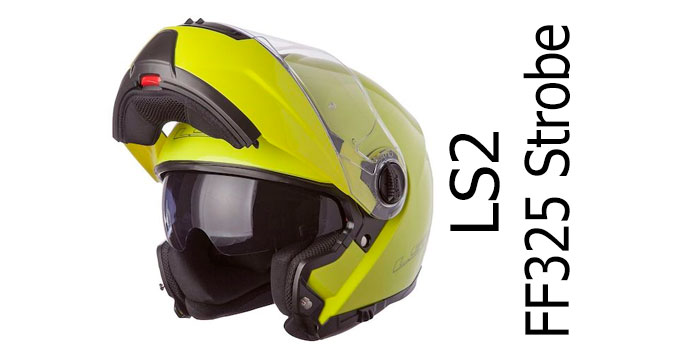
A look at LS2’s polycarbonate modular crash helmet – the LS2 FF325 Strobe
The FF325 Strobe is Chinese helmet maker LS2‘s entry-level flip-up crash helmet. LS2 say it’s aimed at sports-touring riders, which really means more or less anyone and everyone, from commuters to sunday riders and long distance tourers.
As soon as you hear the words ‘entry level’, you start looking for the cost-cutting and money-saving because we know that’s how companies make their entry level helmets right? They usually develop a polycarbonate/thermoplastic shelled model (two names for effectively the same type of helmet material) with a view to releasing it without some of the bells and whistles we’re all increasingly taking for granted in a helmet.
So, with that in mind, let’s take a look at the LS2 FF325 to see if we can find out where LS2 has cut corners, and find out what existing Strobe owners think of their helmet.
Please click below to visit the LS2 Strobe helmets pages at one of our recommended stores and Amazon. And if you buy from either store, we get a small sum from the sale at no extra cost to you – a massive THANKS! (it’s how we finance the site).
Safety
The LS2 FF325 Strobe seems to do pretty well on the safety front.
It’s both ECE 22.05 and DOT certified, meaning it’s passed the mandatory safety testing required before it can go on sale in Europe (that’s the ECE bit) and LS2 confirms its helmets comply with the US DOT requirements. For more information on those, click the links.
FF325 Strobe in full-face mode. This one’s the plain matt black version
The Strobe hasn’t been Snell tested but has been tested by the SHARP crash helmet safety labs where it scored 3 stars out of 5, which is OK but not the best (see our alternatives section at the bottom of the page for some suggested and recommended flip-up helmets that will score four and five stars for safety).
Crucially for a modular helmet, SHARP noted that the chin guard remained closed and locked in 100% of its impact tests. That’s a great result and surprisingly not that common in a flip-up helmet – and probably testament to the solid metal locking mechanism used by LS2.
Of course, you need a helmet to protect you when you hit the ground or skidding along the road, which is why we pay such close attention to SHARP helmet tests.
But there’s other stuff on a crash helmet that’ll help you avoid an accident in the first place.
The Strobe’s got most of the other features you’d hope for in this respect.
Civik graphics are about as way-out as the Strobe gets
There’s a drop down sun visor so you don’t get too caught out by the sun – though as usual, a few owners reckon the tinting is a bit too light for when the sun’s full in your face.
The FF325 also has a micrometric fastener on the strap. They’re widely regarded as safe as houses and really easy and convenient – though you do have to ensure the strap remains correctly adjusted as the strap stretches over time.
So, overall for safety, the LS2 FF325 Strobe has many of the features you’d look for in a helmet and there’s no obvious cost-cuttings gone on here. Just a slightly weaker SHARP performance compared to some of the best-tested modulars on the market lets the Strobe down a little.
Helmet Noise
Chin guard in max raised position. The strobe just has one release button
As usual – a word of warning on how noisy you’ll find the LS2 Strobe.
How noisy or quiet you’ll find the Strobe is very much dependent on things like how noisy your existing helmet is, your riding style, how fast you ride, type of motorbike you ride and so on.
That’s reflected in the feedback given by owners of the LS2 FF325 Strobe whose opinions vary quite a bit.
What’s for certain is it’s not the quietest helmet. But then again, modular helmets are usually on the noisier side (even those that claim to be whisper quiet!).
Most owners reckon it’s either noisy or quite noisy. The occasional one or two do say it’s quiet, but overall, we’d expect you to find it’s noisier than average.
A couple of owners said the noise seems to come in mostly from the vents and closing them quietens things down a bit. But that’s not very helpful if you’re riding along in the summer!
So, if you’re thinking of buying a LS2 FF325 Strobe, go into it expecting it to be quite noisy and buy some decent ear plugs to wear when you’re riding and you shouldn’t be disappointed.
Ventilation
Consensus seems to be that the ventilation on the Strobe is OK but could be better.
It has the conventional array of vents – from a dual chin vent and single crown vent – all venting through the internal shock absorbing liner to take air through to the scalp.
Owners seem to agree that the ventilation is about average – typical comments are that it keeps you reasonably cool but could be better.
There’s also a few comments about the shield vents not managing to keep the shield fog-free at low speeds. However, that’s common on most helmets and why anti-fog Pinlock inserts (or in this case LS2’s own version of a Pinlock) are becoming so popular.
The LS2 FF325 Strobe comes with what LS2 call their Twin Shield System – but what the rest of us call a clear main shield and drop down sun visor!
Having said that, it’s still great to have both in an entry-level modular helmet and from owners comments, they work very well.
LS2 Strobe Civik in blue and black
The main clear shield works on a ratchet and is a quick-release shield. Having a quick release shield on a flip-up helmet is still novel enough to be worth a mention, and in the Strobe’s case it’s LS2s very good ShortShift system.
You’ll notice there’s two round pins on the shield if you look closely at the pics. Usually, they’re locating pins for a Pinlock anti-fog insert, but if you’re used to seeing Pinlock pins, you’ll notice that these are a bit lower down the shield than normal.
That’s because they’re locating pins for LS2’s own version of the Pinlock, the FogFighter. So if you want an anti-fog insert to fit to the rear of your shield to keep it nice and clear, then don’t go looking for a Pinlock for the Strobe and search for a FogFighter instead. They usually sell for around $30.
Overall, folks say the main shield is a good un. There’s one or two comments about the cracked open position being too big and letting too much air in. And there were a similar number complaining their shields were too stiff to open (which sounds to me like there was a bad batch of Strobes around towards the beginning of the production run). It looks like it should be sorted now though.
One final note. The Strobe’s main shield is an optically correct shield. That means it should be distortion-free and, again, is something we rarely see in such an entry-level helmet.
Wineberry strobe with sun visor lowered (notice sun visor slider bottom right)
Sun Visor
The sun visor is operated by a slider on the bottom left of the helmet. Moving the slider operates the sun visor by a cable and it’s an analogue version – meaning you can part lower the sun visor as well as having it fully down (some are up or down and nothing in between).
As with most sun visors, a few folks say the on fitted to the FF325 Strobe is a bit too light; but that’s normally because there’s a legal limit to how dark a sun visor can be in most countries meaning LS2 have to comply with those regs.
If you live somewhere really sunny, then you’ll probably use the helmet’s sun visor in addition to some sunglasses. Which is fine because the Strobe has glasses grooves to make fitting and wearing glasses much more comfortable.
Again, even though the LS2 FF325 Strobe is an entry level, budget modular, we’ve not really found any short-cuts or cost cutting made by LS2 so far.
Chin Guard
There’s two main points to make about the chin guard on the LS2 Strobe.
First, it’s easy to use. To open it, there’s a single large button underneath the chin guard to press and that’s it. Raising the chin guard couldn’t be simpler.
Second, it should be as safe as they come. You see, when a modular helmet is tested by SHARP, they note how often the chin guard becomes unlocked. And if you read our articles on SHARP testing or our visit to the SHARP testing labs, you’ll know that many flip-front helmets fair badly on this test.
Top view of the black & white Civik FF325 Strobe with chin guard fully raised
If our records are correct, the lowest score by any modular helmet showed it stayed locked just 17% of the times it was tested (that was an old Marushin M401 btw – a helmet that’s no longer available thankfully!).
So for the LS2 Strobe to score 100% is an excellent performance and means you can be as sure as you can with any modular that the chin guard will stay locked in an accident.
Which is precisely what you expect with a modular right?!
Comfort & Sizing
Overall, owners say the FF325 is a comfortable helmet, though there’s mixed reports on the sizing, so read on.
Most buyers reckon the sizing’s way out. They say the Strobe is smaller than you’d expect – so order one size and in some cases two sizes larger than you’d expect.
But it’s mixed messages as others say the sizing is spot on.
From our research, there’s more people ordering a size above their usual helmet size (or their measured helmet size) and we’d go with that. But make sure you order from a retailer who’ll happily accept returns without quibbling – and preferably from one who’ll pay for the returns (some of our recommended retailers will do this).
The Strobe is designed for intermediate oval shaped heads (that’s most of us) though a few folks with very long heads said it fits them perfectly too.
Inside the LS2 Strobe, the lining is removable and washable and it’s made from breathable and hypo-allergenic fabrics. There’s also a glasses groove in there so fitting and wearing glasses with the Strobe should be comfortable.
Hi Vis yellow LS2 Strobe
There’s lots of comments by owners saying how comfortable their Strobe is so, as long as you get one that fits right with no pressure points, (and don’t forget, having a helmet that fits right should be your number one safety priority when buying a new helmet) then we don’t expect you to have any problems here either.
Looks & Graphics
The LS2 FF325 Strobe probably isn’t going to win any awards for innovative design. But then it wasn’t intended to. It’s designed to appeal to as many riders as possible so LS2 have made a pretty conventional helmet design with some reasonably ‘safe’ graphic options.
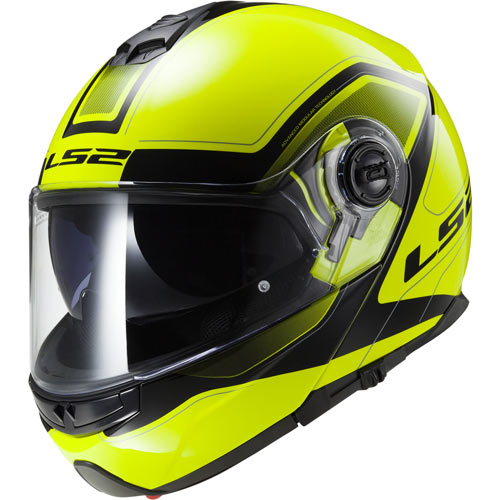
If you’re after a high-viz helmet, you’ll find the hi-viz Civik Strobe and there’s also the gloss black and white along with a cool titanium grey Strobe. Apart from these, the Civik comes in black/white and black/blue versions. Finally, there’s a classy solid colored Strobe wineberry burgandy version around.
For any other design options and to check the latest deals (or just to buy one because they’re such a decent price) visit our recommended retailers by clicking one of the links below. To find out stuff like delivery costs and returns policies, make a note of the retailers mentioned below then click this recommended retailer link for at-a-glance information before buying.
Looking to buy an LS2 Strobe?
Please click below to visit the LS2 Strobe helmets pages at one of our recommended stores and Amazon. And if you buy from either store, we get a small sum from the sale at no extra cost to you – a massive THANKS! (it’s how we finance the site).
LS2 FF325 Strobe Video
Here’s a video giving you a look around the Strobe from the dude at Competition Accessories.
Other stuff – audio, weight, build quality, chin curtain, warranty
There’s no specific bluetooth communicator designed to work with the Strobe, and it’s worth being aware that a few owners (not to mention the guy in the video above) reckons that the sun visor slider might get in the way of mounting your bluetooth. If you’re planning on mounting one, take a good close look at the pics of the helmet to make sure you think it’ll mount OK before buying.
Plain gloss White strobe
A medium size LS2 Strobe weighs in at about 3.4lbs (1.55Kg) that’s lighter than the average flip-up helmet so shouldn’t feel too heavy on the bike.
Most owners rate the materials and build quality as being very good. Having said that, I think most take into consideration that the Strobe is a lower-priced helmet so they’re not expecting Arai or Shoei levels of build quality in the first place. They say it feels sturdy and solidly built. There have been a few moans though and it does sound like there was a batch of helmets with quality issues around the comfort lining pulling away and the chin guard and visors becoming stiff and difficult to operate. However, that seems to be resolved now and most owners are surprised at how well built their Strobe feels.
Having said that, many owners report the chin curtain can come off very easily. It is designed to be removable and it does clip back in, but it’s obviously annoying several owners.
LS2 does give a full five years manufacturer’s warranty with the FF325 Strobe though, so if you do have any build-quality problems, you’ve always got that warranty for piece of mind.
Overall/Summary
Well, we set out to find out where LS2 have cut corners with the FF325 Strobe – and we came up empty-handed.
LS2 seem to have made a great helmet with some premium-level features (I’m talking about you, optically correct, quick release shield!) that would shame some helmets at twice the price.
But apart from these blemishes, it’s a great helmet. That chin guard is super easy to operate (and shouldn’t open in an accident). Fit LS2’s Fog Fighter and the shield should be fog-free. The sun visor is great and the slider makes it really easy to use. It’s also comfortable and has a quick release main shield which many modulars at a much higher price point still lack.
It’s a shame it drops a star or two for safety so we can’t add it to our recommended modular helmets list.
But that’s not to say it’s one to avoid. At this price, the LS2 FF325 Strobe is a great helmet and well worth checking out when you’re in the market for a new flip-up helmet.
[xyz-ihs snippet=”Link-to-guides-page”]
Alternatives to the LS2 FF325 Strobe
It’s amazing what you can get for your money these days. The Strobe offers great value but there are one or two others worth checking out too (and of course check out our top 10 flip-up and modular helmets list).
First off, there’s the Shark Openline. That’s Sharks own entry-level modular. It’s another SHARP 3 star modular helmet with sun visor and Pinlock anti-fog insert in the box.
The Lazer Paname is worth a look too – that’s a SHARP 4 star safety rated flip-up helmet, again with a sun visor and Pinlock included.
If you can stretch to around the $300 mark, you should also take a look at the AGV Numo Evo – that’s a four star safety rated helmet that’s got excellent ventilation and is rated highly for comfort.
[xyz-ihs snippet=”LS2-cat-link”]
Looking to buy an LS2 Strobe?
Please click below to visit the LS2 Strobe helmets pages at one of our recommended stores and Amazon. And if you buy from either store, we get a small sum from the sale at no extra cost to you – a massive THANKS! (it’s how we finance the site).
Schuberth R2 – the all-rounder full-face glass fiber crash helmet
The Schuberth R2 is designed to be Schuberth’s all rounder helmet; meaning as long as you’re not spending hours in an extreme tuck position on your sportsbike, or laid waaaay back on a chop, it should work just fine.
Even though it’s not cheap, it is one of Schuberth’s lower priced helmets. And for the money, it does come with some interesting goodies – including integrated SC1 bluetooth antenna/mic/speakers. So if the price is about right for your pocket, then it may well be worth a look.
Please click below to visit the Schuberth R2 helmets page at our recommended store – checked for great online ratings. And if you buy from them, we get a small sum from the sale at no extra cost to you – a massive THANKS! (it’s how we finance the site).
Matt black Schuberth R2. Note all R2s will come with clear shield as standard.
Safety
Despite most Schuberths commanding a premium price, you might be surprised to know that Schuberths don’t have a great reputation for safety.
Schuberth don’t submit their helmets for Snell testing, but the old Schuberth R1 was tested by the UK SHARP labs where it scored a lowly 2/5 stars – with Schuberth’s average score across seven tested helmets is a distinctly average 3 stars. Not amazing for a premium-priced helmet.
With the R2, they use a new production process in making the fiberglass shell called Direct Fiber Processing which they think will lead to a more uniform layer of fiberglass and strengthened shell.
Though as we’ve seen, the best helmets don’t have a strong/hard shell but seem to hit that sweet spot between a strong but flexible helmet shell and quality shock absorbing liner.
Schuberth also say they use a multi-part EPS lining which helps with energy absorption during an accident.
When the UK testing folk at SHARP got their hands on a few ECE R2’s in early ’19, they scored it 3 stars out of a maximum 5 for safety. Given Schuberth’s past history, that’s entirely expected.
It’s also a slightly lower score than the average across all helmet types tested by SHARP, which is around 3.5 stars out of 5. So given the price you pay for a typical Schuberth, that’s not a great safety score.
Schuberth are also adding an emergency quick-release system (EQRS) to the comfort lining – there to help medics remove a helmet with the minimum of complications after an accident. And they also use a Double-D ring fastener, sighting the fact that a double d ring has to be re-adjusted with every ride; which is definitely a benefit for safety – as long as the rider can be bothered to adjust it correctly.
R2 Nemesis comes in hi viz yellow, white or blue versions
Research suggests that around 8% of fatal accidents involve the helmet coming off. So fasten up carefully guys.
Ventilation
Schuberth say the R2 will have a single chin vent and crown vent and use channels in the EPS to take air through the helmet.
Most helmets these days have double-vents up top so it’ll be interesting to see if the R2 manages to catch enough air to push into the helmet to really drive that cooling and ventilation. Quality engineering is also needed to design effective cooling channels in the shock-absorbing liner and match that up with the external intakes. Not all manufacturers manage it.
Shield
Good ventilation helps immensely with keeping the shield fog-free too, but the Schuberth R2 will also come with a Pinlock ready shield (tbc if there’s a Pinlock insert in the box).
All R2s come with Pinlock-ready shields. This one’s the R2 Enforcer hi viz
If it does, it’ll have to be a Max Vision insert as Schuberth have made the shield opening as wide as possible to improve peripheral vision.
That’s a good thing in any helmet as long as they’ve managed to increase shield width and maintain structural integrity. We’ve seen some makers make massive shield openings but the side-impact test results show real weakness at the side of the helmet, arguably because the helmet’s been weakened because of the massive shield hole!
Early versions of the R2 show a non-ratchet shield but it does come with a lever-based quick release system for the shield. Pictures also show Schuberth looks to have ditched their turbulators along the top of the shield (Schuberth reckoned they reduced wind noise) though a few seem to have sprouted above the shield pivot and along the side of the helmet. We’ll find out if they work once owners have ridden with the R2 later on in 2017.
Comfort & Sizing
Schuberth’s website say they use ShinyTex, Oko-Tex 100 linings inside the R2.
Oko-Tex 100 is an international certification program that ensures a fabric isn’t harmful to the end user – so stipulates certain manufacturing processes and materials aren’t used. So if you’ve particularly sensitive skin, then that might be good for you.
As far as we can find, ShinyTex is a Chinese textile company so that’s not really a massive benefit to us!
Gloss white Schuberth R2. Note single chin and forehead vents
Other than that, the R2 interior is removable/washable, anti-bac and designed to be fast-drying. They also say they’ve designed it to be seamless so you don’t get any seams digging in (good plan).
Looks, Aero & Graphics
The Schuberth R2 is a clean-looking and minimalist helmet. Any aero features hasve been built-in to the actual helmet shell rather than stuck on in the form of spoilers or winglets. That should also help with reducing helmet noise too – something in keeping with the stated goals of Schuberth. They use wind-tunnels in the development of their helmets and sculpt their shells not only to be aerodynamic and stable, but to reduce noise as much as possible.
As for graphics, designs released so far are reasonably classy and understated – in line with most of the designs released by Schuberth on their existing helmets.
They produce a matt and gloss black version and a gloss white. There’s also a few hi-viz fluorescent versions in most of the designs – including the Renegade (helmet at the top of the page), Nemesis and Enforcer.
There’s bound to be some more graphics available after launch though, so click the links through to our recommended retailers after its launched in 2017 to see the latest designs and prices.
Best places to buy a Schuberth R2?
Please click below to visit the Schuberth R2 helmets pages at our recommended store – checked for great online ratings. And if you buy from them, we get a small sum from the sale at no extra cost to you – a massive THANKS! (it’s how we finance the site).
Schuberth R2 Video
Here’s a detailed 12m look around the Schuberth R2 from the Revzilla man.
Other stuff – warranty
The Schuberth R2 will come with a five year manufacturer’s warranty – that’s up there with the best warranties in terms of length of time covered.
This one’s a grey version of the Enforcer graphic
Overall/Summary
We’d expect the R2 to be a good helmet to live with. Schuberth put a great deal of effort into making a really usable helmet, and they’re usually good build quality too.
And with stuff like a nice wide shield and in-built Schubert SC1 communicator mic/speakers and antenna, Schuberth are continuing to make modern-looking helmets that have everyday usability in there as standard.
Just don’t expect it to offer the best protection on the market because when the UK SHARP safety testing crew tested a bunch of ECE Schuberth R2s, they scored it a below average 3/5 stars for safety.
[xyz-ihs snippet=”Link-to-guides-page”]
Alternatives to the Schuberth R2?
There’s the 5 star rated AGV GT Veloce – that’s a composite fiber sports-oriented helmet with a big shield aperture. It retails for about the same price as the Schuberth R2 too.
Or how about an X-Lite X-702 GT – that’s another SHARP 5 star composite helmet that’s light and excels in pretty well everything (noise, comfort and ventilation). Again, it’s around the same price as the R2.
Looking to buy a Schuberth R2?
Please click below to visit the Schuberth R2 helmets page at our recommended store – checked for great online ratings. And if you buy from them, we get a small sum from the sale at no extra cost to you – a massive THANKS! (it’s how we finance the site).
Nexx X.R2 composite and carbon fiber full face crash helmets
With the launch of the Nexx X.R2, Portugese helmet maker Nexx claims to have made one of the lightest full face crash helmets on the market. The carbon versions weigh in at around 1.27Kg while the composite versions are around 100g heavier. And while we’ve seem other helmets on the market around this weight (check our lightweight helmets section), they’re pretty few and far between.
One of the reasons they’ve tried to make it so light is that it’s a road bike helmet but with track aspirations – so if you’re at the track all day, slamming your bike around for lap after lap, then every gramme counts.
But it’s one thing to make a lightweight helmet – and entirely another to make it lightweight and work really well as a safe and user-friendly track or day-to-day helmet.
So here’s the lowdown on what the Nexx XR2 delivers and what owners think of their XR2s – warts and all.
This one’s the Nexx XR2 Anima. Note all XR2s come with a clear shield
Looking to buy a Nexx X.R2?
Please click below to visit the Nexx X.R2 helmets pages at Amazon and Revzilla, one of our recommended stores. And if you buy from either store, we get a small sum from the sale at no extra cost to you – a massive THANKS! (it’s how we finance the site).
Safety
The Nexx XR2 is both ECE and DOT certified so you can be happy that it’ll give at least a decent, basic level of protection.
That’s OK but not great – though as we, and SHARP point out – your first priority when buying any helmet is to buy a helmet that fits perfectly before a great SHARP helmet rating. Though if you can get both, then happy days!
So if you’re after a helmet that’s gonna give maximum protection, you might want to check out one of our SHARP 5 star helmets.
Looking at the SHARP results, the XR2 drops a mark or two on side and rear impact tests. It’s got a very wide shield aperture (see shield section below) so I guess it’s possible that this has weakened the side impacts a little? Just a thought.
Otherwise, there’s some good safety features that you’d like to see in any helmet to be found in the Nexx.
Mean looking XR2 Dark Devil
First off, there’s the multi-density shock absorbing lining. There’s also a smattering of reflectors on many of the designs and they all have a decent double-d ring fastener on the helmet strap.
There’s also an EQRS or emergency quick release system to help paramedics quickly remove the cheek pads and (hopefully) slide the helmet off without disturbing your spine in the event of an accident.
And of course, that nice wide shield should give you an edge to help see anything creeping up on you in your peripheral vision.
So the XR2 packs a lot of safety features – it’s just a shame they didn’t manage a better score with SHARP!
Helmet Noise
As we find with lots of helmets, Nexx XR2 owners express a wide variety of views on how noisy or quiet their XR2s are.
Taking all these views into consideration, we’re gonna have to plump bang in the middle and say it seems to be about average.
Carbon fiber ‘Carbon Pure’ XR2
Nexx seem to have done quite a bit of wind tunnel designing which should’ve reduced external noise; and their blurb reckons they’ve added anti-noise cheekpads into the mix too. And I don’t doubt any of this. But as far as noise suppression’s concerned, it only seems to bring the XR2 into line with most other helmets so scores an average rating.
Bottom line is that if you find your existing helmet really noisy, you’ll probably find the XR2 pretty good. But if you ride a ‘Wing, slowly, and you’re short and tucked behind the screen, and wear something like a really expensive Schuberth. Then you might not. It really is that dependent on how you ride, the bike you ride and how noisy your current helmet(s) is (are).
Ventilation
There’s a single chin vent and dual crown vent on the Nexx XR2.
The chin vent has a panel that can be flicked down to open it and the top vents have small three-way sliders (for closed, half open, fully open).
From rider feedback, it seems all the opening tabs are quite tricky to operate as they’re small, especially in gloves, so it’d be worth taking some time out to get the hang of them before you ride. If you do, they’ll likely become second nature to find and therefore OK.
XR2 in Fuel design
The top vents are generally thought of as great, with lots of people saying the helmet flows lots of air and you can really feel the difference when they’re open or closed.
Having said that, the middle ‘half-open’ position on the top sliders is probably pretty pointless as it’s almost impossible to find when you’re riding along – unless of course you’re someone who sets their vents before they set off (does that sort of rider actually even exist?)
Some owners seem to reckon the chin vents are a bit weedy in the amount of ventilation they offer. A couple of people said the shield can fog easily (which of course most do when it’s cold or rainy and you’re not blasting along) so it’s handy that the XR2 comes with a Pinlock anti-fog in the box (see note below).
Shield
The XR2 comes with a flat, Pinlock and tear-off ready, quick release shield – but the Pinlock insert is sold separately at around $30 or so.
X marks the spot – where you twist the shield pivot before unclipping the shield (Nexx XR2 Carbon shown)
The shield works on a ratchet and it’s massive according to loads of owners. Like most sportsbike helmets, Nexx have maximised the shield opening to give lots of peripheral vision as well as vertical vision so you can get a good view out of the top of the shield even when you’re in an extreme tuck.
And they seem to have done a great job, as most owners say it’s a really big opening – with a couple of XR2 owners saying they can’t see any of the helmet at all in their peripheral vision. Wow.
It’s possible the large shield aperture has compromised side-impact protection (see Safety section above) but if you’re after and extremely large shield opening, the XR2 is right up there with the best track/sportsbike helmets.
It’s also a quick-change shield – what Nexx call their Fastshot system – not needing any tools to remove the shield. Though it’s a bit different from most quick removal shields.
Rear view of the XR2 Carbon showing rear exhaust vents
With the Nexx, you need to turn and physically remove the plastic pin at the shield pivot before rotating the shield and snapping it out to remove. Quite a few owners find this a bit odd and complain that it feels like you’re going to break the shield when you try it (until you get used to it).
To replace the shield, you need to locate the 3 plastic pins into their holes and close the shield. Again, this can be tricky and needs a bit of practice.
Comfort & Sizing
The internal comfort padding on the Nexx XR2 is anti-allergenic and anti-sweat according to the Nexx website – presumably meaning it’s moisture wicking?
It’s also removable and washable so you can keep it fresh after a hot day in the saddle.
And while the XR2 is seen as a comfortable helmet (as usual – as long as you get the right fitting in the first place) a few folks have been left frustrated by the way the lining is fitted into the helmet, meaning there are some reports that the pads can come loose and move around inside the helmet, with at least one owner resorting to gluing them in place.
Top view of the XR2 Acid
There’s also a couple of reports that the lining in the rear of the helmet is particularly prone to coming loose, leading to questions about the QA process at Nexx.
Having said that, lots of owners reckon the finish on their XR2 is second to none – things like paint, shield and vents are mostly being bigged-up, with more than a few owners saying their Nexx is up there with the Shoei’s of this world.
It’s worth saying that a few owners mentioned the opening is very tight on the XR2, feeling like it’s pulling your ears off when you pull it on/off. Though they usually say it’s fine when it’s on and you get used to it – that’s if you can get it on in the first place.
Other than those few gripes, the sizing seems to run true.
And of course lots of people buy the XR2 because they want a helmet that’s nice and light and doesn’t give them neck strain. And this is the biggest comment made by owners – that it feels fabulously light – especially the carbon versions.
Couple that with the massive eye port and quite a few folks commented that you can almost forget you’re wearing a helmet with the XR2 and that because of the lightness they can forgive it any other shortcomings.
This one’s the Anima in black/orange
Looks & Graphics
Most of the carbon versions – that’s the Carbon, Carbon Zero and Carbon Pure, have exposed carbon weave – at least in part. And mostly look very slick and up-market.
The composite fiber versions come in the Fuel, Virus and Acid designs you’ll find up and down this page.
To check the latest prices and offers – as well as the latest designs, click the links through to our recommended retailers below.
Best places to buy a Nexx X.R2 crash helmet?
Please click below to visit the Nexx X.R2 helmets pages at Amazon and Revzilla, one of our recommended stores. And if you buy from either store, we get a small sum from the sale at no extra cost to you – a massive THANKS! (it’s how we finance the site).
Nexx X.R2 Video
Here’s a 3m look around the XR2 from the team at WebBikeWorld.
Other stuff – audio, glasses, buffeting, chin curtain, warranty
The Nexx XR2 has speaker pockets built into the lining – just remove the cheekpads to find them. Owners of both Sena 10s and 20s reported no problems with fitting their sets on the XR2.
Rear view of the XR2 Dark Devil
A few glasses wearers reported that the XR2 works really well for glasses.
Onto buffeting – it seems the small rear spoiler and the trim profile at the bottom of the helmet are great for stability as plenty of owners report that the XR2 is really stable with very little buffeting.
Final two points – the XR2 comes with both a breath guard and chin curtain in the box and has a 2 year warranty.
Overall/Summary
The Nexx XR2 seems to be a bit of a flawed diamond. There’s a strange shield removal mechanism and a few worries about some linings falling out. But on the other hand owners love how light weight it is (especially the carbon versions) and that massive shield opening is a real winner too. And that’s mostly why people bought their XR2 and why most people love it. And if you’re after a good sportsbike or track day helmet – stuff like the Pinlock and tear-off ready shield might well be handy too.
It’s a shame it didn’t score better on the SHARP safety tests but if light weight and great vision are most important to you, then you really should take a look at the Nexx XR2.
[xyz-ihs snippet=”Link-to-guides-page”]
XR2 Acid in black/orange
Alternatives to the Nexx X.R2
If you’re looking for a sportsbike/racing helmet, then the Nexx XR2 is very reasonably priced compared to much of the competition.
Of course, you can spend an awful lot more than the XR2’s $400ish by buying a Shoei X-Spirit 3 or an Arai RX-7V which will cost around double that and can be found lining up by the track-load on grids around the world. And great helmets they are too.
But you don’t have to pay that sort of money for a decent racing lid. So here’s a smattering of some interesting alternatives.
First off, the Shark Race-R Pro can be had for the same money as the Nexx. It’s a SHARP 5 star rated carbon fiber helmet that’s about as light as the XR2 too.
For about the same price as the Corsa, we’ll throw into the mix the Schuberth C3 Pro – one of the only sports-modular helmets out there. It’s only SHARP 3 star rated and, because it’s a modular, it’s heavier (though light for a modular).
Finally, for less than the Nexx, a SHARP 4 star safety rated sportsbike helmet is the LS2 FF323 Arrow. Optically correct shield, Pinlock antifog included (check retailer) – that’s gotta be worth a look too?
Looking to buy a Nexx X.R2?
Please click below to visit the Nexx X.R2 helmets pages at Amazon and Revzilla, one of our recommended stores. And if you buy from either store, we get a small sum from the sale at no extra cost to you – a massive THANKS! (it’s how we finance the site).
Summary: A well constructed flip-up helmet with no massive foibles. Useful internal sun visor, good ventilation and great Pinlock anti-fog visor. The only moans being it’s quite noisy and the micro-lock strap can be a bit clunky and uncomfortable.
The Nolan N104 is a flip up injected polycarbonate helmet that Nolan say is 100% made in Italy. But don’t hold that against them (:-) because Nolan also say it’s been designed and created by engineers who are first and foremost bikers. So it should be extremely user-friendly right? Let’s have a look…
First off, it’s got a pretty distinctive look – much more angular than most modern helmets. Reminds me a bit of the stormtrooper look – especially in white. Looks are generally subjective so we’ll leave that there – if you like it, you like it, if you don’t, have a look at our other flip-up helmet reviews to find one that floats your boat.
Comfort & Noise
It’s widely regarded as very comfortable by users. Like any helmet, it’s important to check it’s the correct fit when buying any new crash hat, and Nolan do offer replacement cheek guards to help customise the fit. If you find yours is too tight/loose, get in touch with your Nolan retailer and they should be able to find you some.
The inside of the helmet is treated with antibac and is fully removable for washing/cleaning. If you look inside, you can see the ventilation channels and you can also see cut-outs for the stems of glasses (so they’re not pressing against your head) and for Nolan’s bluetooth intercom.
One of the only downsides reported by N104 owners was that, like many flip-up modular helmets, it’s is a bit noisy. That probably won’t be too much of a problem for most of us who use ear plugs but it’s nice to have the option (Nolan!). Modular helmets do suffer a little more than full-faced helmets in this respect as they’ve more latches, buttons and sundry other fiddly little bits to pop up into the airflow and generate noise. So if you’re looking for peace and quiet above all else, you’re probably best staying away from modular helmets. There’s also the issue of a great whacking chin-guard and visor mechanism sitting sail-like on the top of your head from time to time too. However, stick in your plugs and you’ll be OK.
[xyz-ihs snippet=”Nolan-Revzilla”]
Ventilation
Reports are that the Nolan’s a comfortable place to be and has decent ventilation for hot weather riders. For those of us in colder places, the vents do a decent job of keeping the visor mist free too. There’s a chin vent and, unusually, separate forehead vents, both operated by the one slider. Click the slider one position and the top vent opens, scooping up air and directing it over the head to exhaust via the vents at the rear. Move it one more notch and it opens the other forehead vent just above the visor. This one does a grand job of directing air over the visor too. The slider’s OK to use with gloved hands, so no problems here.
Shield/sun visor
The Nolan N104 comes with a main shield and a drop-down sun visor. A sun visor is pretty de-rigeur these days with most flip-ups but it’s a dead useful feature nevertheless. Nice one Nolan’s biker/engineer chaps. The main shield itself is wider than most, giving excellent peripheral vision. I’ve never had problems with peripheral vision in any of the helmets I’ve owned, I’ve gotta be honest. But I do know that racing helmets tend to have wider apertures than most road helmets so I guess the wider the better, as long as it doesn’t compromise safety. The shield itself comes with a Pinlock anti-fog insert as standard and it’s optically very good. Combine that with the good ventilation and there’s no reports of problems with fogging.
The sun visor is optically good too – it’s not the darkest visor but is good for general sun shading in most situations. There’s a big nose cut-out at the bottom of the sun visor which means that those of us with Romanesque honkers will be OK but the flipside is that some folks complain that it’s a bit too invasive on the line of sight, especially when you’re getting racy and ducking down a bit. Then again, there’s slight issues with all the alternatives – the fiddle of replacing a clear shields with a smoked shield (and getting caught out when the sun goes down) and the reflections/frame of sunglasses. In the scheme of things, the sun visor’s pretty good.
The sun visor has two positions – up and down. Press the button on the lower left of the helmet and the spring-loaded sun visor pops down, then slide the slider to retract it again. Dead simple.
The main shield movement is a little disappointing though. It secures closed by means of a little tab in the center of the shield. Undo this and it ‘ratchets’ up in a few steps to the fully opened position. If you’re like me and like riding with the shield cracked, then this is tricky as the first ratchet position is about 3 cms open (1 inch or so). So it’s either closed or too far open. Having said that, when the shield’s closed, the ventilation is really good so it’s not as much of a problem as it is on some other helmets.
And finally on the shield (crikey, isn’t there a lot to talk about with shields – almost as much as talking about tires!) the shield release mechanism on the N104 is cracking. I like Shoei’s and Arai’s for this – but Nolan’s is arguably even better. Simply press a button in the center of the pivot and the shield releases, then just press it back into place – job done.
Nolan N104 Action N-com flip up – like a stormtrooper helmet with go-faster stripes 🙂
Flip-up
No problems reported here. There’s a couple of plastic buttons at the bottom-centre of the chin guard that you need to squeeze together to release the front of the helmet and the chin guard and visor then spring up together. The mechanism works nicely – I’m not sure whether it’s because of Nolan’s patented elliptic movement gubbins which is designed to make the opening simpler (and to reduce the ‘sail effect’ of wind catching the open flip-up when it’s on the top of your head) but it’s good, with no complaints from users. There’s also a small lever to lock the guard in the up position. It’s all dead simple and effective.
Shell & Safety
Apart from scoring a nice four out of five in the SHARP safety test, it’s also passed Nolan’s own internal testing regime and of course is DOT certified/ECE 22.05 tested (as all helmets for sale must be) but that doesn’t tell you much because there’s a wide range of prices, forms and performers among all those that are DOT/ECE-approved. So, the N104 is amongst the safest helmets on the market, so you should be fine there.
There are two shell sizes available for the N104 which is good for fit, look and safety. To check out the color schemes available, click the link to the Nolan website on the right hand panel.
In Conclusion – Nolan N104
If you’re after a mid-priced flip-up (system/modular, call it what you will) helmet then this could be the one you’re looking for. Flip up crash helmets are a competitive market and there are several great ones available (check them out here) but the Nolan is holding it’s own. It’s a great price and is popular among those who have bought one with few problems reported. It’s comfortable, has great ventilation, is excellent for hot/cold riding and demisting and has an excellent dual visor system. It’s a tad noisy and the occasional person complains that the microlock/micrometric chin strap is fiddly/clunky or not well enough padded. But all in all for the money it’s a great easy to use helmet which is wholeheartedly recommended as well worth a look.
If you’ve ever owned a Nolan N104 helmet, we’d love to hear what you thought about it – please let us know in the Comments area below. For other motorcycle crash helmet reviews, visit our All Crash Helmets Reviews section or our Only SHARP 4 or 5 Star Helmet Reviews section.
MT Blade SV – a versatile, good value Crash Helmet
The MT Blade SV is an all-rounder full face helmet at the cheaper end of the pricing range from Spanish maker MT. It’s a development from the old MT Blade with the SV standing for the newly added drop down sun visor.
The MT Blade SV is both ECE 22-05 (EU) and DOT (US) certified so should provide a decent level of basic protection.
But that’s the same for any helmet for sale in those regions. Beyond that, the old MT Blade (without the sun visor) was tested by SHARP and given a decent 3 stars (out of 5) for safety. But since MT added the drop down sun visor mechanism, it probably needs testing again to get a true view on how safe the SV is (adding a sun visor requires a certain amount of reengineering of the helmet shell).
Front view of the Blade SV Raceline with tinted shield
The MT catalogue seems to reckon the Blade SV has been Snell tested/certified. However I couldn’t find any mention of MT or the Blade on the Snell website so I’m a bit dubious about that.
Having said that, MT have a growing reputation for making good quality helmets that offer decent protection (such as their SHARP 5 star Revenge and their 4 star Thunder). And, despite being at the cheaper end of the pricing spectrum, the Blade SV does have a multi-density expanded polystyrene (EPS) shock absorbing lining similar to those found on much more expensive helmets.
The Blade SV is made in two shell sizes (that’s OK for a budget helmet, read more here) and comes with a quick and easy (and safe) micrometric fastener.
It also comes with a Pinlock Max Vision anti fog insert in the box – which, if it means you’re not struggling to see on a cold and rainy morning, has gotta be a great addition (though a few owners reckon the Blade SV really needs it – see Shield section below).
[xyz-ihs snippet=”MT-generic-retailers-quick”]
Helmet Noise
Rear view of the Blade SV Reflexion fluor yellow showing three rear exhaust vents
Most helmets are quite noisy – let’s face it, you’re blasting through the air, usually in the slipstream of something fairly unslippery and turbulent like a truck or car. And feedback from owners is that the MT Blade SV is reasonably noisy too. Not mega noisy, just a few folks said it’s quite noisy.
Stick in some decent ear plugs (which you should really do anyhow) and you’ll be OK.
Ventilation
Ventilation on the Blade SV is reasonably standard for full face lids these days.
There’s a pair of inlets on the chin guard, operated by a single switch, and a couple of vents on the top of the helmet – again with an open/close switch on each – to channel air through to the scalp before exiting via the three rear exhaust vents.
Overall, opinion seems to be that the head ventilation’s pretty good. As for the face vents, those small chin vents don’t let much air in and it really needs the Pinlock fitting to keep the shield clear, especially if you’re riding slowly or the air’s cool.
This one’s the Blade SV Morph in fluorescent yellow/black
Shield and Sun Visor
Other than the tendency to fog, everything else about the visors are as they should be.
The main shield has its opening tab on the left side, works on a ratchet and works well (a couple of owners wished it could be a little wider, but no other complaints). It’s also a quick release shield – pull down a tab on each side and the shield pops out for cleaning.
As mentioned, the Blade SV comes with a nice large Pinlock Max Vision anti fog insert in the box. They’re great for keeping the shield fog-free and the Max Vision version is designed to cover more or less the entire inside of the shield so you don’t get any annoying/dangerous edges of the insert interfering with your line of sight.
The sun visor is an either up or down affair and operated by a lever by the left hand shield piovot. Some helmets have their SV slider on the top rear of the helmet which can be a bit weird/fiddly; but having it on the left hand side is much more sensible.
As an aside, the MT website mentions there is an electric shield available for the Blade SV. Electric shields are well known in the snowmobile world where things can get so cold a Pinlock just can’t cope. It’s probably a bit overkill for most of us, but if you do find yourself riding in properly freezing temperatures, it’s always an option with the Blade SV!
Solid matt black. Sun visor slider is visible near the shield pivot and quick release mechanism
Comfort & Sizing
There’s not a great deal to say about the internals. Its got a removable/washable comfort liner – what MT call their Supermax liner – and has a couple of pockets for bluetooth speakers. And that’s about it.
Of course, you’re only gonna find a helmet comfortable if you get exactly the right fitting – and that’s something that’s vital for safety too. So check our fitting guide and if you’re unsure it’s the right fit when you receive your new helmet, you should return it for a different size to double-check and make sure you’re wearing exactly the right size (and use one of our recommended retailers who all have no-quibble returns policies).
Looks & Graphics
The MT Blade SV is a modern-looking helmet with external grooves and channels that show there’s quite a bit of aero-sculpting gone on to reduce buffeting and wind resistance. It’s available in lots of funky graphics too – as well as a range of hi-viz versions and the usual solid/plain base colors.
Hi Viz Reflection version is available in orange, yellow or gloss white
MT are always updating their designs, so to see the latest range (and the latest offers) check the links to our recommended retailers below.
However, up and down this page you’ll find examples of the Solid, plain color versions, along with the hi-viz Reflexions, the Morph, Alpha and Raceline graphics.
[xyz-ihs snippet=”MT-generic-snippet”]
MT Blade SV Video
Here’s a short video we found that gives you a quick look around the MT Blade SV.
Other stuff – fastener, weight, build quality, chin curtain, warranty
The MT Blade SV comes with a micrometric fastener – if you’re after a fastener that’s really quick to use (and safe as long as you keep them correctly adjusted) then a micrometric is great.
MT Blade SV Alpha (also in Fluor green and blue versions)
It weighs about 3.2lbs (1.45Kg) – which is pretty light for a full face polycarbonate crash helmet (average weight is closer to 1.6Kg). It comes with a chin curtain to keep out the road noise and some draft from around the neck – and a breath guard to help stop the visor steaming up.
For the money, build quality seems to be pretty good – though it only comes with a one year warranty, which ain’t the best.
Overall/Summary
Owners seem to really like their MT Blade SVs. Sure, it’s a budget helmet so folks’ expectations are that it’ll be a little rough around the edges. But it’s got decent build quality, a nice finish and some great features like the sun visor and Pinlock Max Vision that make it a bit of a standout at this price. It’s not really remarkable in any way – but then it was never meant to be. It’s a workhorse. An all rounder. Old reliable for those of us on a budget. So if that’s the kind of helmet you’re after, then you could do worse than giving the MT Blade SV a whirl.
[xyz-ihs snippet=”Link-to-guides-page”]
The classy MT Blade SV Raceline range. Also available in green and black/red
Alternatives to the MT Blade SV
If you’re after a similar spec to the Blade SV – i.e. a cheaper full face with sun visor – you might want to check out the Shark 700s – a SHARP 4 star polycarbonate helmet with sun visor.
There’s also the Lazer Bayamo – $90+, SHARP 4 star, 5 year guarantee. Can’t say fairer than that.
Both these helmets are a great alternative for the same or less money than the MT Blade SV. For other alternatives, check out our Budget Crash Helmets pages, our Safest Helmets pages – or even try our smart filters to narrow down the crash helmet features you’re after.