BillysGear link
Home Blog Page 26

A Good look at the Shoei RF-1200 Motorcycle Helmet

shoei-rf1200-disc-try-evo-featured

Shoei launched the RF-1200 crash helmet in 2014 as a replacement for their much loved (and much-bought) RF-1100. The RF-1100 is one of our all time top scoring helmets, but was recently phased out although deals are still to be had at many retailers. So the RF-1200 has a big reputation to live up to.

The RF-1200 is aimed at sportsbike riders, so expect it to work best when you’re tucked in a bit with your head down. Which is not to say it’s not right for sports tourers or anyone else who wants one – it’s wind-tunnel designed to reduce buffeting and noise – and it’s light and user friendly, so should work well for pretty well anyone, as long as your pockets are deep enough.

Note the RF-1200 is available as the Shoei NXR mostly outside of America.

  • 3.5lbs/1.6Kg (about average)
  • D-ring fastener
  • Snell certified
  • SHARP 4 Star rated for safety (out of 5)
  • Low noise
  • Good ventilation
  • Manufactured in four shell sizes
  • Sizes XS-XXL
  • Typical price range: $485-$589 depending on model/retailer

Note: The RF-1200 has now been discontinued, replaced by the Shoei RF-1400.

Safety

Shoei-RF-1200-crash-helmet-in-white
RF-1200 in plain white shows off its curves perfectly

The Shoei RF-1200 has been DOT/ECE 22-05 approved for sale so has passed the minimum safety testing requirements. It has also been Snell certified – though hasn’t been SHARP reviewed at the time of writing though, so it’s impossible to say quite how it’ll perform in impact testing. What we can say is that Shoei have a good reputation for build quality and the last time we looked at a range of Shoei helmets, they came sixth in our review of the safest crash helmet brands. The RF-1200’s predecessor, the RF-1100, scored 5/5 (top marks) in the SHARP test, so we expect the RF-1200 to score well in terms of safety too. We’ll let you know as soon as the SHARP rating becomes available. 2015 UPDATE – the RF-1200 has now been SHARP tested and scored a creditable 4/5 stars which means it’s right up there in terms of safety.

The shell of the RF-1200 is primarily a composite of various fiberglass layers topped with a thermoplastic layer to give a nice smooth finish. Shoei call this AIM or Advanced Integrated Matrix and it’s how they construct most, if not all, their fiberglass helmets these days. The RF-1200 is actually AIM+ but the only explanation on the Shoei website (I kid you not!) is that AIM+ has an extra layer comprised of ‘special fibers’. Oooooh – special fibers. They sound very technical and must be really costly!

There’s an interesting safety feature in the interior called the Shoei Emergency Quick Release System. If you have an accident, it’s quite easy to worsen injuries when removing a helmet. You know how much of a tug it can be when you’re doing it yourself stood up in the comfort of your own garage. Well, if you’re unfortunate to be contorted and unconscious, it can be much worse – especially when an untrained medic is trying to do it. The quick release system helps removal of the helmet by pulling a couple of tabs under the helmet to remove the cheek pads before the helmet’s removed. That should allow the helmet to slip off much easier and thereby avoid aggravating any injuries. Of course it needs the emergency services to be aware such a mechanism exists in the first place – however it’s a good and well thought out innovation that we welcome.

Wind Noise

Shoei have wind-tunnel tested their helmets for some time now and you can see that with the RF-1200 they’ve gone to lengths to give it a slippery profile. It’s always going to be necessary to have some bits on a helmet stick up a little so your gloved hand can get hold of things like visors and vents to open them. But Shoei have made everything else aerodynamic. Gone are unnecessary spoilers and indents. The RF-1200 looks uncluttered because any clutter causes turbulence and turbulence causes noise. They’ve also thickened up the padding on the side of the helmet and cheek guards to try and insulate us from the noise. And does it work? Why yes it does. Quietness is one of the most mentioned features on forums and in reviews around the web so Shoei have got that right. Having said that, don’t for a minute expect to be able to ride for hours without plugs – and be able to hear anything for the next day or two. It’s not that quiet!

Size

There’s one other thing owners are amazed at. The size of the helmet. Almost as one, they say it’s smaller than any helmet they’ve had; meaning that for any given helmet size, the shell size seems smaller. If you read Shoei’s bumf, they say they’ve worked hard on reducing the shell size by a ‘redesigned shell baseline on both sides’. Not really sure quite what they mean by that, but it seems to have worked. The shell itself is produced in four sizes – which is probably the most individual shell sizes produced for any helmet we’ve come across. That’s good for looks and arguably good for safety. Good work Shoei. The RF-1200 helmet is available in sizes XS-XXL.
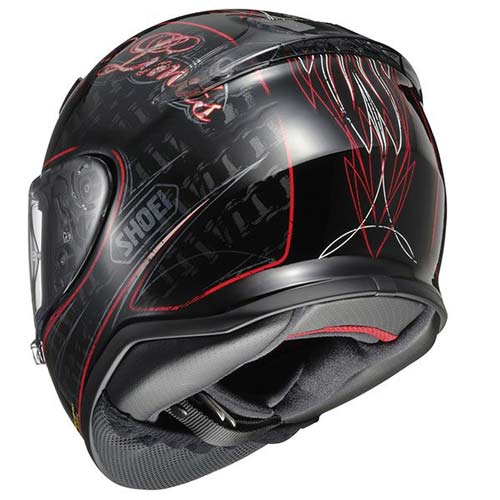
Shoei-RF-1200-inception-tc-1-crash-helmet
Shoei RF-1200 Inception – subtle spoiler and rear vent

Ventilation

The RF-1200 has one chin vent and three forehead vents along with one rear exhaust vent cunningly hidden underneath the rear spoiler. All vents can be closed/opened and are not massively fiddly to work with gloved hands – except for the rear exhaust, though it’s unlikely you’d ever want to fiddle with that when riding along.

The front chin vent is the easiest to open as the whole cover simply moves downwards to open, with a single position in between open and closed. It’s very effective and nicely directs air up across the visor. The forehead vents work well too though the smaller lever on the central vent can be a bit more fiddly to use. These forehead vents direct air through the polystyrene lining (which manufacturers like to call EPS because it sounds more technical than plain ole polystyrene, the stuff your take away trays are made of, but it’s more or less the same thing!) and there are several channels that direct the air onto your scalp then pull the now stinky air off and out of the exhaust vent. It works well in keeping folks cool in hotter regions – though not as well as the Shoei GT Air according to those lucky enough to own both – but is very good nontheless. In colder regions you can, of course, close off the vents as required, but it does pull in enough air to effectively de-mist the visor. So all good here.

If a helmet with great ventilation is your thing, don’t forget to check out all our helmet reviews only featuring helmets with fantastic ventilation.

Shield

There’s probably not much more important on a helmet than the shield. Good, clear forward vision; wide peripheral vision; good ventilation to keep it clear, probably with an anti-fog; easy to open and close with a good seal; and easy removal when you need to change it or clean it. These are a few of my favourite things. Well we’re happy to report – or rather owners are happy to report – that the Shoei RF-1200 has all these bases covered.

Shoei says (in VERY broken English) on its website that they’ve totally redesigned the shield baseplate and associated bits and bobs. And generally most of us would probably shrug and say something along the lines of ‘so f***** what?’ And rightly so. But what it actually means in practice is that the seal on the shield is very good, and if it’s not, we can all become helmet technicians and adjust it ourselves because the RF-1200s all-new shield baseplate has a little wheel you can twiddle to adjust the shield seal front an rear. To be honest, a good old plain tight fit is all I need, and Shoei have never suffered there, so it’s possibly a bit overkill. However, it’s kind of gratifying to know that if the seal isn’t right, we can make it right. I suppose.

Shoei-RF-1200-crash-helmet-isomorph-tc-4
Shoei RF-1200 Isomorph. Nice design – and at least your 10 year old will love the name.

Other than that, the shield is very thick and alters thickness to keep vision clear for the user. This is becoming more common practice, especially against some of the more premium brands – using different thicknesses of plastic to stop distortion of vision around the peripheries – and apparently it works, with users reckoning it’s noticeably clearer than helmets they’ve worn before.

Onto fogging and ventilation. Well, we’ve mentioned that the ventilation to the shield is very good. But it’s also supplemented by a Pinlock anti-fog insert, supplied out of the box. If you live in cooler states, an antifog insert or spray is a must for Autumn/Winter riding so that’s a welcome inclusion.

A Transitions photochromic visor is also available for the RF-1200. Photochromic, or light-adjusting visors, work well and are a great alternative when there’s no drop-down sun visor available.

And finally on the shield, the removal system needs a mention. I’ve always been a fan of the quick release system on Shoei’s and the RF-1200 is the usual fayre – just pull a couple of lugs either side and the shield pops out. Repeat and it’ll snap back in. This is a must if you do lots of riding to help you clean the shield between rides – and is nice and simple on the Shoei.

And finally finally, usability. The shield seals nicely, is easy to open thanks to its slightly off-centre opening tab at the bottom of the shield and has lots of positions on the ratchet to open it anything from the merest crack to wide open – and the shield will stay where its put. Good work – nice and simple and effective.

Comfort & Internals

Shoei-NXR-Boogaloo-crash-helmet
Pretty striking in Boogaloo colors

The RF-1200 scores well for comfort too with typical comments from owners being it’s so light they almost forgot it’s there and the interior being so plush and well fitting it feels like a helmet should do. Of course, it goes without saying that you have to get the right fit and right size in the first place but if you do, then the Shoei RF-1200 feels right and is very comfortable.

It almost goes without saying that the interior is fully removable and washable these days – but the RF-1200 also uses a couple of different materials internally for comfort and sweat absorption/wicking. It also has double-density EPS (polystyrene) shock absorbing layer inside the helmet shell. That’s pretty commonplace in most helmets these days and sounds a little low-tech, but it’s about as effective as shock absorbers come (probably comparable to still seeing bundles of car tires still adorning Indy circuits). So all’s good here.

Looks & Graphics

Looks are very subjective, but I think it’s fair to say the Shoei RF-1200 is a pretty understated crash helmet (except for that electric pink one above!). To be honest, most Shoei’s are. The only real hint of modernity is probably how it’s slightly sleeker to reduce buffeting and noise by tucking in all its vents and spoilers. For 2014 there are a dozen or so color schemes and we’ve dropped some of the most notable throughout the review. At least, they’re the ones we liked the most!

Video

For another point of view on the RF-1200, here’s a vid from those nice people at the Two Wheel Centre (I say nice. Never met em). Take it away Abi..

Other stuff – fasteners & glasses

The Shoei RF-1200 has double d-ring fastener which means it’ll be fine for track use. There are limited reports of glasses use but so far so good – even though padding at the side of the helmet has been increased, people report that there’s enough room to slide your glasses in and they’re comfortable once they’re in there.

Overall

The Shoei RF-1200 is a very competent helmet make no mistake about that. It’s typical Shoei – well built with quality materials that makes you feel you own a premium, expensive helmet. It also performs well in terms of safety – and it’s comfortable and quiet and all the bits you want to work well like shield, vents and internals work very well too. It also has a few nice features such as the quick release system and quality visor system. Where it does fall down a little is on value for money. It’s an expensive lid and no mistake. But, if that’s not really a problem, we’re pretty sure you’ll be happy with your new Shoei RF-1200.

For other helmet reviews check out either our Crash Helmet Reviews or Safest Crash Helmet reviews sections! Or indeed click a feature name in the panel top right to see helmets that score particularly highly for the feature. And, as always, if you have experience of the Shoei RF-1200, please add your thoughts in the comments section below – cheers!

[xyz-ihs snippet=”Shoei-Cat-link”]

Star Ratings

Duchinni D405 Helmet First Look

Duchinni D405 full face helmet white

Note: Duchinni are not DOT certified for sale/use in the US.

There is plenty that can be said about this budget helmet from Duchinni. It looks a little dull if I’m honest, but it promises to offer superb value for money, so we thought it’s worth at least a quick once-over. And if we like it, we might give it the full treatment at a later date. So, here’s the lowdown on the ECE 22.05 approved Duchinni D405 helmet.

Safety and Design

It’s a full face helmet with an ABS (thermoplastic) shell that comes with more or less everything you’ll need on a helmet these days. It’s got a seatbelt-style chin strap – dead user-friendly and one of our favourites – and an integrated, anti-scratch, flip down, UV blocking sun visor. Tick, tick. However, although it’s ECE approved, it’s not distributed in the US so hasn’t been DOT certified – and it hasn’t been independently SHARP tested at the time of writing so we don’t really know how well it’ll do in an accident. Having said that, most Duchinni’s have scored around 4/5 in the past so we’re hopeful the D405 will be up there too.

[xyz-ihs snippet=”Duchinni-SBS-quick”]

Fitting & Comfort

The Duchinni D405 is broken in quite easily on first use and turns out to be a really comfortable lid. It comes with the usual top and chin vents at the front and exhaust vents at the rear, with channelling through the EPS padding to bring airflow through to the scalp and out of the exhaust. The lining of the helmet has got a nice feel to it and is fully removable and washable – like most helmets these days – and it also includes a chin curtain and removable breath deflector.

Again, nothing to moan about there. All the big brands have similar features and the Duchinni’s doing well to keep up so far.

Usability

So far so good then – but how does it fair on usability? Well, generally fairly well, though there are a couple of minor niggles here. It doesn’t come with an anti-fog shield, which is a bit of a must these days, though there are plenty of anti-fog treatments available for you to try so it shouldn’t be too much of a problem if you do a spot of Ebaying to sort it out. It is worth noting though, that the first step of the shield is set quite high meaning that you can’t crack open the shield just a little. It’s up to you to decide whether this would be a problem; however, in my opinion it can be quite a pain as a small first opening is really useful, especially if it’s not got an anti-fog shield.

Onto noise levels – well we’re moderately happy to report it’s not particularly noisy, though it’s not particularly quiet either. In any case, you’ll probably want to wear ear plugs for most journeys anyhow, so noise shouldn’t be a problem.

Overall

So there you have it. If you’re looking for a low-priced lid with a mid-priced spec then it is definitely worth checking out. Duchinni have done a great job in producing a helmet that looks OK, is available at a really attractive price and has a good range of features. On first view at least, the Duchinni D405 is well worth a look.

[xyz-ihs snippet=”Duchinni-SBS”]

Caberg Tourmax Modular Crash Helmet Review

caberg tourmax sonic

The Caberg Tourmax is a modular dual-sports helmet (modular meaning the chin guard flips up and dual-sports referring to the mix between full face and motocross style). It has a good range of useful features, is well built and comfortable. It’s also dual-homologated to work as both a full face helmet or with the chin guard in the open position as a jet-style helmet. The one major downside is that it’s quite noisy, though that goes for pretty well all flip-up helmets. However, given its low price point, it’s a great value helmet and well worth a look.

  • NOT DOT certified for sale in the US
  • Flip-up dual-sports helmet
  • 1.8Kg
  • SHARP 5 star rated (maximum)
  • Not Snell certified
  • Good ventilation
  • Micrometric fastener
  • Comfortable and well-built
  • Sizes XS-XL
  • Typical price range: £150-£215 GBP (Not distributed in the US)

SBS GG [xyz-ihs snippet=”Caberg-SBS-GG-GB-quick”]

Safety

Like all helmets on sale in the EU, it’s been ECE 2205 approved so it’s passed a basic set of safety tests – including being dual-homologated for use in both open face and full face modes. It hasn’t been DOT certified so isn’t for sale in the US, but when it was tested by SHARP in March 15 and scored the maximum 5/5 score meaning it’s in the top 15% of all tested helmets. That’s an excellent score for a modular/system helmet.

It’s worth noting that in the SHARP tests, the chin guard stayed closed and locked in 87% of their tests. That’s actually a respectable figure for a modular helmet, but if you’d rather have the chin guard stay down 100% of the time (wouldn’t we all!) then you’re probably best opting for a full faced helmet. Having said that, folks who buy flip-front helmets presumably like riding with the front up and open some of the time (I know i do) and understand that they’re potentially exposing their good looks to danger while they do so. If that’s the case, that 13% failure rate is probably acceptable for the freedom a flip-up helmet offers.

caberg tourmax in metal white
Tourmax in Metal White colorscheme

Wind Noise

Several owners reckon it’s about average for quietness, commenting it’s pretty much like most other modular helmets they’ve owned. Modulars have to accommodate the moving chin guard and that usually compromises noise-suppression compared to a full face helmet. A couple of guys reckoned it was slightly noisier than a Schuberth they’ve previously been using. Of course, if you’re going any distance, most of us use ear plugs so if you’re a regular ear plug user, then you should be fine with the Tourmax. If you don’t, it’s probably going to be OK for lower speeds but noise will get a bit too much at anything above 60.

[xyz-ihs snippet=”Caberg-gen-multi-quick”]

Sizes

The Tourmax is produced in just one shell size. This means if you buy one of the smaller sizes – say XS and below – the helmet shell may look a bit large on your head. It may also slightly compromise safety a little too. There’s also an issue with the size of the chin guard, with many people finding that the chin guard is set a bit further back than most, meaning some people complained their chins were rubbing on the inside. So if that may be a problem for you, it might be worth trying first before you buy.

Ventilation

Ventilation is widely reported as very good. The Tourmax only has one chin and one forehead vent but they’re enough to pull in lots of air. The chin guard vent is always open but the forehead vent is opened with a slider – and that’s pretty simple to operate, even with gloves. There haven’t been any complaints about the always-open nature of the chin vent so we reckon you should be fine – even in cold weather. The air is channeled through the top of the helmet in channels in the polystyrene and there are ventilation holes in the top of the liner to keep your head cool – and they do a good job. In colder weather and rain, the vents, in combination with the Pinlock, manage to keep the visor clear so all good there.

Shield

The Tourmax has a single anti-scratch clear outer shield and comes with a Pinlock anti-fog insert out of the box. It’s also got an integral anti-scratch sun visor that operates from a single big slider on the top of the helmet. The sun visor is simple to use and uses friction to keep the visor open/closed so it can be set for any position you want. The outer shield has a single tab in the bottom center to open the shield and owners reckon everything with the shield system is fine and dandy and works well. Only issue that one or two people have reported is that it’s possibly a slightly narrow aperture – restricting peripheral vision a little compared to helmets they’ve previously owned. Other than that, it’s all good.

caberg tourmax in matt black paint
Tourmax in matt black showing sun visor and chin guard.

Chin Guard

As mentioned before, there’s a possible issue with the chin guard for those of us with bigger chins – you may find your chin touches the back of the chin piece which might prove a bit uncomfortable. If that’s not an issue for you, then the chin guard works well. When you move the chin guard up, the peak rotates a little to get out of the way and bring the peak closer to the chin guard for aerodynamics. In the fully open position, you can lock the visor by using a little plastic slider to the left so you can ride off road and the chin guard won’t slam shut. It works well.

It’s worth noting that in the SHARP crash helmet testing, the chin guard remained locked and closed in 87% of the tests. That’s actually pretty decent for a modular helmet however we’ve subtracted half a star as it’s still compromised.

Comfort

Apart from the issue with the slightly short chin-guard and the usual advice about making sure the helmet fits you properly, reports are that the Caberg Tourmax is a comfortable helmet. It has a fully removable and washable liner that’s hypoallergenic. It’s also reported as good for glasses wearers in terms of comfortable fit and good ventilation when it turns wet – with one owner saying it was the best he’d used even in cold and rainy weather! Surprisingly, users report that the peak doesn’t really catch the wind too much either so they don’t complain of much buffeting in comparison to even a full face helmet, though one user did mention that it can catch side winds a little when it gets really windy. But then you’re on a bike so no surprise there!

Looks & Graphics

It’s a pretty slick helmet with more than a hint of Halo about it. At the time of writing, it’s available in mostly plain colors – white, black and gun metal grey, with only the Tourmax Sonic having a bit of a sporty paint job (the one you can see in the video below).

[xyz-ihs snippet=”Caberg-SBS-GG-GB”]

Video

Here’s a video of a guy using it on his bike. Skip to 1.20 to get to the meat of the review.

Other stuff – fasteners, audio, weight

The Tourmax is pretty light weight for a modular helmet, weighing in at a smidge under 1.8 kg. If you’re used to a full face, it’ll probably feel a little heavier but it’s well within what’s manageable. It also comes with a micrometric fastener. If you’re not used to micrometrics, they’re dead simple to use – slide in a small ratcheted bar to lock it and pull on a little red tab to unlock – fast and quick and I love em. As to audio, it’s equipped to integrate the Caberg ‘Just Speak Easy’ bluetooth system – but if you’ve got a 3rd party system, it has a small, slightly offset cut out in the padding of the chin guard for a microphone but only shallow recesses for earphones. Users reckon it generally works well with only the usual bit of fiddling for installation.

Overall

The Caberg Tourmax is available at a great price – that’s the first thing to be said. At this price point, you get a helmet that’s packed with features, looks good, is solidly built and has Caberg’s reputation for producing safe helmets. Users like them and there are no major flaws reported. All of which means we’d wholeheartedly recommend the Caberg Tourmax (especially now it’s SHARP 5 star tested!)

[xyz-ihs snippet=”Caberg-SBS-GG-GB-quick”]

[xyz-ihs snippet=”Caberg-Cat-link”]

Star Ratings

caberg tourmax star ratings

Limited Edition Release of the Arai Joey 85 Replica Crash Helmet

Arai Joey Dunlop 85 limited edition crash helmet

To mark the fourteenth anniversary of the death of racing great Joey Dunlop, Arai have released a limited edition replica crash helmet. Before that fateful day in Estonia, Joey had just delighted fans by winning the Formula One and Senior races in the 2000 TT on his Honda SP-1. In the 1985 season, to which the ‘85’ refers, he raced to victory in two races at the North West 200, three races at the Ulster GP, and the Junior, Senior, and Formula One TTs on the Isle of Man.

And he did it all wearing the same design that he’d worn throughout his remarkable career. The helmet is instantly recognisable to aficionados of road racing, because Joey always wore his distinctive yellow lid, with the ‘85 season helmet also showing the Downtown Radio logo of his Northern Irish sponsor and the ‘Joey’ logo that he wore on his lid at the time. The vibrancy of his talent is well represented in the bright yellow coloring and, like Arai’s standard RX-7 GP helmets, it scores highly in all the essential areas – in terms of safety and performance. We particularly praised the great build quality, the good ventilation, the all-day comfort and the quietness.

Joey in Action
Joey in Action

This is the first replica crash helmet that’s been released since the one year anniversary version after Joey’s death. It has been approved by his widow, Linda Dunlop, who has signed a certificate of authenticity to be included with each sale. The run is a strictly limited edition with only 305 helmets manufactured. Each purchase will also include a numbered sticker, and they are available (for now) in sizes XXS-XXL through Northern Ireland dealer Crossan Motorcycles.

If you’re looking for a new crash helmet or simply want to join in the tributes to the most successful TT racer ever with a truly exclusive and limited edition helmet, then you won’t go far wrong with a Joey 85.

[xyz-ihs snippet=”Arai-multi-retailer”]

[xyz-ihs snippet=”Arai-Cat-link”]

Quick look – Held Alcatar Crash Helmet

held alcatar crash helmet

It’s simply too obvious to make a remark about German efficiency. We’re at the point now where a helmet – no, more or less anything manufactured by the Germans – could be made from recycled crisp packets and chewing gum and people would trot out the old line about German efficiency.

Having said that, Held do show a pretty tasty line in motorsport equipment across their remarkable 318-page catalogue, though their naming conventions could be a little smoother. Scard is a rock-hard name for a helmet, and Masuda sounds suitably mysterious, but whoever came up with ‘Travel-Champ’ needs to stop using Google Translate quite so much.

While ‘Held Alcatar’ does sound like a something Severus Snape might scream at Harry Potter, it’s actually a dual-sport helmet. A nice looking and reasonably priced one at that. It’s available in either plain black or white/red graphics (as shown above), and has a wide-face aperture and a peak giving it a motor-crossy look; a peak which many people find a pain but many others find makes them look like a sinister movie character coolly disappearing off into the distance on a dirt bike with the heist gang’s takings.

But I digress. The helmet’s peak, though, does tend to catch the wind quite a bit – so if you’re inclined to ride around windy parts a lot where you get quite a few cross winds – you might find the peak a bit of a pain. The visor is a little stiff which could impact speed of opening but it does mean it stays where you want it – which in our book is the priority.

The Alcatar has got a very useful internal drop down sun visor – again, absolutely key to looking sinister – but with a secondary benefit that it keeps the sun out without the need for shades. The aerodynamics are well designed, with little noise detected at lower speeds. Its ventilation is average though, and the inner lining is a little rougher than some similar helmets – though at this price point, some shortcomings are to be expected I guess.

Obviously, it’s a sturdy piece of kit given the predictably German efficiency – oh damn it – but although it meets the usual ECE 22.05 safety standards and should be DOT certified if you happen to find one for sale in the US (though not Snell or SHARP tested), it does feel a little lightweight. And even though it’s a German brand, the helmet’s actually made in China. Nevertheless it’s a very competently made piece of head gear, especially for those looking to try a dual-sports helmet for the first time and who doesn’t want to scare the bank manager.

The Alcatar’s plain variant is available at a smidge under $230 at the time of writing, with a tenner more for the graphic version.

If you’re looking for a new crash helmet or simply want to join in the tributes to the most successful TT racer ever with a truly exclusive and limited edition helmet, then you won’t go far wrong with a Joey 85.


Behind the Scenes – a tour round the Triumph Motorcycles Factory in Hinkley

Triumph Factory hinkley main entrance
Triumph Factory main entrance

It’s not often you get to look around the Triumph factory in Hinkley, UK – I should know, I’ve called and asked more than once. They just don’t usually do tours, I guess downtime equals lost production. But on the weekend of the Triumph Live event outside the heritage centre in Gaydon, that’s just what Triumph did. We bought our tickets for the event early and, out of the blue, we got an invitation for a tour of the Hinkley factory on the Friday afternoon before the event. Fantastic.

So down we rode, not knowing what to expect – and certainly not expecting to be able to access the whole factory with staff there, chilled out and helpful, to answer any questions.

We parked up among the descended masses of Triumphs and wandered over to an open gate in the side of the factory building. There we found happy, smiling employees showing us where to bung our gear and giving us a quick word about what we’ll see – then we were off into the despatch bay.

It was incredible to see row upon row of completed bikes, bagged and boxed and stacked on racking ready for despatch. And spares too – a massive row of 675 front and rear wheel rims – we picked them up. They were incredibly light for the power and stresses they have to handle. And fair play to the Triumph staff – as long as we kept to the routes they’d taped off, then they were happy for us to take as many photos as we wanted and handle gear that was laying around. Big thumbs up there.

Check out some of the labels on the boxes – wouldn’t mind one of those turning up on Christmas day morning!

The despatch and warehousing area took up two large storerooms. After walking through an area with some Daytona 675 engines and a few part-built bikes for us to look over, we entered the production area proper, the first part which was full of milling machines, polishers and ovens where they finish off the crankshafts, crankcases and cylinder blocks.

To be quite honest, we didn’t really expect to see this level of engineering being done in house. These days much of this sort of engineering is done off-site at fabrication plants with the parts being pulled together in an assembly plant. But here in Hinkley, the cast components are brought in and finished on site before being moved to the assembly line. We saw milling machines and polishing machines and a massive oven where 16 different types of cranks are baked. We also saw Rocket 3 and Thunderbird Storm cylinder heads in various stages of machining. As you can see from the pictures, Triumph laid on some displays of the various components for us to gawp at. I thought my Rocket III cylinders were big enough – until I saw the Thunderbird storm pots. They were ginormous.

And so we moved on to the best bit – the assembly line. There seemed to be four models being fettled when we went round – the Rocket 3, Thunderbird Storm, Tiger and (I think) a Street Triple. First off we just saw the engines – massive great lumps on a conveyor belt. Huge racks of components all labelled and stored in bins, trugs and shelves. Box after box of camshafts and racks of Rocket rear ends. For a Triumph lover, it was heaven.

Moving round a bit and engines and frames met and became recognizable bikes – Rockets and Thunderbirds in the earlier stages then Tigers and (I think) Street Triples. From conveyor belt for assembling frames and engines, they’re then winched onto an overhead system that holds the bikes at person height so the rest of the bike can be added – wiring, forks, wheels, tanks etc. etc. It all looked incredibly organised – and clean and tidy – but then I guess that’s what all production lines are like these days.

From there, we moved on to the the quality control area. You didn’t get much of a sense of what was going on there because there were a load of very shiny and very finished bikes hanging around ready to be put through their paces. There were one or two with labels on them mentioning faults and tweaks that needed to be made, so I guess their process is working and they’re picking up any problems before they leave the door.

All of which culminated in the bizarre spectacle of a bike on a bench ready to be bagged and boxed. They also have to partially dismantle some bikes for shipping, depending on where they’re being sent to. Apparently countries like Brazil put a hefty duty on complete machines being imported, so they have to be shipped over as kits, to be reassembled on delivery and avoid the import duty. Others, like the Rocket in the picture above, have to have bars, wheels and other sticky-out bits to be taken off and packaged separately so they’re a decent size to be boxed.

So there you have it. It was great of Triumph to open their gates to us all – free of charge – and be so chilled about us wandering round, snapping, videoing and generally causing a nuisance.

Nope, it left me and my Ducati-riding bro with nothing but thanks for Triumph – and astonishment at the great job they’re doing to keep this fantastic brand and range of motorcycles going.

Thanks Triumph and good luck to ya!

To finish, here are some video snippets I shot on the tour. Kinda bring it to life a little (but sorry about my mumblings over the top!) – and there’s one or two more on the YouTube channel.


Shark Speed R helmet review

shark-speed-R-discontinued-featured

Note: the Shark Speed R is now discontinued. Try the Shark Race R Pro instead.

The Speed R, from French helmet producer Shark, is a pretty aggressive-looking, sports-oriented full faced crash helmet. It’s notable for the range of funky color schemes it comes in as well as the integral sun visor and optically-correct (and thick!) clear shield as well as scoring a healthy four star rating in the SHARP crash helmet safety test. See summaries below for more information as to whether you should buy one.

  • Mid-priced fiberglass helmet with sun visor
  • SHARP 4 star safety tested (out of 5)
  • Optically correct shield
  • Moderate noise
  • Good for glasses-wearers
  • XS – XL
  • 3.2lbs/1.45Kg
  • Typical price range: $400-$470 depending on retailer/model

Safety & Shell

Unfortunately, Shark don’t seem to submit their helmets to the Snell Foundation for testing. However, the Shark Speed R scored a creditable 4/5 in the SHARP helmet test, meaning it should perform above average in an accident. Like all other crash helmets for sale in the US it’s also DOT certified so you should be reasonably confident that it’ll stay on, not crack and absorb the impact well.

The shell is constructed from layered glass fiber – what Shark calls ‘multiaxial’, meaning that the layers of fiberglass are laid at different angles to reduce splitting and help with overall stiffness and structural integrity. There’s also a Speed-R Carbon which is also mainly constructed from fiberglass but with a layer of carbon fiber on top to give it a cool carbon fiber look.

Shark-Speed-R-Side-on-in-black
Shark Speed R Blank in Gloss Black

While the carbon fiber layer is mostly there for looks, it should help with  abrasion resistance in a crash too.

Size

The helmet is built in two shell sizes – which is kinda what you’d expect at this price of helmet – more expensive helmets tend to be produced in two or three helmet sizes. Remember, the closer the helmet shell size matches the helmet size you need, the more the level of padding inside the helmet is optimised. That means if you use a ginormous helmet shell for an XXS fitting, then they have to use lots of padding inside the helmet to make it fit – and the more you’ll look like a lollipop when you wear it (massive helmet on small head). For more info on helmet fitting, look here.

Wind Noise

The Shark Speed-R is about average for noise suppression. Much of the way owners feel about the level of noise in a helmet is dictated by the type of bike ridden (sporty & faired or naked and unfaired) and the position (lean forward or sat upright). It’s also dependent on how quiet your last helmet was as it’s a comparative judgment. However, Shark designed the helmet with sporty naked riders in mind (the bike, not the rider 🙂 ) and this is born out by owners who reckon that it’s best for more upright riders where the helmet is more in the wind. If you’re crouched forward, it gets noisier. The helmet was designed  with a spoiler at the rear of the helmet that’s supposed to reduce buffeting and increase stability – and as long as you’re sitting reasonably upright, folks reckon it’s pretty good – with the aerodynamics working best when in the windflow, making it quieter and reducing buffeting. On average, the Speed R seems about average for quietness.

Ventilation

The Speed R has chin/forehead vents and a rear exhaust vent. Pretty standard really. The exhaust vent is located at the back of the lid with a bit of a spoiler over the top which is designed to create a ‘venturi’ effect – meaning it lowers the pressure behind the helmet, effectively sucking all the fetid head-air out of the helmet to produce extra cooling. Quite a few helmets do this these days and with the Speed-R, Shark has made done quite a bit of external and internal work to maximise the air flow. To quote the marvellous Franglish from the Shark website, ‘The immediate benefit is an ultra fast refreshment hence the quasi-nonexistent mist.’ Couldn’t have put it better myself!

Shark-Speed-R-rear-view
Speed R rear view showing exhaust vent spoiler and base spoiler to reduce buffeting

There are the usual external vents on the Speed R but, to work well, these have to be complimented by well routed and large interior air channels in both the polystyrene shock absorbing material and internal lining and skull cap to allow it to reach the head. Shark have done their homework here and most owners report that it works very well, keeping the head cool in hot weather.

Having said that, there can be an issue with the shield fogging but that’s pretty standard on most helmets so an anti-fog insert is going to be necessary.

Shield

There’s some very good things and a very bad thing to report on the shield. On the outer, clear shield, Shark have gone for a very high quality, optically-correct shield that owners say is great to use – some people commenting that their vision’s as clear with the shield down as it is with it up! It’s also notable because it’s so thick – over 4mm in the centre, reducing to just under 3mm at the edges. There aren’t any notches on this shield mechanism to keep the shield open at set points, but there aren’t any complaints about the way the shield keeps open where the user puts it so shouldn’t be a problem there.

The main problem is that there isn’t a tab on the front of the shield so a gloved finger can find the edge of the shield to open it. More than one person has moaned like crazy about the barmy oversight with a coupe of folks saying it’s impossible to open the shield without taking your glove off. It does seem a bit mad that they’d produce a shield without an opening-tab and it’s something that should be pretty easy for Shark to rectify – so might be worth checking with the retailer that the problem’s been sorted before you buy.

One thing that’s worth noting is that the shield’s really easy to change with a couple of pull-tabs below each shield pivot that release the shield quickly. Great for taking your shield off quickly to give it a clean.

The sun visor is operated by a nice alloy slider to the top left of the helmet and works well, with users reckoning their vision is nice and clear, even when the sun visor’s down. To view other helmets with integral sun visors, click through to our helmets with sun visors page.

Comfort

As ever, comfort is dependent on making sure you get the right fit. It should be snug but not too tight and match the shape of your head. Occasionally people are finding that the cheek pads are a bit oversized and might squeeze the face a little until they give. Also, there are some comments that if you have a pronounced forehead, you might find the helmet presses there – so, if that’s you, you might want to try one on before you buy first.

shark-speed-r-texas
In Texas color scheme showing integral sun visor.

If you wear glasses, there’s a handy groove cut in the liner that allows glasses’ stems to seat easily inside the helmet and there’s plenty of space inside for the lenses to sit without being interfered with by the visors – so all good here.

The internal lining is fully removable and washable (delicates/cold cycle) and there’s no complaints about comfort or abrasion so should be fine.

Other stuff – fasteners, audio, weight etc.

The Shark Speed R has a d-ring fastener which is a reliable and easy to use fastener that’s compatible with track use, if you fancy doing a track day. There’s a cut-out in the EPS liner for third party communicator/intercom speakers but it’s also Sharktooth bluetooth-ready (Shark’s own brand of communicator). One thing everyone agrees with is that it’s a light helmet – with the XS size helmet weighing in at just 1.45 kilos – right up there with the lightest non-carbon fiber helmets.

If you want another opinion about the Speed R, here’s a video review that’s got quite a few ‘likes’.

Warranty

At the time of writing, Shark helmets come with a 5 year manufacturer’s warranty (2 year’s statutory with an extra 3 years) which covers manufacturing defects and mailing too. That’s a pretty good deal on the face of it and, at the least, shows that Shark are confident in their manufacturing and QA process. We’d love to hear if you’ve used their warranty. Please let us know using our contact form.

Overall

The Shark Speed-R combines modern, slightly-aggressive styling and attractive graphics with good safety levels and useful features – including integral sun visor and optically correct clear shield. The only notable, and slightly odd fail is the lack of tab to open the main shield. Otherwise, it’s a mid-priced helmet that performs either average or well in most other respects and should provide a trusty and reliable buy.

Other places you might want to look

If you’re looking to buy a crash helmet, there’s a few items in the links below to equip you with most of the things you need to know:

  • A range of other useful articles/research you should be aware of if you’re looking to buy a crash helmet.
  • Other reviews and previews of other Shark helmets.
  • Other reviews and previews of full face helmets.
  • Otherwise, just click on the feature you’re interested in from the list to the right to see only helmets with that feature.

And if you’ve experience of the Shark Speed-R that you’d like to share, please add a comment below or fill out the form and we’ll publish it – the site’s based mostly on feedback from users and owners like you so we’d genuinely love to know what you think.

[xyz-ihs snippet=”Shark-Cat-link”]

Quck look – AGV K3 SV Helmet

AGV K3 SV in gloss white and matt black

For our full review of the AGV K3 SV go here.

The recently introduced AGV K3 SV is the successor to the popular K3. What’s the difference? Well mainly the SV part which refers to the integral sun visor in the new helmet. The original was a good seller because it looked nice, had some useful features, offered good safety levels (SHARP 4 Star tested) and, all in all, offered greatvalue for money.

Well, this new K3 SV looks to give more of the same. Its thermoplastic shell is made in 2 sizes – which is ok for a medium priced helmet. It should mean you get a reasonable fit and the helmet doesn’t look too large/small on your head if you’re at one of the extreme sizes – such as XXS or XL. Ventilation is supposedly good, with chin, brow and top ventilation intakes and a rear exhaust covered with integral spoiler, which is designed to increase stability at higher speeds.

AGV K3 SV helmet Rossi Blue
K3 SV In Rossi Winter Test Blue color scheme

The internal padding is all fully removable and, as long as you’ve got the right fitting in the first place, beds in nicely and is comfortable. The most notable feature about the visor system is the integral sun visor that’s pretty easy to operate (easier to lower than to raise it apparently). Other features are that it’s AGV bluetooth communications system-ready, has a great/quick shield release system (just pull down a tab on each side and out pops the shield) and has a nice and easy to operate micrometric fastener to secure it.

AGV K3 SV in Rossi Gothic Black
Really like this one – K3 SV in Rossi Gothic Black

The AGV K3 SV hasn’t yet been SHARP tested for safety, though if the previous version is any measure, it should do pretty well. At this price point, it’s not the best quality helmet in terms of build quality, but it does offer good features at a very attractive price point – at the time of writing prices start around the $200 mark. Provided it does score well when tested by SHARP, the K3 SV should be a good buy and well worth taking a look if you’re in the market for a mid-priced full face crash helmet.

Here’s a video we found giving some more info on the K3 SV that you might find useful.

Other places you might want to look

  • A range of other useful articles/research you should be aware of if you’re looking to buy a crash helmet.
  • Other reviews and previews of AGV helmets.
  • Other reviews and previews of full face helmets.
  • Otherwise, just click on the feature you’re interested in from the list to the right to see only helmets with that feature.

And if you’ve experience of the AGV K-3 that you’d like to share, please add a comment below or fill out the form and we’ll publish it – the site’s based mostly on feedback from users and owners like you so we’d genuinely love to know what you think.

[xyz-ihs snippet=”AGV-generic-multi-retailers”]

[xyz-ihs snippet=”AGV-Cat-link”]

A Review of the HJC R-PHA Max Crash Helmet

hjc-rpha-Max-discontinued-featured

Note. The HJC RPHA-Max is now discontinued. You can find some great alternatives though on our Top 10 modular helmets page.

Summary

The RPHA Max is a modular/flip-up helmet that’s well liked by most owners. It’s comfortable, well put together, pretty quiet and light for a flip-up. It’s a more expensive helmet, isn’t Snell certified and only scored 3/5 stars in the SHARP crash helmet test. But for daily use, it’s practical and works well.

  • Weight – 3.2lbs (1.45Kg) – size XS
  • Not Snell certified
  • SHARP 3 star safety rating (out of 5)
  • Comfortable
  • Average/good wind noise
  • Integral sun visor
  • Comes with Pinlock anti-fog insert
  • Good for glasses & speakers
  • Available in sizes XS-XXL
  • Typical prices: around $330

[xyz-ihs snippet=”HJC-Rev-quick”]

Safety

HJC reckon the shell is one of the most advanced around – and is made up of layers of Aramid (Kevlar is an aramid), carbon fiber and fiberglass. It sounds like it should be the business for safety – and of course it’s DOT certified. However, when tested by SHARP, it only scored 3/5 stars so it’s not as safe as some other flip-up helmets such as the five star Shark Evoline (check here for other 5 star helmets*).

Its worth noting that the HJC R-PHA Max isn’t dual homologated in the EU (meaning it’s only been approved for use as an open face helmet). I know I’d want my own flip-up helmet to give as good protection – or at least be designed to try and give as good protection – as a full face. If you’re reckoning along the same lines, then check out our reviews of dual-homologated lids as they give you an idea which helmets should perform best as both open and full face helmets.

Having said that, the RPHA Max’s chin guard stayed in place during 93% of the impacts during the SHARP tests (yeah I know, I’d like to see a score of 100% there too!).

Wind Noise

Most folks love how quiet the R-PHA Max is – HJC claim 84db at around 60mph. It’s been wind tunnel designed to be as slippery as possible – and we need to add the usual caveat here that how noisy your helmet is also depends on the type of bike you ride and the position you ride in – plus you should probably ride with ear plugs most of the time anyhow. That said, it’s widely regarded as a quiet helmet – though a couple of guys who previously owned Schuberth C3’s reckoned it’s not as quiet as that. Again, it’s a relative judgement – to the man with no shoes, the flip-flop is the height of comfort (Confuscious).

HJC have included an integral (non-removable) chin curtain and neck curtain around the bottom of the helmet that should keep some breeze out and is designed to reduce noise coming into the helmet from wind blast around the bottom of the helmet and the jacket collar. Words pretty well by all accounts.

HJC RPHA Max RC10 motorcycle crash helmet
the R-PHA Max in the MC-10 color scheme. Looks pretty nice and sleek?

Size

The R-PHA Max is produced in three shell sizes. Which is a good thing. Most expensive lids are produced in three shell sizes meaning they don’t have to over or under-pad the shell to make it fit the different sizes. If you have only one helmet shell size, they have to really cut back on shock-absorbing material and/or padding for the larger sizes or stuff it full for the smaller sizes – often resulting in a helmet that looks massive on an XS head. Having three helmet shell sizes means the Max should have the right shell size for your head whatever size helmet you pick – XS to XXL.

Ventilation

There’s mixed opinions on the interweb about ventilation. There’s an air vent in the chin and one in the brow – with an always-open exhaust vent at the back. When you look inside the helmet, it’s obvious HJC have made quite an effort to make sure there’s good routing for the breeze around the head and most people who ride in hot places say it does a good job of keeping them cool with the chin guard down. All good there. There are some minor moans (and it has to be said, they are pretty low-key) that because the shield fits quite close to the face in the RPHA Max, that it’s more prone to fogging – even in warmer temps.

However, the shield on the Max is Pinlock-ready and there is a Pinlock insert supplied – so fit that and it will stop the fogging – though if, like me, you’re rather well-endowed in the snout area – you might find that brings the inside of the shield a bit too close for comfort as a few wearers reckon the R-PHA Max is slightly shorter front-to-back than your average helmet, so the shield sits closer to your face.

Shield & Sun Visor

As mentioned, the main (clear) shield comes with a Pinlock so fogging needn’t be an issue as that’ll sort it out. The R-PHA Max also comes with an integral sun-shield operated, rather bizarrely, by a spring-loaded slidy-knob towards the top centre back of the helmet. Most folks find it a bit odd to have it there – but once you get used to it, it works well enough, with three positions – fully down, slightly less than fully down – and up. If the sun visor’s down, because it’s spring-loaded, you can press a button on the top of the helmet that will

RPHA Max helmet in silver
Showing the rear exhaust vent and sun visor slider.

retract the sun visor in a second. It does feel a bit cheap to operate and there’s the occasional report of squeaking – but all in all, it does its job.

One thing worth mentioning is that the Rapid Fire II shield removal mechanism is pretty easy to use (though not as easy as some other HJCs). Open the shield, and there’s a little tab that needs pushing up while wiggling the shield to release it. A bit weird why they’ve replaced their awesomely-quick Rapid Fire I shield mechanism with one that’s a bit fiddly. However, it’s still good and allows you to quickly pull off the shield when you need to clean bee/horse fly/bird-juice off it after a fast summer blast.

Chin Guard

To open the chin guard, you push in a button under the guard and the guard rotates upwards. Push it down and it clicks back into place locating over a couple of sturdy-looking aluminum pegs at each side. The occasional person complained that it feels like a two-handed job to click the chin guard back in place so might be worth having a go in person to see if it suits you (though in my experience, you get the knack pretty quickly).

Comfort

One of the main plus points reported by owners is that it’s very comfortable. Not for people with square heads apparently – and of course it needs to fit pretty snugly – but for those with a good fit then it’s a very comfortable helmet. It comes with fully-removable and washable internal padding made from an anti-bacterial and wicking material – that’s also supposed to suck heat out quickly (called it Cool4Ever – nice). That’s arguably not such a great thing in January in Washington State – but no one seems to think it works particularly well anyhow, so possibly no damage done there.

[xyz-ihs snippet=”HJC-Rev-long”]

Video

Other stuff – fasteners, audio, weight, glasses

The HJC R-PHA features a double-d ring fastener – which is a very reliable and easy to use fastener (if a bit old-style these days). It’s a pretty light helmet – though note when comparing helmet weights, it does depend on which helmet size is tested. The XS version of the Max is 3.2lbs (1.45Kg) while the Large is around 3.5lbs (1.6Kg).

One feature liked by most who wear intercoms or Bluetooth is that there’s plenty of room for speakers in the helmet. There isn’t a corresponding cut-away inside the foam but there is one in the padding so most 3rd party speakers seem to work well.

The RPHA Max has also been designed with glasses-wearers in mind – and there’s plenty of room at the side of the eyes to slot the glasses stems through.

Overall

It’s not the cheapest of helmets, but it’s a good all-round performer that holds together well with good build quality and lots of useful features. It’s quiet and comfortable though not the safest as tested by SHARP, scoring only 3/5. That said, If you’re after a flip-up that looks sleek, with a full-array of features like sun visor, anti-fog, then the HJC R-PHA Max may well be the one for you.

Alternatives

There are a number of good alternatives to the R-PHA if you’re looking for a flip-up. A few we’d recommend checking out the Schuberth C3 is a good performing and quiet helmet, the Roof Desmo which is great-looking and dual-homologated, the Lazer Monaco which has great ventilation and scores 4/5 in the SHARP test; and the Shark Evoline 3 that’s got some great features and scored a maximum 5/5 in the SHARP test.

To see reviews on other helmets, click our crash helmets review section. For other four or five star SHARP rated crash helmets, choose from the menu at the top.

If you’ve any experience of the RPHA Max, we’d love to know what you think in the comments section below. Nice one.

[xyz-ihs snippet=”HJC-Rev-quick”]

[xyz-ihs snippet=”HJC-link-to-Category-Page”]


A look at the MT Flux helmet

MT-Flux-fluorescent-side-view

MT is reckoned to be a massive name in Spain but not yet well known in the US. And with flip-up helmets becoming more and more popular, I thought it’d be worth taking a look at one that’s pretty cheap and that’s getting increasing traction in the world of crash helmets.

The thing about the MT Flux is that its got pretty well all the features you’d want in a modular lid at a really low price. Its chin bar opens at the touch of a button, its got an integral sun visor and it’s got a decent, solid feel to it. While it’s not yet distributed in the US, it has been ECE 22-05 approved. It’s also been SHARP tested where it scored an extremely respectable 4/5 stars for safety which is very good.

However, for flip-up helmets, SHARP also report on how many times the chin guard remains fully locked after an impact and unfortunately the Flux scored very badly here, remaining locked and closed in only 40% of impacts (the tested average is 77% for flip-up helmets).

MT Flux crash helmet in gloss white
MT Flux looking nice in Gloss White

That said, the Flux has got that modern aerodynamic, angular look that’s designed to reduce drag and turbulence and most owners reckon it’s pretty good in that respect – though it has to be said that the level of buffeting you’ll feel is always very much dependent on what sort of bike you ride and whether you’ve got a fairing or not.

[xyz-ihs snippet=”MT-generic-retailers-quick”]


Other stuff: the MT Flux has a thermoplastic shell available in the usual XS-XXL sizes and has removable lining so you can rag it out and wash the stink out from time to time! It’s fastened by a micrometric fastener – which are increasingly popular and, if you’ve not come up against one before, they’re really easy to use (find out more on our micrometric page). What else? Well, its got a decent, thick shield, is generally regarded as comfortable and comes in four colors – gloss black/white, moody matt black and decidedly un-moody flu yellow.

Front view of the MT Flux crash helmet
Front view of the MT Flux

So how much will all this flip-up goodness cost? Well you can pay loads for flip-ups of course – check out the Schuberth C3 review to see one of the most expensive (and best performing) – but prices for the MT Flux (at the time of typing) are around $130 which is a whole lotta features for the price.

For other helmet reviews check out either our Crash Helmet Reviews or for the safest helmets on the market, check the SHARP 4 & 5 Star Crash Helmet reviews section! And if you’ve ever worn an MT Flux helmet, please comment below and let us all know what you think. Thanks!

[xyz-ihs snippet=”MT-generic-snippet”]

And finally here’s a video showing how to change the shield on the MT Flux (might come in handy?)

[xyz-ihs snippet=”MT-Cat-link”]