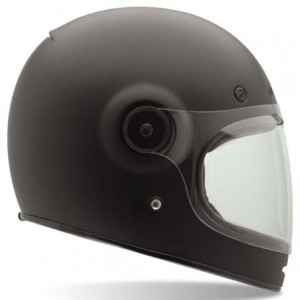
Note. The HJC TR-1 is now discontinued in the US. For a great Snell certified alternative, check out the HJC FG-17.
The HJC TR-1 is a budget-priced full face polycarbonate crash helmet. It has a few interesting features such as an integrated sun shield and quick release visor system.
Unfortunately, the TR-1 was never Snell certified and scored a lowly 2 star rating (out of 5) by the crash helmet safety testing guys at SHARP – specifically the helmet failed to give adequate protection on side impacts. Because there are far superior-scoring helmets in the same price range with very similar (or better) features, we’ve not taken the review any further and suggest you check out the helmets below to find a helmet that’ll protect your head better in an accident. As we always say, if you’ve gotta wear a helmet, you might as well wear one that’ll protect your head! Click the following links for more information about the SHARP crash helmet testing scheme.
So which crash helmet should I buy?
For a similar price to the TR1, you should check out the HJC IS-17. This is also a full face helmet with an integral sun visor, but the IS17 scored a maximum 5/5 SHARP rating too. It’s a cracking helmet and scores highly in pretty well every respect so well worth having a look. If you’re after something that’s a little more up-market, then the Shoei NXR scores well across the board, with a commendable 4 stars for safety. It’s a notch up in build quality too. Either of these helmets should give you great service and happy in the knowledge that your noggin’s safe.
Or you could look down our top 10 helmets 2015 list to see our overall winners regardless of helmet type – or look here if safety is your main criteria for buying a new helmet. Visit our homepage for our crash helmet buying guides and lots of other links to useful helmet information around the site.
If you’ve not bought a new helmet for a while or want to find a refresher on some of the latest features, check out our guide below. We’ve hyperlinked some of the terms for you to click through for more information – or sometimes to show you crash helmets with a particular feature.
1. SHARP rating* or Snell certification
We bang on about SHARP and Snell because if you’re going to buy a crash helmet, you might as well stack the deck in your favor and buy one that’s going to do a good job in an accident. Buy a helmet that’s been Snell tested and you know it’s been rigorously tested to make sure it’s well built and should perform. Get one that’s SHARP tested and scored four, or preferably five stars, and it stands a good chance of keeping your skull intact in an accident too. Both are worth looking out for.
2. Shield
Anyone who’s been stuck with a leaky or misty shield knows how important shields are to living with a helmet. Look for a shield that’s Pinlock-ready and that’s got a nice wide aperture. Thankfully you can click those words in the link cloud to the right to find helmets with those features. Go for a helmet with a shield that’s quick-change too, that’ll make it much easier to clean.
3. Modular/flip up helmets
They’re great if you fancy a bit more wind in your face and the convenience of actually being able to speak to someone or make a call with your helmet on. If you’ve not had one before, they’re usually a bit heavier and noisier than a full face and the weight distribution can seem a bit odd when you wear it. They’re often slightly compromised in terms of little things like visor sealing or ventilation so be prepared for the occasional niggle.
4. Chin strap
If you want to go on a track day, buy a crash helmet with a double-d ring fastener as only those are allowed on track. D-rings are pretty easy to use too. Micrometric fasteners are in vogue at the moment – a ratcheted strip slots into a hole and shuts tight, pull a tab to release. They’re even easier to use so don’t be put off.
5. Communicators
More and more folks are using bluetooth devices with their helmets. So check your helmet has got the right cut-aways and space for your speakers and microphone. Many of the latest helmets come with little removable areas in the lining – again check the feature cloud to the right to find helmets that are communicator ready.
6. Fitting
Getting the right fitting is absolutely crucial. Your helmet should be reasonably tight all round but without pressure points otherwise you’ll suffer on longer rides. The polystyrene liner will usually give a little after you buy it – but not too much. See our fitting guide for more info.
7. Ventilation
Helmets are broadly pretty good for ventilation these days (but check our best vented helmets list to make sure). A chin vent, one or two forehead vents and some exhaust vents should do the job to pull the air in and over the scalp – and check the front vents are all be closable. The chin bar vent needs to be able to pull a decent amount of air up across the shield to help with demisting. Our reviews will tell you if they do or not.
8. Sun visors
Many full face and modular lids have built-in sun visors. Sun visors are secondary tinted visors that slide down inside the main clear shield, usually operated by a small lever or slider on top of the helmet or to one side. They can be very useful though they can fog on cold days and it’s worth checking that it’s anti-scratch too as some older ones aren’t. Sun visors are becoming an essential item for lots of riders though.
9. Best helmets
We rate helmets on a range of important features that mean a helmet will work well when you buy it. Check our top 10 lists. Get one of these helmets and the chances are you’ll be happy with it.
10. Retailer
When you buy your helmet online, make sure you go for a retailer who’ll replace or refund without any quibbles. Many retailers have very specific returns policies (you’ve gotta call for returns number, use their carriers and pay for it yourself, keep all stickers on etc. etc.) so go for one who are a bit more relaxed. Free delivery is good. Long returns policy is good – some even do 365 days. They’ll all want the helmet returning in perfect, unused condition though so don’t go for a blast on your bike before deciding it’s not right.
*We’ve also analysed SHARP helmet safety data to find out which types of helmet materials are safest and lightest and discovered if flip-up crash helmets are as safe as full face. Read our guide here.
Widely advertised as an aggressive, incredibly versatile and balanced helmet, the Shark S900-c is designed to replace the earlier S900 model, with just a few modifications here and there coupled with some rather nifty features, such as new shell construction, an ergonomically improved sun visor and Shark’s innovative integrated ‘Air Pump’ system (more later).
Shark want us to think of the S900c as a kind of ‘upgrade,’ a self-assured ‘top-of-the-line’ helmet for street riding but with all the practical functionality you’d expect from a ‘sports touring’ helmet and that’s comfortable and secure.
But what do owners think about living with the 900C…
Model now discontinued. Try our recommended retailers below for good deals
3.3lbs/1.5kg
Sizes S-XL
Micrometric locking
Quite noisy
Ergonomic internal sun visor
Very comfortable with integrated air pump system
Good for glasses wearers
Prices typically range from $150-$200 depending on retailer/model
Safety and Construction
First off, the S900c has yet to receive a SHARP rating, though this might not be of paramount concern as the entire Shark range has achieved consistently high marks in all SHARP safety tests so far (ranking them joint 3rd in our look at the safest crash helmet brands). As soon as it gets SHARP tested you will be the first to know.
The helmet itself is constructed from an injected thermoplastic resin, which in layman’s terms means it’s plastic that’s injected into the mould in liquid form before being cooled. Thermoplastics have long been used for helmets and lots of other gear that needs to be tough and light weight. It’s also relatively cheap compared to laminates and composite helmets. But don’t let that put you off – some of our top 10 best performing helmets are thermoplastic so you shouldn’t have a problem there.
The fact that it’s light weight has been mentioned by many a S900c owner, which means it’s an easy helmet to live with and reduces fatigue on the neck when you’re in the saddle for long distances. So bonus points earned here.
Another contemporary feature is the quick release micrometric fastener; if you’ve not used one before, we love em. It’s a simple toothed design where a sharp tug on a tab quickly opens the chin strap – a good safety feature if you’re involved in an accident (or after ten hours on the bike and you’re desperate to get your sweaty lid off!)
Rear view of the Shark S900C showing air pump controls underneath
You could be risking your health wearing an ill-fitting helmet – so the Shark have tried to combat this and improve fitting in the S900c helmet by adding something called their ‘integrated air pump system’, allowing you to adjust the internal dimensions of the helmet for (what Shark say) is a perfect fit by pumping air into the liner. Users maintain that this is the most impressive part of the helmet design by far, especially by those who possess rather small heads and have to experience that hazardous moment when the head turns sharply right but the helmet stays facing straight ahead! Believe me it can happen, even with a fully fastened chin-strap (I speak from alarming personal experience here!).
Many owners thought the air pump might be a bit of a gimmick or not work very well but most reckon it’s actually not and it does! So, another bonus point earned here and maybe it’ll be something we’ll see in other helmets in the future (as long as Shark haven’t patented the arse out of the idea!).
[xyz-ihs snippet=”Shark-multi-retailer-quick”]
Size and Comfort
The S900c helmet comes in five sizes, XS-XL, with the usual removable and washable lining made of a microfiber fabric. Comfort and fit is enhanced by the aforementioned integrated air pump system, situated in each cheek sack. Users report that the ‘Air Pump’ system is very easy to use; to inflate you simply press a button on the cheek pad to inflate/deflate. But even without it, owners say it’s a pretty comfortable helmet.
Wind Noise
Wind noise is not one of the helmets strongest points, receiving mostly poor reviews on the whole, with an approximate 70/30 split between users experiencing quite a lot of noise to very little noise at all. This is somewhat surprising considering its new design features but if you are the type of biker who wears ear plugs, then this shouldn’t be an issue for you.
In defence of the S900c, I have yet to find a helmet that totally eliminates all outside noise though you have to feel that the 900Cs logos that stand up from the shell surface won’t help one little bit. Most manufacturers are at pains to make their helmets as slippery as possible yet Shark make the Shark logo on the front and the model number on the side stand proud to catch the wind. Some folks report that the top vents are fairly noisy too.
As any self-respecting biker knows, the efficiency of their helmet ventilation can easily be influenced by a number of outside factors, such as their height, the bike’s seating position, the size of the windscreen, speed and so on.
Notwithstanding this, the S900c rates above average on ventilation, with the majority of users reporting ample air flow and no annoying high-pitched whistling. The helmet has an adjustable ventilation system, consisting of two top vents and a bottom chin vent. All vents can be opened and closed, the lower vent being the easiest to operate, even with gloves, and consists of a long narrow vertical switch, which emits a loud click when opening and closing. When the lower ventilation is open the breath guard and well-padded chin cover can be easily removed. This lower ventilation is also designed to direct a constant flow of air over the visor to prevent mist forming, though some reports do remark upon a certain degree of fogging at low speeds (though this is sorted by adding the Pinlock – see below).
The top vents consist of narrow plastic strips that open and close via a basic sliding switch. Owners reckon these are a bit of a disappointment on the whole, with several comments referring to them as being rather ‘cheap’ and/or ‘flimsy’ and noisy.
Face shield
One of the most important features on any helmet is a good shield and I am pleased to report that the S900c helmet scores highly here. The helmet comes complete with a 2.2mm clear shield, which has an excellent optical quality to it, providing the user with well-defined all round vision. The shield shuts with good solidity and seals well against the shield seat (with one or two exceptions where an owner reported it didn’t seal properly but was sorted with a return to the retailer).
Shark S900C in foret color scheme
As you would expect the shield is anti-scratch and it’s also Pinlock-ready (though doesn’t necessarily come with one when you buy) which users found to be highly effective. For those who have attempted to spray their own shield with the latest ‘recommended’ anti-fog product, and failed abysmally, you will appreciate just how great and effective Pinlocks are!
A really impressive feature here is the face shield removal system. Removal is an easy process, a quick press on a pivot point, a gentle push, a little slide and ‘hey presto,’ the shield slides right off. Re-installation can be somewhat tricky, but it’s the old story of ‘once you know how’ and then it’s a doddle. A quick re-alignment and the visor should click into place with no great difficulty. Owners like this.
Another much-loved feature is the integral drop down sun visor. It’s one of the main reasons owners bought the helmet because it means you don’t need to carry a spare shield with you and you don’t get caught out when the sun starts to set. They’re awesome and it works well on the 900c.
The Shark team has given considerable thought to glasses-wearers too, leaving plenty of space within this shield and sides of the helmet for glasses to be worn in comfort. A big ‘thumbs up’ here me thinks.
Looks and Graphics
Bizarrely named ‘comfort hedge’ ~ S900C color scheme!
Colour schemes and graphics are somewhat subjective, but a quick browse on the Shark website will show you the vast range of ‘jazzy’ paint and design options that are currently available, including a rather groovy ‘glow in the dark’ option for those of you who like to spend their spare time riding in the gloom.
Other Stuff – communicators
For those of you who use communicators/bluetooth and need to install speakers, the S900c has an in-built cavity in the sides of the lining, with people stating that the speakers nestle nicely in the helmet without squeezing your ears.
Overall
So what’s the verdict? Well the Shark S900c is a decent helmet that scores highly in comfort and design. All the important bits you would like to work do and do rather well, the only let down being it’s a bit noisy and the anti-fog isn’t quite up to the competition unless you get a Pinlock. However, the S900c offers good value for money, is mostly well built and is available with a wide range of optional extras, such as titanium linings, additional Pinlocks and tinted shields, as well as a full five year warranty.
Alternatives
You might want to look at our Top 10 helmet list to find our current favourite helmets. If you’re looking to buy a mid-priced full faced helmet, one very good alternative in the same price range is the HJC IS17 – another medium priced helmet that is outstanding for safety, noise and ventilation and also has an integral sun visor. There’s also the Nolan N86, a 4 star rated full faced helmet that comes with a Pinlock and also has an integral sun visor. Both these helmets are brilliant performers at a sensible price point.
If you’ve experience of the Shark S900C, let us know what you reckon by adding a comment below or fill out the form and we’ll publish it – the site’s based mostly on feedback from users and owners like you so we’d genuinely love to know what you think.
[xyz-ihs snippet=”Shark-multi-retailer”]
If you’re looking to buy a new crash helmet, check out our homepage for links to some vital stuff you should probably consider first.
Arai describe it as ‘race-tested’ and it’s based on RX technology, but it really seems to be made for the all-rounder who takes long trips.
Positive comments are that it works well when you wear it all day; it deals with speed once you get to the interstates, but it also keeps you comfortable. It does this partly by making sure you can get the shape as well as the size just right for your own unique head before you start. It’s a slightly longer version of original Signet-Q – another 5mm from front to back – with inserts that allow you to adjust the fit for individual contours, using ‘peel off strips’ and replaceable inner linings to personalize the fitting.
Arai have put plenty of thought into the lining because they assume you will wear it for extended periods. It isn’t cheap but, like any expensive purchase, if you get enough wear out of it, then you may well decide it is still good value. It’s been described as the kind of helmet you can forget you are wearing – especially true if your head is an Arai-shaped head (that means a long oval shape – i.e. it’s longer than it is wide).
Note: The Signet Q is no longer available – replaced by theArai Signet-X
Good fitting if your head is longer than wide (oval heads)
Plenty of ventilation
Good visibility
Quite noisy
3.5Lbs/1.6Kg (about average)
Available in sizes XXS – XXXL
Price range: $550-$700 depending on model
Safety
Arai Quantum ST in Diamond Black
There’s a lot of impressive sounding technology to protect your thinking equipment – “super complex laminate … enhanced hyper ridge strengthening … triple density inner shell”. The super complex laminate is claimed to be 40% stronger than standard fiber glass and it all sounds very reassuring to the lay reader. The original Signet-Q was awarded SHARP three stars, with good results for front and crown impact and the new Signet is described by the manufacturer as “one of the few” that meets both ECE22-05 and SNELL M2010 standards”. It was SHARP tested in June 2015 and scored 4/5 stars, dropping points only on the left hand impact test (though bizarrely not the right). This latest version is also Snell certified in 2015 so, as far as we can tell, it should perform well in an accident.
If you consider comfort an element of safety, then being able to adjust fit size makes this a safer helmet than something that either moves too much or pinches when you’re riding it.
Hopefully you’ll not need it, but in an emergency, when the ambulance staff need to remove your helmet they’ll find the emergency release mechanism that allows the chin pads to be pulled off first so the helmet can slide away easily. As helmets become more sophisticated and have special safety features like this, let’s hope the emergency services get medical training that includes updated helmet awareness to take advantage of these systems.
Helmet Noise
There’s plenty of air rushing through when vents are open and that creates noise. But if you close vents and pull out the chin spoiler to maximum users reckon it makes a big difference. One advantage of the vent system is that the rear outlet not only lets the damp air escape but also acts as a kind of spoiler to improve airflow around the helmet and that smoother air flow does help noise reduction. In general, air tends to move smoothly along the shell rather than towards the body, with minimized turbulence (that also helps reduce buffeting).
Having said that, in comparison to other helmets, the Arai Signet-Q is generally reckoned to be on the noisier side.
In Content Black colors – nice.
Size
Arai are proud of their wide range of helmet sizes. They’ll even make one to measure if you need it, but most people don’t as they use up to 6 outer shells then add a range of detachable inners shells in different shapes and sizes, matched to the normal head shapes for each continent. They say that for most of their helmets, there will be one unique shell size covering two fitment sizes (eg. one shell size for XXS & XS, another for S & M and so on).
The Signet-Q is advertised for XS/54 to XL/62 for general distribution but they do go as far as XXS to XXXL. However, there is so much adjustment to the standard shell, using those replaceable inserts, some users have had to reconsider their basic size on this particular model, as the new shape can make all the difference to where you start and finish within each helmet size.
Removable foam padding allows for small adjustments but owners report that the lining can take time to settle in, so you may have to allow for this when buying one new.
Ventilation
The Free Flow System (FFS) has vents front and back, top and bottom – it’s very effective at cooling in summer but can be pretty chilly in winter. Thankfully, most vents are easy to open and close with gloves on, although some people found the chin vent took a little practice. Except in the most disgusting weather, it’s pretty rain tight, and the most that has been reported so far is an occasional dribble from the top after several hours of heavy downpour.
For safety, all the vents and ducts are supposed to break on impact, so it remains to be seen how easy it is to damage them with careless handling (though no one reported any damage so far).
Shield
Arai Quantum ST in diamond white with Pro Shade System fitted
The Signet-Q has very good overall vision, with an extra 10mm on the width of the shield, so you get a good sideways view as well (click here to see other helmets with wide face shields). The shield is fairly flexible so you can change it quickly without any tools or fiddling about – a single lever gets it off and it clicks back easily.
There’s also an easy-to-use Pinlock Max Vision shield is included in the box. Briefly, it means your anti-fog insert is located onto the shield using two locking ‘pins’ which ensures the insert stays in place and forms a good seal between an anti-fog insert and the main shield. The Arai Signet-Q insert fits into what they call their “cavity shield” so it covers practically the entire shield area, with no misty margins, and you still get good vision even on potentially steamy days.
A breath deflector also helps and there’s a pull down chin spoiler with three positions which is a useful touch.
But what about sunny days? The helmet comes with a clear shield as standard but a ‘Pro-Shade’ option is also available. This is a sun shield which fits over the clear shield. You can raise or lower it easily and it locks in position, so you just need to decide whether it is worth around $80 extra and, if so, do you fit it before you leave the house? Some users preferred to avoid the choice by making their own sun strip on the original clear shield while others, with a stronger or more reliable sun, were more grateful.
Again, some retailers are offering a Pro Shade free of charge with the helmet, so worth shopping around.
Comfort
The Signet-Q is elongated – 5mm longer than the original – so it’s better for those many heads that are not standard ovals. Side cheek pads can be put in or taken out to get a perfect fit for all face shapes, with and without bulges and beards. The Facial Contour System (FCS) also allows headband room to be adapted for the individual; with the goal of making the final result good fit all over without feeling too tight.
Many owners say it’s the perfect fit for their head shape. You tend to hear lots of people say their head is an Arai shape – and that generally means they’re folks with longer oval heads as that is who Arai generally target with their lids. So if that’s you, then you may well find that the Signet-Q is the ideal helmet for you.
With a bit more chin space from the previous Signet-Q, and adjustable foam lining, you can swear at white vans and chew the remains of your scotch egg whilst remaining perfectly cradled inside the shell. It also makes it easier to get off at the end of the day.
There are up to 13 design options on line – possibly fewer in your local shop – but one of them is scary fluorescent yellow. Car drivers have no excuse for not seeing that one coming! It’s fair to say that Arai tend to opt for more subdued and plainer color schemes, but none of our owners claimed they bought it because of how it looks, more for how it feels and how well it seems to be made.
Other stuff – fasteners and glasses
The fastening is a double-D system. You either like them or you don’t but in our experience they’re easy to use and fairly reliable. Once you master doing them up with either cold or gloved hands, they are certainly secure and they’re quite easy to undo. It’s also a pre-requisite to take the helmet on a track day.
Glasses are less of a problem because you have more adjustment to play with. Owners don’t report any problems using the Signet-Q with glasses. If you only use sunglasses, a Pro-Shade might mean you won’t have to any more.
Buying one new
There’s quite a few things to consider when buying a new helmet. We’ve put together a few guides on the homepage that might help you with buying your next crash helmet. Amongst other things, they cover getting the right helmet fitment, Snell certification, SHARP helmet safety testing and a few other bits and bobs we think you’ll find useful.
Signet-Q video
A quick video of the Signet-Q from J&S.
Overall
The Arai Signet-Q is well liked by owners. It has good ventilation, but can be a bit noisy. It’s Snell certified and scored a creditable four out of five stars for safety when tested by SHARP which should mean its safety performance is up there with some of the best. The build quality is good and owners like the comfort; you can personalise the fitment of the Arai Signet-Q to a surprising degree and, if you’re a long-oval head shape, ought to be able to get the ideal fit. At this price point there are some great alternatives (see below) but the Arai Signet-Q is a quality performer and well worth a look.
Alternatives
There are lots of alternatives – click on our top 10 best helmets to see which lids we’d recommend you buy. Here’s a couple worth checking out. The HJC IS-17 is a fantastic helmet – it’s 5 star rated (the maximum) by SHARP for safety, is all day comfortable and great value. If you’re wanting something a bit more exclusive (read pricey!) then the Shark Race R carbon fiber lid might be what you’re after. It’s another 5 star rated full faced helmet that’s got great build quality, light weight and with a wide visor for improved visibility. Both these lids are better options than the Signet Q – unless you have a long-oval head in which case, the Arai might work better for you.
If you’ve found this Arai Signet-Q review helpful – or if you’ve owned an Arai Signet Q, we’d love to hear what you thought about it – please let us know in the Comments area below. For other motorcycle crash helmet reviews, including other Arais, visit our All Crash Helmet Reviews section or our Only SHARP 4 or 5 Star Helmet Reviews section.
The Neotec is Shoei’s top of the range modular/flip-up crash helmet and superceded the popular (and cheaper) Multitec. It’s been designed to be the quietest and safest flip-up lid on the market and to add a drop down sun visor to the range. Shoei are known for excellent build quality and attention to detail; and that usually translates into safety, meaning they’re our current 6th safest crash helmet brand in our top 10.
SHARP 4 star safety rated (out of 5)
Fibreglass shell
Average noise suppression
Great ventilation
Wide shield aperture
Good for glasses wearers
4lbs/1.8Kg (large size)
Typical price range: $580-$680 depending on retailer/model
Note: the Neotec I has now been replaced by the Shoei Neotech II.
[xyz-ihs snippet=”Shoei-2-quick”]
Safety
Shoei as a brand are generally pretty good for safety (they’re currently number 6 in our top 10 safest brands) and the Neotech is no exception – scoring four out of five stars in the SHARP crash helmet safety test. That’s pretty good going – and only failing slightly on the side impact tests. Having said that, one of the potential weaknesses for a flip-up helmet is if the chin guard opens under impact. SHARP reported that the chin guard remained closed in 93% of impacts, which is actually pretty good for a flip-up, though you’ll have to decide whether that’s good enough for you!
Neotec in moody matt black
The helmet shell is what Shoei call AIM or Advanced Integrated Matrix – essentially a composite of different layers of fiberglass – but it seems to do the job pretty well. It’s manufactured in 3 shell sizes; the smallest covering sizes XS to M, the medium covering size L and the largest for sizes XL-XXL. That’s good for safety, fit and the look of the finished helmet – check here to see why.
The Shoei Neotech comes with a micrometric chin fastener which is a really easy to use system, and it’s made from stainless steel for extra safety to stop it breaking under pressure.
Helmet Noise
Crash helmet noise is always subjective and depends largely on the kind of bike you ride and whether your last helmet was noisy or not. In general, most folks find the Neotec about average for noise and a little above average for a modular helmet, which tend to be noisier than a full-face. A few people commented that opening the top vent increases noise and that fitting the removable chin curtain quietens things down a little.
Shoei do say the Neotec has been designed with a ‘vortex generator’ that ‘creates small turbulence around the frontcover to avoid air leaking into the helmet and creating windnoise.’ Hmm righto. Maybe it’s a bit different in their wind tunnel but with the blast and bluster that goes on around my lid when I’m hammering down the highway, I’m fairly cynical whether any vortex generation would make that much difference – and that’s borne out by its only average rating by owners of the lid.
All that said, if you ride with ear plugs (like most of us do) then you should be fine.
Size & Comfort
The Neotec comes in XS – XXL sizes and 3 shell sizes. It’s got a fully detachable and removable lining so you can wash it and keep it stink-free, and it’s got replaceable cheekpads so you can buy pads of different thicknesses to get the fit just right. As long as you get the right fitment in the first place, without pressure points for your head shape, people say it’s extremely comfortable. The lining is plush and, because it’s got good ventilation, it’s comfortable even for full day’s riding.
Vents at forehead and chin guard.
Ventilation
Ventilation can be tricky to get right on a modular helmet, especially one with an integral sun visor because the visor sits within the shell right where the forehead vent would usually be. But with the Neotec, Shoei have got things just about right. There’s a single chin vent and forehead vent and just one exhaust vent. All are nice and big so they can be easily operated with gloves, and all work really well according to owners – not well enough that you don’t need to fit the Pinlock to stop fogging up when it’s cold/wet, but well enough to keep your head cool and visor fog free in mild/hot conditions – and to keep you comfortable on long journeys.
If you used to own a Multitec flip-up (the Neotec’s predecessor), Shoei say the Neotec has 267% better airflow (I found it more like 253% – but they were close) – suffice to say it’s better.
Shield
The Shoei Neotec comes with two visors – a plain external shield and an internal sun visor.
The main shield works well. Owners particularly like the positive feel of the shield mechanism and how it stays open just where you put it; not slamming shut when you start to gun it a bit. It’s also got a wide opening for great peripheral vision. It’s opened by a tab towards the left hand side of the shield – one or two people commenting that they’d prefer it in the center but that’s the kind of thing you’ll just get used to over time – my Roof Desmo has its visor tab in the center but at the top of the shield which I found awful at first. Now, it’s second nature.
The Neotec comes with a Pinlock in the box – and once fitted you’ll find you can ride in pretty well any conditions without the main shield fogging. That’s not to say the sun visor won’t fog (or your glasses!) but the main shield on the Neotech is truly sorted. The only slight niggle is that Shoei’s shield removal mechanism is looking a little dated these days. They used to be one of the best – pull a lug below the shield pivot and the shield comes off, reverse to seat it. But compared to some mechanisms (notably HJCs Rapidfire system), Shoei’s now seems a bit fiddly and laborious.
Onto the sun visor – it’s anti-fog and anti-scratch and UV repelling – so that’s all good. There’s a little slider to the left/below of the shield pivot to raise/lower the sun visor (see the top image on the white helmet). Some owners find it a bit fiddly to find as the knob is on the small side. I guess keeping it small reduces the amount of noise created by the airflow – but it also reduces how easy it is to find and use too. But one good thing about the sun visor is that it’s entirely analogue – so you can slide it a quarter of the way down and the visor will drop a quarter – rather than some sun visors that have either fully up or fully down. That’s great to see and makes the Neotec sun visor particularly useful.
Chin Guard
Not much to say here really – it works just like it should with a well-made positive feel to it. If you wear a communicator, it can get in the way of your boom mic, but then you expect that with a flip-up and it just means you need to reposition it a little when it’s down.
To open the chin guard, you press the big red button on the front and up it goes. The open/closing mechanism is all steel, designed to hold the chin guard firmly closed in an accident – though as we mentioned earlier, that only ‘mostly’ works.
Shoei Neotec – Borealis paint
Looks & Graphics
Shoei’s tend to be pretty reserved in the syling and graphics. The Neotec is available in plain colors only at the time of writing – with the usual silvers and matt blacks and whites. The black/yellow Borealis is the only exception to the rule and is their most way out version – and I reckon it actually looks pretty cool. Otherwise, the Neotec is really function over form. If you’re after something a little more way out – you might want to check our Coolest Crash Helmets section.
[xyz-ihs snippet=”Shoei-2-long”]
Video
If you want to get a feel for the helmet, checkout this vid that takes you through the features of the lid.
Other stuff – fasteners, audio, glasses etc.
The Neotech is about average weight for a flip-up. If you’ve not worn one before, they’re generally a tiny bit heavier than a similar full face and when the chin bar’s up, they can feel a little weird/unbalanced. The Neotech’s no worse than others in this respect though and they feel totally fine and balanced when the chin guard’s down.
If you wear a communicator or bluetooth set of any sort, the Neotec is generally a friendly place to put it. There’s removable pads in the ears to fit the speakers (though not that much room if your speakers are large) and most people reckon there’s lots of room behind the chin bar for a microphone. Reports from Sena and Blueant F4 bluetooth users are that both were easy to fit and work just fine with the Neotec. As mentioned, the only real issue is that the chin bar can move your boom mic a little – but as issues go, it’s not a biggie!
Rear view showing exhaust vent on the Neotec Borealis
In the US, the Neotec comes with a double-d ring fastener. These are as old as the hills but still work well and are really easy to use.
As for glasses wearers, well flip-front crash helmets are generally glasses-friendly because you can slot them on really easily while wearing the helmet with the chin guard up. The Neotec is no exception. It also has a notch in the liner to allow the stem of your glasses to fit inside the helmet without them pressing into the side of your head and there are no reports of any glasses wearers having a problem at all.
Overall
In Summary, the Shoei Neotec is a a great performing flip-up/modular crash helmet that’s a solid development from previous Shoei’s. It’s got excellent ventilation, a sun visor and main shield system that works well and is all-day-long comfortable if you get the right fit. It’s only really let down by the noise levels – they’re good in comparison to some other modulars but poor in comparison to the best performing full face helmets. And while it should perform well in an accident, there’s a slight concern over the chin guard popping up and its only average rating for a side impact. It’s also not cheap, but if you’re happy to pay the premium, then you’ll undoubtedly be rewarded with a crash helmet that is a pleasure to live with.
Alternatives
Popular alternatives are the Schuberth C3, and the Shark Evoline 3. The Schuberth only scored 3 stars when tested by SHARP, but it’s a well liked flip-up that’s slightly lighter than the Shoei and is a very high-quality lid. The Shark Evoline 3 is a polycarb helmet that scored a maximum 5 stars for safety. It has an integral sun visor and is popular with owners.
For other helmet reviews check out either our Crash Helmet Reviews or SHARP 4 & 5 Star Crash Helmet reviews sections! Or indeed click a feature name in the panel top right to see helmets that score particularly highly for the feature. And, as always, if you have experience of the Shoei Neotec, please add your thoughts in the comments section below – cheers!
Introducing Chris – our latest crash helmet review recruit. Take it away Chris…
The Bell Bullitt is a retro imagining of Bell’s popular old Star helmets; and from a company who’ve been in the game for 60 years (and who are our current No.1 top brand for helmet safety!) it deserves to be taken seriously. The 1960’s style will not be to everyone’s taste, but those keen to revisit the summer of ’69, you could be on a winner with the Bullitt.
So if you’re thinking about buying one, here’s the real story about how well the Bell Bullitt performs.
DOT & ECE certified
Not Snell tested
SHARP 3 star safety rated
3.1Lbs (1.4Kg)
Comfortable suede interior with expensive feel
Double-dring fastener
Wide view angle
Excellent ventilation
Limited chin coverage
Stylish plain design in five colors
Prices around $430
Carbon around $640
Looking to buy a Bell Bullitt?
Please click below to visit the Bell Bullitt pages at our recommended stores – all checked for great online ratings. And if you buy from any store, we get a small sum from the sale at no extra cost to you – a massive THANKS! (it’s how we finance the site).
Safety
The Bell Bullitt hasn’t yet been reviewed by the bods at Snell but it has been safety tested by the UK government’s SHARP safety rating unit and scored a creditable three stars (out of a maximum 5) which is a very respectable performance considering it’s a retro lid.
It is certified under the DOT standard and it’s also secured an EU ECE standard, the Economic Commission for Europe safety test accepted in 47 countries, including the UK. Each standard involves dropping the helmet from a fixed height onto a spherical and flat surfaced anvil, which is probably not what you’ll be doing with it but it saves on crash test dummies.
Given Bell’s outstanding track record for producing very safe helmets (almost every SHARP-tested Bell helmet to date has scored a maximum 5/5 stars) we’d expect the Bullitt to perform pretty well. There was definitely a question mark over its expected crash performance given its massive nod to retro-chic. But with a three star rating, that’s mostly been put to bed.
In matt black with standard visor down.
Helmet Noise
One issue that has been noted with the helmet is its noise when the shield is fully open. A loud whistle has been reported even at low speeds, which reduces when the shield is partially closed and eliminated when it’s fully closed. This suggests a flaw in the design though it should be pointed out that not every owner of the helmet has reported the same problem. At higher speeds it is not a quiet helmet, most likely due to the very wide aperture, so what you may lose in aural defences you gain in vision.
Size
The Bullitt comes in three shell sizes and six fitting sizes, from XS to 2XL. Reports suggest it may be worth trying a size larger than you may be used to – a normal sized head may fit better into a large Bell Bullitt than a medium, for example. It’s interesting that Bell have produced the helmet in 3 shell sizes. Given that producing 3 shell sizes is usually reserved for more serious and high quality helmets, it shows Bell have a commitment to this helmet and see it as much more than a mere novelty.
There have been some complaints that the space between the face and the shield is limited so if you need a bit of breathing room you may be advised to either look elsewhere or ensure you go for the bubble-style shield.
Ventilation
Praise has been near-universal for the Bell Bullitt’s ventilation. In the stifling heat of Summer it performed well, its five metal mesh intake vents allowing for the smooth passing over air over the top of the head. The vent at the back of the helmet is the key to its talents in this area as the lip at the top of the rear vent helps guide air along the top of the head and adds to the generally aerodynamic feel of the helmet. The front chin vent is also closeable from behind. Very little turbulence or buffeting is reported.
Bell Bullitt in blue flake – showing leather visor tab and retro interior
Shield
The Bell Bullitt’s aperture is wide, with an excellent viewing range with minimal head-turning. It almost feels like an open-face helmet, it’s that wide.
Some people may have an issue with the shield having only three positions – up, down or halfway between the two. It lacks a ‘slightly open’ position, which may lead to issues in the winter when colder temperatures could lead to fogging with the shield closed – though we strongly recommend using an anti-fog treatment or shield to prevent this (the Bullitt doesn’t come with one).
The shield comes in two styles, flat and bubble, each with various pros and cons. The flat shield eliminates the slight visual distortion of the bubble shield, but the bubble allows for better ventilation and looks more retro, which is presumably the goal if you’re getting this helmet in the first place. The shield is closed using what Bell are calling a ‘Magnefusion Shield Closure System’. Magnets, in other words. There’s a small tab attached to the bottom of the shield that you can use to open and close it, and it’s held flush to the helmet by a magnet. It may take a bit of getting used at first but it’s a pretty cool addition to the helmet.
The shield is not quick release, and needs a bit of working with the edge of a coin to get it off the helmet. Top work there Bell – now that’s what I call proper retro!
Chin Guard
This seems to be where the Bell Bullitt falls down for some people. It’s a full-face helmet so you’re expecting there to be a large degree of chin protection, but the Bullitt’s design has reduced the chin guard to a minimum for visual effect and to maximise the height of the helmet’s front aperture. I guess we’ll see how well it performs if Snell/SHARP test it. The chin bar includes a small vent that’s open/closable from inside; though it’s arguable there’s much point to it given the masses of ventilation below and around the chin. If you’re not a fan of breeze coming into through the bottom of your helmet this could be a problem for you. Buy more scarves (don’t worry, you’ll look even more retro!).
Comfort
The suede lining is designed for maximum comfort – and to look the part; and for most people it seems to do the trick. The Bullitt’s cheek pads don’t feel like they impose on the space within the helmet. The EPS foam used by Bell is designed to be lightweight and for maximum comfort – and it seems to work well. The only real issue reported with comfort is where the size chosen is too small, though one online reviewer did comment that it’s perfect for a round-headed person ‘so oval heads need not apply’. Are you an ‘oval head’? See a doctor.
Looks & Graphics
There’s a sodding great circle on the side of the cream and red version of it; that’s the first thing you, or anyone you happen to whizz by, will notice about this helmet. It’s a bit distressing that they’ve called this helmet the ‘Bullitt’, given they’ve painted a target on the side. We often feel like we’re targeted enough (u-turning cars, plod etc. etc.) and folks really don’t need the help of an actual, real live red target on the side of our bonces to pick us off! But overall the colors are bang on. There’s a solid or matt black version for when you want to be moody – and there’s the TT (cream with red target) and blue flake for if you want to look classically retro. And the bubble visor option is a stroke of genius. It even comes in a smoked option. Not sure how many of us will have the guts to wear one, but it looks great in the flesh. Bell have got their styling bang on.
Best places to buy a Bell Bullitt?
Please click below to visit the Bell Bullitt helmets pages at our recommended stores – all checked for great online ratings. And if you buy from any store, we get a small sum from the sale at no extra cost to you – a massive THANKS! (it’s how we finance the site).
Other stuff
The Bell Bullitt comes with a double-d ring fastener and has internal speaker pockets in the lining. Other than the fact that the Bullitt comes with a five-year warranty (nice!) there’s not much else to report. So here’s a video with the designer of the helmet. He’s not quite Lawrence Olivier in front of the camera, poor lad, and you might find yourself drifting off a bit, but it’s quite interesting to have a word from the designer.
Overall
A retro helmet needs to have more than just the classic look about it to ensure it’s value for money, particularly when it’s going to set you back a few hundred notes. In terms of ventilation the Bell Bullitt can do no wrong, and it’s not lacking in terms of comfort for most people though that minimal gap between face and visor may be off-putting. It’s best described as a good retro helmet for the price, but there are better non-retro helmets out there for the money. At the end of the day, it all depends on how much you want to ride about with a target on your head.
Looking to buy a Bell Bullitt?
Please click below to visit the Bell Bullitt pages at our recommended stores – all checked for great online ratings. And if you buy from any store, we get a small sum from the sale at no extra cost to you – a massive THANKS! (it’s how we finance the site).
Not sure about this one. Yes, it’s cool and yes it’s clever – and yes someone was bound to make one. But I’m still not sure if it’s more of a distraction than anything else.
What am I blithering on about? It’s a crash helmet smothered in cameras and tech to provide an in-helmet heads-up-display that shows all kinds of ‘essential’ information as you ride. It’s called the Skully AR-1.
As you can see from the diagram below, there’s a rear-facing camera, bluetooth for internet connectivity via a smartphone, and some clever visual display that seems to project data onto a ‘transparent’ screen offering infinite focus, presumably meaning you don’t have to refocus your eyes away from the road to see what’s on the screen. There’s also voice control and an electronically tinting shield. It looks seriously cool too. From that list, I reckon even Robocop will be on the waiting list!
Looking at Skully’s website, it seems the helmet’s still in development and there’s a ticker showing the amount of funding sourced via crowdsourcing. So whether it makes it to retail is anyone’s guess.
However, the big question in my mind is will it add to the riding experience or be a distraction – possibly even a very dangerous distraction. Yep, I can see a benefit of having GPS directions displayed from time to time, but much else might well take your eye off the road. I guess we’ll have to wait and see. It looks like Skully is being developed by some bright people who love biking, so let’s give them the benefit of the doubt for now.
Click to see features
I’d love to get my hands on one to find out, though at around $1400 a go, I reckon it’s pretty unlikely. If you do get to try one, do let us know what you think.
Due out May 2015.
Check out the video. They’re very earnest aren’t they. Particular highlight is the man calling it an Ecosystem.
The AGV Horizon is AGVs sports-touring helmet. They’ve designed it to be quiet and comfortable and incorporated an integral sun visor which is a nice feature for a full face lid. It’s on the market at a middling price point – a place where there’s lots of strong competition – so lets see if it can cut it with the competition.
Target price range – $250-$300 (depending on paint scheme)
Safety
AGV Horizon in White showing front vents and sun visor
The shell of the AGV Horizon is made from a carbon fiber and fiberglass composite material, called Carbonglass by AGV, that’s designed to be both tough and light. That’s coupled with a multi-density polystyrene shock-absorbing liner on the inside of the shell and a comfortable/padded internal liner and double-d ring fastener to keep the helmet in place on impact. And it works. The helmet has been DOT and ECE 22.05 certified and has been tested by SHARP and rated 4/5 stars which is pretty good going – only failing slightly on the side impact tests. All of which means that the AGV Horizon offers good performance in terms of impact resistance and safety.
[xyz-ihs snippet=”Q-AGV-top-txt”][xyz-ihs snippet=”2W-AGV”]. Please click the link to drop straight onto their AGV helmets pages or see here for more info about our recommended stores, including T&Cs.
Helmet Noise
Quite mixed reviews here but the consensus seems to be that it’s somewhere between average to poor on noise suppression. AGV have tried to design the helmet to reduce noise by creating an aerodynamic shell and improving the helmet lining so it cuts out noise. However, it’s only worked so far. Owners say that above 50-60 mph that things start to get quite noisy and that the Horizon is only quieter than more budget helmets. There’s also a few reports of a whistling noise from somewhere around the face shield. Not many people have found a solution but one guy did at his local helmet shop, even after the AGV technicians couldn’t. The shield mounting baseplate is adjustable and it’s the poor adjustment of this that seems to cause the whistle. They didn’t go into details of how it was fixed, but if yours whistles (and not all do) then that’s where to start looking.
If a quiet crash helmet is your number one priority, then you should look elsewhere – probably starting with our quietest helmets section – where you’ll find reviews of helmets that score highest in noise suppression. Of course, if you wear a decent pair of ear plugs, even the AGV Horizon should be fine so it won’t be an issue.
Ventilation
The AGV Horizon has something called AGVs Integrated Ventilation System or IVS which was first used on their more premium helmets and developed from their racing program but has trickled down to their mid-priced helmet range. In truth it’s much the same as many other helmets at this sort of price point comprising multiple front vents with the forehead and top vents passing air through channels cut into the polystyrene liner and onto the scalp. There’s usually a couple of exhaust channels that are then used to take the air away from the head and out of the rear exhaust vents (in this case hidden below the rear spoiler). In the AGV Horizon’s case, the whole system works very well with owners saying it’s great for defogging as well as keeping your head cool in summer.
Rear view of the exhaust vents on the Horizon in Racer colors
The Horizon has four mesh-covered slots in the chin guard that direct air up onto the visor. They look fixed but you can actually open/close the chin vent from the inside. It can be a little tricky to do, especially with the chin guard fitted – although there is a handy hole fitted in that to allow finger-access which is a nice, well thought out touch.
Overall, ventilation on the AGV Horizon is very good.
Face shield
The Horizon has both a main shield and an integral sun-visor that’s operated by a single lever to the left hand side of the helmet right behind the main shield pivot. The main shield is anti-scratch of course but is also anti-fog treated which users say works well. The shield opens and closes with a nice positive movement along the ratchet too. Interestingly, the Horizon comes with a choice of replaceable ratchet mechanisms that you can adjust depending on choice. There are three inserts in the box offering a different number of notches or ratchet settings – from 3-5 – what AGV call their PVM or Personalised Visor Mechanism. It’s an unnecessarily complication for most people, but it’s there if you find the default shield opening notches a bit of a pain – in which case it’s a nice touch.
Horizon in Absolute colors showing sun visor and red visor switch
The sun visor is another nice touch for a full face helmet with many folks saying the shading is just the right level – not too dark and not too light – meaning it doesn’t need to be raised when you enter shaded areas. One or two people say theirs was a bit distorted – but generally it works well and is easy to use with gloves.
There are no problems with the main clear shield. Apart from the potential for whistling caused by the baseplate, then it seals well and keeps the rain out. It’s optically very good too and has a reasonably wide opening for good peripheral vision.
One last point about the shield is AGVs quick release system – AGV feel the need to call it XQRS (maybe it’s company policy that everything they design has to have an acronym?) Either way, it works really well – arguably the best around at the moment. All you do is pull a red slider beneath the shield pivot and the shield gets released. To replace the shield, you just push it in at the pivot and it snaps back in place. Totally simple and works really well. Top marks.
Comfort
Of course, the most important factor in getting a comfortable helmet is to get one that fits right in the first place. Assuming you have, then the AGV Horizon is reported as comfortable by every review we’ve seen. It’s got an antibac lining that’s also made of a wicking material in the padded places that touch the scalp (that AGV call Dri-Lex), and an area that’s mesh to let ventilation in. It’s fully removable and washable too. AGV reckon the type of fabric they’ve used is designed to be as comfortable as possible and also make it easier to pull the helmet off. One owner reckoned it was very easy to get off and on – but in general people just say it’s very comfortable – moreso than some of the other top helmet makes they’ve used.
My favourite colors – the Horizon Stamina
Sizing and Shell
The Horizon is produced in two helmet shell sizes and is available to fit sizes XXS-XXL. It has AGVs usual shock absorbing liner (which is very good) and in this case has cut outs for a microphone and speakers in the liner; they’re designed specifically for AGVs SHARE communication system but should be big enough to fit 3rd party communicators too.
The helmet shape is pretty slippery and owners say it generally performs well at keeping buffeting to a minimum, though that’s very dependent on if your bike is naked or faired. Paint finish and overall build quality is reported as very good.
Video
Other stuff – fasteners, weight, glasses etc.
The AGV Horizon is about an average weight full face helmet at about 3.5Lbs/1.6Kg. It has a double-d ring fastener so should be good for days on track. No reports of whether it’s good for glasses wearers though a couple of users have said there’s lots of room around the ears for ear plugs, so maybe that means it’ll be OK. If that’s a particular issue for you, you’re best trying before you buy.
Overall
A solid helmet but with a couple of possible niggles. Owners are broadly happy with the helmet – especially where having good ventilation and/or comfort are their main priorities – but often find at least one minor problem. The positives are that it’s well constructed, has some nice touches and is well rated for safety.
Alternatives
The Nolan N86 is very similar to the Horizon in that it’s a mid-priced full face helmet with integral sun visor. It’s also SHARP 4 star rated for safety too and edges the Horizon for quietness. If your pockets go a little deeper, the Shoei Qwest is 5 star rated, is well built and performs above average in most other respects. Or if you really want to buy an AGV, check out the rest of the AGV helmet range.
Nowt but respect for MD – arguably the best road racer around at the mo and he’s always there in the pits, chatting and having photos taken. Proper star. Top lad and top riding skills – well worth a watch.
X-802RR is now discontinued, replaced by the X-803
First off, let’s get straight on the name. The Nolan Group produce helmets under three names, Nolan, X-Lite and Grex. So you might see this helmet sold as the Nolan X-802RR or the X-Lite X 802RR. Either way, it’s the same helmet. We’ll call it an X-Lite here because that’s what it’s generally being sold as.
The X802RR is X-Lite’s premium racing helmet designed with sports bike riders in mind. It’s a slight development from the last X-802R, as X-Lite have a continual program of development with their MotoGP and WSBK sponsored riders to try and improve their helmets under race conditions.
To be a good racing helmet means it needs to work in 4 key areas above all: it needs to be light, offer good vision when tucked in – forwards and peripheral; have good ventilation; and be slippery to reduce buffeting. If it can work in those areas, then it’ll be in with a chance.
Note: the X-802 is now discontinued, replaced by the X-Lite X-803 sportsbike/track helmet.
X-802RR v X-802R
The new RR has a new comfort liner and that’s pretty well the only difference between the two helmets.
The new liner has an activated carbon fabric interior (oddly, called Carbon Fitting Race) which is supposed to do things like lower your head temperature, decrease oxygen intake, lower lactic acid generation and lower pulse rate. Crikey! Maybe it’ll do a bit of that on the track, but doubt most of us mortals will notice much difference.
There’s also a range of Ultra Carbon helmets – alongside the composite helmets of the old R version. According to X-lite they’re ‘high carbon content’ and reduce weight.
The old X-802R was independently SHARP safety tested where it scored a very good four stars, out a maximum five. X-Lite (owned by Italian Nolan Group) has an outstanding reputation for making safe helmets. safety; they are our 3rd best brand in terms of tested helmet safety.
There’s a range of replica versions available with the composite fiber shell – including this WSBK Chas Davies
The X-802RR has a double-d ring fastener, making it good for track day use – they’re solid, reliable and easy to use fasteners so don’t be put off because they’re an older style fastener.
You’ve an option of shell types – with both a carbon fiber version or a composite of carbon fiber, Kevlar and fiberglass – but we reckon either will be up to the job in an accident.
But both helmet types are light, with many owners commenting that it’s the lightest helmet they’ve used, which is great if you’re doing lots of miles on or off the track as it’ll keep fatigue to a minimum.
Shell Sizes
The X-802RR is built with three shell sizes – that means they manufacture the helmet in three distinct sizes rather than producing one shell and under/over padding it for different head sizes.
That’s good for looks, safety and for how well the helmet will perform aerodynamically – you ideally want the smallest helmet shell size for your head size possible to reduce wind resistance and buffeting. So thumbs up here.
Noise and Aero
It’s widely regarded as about average for wind noise – which is surprising considering how much race track development’s been going on to make it as slippery and aerodynamic as possible.
But then again, racers always wear quality ear protection anyhow and noise insulation is much less of a development priority than things like aero, comfort, vision and impact protection.
Rear view of the Puro Carbon showing the adjustable rear spoiler
However, for road riders, it’s a bit more important. Having said that, if you wear ear plugs while you ride, then it’s not going to be an issue anyway. On the plus side, the focus on aerodynamics means X-Lite have developed a helmet that is stable and has reduced buffeting – even when turning your head. Part of the reason may be that large rear spoiler that not only helps vent the helmet, but is three-way adjustable to customise the airflow over the helmet a little and help improve stability.
Ventilation
Ventilation is one of the X-Lite X-802RR’s strong points.
It has X-Lite’s Racing Air Flow system – essentially, that’s four front vents – one in the chin guard, one on the forehead and two smaller inlets either side at the top of the helmet.
There’s three exhaust vents too – one big one to the rear under the spoiler and two side exhausts. They work really well with one owner saying that for the first time they’ve felt wind blowing on their head.
Most of the vents are closeable – all apart from the bottom chin vent – and are fairly easy to operate with gloves. In previous incarnations of the X-Lite 802, there were problems with the vents being a bit cheap and nasty and not closing so well. You can see that X-Lite have listened and improved them on the 802R and 802RR – they’re solidly built and stay closed when you tell them to!
Plain solid white version of the 802RR
Onto anti-fogging; there’s a breath deflector that helps keep your warm breath away from the shield to reduce fogging, while the vents pour cool air onto the rear of the shield. It’s a feature that’s par for the course on many helmets these days of course but it’s pretty effective and, if used together with a Pinlock anti-fog insert, will keep the shield mist-free under pretty well all conditions.
Shield
The shield has been designed with a particularly wide aperture for good peripheral vision. It has X-Lite’s excellent quick release system that means you can take your shield off by pressing a tab to release. It can also be locked in place to stop any chance of it opening on track – and has a setting to keep it slightly cracked to improve de-misting.
All these features are well thought out for a track-biased helmet and work well according to users; the shield lock can be fiddly but once you get the hang of it, it’s fine.
It goes without saying that the shield is anti-scratch these days, but it’s also Pinlock-ready, though it doesn’t come with a Pinlock in the box in the US (but check with your retailer before you buy – maybe they’ll throw one in!).
Nolan Group helmets have a nifty adjustable Pin on their shields to allow you to more easily attach the Pinlock to the inside of the shield, then rotate the Pin to get the perfect fit against the shield. Good feature that. For more info on Pinlocks, read here.
The shield’s opened by a small central tab which does the job and is the best position for the tab – and it has several positions on the ratchet that are positive and hold the shield in place well. All’s good on the shield front.
Green liner denotes active carbon comfort lining. Sadly, no EQRS tabs tho
Sizing & Comfort
Owners reckon that the X-802RR, like the X-802R before it, tends to sit a little higher on the head. Not a problem, just an observation really as no one seems to find it a problem.
If anything, their sizes tend to be a little on the generous side too, again, just worth bearing in mind if you order one.
The internals of the X-802RR are fully removable and washable with separately removable cheek pads which can be replaced with different sizes from X-Lite to make an exact fit – something that’s particularly important in a racing helmet to reduce buffeting and improve protection in an impact.
Improved from the X-802 R is that the comfort lining of the RR is now X-Lite’s active carbon liner. Essentially, weaving carbon strands into the liner is designed to improve cooling, which in turn reduces the load on the body. It’s something that might be of benefit to riders who spend their lives at the track – or those who do lots of riding in hot countries.
It’s also breathable, anti-static and anti-bacterial (actually, it’s bacteriostatic which means it stops bacteria from reproducing. You learn something every day!)
It’s been reported that the chin-guard sits a little closer to your chin than other helmets – again not a problem reported by many people but if you’ve a prominent chin, it might be worth checking out before you buy (or find a retailer with a no-quibble exchange/refund policy – which all our recommended retailers do of course).
Other than these potential niggles, the X-Lite X802RR is reported to be a nice, comfortable helmet.
X-Lite X-802RR Videos
Here’s a 10m overview video from the team at Revzilla.
Overall
So does the X-Lite X802RR tick all the boxes for a decent sports bike and track day helmet?
Good looking and light weight – the X-802RR Ultra Carbons
It sure does.
X-Lite have obviously put in a great deal of effort to make a helmet that performs for their WSB and MotoGP racers – so it should for you too, especially if you’re a track junkie. They make some of the safest helmets around and the old 802R (same helmet shell as the RR) scored well in the SHARP safety test too, scoring 4/5 stars.
It offers great vision through a wide shield opening with well thought out operation and has excellent ventilation to keep the head cool and the shield clear. It might lack some of the features of some of the more recent crash helmet releases (I’m thinking EQRS mainly here which would’ve been a good addition), but Nolan have focused their effort in making a track-biased helmet that performs well exactly where a racer needs it. Owners love the build and finish quality too. All in all, a great helmet from the Nolan Group and well worth a look.
[xyz-ihs snippet=”Xlite-RZ-SBS”]
Danny Kent replica X-Lite X-802RR
Alternatives to the X-Lite X-802RR?
There are a few superb alternatives to the X802RR that immediately come to mind.
First off, the Shark Race-R Pro is a top performing SHARP 5 star rated track-focused carbon helmet, that’s super light at 1.3Kg.
Then there’s the new Shoei RF-1200 – a popular lower priced helmet aimed at sportsbike riders; or check out their top of the range Shoei X-Fourteen. That’s a SHARP 5 star rated thoroughbred sports/track helmet that’s the same as the one that adorns Marc Marquez’s head.
Finally – and especially attractive if you’re a Vinales fan – there’s the Arai Corsair X. That’s SHARP 5 star rated helmet that’s Arai’s top of the range sportsbike helmet.


 Chin Guard