BillysGear link
Home Blog Page 20

The Scorpion EXO-T510 full face crash helmet

scorpion-exo-t510-updated-featured

Full Review of Scorpion’s thermoplastic full face helmet with sun visor

  • Polycarbonate shell
  • SHARP 4 star safety rated (ECE helmet)
  • Drop down sun visor
  • 5 year warranty
  • Three shell sizes
  • EQRS
  • Scorpion’s innovative air pump system
  • Sizes XXS-XXXL
  • Prices from $229

Looking to buy a Scorpion Exo T510?

The T510’s now been discontinued, but the last time we checked it was still available on Amazon. Please click below to drop onto their Scorpion T510 helmet page, and if you buy from them, we get a small sum from the sale at no extra cost to you – a massive THANKS! (it’s how we finance the site).

Shop for helmets at Amazon

The Scorpion Exo T510 looks to pack quite a bit of punch for the money (though check out our alternatives at the bottom of the page).

scorpion exo 510 air crash helmet matt black side view
Side view of the Matt black version

It’s Scorpion’s attempt at an all-rounder. An evolution from their well regarded Exo-500 helmet, it’s a thermoplastic-shelled full face helmet that comes in at a very reasonable price – especially considering the spec.

But for that low price (just sneaking into our budget helmets category) you’d expect a few corners to be cut, wouldn’t you? Well read on for a bit of a surprise…

Safety

Even though it’s a polycarb helmet, don’t let that put you off – some of the safest helmets these days are polycarbonate. And this one comes in three shell sizes – always a good sign that a manufacturer’s intent on making a helmet that fits as well as possible and looks in the correct proportion for your body size.

scorpion exo 510 air sharp helmet test results
Courtesy of sharp.dft.gov.uk Scorpion Exo 510 Air 8.5 m/s Impact test results (ECE helmet)

Scorpion helmets have scored an average of 3.5 stars out of 5 when tested by SHARP for safety (they’re not Snell tested) so we expected the T510 to score around about that mark too. The T510’s predecessor, the 500, was also a polycarbonate helmet and scored four stars out of five which was very good.

We were pleasantly surprised that when SHARP tested the 510 Air (what the T510’s called in Europe) at the end of 2021, it scored equally well with an excellent four stars out of five.

Which means that although the 510 is a lower price helmet made from lower tech materials, it could still give very decent levels of protection on the road. I say ‘could’ because those results are for the ECE spec helmet and we’ve no idea of knowing if it’s exactly the same helmet as the DOT certified T510 sold over here.

scorpion exo t510 Cipher green motorcycle helmet front view
T510 in Cipher graphics

Helmet Noise

According to Scorpion, the Exo-T510 has been wind tunnel designed. Well, that may be the case, but it seems they didn’t think to put a microphone in the helmet when it was in the wind tunnel, because most folks seem to think it’s pretty noisy.

As always, there’s a variety of opinions, usually dependent on how noisy peoples’ previous helmets were or type of motorcycle they ride. But overall, the comments we found (and we look very hard!) ranged from between a bit noisy to very noisy.

Weighing up the range of comments, we’re gonna plump for saying the T510 is seen as below average for noise levels – so if you’re after a quiet helmet, you better check out our quietest helmets section instead.

Ventilation

Ventilation looks pretty generous on the Exo T510. It has the usual single chin vent in the chin bar but that’s supplemented with the three top vents, which should pull in plenty of air.

scorpion-exo-510-air-stage-black-red-motorcycle-helmet-side-view
T510 in black/red Stage graphics

And sure enough, word is that the T510 vents plenty of air into the helmet. As you’d expect with three vents, the scalp ventilation is widely seen as particularly good, though the chin/visor ventilation isn’t bad at all either.

Of course, you also need the sliders and switches that cover the vents to be easy to use – especially in gloves. There’s no point having all those vents but not being able to open or close them when you’re riding along.

But the Exo T510 seems to do well here too as a few owners rated the switches highly, saying they’re easy to find and operate in gloves.

So if you go for an Exo T510, you should be pretty well sorted for decent ventilation all round.

Shield

Which is not to say your visor won’t still fog up, because it will if the weather’s cold or humid. Let’s face it, you’ve got a sheet of polycarbonate scant few millimetres from your mouth and nose so in those sorts of conditions – and if you’re not moving fast enough to generate a ton of ventilation – then it’s going to fog up.

scorpion exo 510 air sublim crash helmet
EXO T510 in Sublim graphics

Looking at the visors – the Exo T510 comes with a built-in drop down sun visor that’s anti-fog treated, and the main shield is both quick-release and comes with Scorpion’s own EverClear antifog treatment as standard too (though word is that’s not very good).

In Europe, the T510 is sold as the Scorpion Exo 510 Air and comes with a Pinlock Antifog insert included in the box. So if you suffer from fogging, there is a Pinlock available for the T510 – though it’s a bit annoying we don’t get one included too!

The shield on the Exo T510 features Scorpion’s Ellip-Tec system. That means it’s got a quick-release shield that’s spring-loaded to pull the shield more tightly shut against the weather-proof rubber gasket.

It all works well according to owners – though it does mean there’s no conventional ‘cracked open’ position for defogging. Instead you’ve got to use the shield lock mechanism at the bottom left of the shield.

One way locks the shield in place to stop it popping open if you don’t want it to – the other way cracks the shield open a bit (although one owner said it doesn’t work very well. Only one, mind)

scorpion exo t510 visor close up
Close up of the sun visor adjuster, lever and main shield lock

Sun Visor

The Scorpion Exo T510 comes with a build-in drop down sun visor too. If you’ve not had a helmet with one before, they’re great and highly recommended.

It’s operated by a level to the rear of the left hand visor pivot which, even though it’s relatively uncommon positioning, is probably the easiest-to-use place for the sun visor lever.

Another plus point for the sun visor on the Exo T510 is that quite a few owners commented that it’s just about dark enough. That doesn’t sound a glowing endorsement, but most sun visors are fairly lightly tinted and quite a few riders – especially those who ride in brighter and sunnier places – tend to find them too light to be a true replacement for shades. But on the T510, that’s not the case.

There’s another feature with the sun visor on the T510 that’s unusual too.

In front of the sun visor lever, there’s a small screw. This can be rotated into three positions to adjust how far the sun visor actually drops down.

That’s a great idea because we’re all built differently and this means you can customize the sun visor drop to suit your face shape and preference.

All in all that’s 10/10 to Scorpion for the sun visor on the T510.

scorpion-exo-510-air-sync-black-red-motorcycle-helmet-side-view
Scorpion 510 Air in Scorpion T510 in Sync design (also in blue, pink and yellow)

Comfort and Sizing

The Scorpion Exo-T510 is designed for folks with slightly longer, narrower heads – commonly called intermediate ovals.

But a few owners have said it’s wider in the cheek area too – so if you need a bit more space there, then you might be onto a winner with the T510.

Having said that, inside the Exo-T510, you’ll find Scorpion’s AirFit system, which is designed to tighten the fitment up a bit.

Essentially, there’s an air inflating pump in the chin guard. Squeeze it a few times and you’ll feel the cheek pads inflate, pressing the cheek pads inwards slightly to tighten the fit. And to loosen things up again, there’s a valve you can press to release the air.

Does it work?

Well, some folks find it really useful and use it on more or less every ride. Others, who either find the fit of their helmet just right without it or who don’t want the hassle; they just leave it alone.

Inside the lining of the helmet, Scorpion have used padding that’s anti-bacterial as well as designed to wick sweat away – what they call KwikWick 2 material. It’s also removable/washable too.

scorpion exo t510 solid white motorcycle helmet rear view
Rear view showing small spoiler and exhaust vent

There’s also a glasses groove in there to stop the stems of glasses – or shades – pressing into the side of your head.

And we’ve not finished yet, because despite being (just about) a budget helmet, the Exo-T510 also has EQRS – that’s the quick removal system that allows you to pull a couple of red tags at the bottom of the helmet to quickly pull the cheek pads out of the bottom of the helmet to help with removing the helmet in an emergency.

That’s the first time we’ve seen EQRS on a motorcycle helmet in this price range, so great work Scorpion!

Best places to buy a Scorpion Exo T510?

The T510’s now been discontinued, but the last time we checked it was still available on Amazon. Please click below to drop onto their Scorpion T510 helmet page, and if you buy from them, we get a small sum from the sale at no extra cost to you – a massive THANKS! (it’s how we finance the site).

Shop for helmets at Amazon

Scorpion Exo-T510 Video

A short 3m video quickly showing you round the T510.

Other stuff: fastener, warranty, speakers, build quality, weight

Other stuff worth noting is that the Exo T510 comes with a micrometric fastener and has Scorpion’s excellent 5 year warranty – that should cover you for about the lifespan of the helmet.

Inside, there’s a decent amount of room (and cut outs) for speakers and owners report that the build quality of the helmet is good.

Finally, it weighs about 3.5lbs (1.6Kg) which is just about average weight for a polycarbonate helmet.

scorpion exo 510 air Xena crash helmet rear view
Rear view of the T510 Xena

Overall/Summary

On the face of it, the Scorpion Exo-T510 looks like a great buy.

With its well thought out shield system, EQRS and excellent ventilation, it’s a helmet that should cover everything from your daily commute to your touring vacation.

And now it’s been SHARP 4 star safety rated (ECE helmet – see safety section), we’re happy to say that it’s a fantastic and great value for money helmet that should give good protection too.

Owners rate theirs highly – so if you don’t necessarily need a big brand lid to accompany your big brand ride, then the Scorpion Exo T510 might well be just the best value for money helmet on the market today.

[xyz-ihs snippet=”Scorpion-Cat-link”]

Alternatives to the Scorpion Exo T510?

If you’re looking for a full faced crash helmet with a sun visor for not very much money, then there’s some great options around.

There’s HJC’s FG-ST, that’s a SHARP 5 star rated fiberglass helmet with Pinlock antifog and available for about the same as the Exo-510 Air (maybe a little more).

Or there’s the Shark Skwal – a 4 star SHARP rated polycarbonate helmet with a Pinlock included and an interesting strip of LEDs along the rear for extra visibility too. Costs about the same as the Scorpion, if not a little less.

Or you might want to check out AGVs K3 SV. That’s a SHARP 4 star rated helmet with sun visor. It’s a bit pricier than the Scorpion but owners love em and it’s got that AGV name and quality included in the price!

Looking to buy a Scorpion Exo T510?

The T510’s now been discontinued, but the last time we checked it was still available on Amazon. Please click below to drop onto their Scorpion T510 helmet page, and if you buy from them, we get a small sum from the sale at no extra cost to you – a massive THANKS! (it’s how we finance the site).

Shop for helmets at Amazon

Kabuto RT-33 full face crash helmet review

kabuto-rt33

Kabuto RT-33 review – a SHARP 4 star composite fiber full-face helmet.

Note: The RT-33 is now discontinued, so you might want to check out some of our Top 10 Helmets lists to find your next helmet instead?

top-10-full-face-motorcycle-helmetstop-10-flipup-modular-helmetssportsbike-and-track-motorcycle-helmets-top-10top-10-safest-motorcycle-helmetstop-10-budget-motorcycle-helmetsall-helmet-types-top-10safest-motorcycle-helmet-brands-top-10

For those not familiar with the Kabuto name, they’re the new name of helmet maker OGK who’ve been making crash helmets since the 80’s (apparently a Kabuto is the name of the traditional Samurai headwear).

The Kabuto RT-33 is a composite-fiber full face helmet aimed at sports bike riders.

  • SHARP 4 star safety rated (out of 5)
  • Not Snell tested
  • ECE & DOT certified
  • FIM Homologated
  • Full face helmet
  • 2 shell sizes
  • Sizes XS-XL
  • Quiet helmet
  • Pinlock anti-fog included
  • Expect to pay $399-$449

Safety

The Kabuto RT33 is both  US DOT and EU ECE 2205 certified – and while it hasn’t been safety tested by Snell the European version has been tested by SHARP in the UK and awarded 4 stars out of a maximum 5.

kabuto-RT-33-crash-helmet-gloss-white
Gloss white version of the RT-33

That SHARP score is important as it means the RT-33 should offer a good level of protection in an accident – as well as allowing us to compare the RT-33’s safety performance with other helmets. Follow the link to find reviews of other four and five star SHARP rated crash helmets.

Apart from the SHARP rating, several sizes of the RT-33 have been FIM tested/homologated for professional circuit racing, which is great to know if you’re after a helmet for the track.

Plus there’s a few other features on the RT 33 that add to safety:

The shell is made out of a fiberglass-based composite material and comes in two different shell sizes. Though no details are available from Kabuto, that usually means the smaller shell size covers XS-M with the larger shell size covering L-XL. Read why more shell sizes may contribute to safety here.

The RT-33 also comes with a Pinlock Max Vision in the box – having a fog-free shield is obviously important for safety – and it’s fastened with a good ole fashioned double-d ring fastener. They can be a bit fiddly at times but have worked well keeping helmets in place for decades.

kabuto-RT-33-crash-helmet-rapid-rear-view
Kabuto RT-33 Rapid rear view

Helmet Noise

Unusually for a more sports-biased crash helmet, the RT-33 is a pretty quiet helmet. Sports lids tend to prioritise things like better ventilation and lighter weight over noise-suppression. But the RT33 is widely regarded by owners as one of the quieter helmets around.

Opening the vents doesn’t seem to increase noise very much and while we always recommend riding with ear plugs in, the Kabuto RT-33s slippery shape and excellent internal padding seems to contribute to making a quiet helmet. I guess those development hours spent in the wind tunnel have paid off for Kabuto!

Size

The Kabuto RT-33 is made in two shell sizes and fitment sizes range from XS-XL.

Ventilation

kabuto-RT-33-crash-helmet-pear-white-top-down
Top view of the Pearl White RT33 showing top vent slider

Ventilation is another strong point for the RT33.

It has a single chin vent operated by a slider that’s easy to find and use, even in gloves. In fact all the vents are nice and simple to use and large enough to be found with gloved hands. The top vent is another easy-to-find slider and there’s a large single rear exhaust vent that can also be opened/closed. So as far as operation is concerned, things couldn’t be much simpler.

According to owners, all those vents do a decent job in pulling a good amount of air through the helmet too, taking air through the vents and into the channels in the shock absorbing internal liner and keeping the head cool in all but the hottest weather.

Couple the chin vent with the Pinlock MaxVision insert that’s included in the box and the front vent works well in keeping the shield clear too when things cool down or it gets rainy.

Shield

There’s not much fancy going on with the main shield – no sun shield or optically-correct shield here. But what it does do is cover all the basics very well.

kabuto-RT-33-crash-helmet-rapid-black-silver
RT-33 Rapid

The RT-33s shield has a decent aperture size, is Pinlock-ready (with a Pinlock in the box) has a nice positive ratchet system and one of the best quick-release mechanisms around.

In fully closed position, there’s a small snap-lock to the bottom left that’s designed to keep the shield locked closed (much like Arai’s system). Once you’ve got the hang of it, to open the shield, you simply push up on the snap lock and that disengages it and opens the shield. It becomes very easy and second nature so you eventually don’t even realise you’re unlocking at the same time as opening.

The Max Vision insert is good because when you’re using this helmet as it’s meant to be used – i.e. in a more sporty tuck position – the top of a standard Pinlock can sometimes get in your line of sight. With the Max Vision being much larger, you shouldn’t have a problem. It also offers 100% UV protection – so there’s an added benefit for using it not only when it’s cold and wet!

Comfort & weight

The liner of the Kabuto RT-33 is removable and washable and created from CoolMax material, designed to keep the head cool and wick away sweat.

kabuto-RT-33-crash-helmet-rapid-red-white-blue
RT33 Rapid red/white/blue

It’s also got a glasses groove in it. That means there’s a groove where the cheek pads meet the upper lining, which the stems of glasses sit in when riding, stopping them pressing into the side of your head. A glasses groove doesn’t always mean it’s easy to get your glasses on though. That’s usually more dependent on how straight or bent the ends are – but once they’re on, it helps making riding with glasses much more comfortable.

But arguably even more importantly than that – riders reckon the lining feels plush, insulates the ears well from noise and is very comfortable, even when riding for hours.

As always, that’s only if you get the fitment right in the first place – read our helmet fitting guide.

One other thing that can contribute to comfort is weight – and the RT33s composite fiber shell means not only is it strong, but composite fiber helmets tend to be lighter too – sitting somewhere between fiberglass and carbon helmets. The RT33 weighs in around 1.47Kg – putting it just 100g over the average weight of all composite fiber helmets and bang on the average weight of all SHARP tested full face crash helmets.

Looks & Graphics

The Kabuto RT33 is available in a range of solid colors – gloss white/black/red and matt black – as well as their very much more in-your-face Veloce and Rapid designs.

As usual, you’ll find pictures of most/all these around the page, but to check out the latest colors and designs (and prices) you’re probably best clicking through to our recommended retailers – and you can find out why you should use our recommended retailers here.

Video

Here’s Web Bike World’s 2 minute look around the RT-33

Other stuff – fasteners, build quality, buffeting, chin curtain & breath guard.

The RT-33 comes with a double-d fastener – they’re good solid fasteners though generally not as easy to use as the latest micrometric fasteners.

kabuto-RT-33-crash-helmet-veloce-green-orange-rear-view
RT-33 Veloce rear view showing exhaust slider

Build quality on the Kabuto RT-33 is very good with owners saying the paint finish and attention to detail is of high quality.

Kabuto designed the side of the helmet with what they call their Wake Stabilizer. This is designed to reduce buffeting and turbulence caused as the helmet cuts through the air. Owners thoughts seem to be that the RT33 is pretty good for buffeting though arguably no better than many helmets and buffeting certainly can occur in some circumstances (much like it can with most helmets!).

Finally, also in the box are a removable chin curtain and breath guard.

[xyz-ihs snippet=”Link-to-guides-page”]

Alternatives to the Kabuto RT-33?

One obvious alternative is AGVs great Corsa that can be had for just a little more than the Kabuto. The Corsa is a SHARP 5 star rated sports helmet that’s lighter than the RT-33 and comes with an optically-correct shield. Or for something a little different, how about Schuberth’s excellent sports-focused SR-1 – that’s another composite fiber four star helmet with good ventilation. Finally, you might want to look at the Shoei X-Twelve – that was Shoei’s top of the range sports helmet until the X-Fourteen came along – meaning you can now get a discounted SHARP four star X-Spirit II for around the same money as the Kabuto. Worth a look?

Overall/Summary

The Kabuto RT-33 is a very competent crash helmet. Although it might lack some of the latest features and bells and whistles of some alternatives, it has a solid SHARP 4 star safety rating as well as FIM homologation for track use, it’s very comfortable, has excellent ventilation and is one of the quietest full face helmets out there. It’s also well finished and while it’s not the cheapest helmet, if you’re looking for a more sports-focused great performing helmet, then the Kabuto shouldn’t disappoint.

Star Ratings

Review of the Arai Defiant full face crash helmet

arai-defiant-older-model-featured

Arai Defiant – a helmet designed for streetbikes and nakeds

As we’ve found many a time, the performance of a crash helmet can change massively depending on the type of motorcycle you ride – ventilation, noise and buffeting are all altered depending on whether you’re in the airflow or out of it – or somewhere in between. So Arai decided to produce a helmet that works when you’re riding in the wind, one that’s designed to work best on naked bikes without fairings. The result is the Arai Defiant; a composite fiber, full face helmet with chin spoiler and slippery rounded shape to reduce buffeting.

  • Snell 2015 certified
  • SHARP 3 star safety rated
  • Full face helmet
  • Double-d Ring fastener
  • Amazing ventilation
  • Designed for naked bikes
  • Composite fiber shell
  • Pinlock Max Vision included
  • XXS – XXXL (see Sizing below)
  • Deals around $550-$650

Note: the Arai Defiant has now been replaced by the Defiant X. Which means there’s some great deals to be found on the old helmet – check our store links below.

[xyz-ihs snippet=”Arai-multi-retailer-quick”]

Safety

Arai-Defiant-pro-cruise-timeline-crash-helmet
Arai Defiant Pro Cruise is available with or without Arai Pro Shade

The Arai Defiant has been DOT certified and ECE 22.05 tested so you know the basics should all work well. It’s also been Snell 2015 certified and SHARP safety tested where it scored 3 stars out of 5. SHARP is useful because it allows us to compare helmets (Snell is either certified or not) and with SHARP it scored an average mark. Looking at the SHARP data, while it scored top marks for front and rear impacts, it scored lowest marks on both side impact tests – which is a concern.

Some folks reckon that Arai build their helmets with a view to passing the Snell test above SHARP, and that doing so may result in Arai creating a helmet with a harder shell. If true, that’s arguably not the best for shock absorption during an accident (read more here).

Arai do say they design helmets to be more rounded to glance off surfaces during impact, and that external features like spoilers are designed to break off during an accident to lower potential rotational forces – which is very sensible helmet design.

Having said that and despite the price point and Arai’s great reputation, because of the SHARP test result we’ll only rate the Defiant as average for safety.

Helmet Noise

Owners of the Defiant tend to say it’s around average to quite noisy for a full face helmet.

Which is a shame because with its rounded, slippery shape and the inclusion of its innovative pull-out chin spoiler, Arai have obviously gone to some lengths to make a helmet that’s not too noisy.

Of course helmet noise is very subjective and depends on lots of things – including how quiet your previous helmet was and your riding style. But while some owners do say it’s a quiet helmet, overall owners say it’s somewhere in the range of average-noisy, with noise increasing with speed and whether the vents are open or not.

Ventilation

arai rebel gloss black front view
Front view of the gloss black showing all five front vents

Ventilation is one of the Arai Defiant’s strong points. In fact it’s probably the best vented helmet we’ve come across yet.

It features a chin vent, brow vent that actually vents through the top of the shield and scalp vent towards the top of the helmet.

There’s also two sets of rear exhaust vents with the pair situated underneath the rear spoiler having an open/close switch.

Overall then, owners of the Defiant say it’s amazingly well vented; open all the vents and from the moment you start off you can feel the air move around your scalp and blow onto your face.

Each vent has multiple positions to either restrict airflow or change which parts are ventilated.

The chin vent has a 3 position slider that either fully closes the vent; or opens just the top part to push air onto the shield and face; or opens the top and bottom to vent shield, face, mouth and chin.

Arai-defiant-base-orange-rear
Rear of the Defiant base orange showing exhaust vents

The brow vents are actually – and unusually – a part of the shield. If you look at the top of the shield, you’ll see two small black covers which cover vents. These have 3 positions too – closed/intermediate/open and channel air into the top of the helmet.

Finally, there’s the scalp vents. Again, these have a 3-way slider for closed/medium/fully open and direct air into the top of the helmet, around the channels in the shock-absorbing EPS liner and over the head, then out of the rear exhaust vents.

All these vents are said to work really well – so much so one rider who uses his helmet in cooler weather commented it’s almost too well vented. But if you tend to ride in warmer weather and want a helmet that keeps you cool, then the Defiant should be bang-on.

The only slight downside is that the chin vents don’t have much of a mesh in them, with a couple of owners saying bugs got in. Not ideal!

Shield

arai_DEFIANT_BLACK_FROST
Solid Black Frost Arai Defiant

The shield on the Defiant is Pinlock MaxVision-ready (and comes with a Pinlock in the box), is quick(ish) release and uses friction to keep it open rather than a ratchet.

Starting with that last point, unlike lots of manufacturers who use a ratchet on their shields, Arai instead use friction which allows you to open your shield as much as you want and the shield stays there. Arai have been using this system for years and it works well so nothing to worry about here.

There’s a locking mechanism at the bottom of the shield to keep the shield closed and locked and and which pulls the shield tight towards the gasket – keeping it sealed and watertight. It’s easy to unlock and raise by pushing up on the locking tab – pretty much like you would with a non-locking shield and there’s no opening tab built into the shield.

Arai reckon the Defiant has been designed with a wide field of view – obviously lots of peripheral vision is important in a crash helmet – but owners don’t really feel they’ve succeeded. It sounds like the shape of the shield aperture cuts out some of the peripheral vision.

If having a helmet with really wide periphieral vision is a priority for you, check our reviews of crash helmets with wide shield apertures here.

Finally, the Defiant’s got a quick-change shield. Ish. Once you know how, it’s pretty easy though a little bit more fiddly than some other brands. To remove the shield, you open the shield up and push up a couple of levers near the shield pivot and pull out the shield. To put the shield back in, just push the ends of the shield into each pivot and close the shield. It sounds easy and once you’ve had a go a few times, owners reckon it is.

Arai-defiant-jolly-roger-crash-helmet
Defiant in Jolly Roger design

Comfort & Sizing

The Arai Defiant is available in sizes XXS-XXXL so if you’re looking for a helmet in any of these extreme sizes, it’d be worth pressing a retailer to grab you one from the distributor – they do exist.

There’s a few nice touches Arai have included inside the Defiant to make it fit as well and comfortably as possible. But first, the basics.

Inside, you’ll find a removable and washable comfort lining made from an anti-microbial lining Arai call Eco-Pure. The bottom of the lining has something called Dri Max applied to it – a hydrophobic material designed to repel water and stop the bottom of the liner getting wet when it’s raining.

Owners reckon the lining is high quality and very comfortable. One reason for this may be that the Defiant’s got Arai’s FSC system – essentially springy cheek pads, there to gently push the pads against the face and make the fit just right. And if that doesn’t quite do it, included in the cheek pads is a 5 mm pull-off section that allows you to tailor the internals further still to get the fitting right.

Arai Rebel street crash helmet rear view
Arai Defiant rear view

And if it’s still not quite right, Arai have a range of different sized internal linings available, so you’ve almost no excuse to have a badly-fitting Defiant! I say almost because if the fundamental shape of the helmet isn’t right for your head, then no amount of tweaking is going to help – read our fitting guide for more info.

So, Arai have gone to great lengths to help you fine-tune the fit to your head. It’s surprising then that they’ve neglected the chin strap a little because a few owners comment that there should be more padding on the strap and it can get a little uncomfy over time.

Looks & Graphics

It’s probably fair to say that some folks reckon the Arai Defiant is a bit staid and retro. Arai don’t blow with the winds of fashion like some other makers and the Defiant’s definitely got the look of the Arai family. But maybe it’s more about buying into that classic Arai style as opposed to buying a helmet that panders to modern styling.

As for designs and color schemes, there’s a Black Frost solid version as well as some more funky designs – including the Jolly Roger, Base White Frost and Base Orange frost. Some versions come with Arai’s Pro Shade system – including the Pro Cruise pictured above. As usual, we’ve tried to smatter the page with these designs, but to see the latest designs and color schemes available, click the links to our recommended retailers.

[xyz-ihs snippet=”Arai-multi-retailer”]

Video

Here’s the dude from Revzilla introducing the Arai Defiant.

Other stuff – chin spoiler & curtain, buffeting, fasteners, weight, glasses, build quality

Arai-defiant-base-white-frost-crash-helmet
Arai Defiant in Base White Frost design

The Defiant has a retractable chin curtain and front spoiler which are designed to work together to reduce wind getting inside the helmet, reduce buffeting and noise and increase helmet stability and downforce. Quite a few owners reckon they work well with a number commenting how stable the helmet is even at speed.

All Defiants come with a double-d ring fastener. There’s also a glasses groove making it easier to live with if you’re a glasses wearer. As to weight, it’s not the lightest full face helmet with a medium weighing in at 3.4lbs (average weight for a full face helmet we’ve found is 3.26lbs) though we didn’t find anyone who found weight a problem.

Finally, owners report that the build quality is excellent with Arai’s near-legendary attention to detail evident in finish and features.

[xyz-ihs snippet=”Link-to-guides-page”]

Alternatives to the Arai Defiant

If you’re after a more exclusive helmet that’s not sportsbike focused, we’d recommend you check out AGVs GT Veloce – a SHARP 5 star rated all-rounder that’s lighter than the Defiant and cheaper too. Of course, if you do want an Arai, the Signet-Q is worth looking at – SHARP 4 star rated and around the same price point as the Defiant. Finally there’s the Shoei GT Air – an excellent sports touring helmet that’s quieter than the Defiant and has a wide, optically correct Pinlock shield.

[xyz-ihs snippet=”Arai-Cat-link”]

Overall/Summary

The Arai Defiant is a very competent crash helmet. It’s got amazing build quality, is extremely comfortable and has some of the best venting this side of an open face. There’s a few downsides – namely it’s not the quietest of helmets, it drops a couple of points for safety according to SHARP and it’s pretty expensive. But as a usable helmet that’s all day comfortable and a real hot-weather beater, the Arai Defiant is hard to beat.

[xyz-ihs snippet=”Arai-multi-retailer-quick”]

Star Ratings

HJC Sy-Max III modular crash helmet review

hjc-csy-max-III-disc-featured

The HJC Sy-Max III – HJCs mid-price fiberglass flip-up helmet

The Symax modular has been around in one form or another for many years now. The latest iteration is the Sy-Max III, the third generation, which mates a fiberglass shell with a polycarbonate chin guard to offer a flip-up at the lower price end of the market. Here’s some of its main features… and read on for a full review of what owners think about the Sy-Max III (or Symax as it’s widely known).

  • Fiberglass flip-up helmet
  • Polycarbonate chin guard
  • SHARP 3 star safety rated
  • Not Snell certified
  • Drop down sun visor
  • Optically clear, 95% UV protective main shield
  • Micrometric fastener
  • Available sizes XS-XXL
  • Expect to pay $299-$315

Note: the HJC Sy-Max III has now been discontinued. Please visit our Top 10 Modular Helmets Page to find a great alternative flip-up helmet.

Safety

As usual, the Sy-Max III is both DOT and ECE 22.05 certified for sale in the US and Eu so it’s going to offer at least a reasonable level of protection.

However, while it hasn’t been Snell certified, it has been independently tested by the SHARP labs which rated it 3 stars out of 5 – which is pretty good (though check out our safest motorcycle helmet reviews to find four and five star rated helmets reviews).

As you’ll probably know, we put a lot of emphasis on safety here at Billy’s Crash Helmets (if you’ve gotta wear a helmet, you might as wear a safe one!) so while the overall SHARP rating is OK, they also record the % of times the chin guard stays locked and closed during impact testing. And in the case of the Sy-Max III, the chin guard only stayed locked in 40% of the impacts.

I don’t know about you, but I’d like my modular to stay well and truly locked if I had an accident; something quite a few modulars don’t manage to do (read here for more info).

HJC-Sy-Max-III-modular-crash-helmet-gloss-white
Gloss white version

Other stuff that we’d consider contributes to improved safety (i.e. stopping you getting into an accident in the first place) are the optically-correct shield, the drop-down sun visor with it’s spring-loaded quick retraction mechanism and the Pinlock included in the box that’ll stop fogging on cold/rainy days. All good stuff.

Helmet Noise

As always, the amount of helmet noise is very subjective, depending on how loud your last helmet was, type of bike (naked or faired) and – last but not least – how good your hearing is!

That said, we always try and assess the overall level of noise in the lid as perceived by owners who actually use the helmet.

Overall then, owners seem to rate the HJC Sy-Max III as about average compared to all helmets and pretty quiet for a modular (remember modulars are generally lots noisier than full face helmets).

HJC-Sy-Max-III-modular-crash-helmet-shadow-matt-black-rear-view
Subtly highlighted matt black Shadow Symax III

So that’s good going.

I’ve gotta say though, that this ignores the fact that a couple of folks said they had to return the SyMax because they found it just too loud. And conversely there’s some people who said it was quieter than their full face and they could talk happily on the phone via their bluetooth sets at fast motorway speeds. See how individual it is?

Again though, generally the Symax seems pretty decent in suppressing noise compared to many flip-ups.

If a quiet helmet’s important to you, have a look at our quietest helmets page (you can see which helmets have this and lots of other features in our feature cloud in the right hand sidebar above).

Size

The Sy-Max III is created in two helmet sizes and available in fitment sizes XS to XXL. Read here why more crash helmet shell sizes are better than fewer.

If you’re looking to buy a Sy-Max III then, it’s worth noting that quite a few people said they can be slightly under-sized, which means if you usually find you’re half way between a large and extra large for example, go for the larger size and you’ll probably find it fits just right.

Do that after reading our helmet fitting guide of course, because getting a correctly fitting helmet is probably the single most important factor in getting a crash helmet that’ll protect you in an accident.

Ventilation

There’s three vents in the front of the Sy-Max III and a couple of exhaust vents in the rear.

HJC-Sy-Max-III-modular-crash-helmet-fluorescent-front-view
HJC Sy-Max III in fluorescent yellow

The front chin vent is operated by pressing the large v-shaped toggle in the centre; press the bottom to open and top to close. That’s nice and easy to find and to open/close with gloved hands.

The top visor isn’t. It’s a very small slider that opens two small vents to allow air into the top of the helmet. And while it works fine, it’s a bit too small to be easy to find and operate until you’ve got used to it.

Overall though, owners reckon the airflow is OK. There’s a reasonable amount of air pushed over the front of the face and rear of the visor; though as usual, it’s not enough to keep the visor fog-free in cold weather (see visor section below) while the top vents let in enough air to keep things moderately cool in all but the hottest weather. It’s far from the best ventilated helmet around but it’s OK in most conditions.

Shield and sun visor

The HJC Sy-Max III has a good quality main clear shield and a spring-loaded drop down sun visor.

The main shield is not exactly class-one optically-correct (the de-facto standard in distortion-free shields) but it’s very good, with a number of owners reporting no distortion and a nice wide aperture. It’s a ratchet opening and that works well with a number of very positive ‘detents’ or positions that the shield will open and stay at, including a ‘cracked open’ position for a bit of ventilation and clearing fog on the shield. It also has the opening tab to the bottom left which is well placed.

HJC-Sy-Max-III-modular-crash-helmet-gloss-black-top-view
SyMax III in gloss black

It’s also Pinlock-ready but doesn’t come with a Pinlock anti-fog in the box. If you’ve never used a Pinlock, click the previous link for more information on why they’re really handy, especially in cold or rainy areas.

The main shield gives 95% UV protection too.

The integral sun visor is dropped-down by a slider on the top of the helmet with three positions – and it features a button allowing you to quickly retract the visor without having to move the slider.

Owners like the sun visor on the Symax. They particularly like the way it drops down further than many other helmets with a few commenting that it can completely cover your vision and removes the need for sunglasses altogether. They do say the retract button is set very far back which is a bit awkward, but overall the system works well.

Chin Guard

Sy-Max III owners say the chin guard works well; it can be opened and closed with one hand and has a solid feel about it.

However, as mentioned in the safety section, the chin guard only remained fully locked in 40% of impacts when tested by SHARP. Which isn’t good by anyone’s standards.

HJC-Sy-Max-III-modular-crash-helmet-fluro-side-view
Showing full extent of chin bar movement

If you buy a flip-front helmet, you only want it to flip open when you decide… and especially not during an accident.

SHARP doesn’t actually say it’ll flip open – each accident’s different so they can’t say whether it’ll put you in danger or not – but with the test impact causing it to become unlocked in 60% of test impacts, that’s gotta mean there’s more of a chance.

For some suggested safer modular helmets, check our suggested alternatives at the bottom of the review.

Comfort

The interior is what HJC call SilverCool. A few manufacturers have started using silver fibers weaved into their interiors as it has good anti-bacterial properties – though it’s usually reserved for helmets at the upper end of the price range. So having silver fabric inside the SyMax liner is pretty unusual in a lower priced helmet.

The Sy-Max III padding is also moisture wicking, designed to pull sweat away from the scalp and, ideally, into the air channels and out of the exhaust vents.

While the ventilation is about average (so don’t expect a totally dry head when things heat up), owners do rate the Sy-Max III as being very comfortable (again as long as you get the fitting right). A number of owners praised it as keeping them happy all day long on ten hour rides so the comfort lining seems to be doing its job nicely.

On fitting – if you haven’t already, check the size section above for info of which size to buy – but note there are replacement cheek pads available for the SyMax should you want to fine-tune the fit further.

One final thing to note in this section is that there’s a glasses groove in the internal lining which lets the stems of glasses sit inside the groove, stopping them pressing into the side of the head. That’s a great feature that many helmet makers have now adopted.

Looks & Graphics

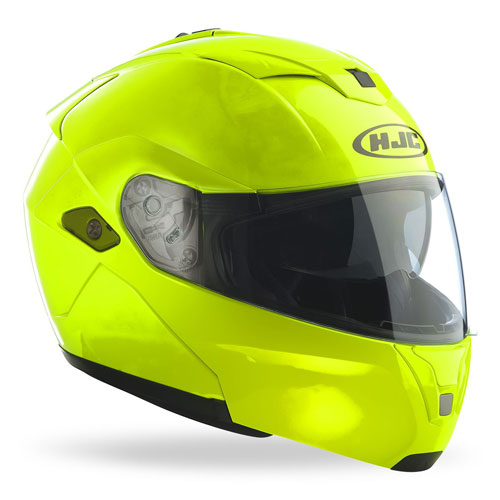
The HJC Sy-Max III is available in a pretty standard range of solid colors. We’ve shown them all on this page, and it includes the usual matt & gloss black, solid white, a silver and a hi-viz yellow version. If you look around, you might also find the subtly-cool Sy-Max III Shadow that’s a matt-black version with grey piping.

Video

This guy gives you a quick-overview of the SyMax III.

Other stuff – fastener, build quality, bluetooth communicator

The Sy-Max III comes with a micrometric fastener (easy to use and quick-release). Build quality is pretty good although, according to a couple of owners, you might notice a few areas around the chin guard that aren’t quite up to scratch – if you look closely.

HJC-Sy-Max-III-modular-crash-helmet-silver
Classic silver version of the Sy-Max III

And finally, the SyMax is designed to accommodate HJCs Chatterbox bluetooth system – with a removable section on the left hand side. Of course, many folks will already have a bluetooth they want to use with the SyMax III and there’s reports of people fitting both the Sena SMH-10 and the Cardo Scala Rider G9 without too many problems (though one owner struggled to fit their Scala G4).

[xyz-ihs snippet=”Link-to-guides-page”]

Alternatives to the HJC Sy-Max III

There’s lots of competition in the flip-up helmet market at this price point and some fabulous helmets to be found. The AGV Compact is a SHARP 4 star rated modular with sun visor and free Pinlock. Then there’s the very light 4 star Lazer Monaco – a bit more expensive but a great helmet with a photochromic visor as standard. Both are great performing modulars.

For more alternatives, why not check out our Top 10 flip up crash helmets page?

[xyz-ihs snippet=”HJC-link-to-Category-Page”]

Overall/Summary

Owners seem to like their SyMax IIIs. It’s pretty quiet (for a modular!) feels well-built, has a great pair of visors and does everything pretty well. The only fly in the ointment is the SHARP safety score of 3 stars (out of 5) and the 40% rating for the chin bar. If you can live with that, in all other respects the SyMax is a well regarded helmet that’s easy to live with.

Star Ratings

Review of the Shark S600 full face crash helmet

shark-s600-disc-try-the-ridill-us--featured

Shark’s entry-level thermoplastic full face helmet – the Shark S600

The S600 is Shark’s current entry-level helmet. But even though it can be had for under $200, that doesn’t necessarily mean you have to compromise. As we show in our cheapest crash helmets section, there’s plenty of choice and great performing helmets to be had for well under $200.

The S600 might look a bit plain in comparison to some of the latest top end releases, but with a quick release shield, removable lining – and a Pinlock anti-fog insert in the box – as well as very good SHARP safety rating, the Shark S600 is shaping up to be a real contender – and not just against other entry-level helmets.

Note: the Shark S600 has been discontinued and rarely in stock these days. You might want to try the Shark Ridill instead (or take a look at our Top 10 full face helmets).

  • Shark’s entry-level full face
  • Thermoplastic shell
  • Not Snell tested
  • SHARP 4 Star rated for safety
  • Pinlock anti-fog insert included
  • Sizes XS-XXL
  • 5 year Shark warranty
  • Expect to pay $150-$200

Safety

Shark-S600-solid-gloss-white-crash-helmet-side
S600 in solid gloss white

Even though the S600 is the cheapest of Shark’s current range, it’s received four stars in the SHARP safety test which is a fantastic performance and only one star off the maximum five stars. It’s also been ECE 22/05 tested/approved so you can be confident the S600 will offer a good level of accident protection, should the worst happen.

Other features that contribute to overall safety levels are the fact that it comes with a Pinlock-ready shield (Pinlocks are great for reducing fogging and mean you shouldn’t be scrabbling around to see when things get misty) and it has the well-regarded micrometric locking mechanism to keep the strap locked closed.

Shark are our current joint second best rated crash helmet brand for safety and the S600 continues their trend for producing well made and safe helmets.

All in all, we reckon the Shark S600 is almost as safe as they come (though check our SHARP 5 star helmet section for the absolute safest helmets on sale).

Shark-S600-Exit-black-green-crash-helmet-front
Shark S600 in Exit graphics showing single chin and forehead vents

Helmet Noise

Of the feedback that’s available, owners say the Shark S600 is very quiet. That’s possibly down to a few factors.

Firstly, the S600 has limited inlet and exhaust vents cut into the shell. If you have lots of vents (and some helmets have six or more) then they can let quite a bit of noise into a helmet, along with the fresh air. Because the S600 only has a couple of vents and therefore holes cut into the shell, it could mean less noise can get in.

Secondly, the bottom of the liner is quite a snug fit. That could keep out a fair bit of noise from coming into the helmet from below.

Finally, many of the owners of the S600 are new to motorcycling and this is typically one of their first helmets. As we know, helmet noise is very subjective so if you don’t have many other helmets to compare it to, it could give a slightly false impression.

That said, most owners were adamant the S600 is quiet so we’ve reflected that in our ratings below.

Ventilation

The S600 has just two vents in the helmet – one chin and one forehead vent. Both are operated by a toggle switch that works a bit like a light switch; so to open, you press the switch one way, and the other to close. They’re simple to operate – even in gloves – and there’s no complaints from owners.

Shark-S600-volt-black-green-yellow-rear-view
Rear view. No spoilers or exhausts.

The forehead vent routes air through channels in the EPS polystyrene lining through to the scalp and the warm/stale air exits the helmet via the exhaust vent that’s around the rear collar area at the base of the helmet – so no rear vents cut into the helmet shell that you find in more expensive models.

However, according to some owners, it seems these two small vents can struggle to feed all the air needed into the helmet.

In cold weather, the shield steams up easily because the single chin vent can’t pull enough air into the front of the helmet. Of course, fit a Pinlock anti-fog insert and that problem will disappear. And in cold weather you’re probably more interested in reducing air flow around your scalp to keep your head warm rather than getting ventilation into the helmet.

But, as we say, if you ride in colder weather, then get a Pinlock fitted and you should be fine.

However, the lack of ventilation can be a bit of an issue in hotter areas when plenty of cool air flowing around the helmet is more useful.

Shield

The Shark S600’s shield works well. It ticks all the important boxes and though there’s nothing massively fancy about it, it has some of the most important features – namely it’s quick release, reasonably optically correct and comes Pinlock-ready. Job done.

Shark-S600-play-black-yellow-blue-crash-helmet-front
Shark S600 in Play black/yellow/blue graphics

The ratchet on the shield is nice and firm and allows you to open it just a crack – something many of us like to do when we’re bimbling through town at low speeds. The shield itself has an opening tab front and left – which is probably the best place for it.

It has one of the best quick-release shield removal mechanisms around – press in a button on each side and the shield slides off (check the video to see it in action).

To find other helmets with quick-release shields, check our quick change shield section, (to see helmets with a range of important features, use our feature tags found above on the right sidebar).

Comfort

There’s no problems reported with the comfort of the S600. Like other Sharks, it features a sweat-wicking, fully removable and washable lining which owners say is very comfortable. As always, that’s dependent on getting the right fitting in the first place.

Looks & Graphics

Looks are pretty subjective but the S600 certainly doesn’t disgrace itself. It’s a reasonably basic, uncluttered design that’s available in the usual solid black & white, gloss and matt versions and Shark regularly update the range with other designs.

At the time of writing, the S600 is available in the Swag, Prime, Exit, Volt and Play graphics and you’ll find many of those dotted around this page. For the latest designs, you could visit the Shark website or visit our recommended retailers who’ll usually have a range that includes both recent and older graphics, often at reduced prices.

Video

A 5 minute look around the Shark S600 from this dude at Bikenation.

Shark-S600-solid-matt-black-helmet-side
Shark S600 looking moody in solid matt black

Other stuff – weight, fastener, build quality

The S600 weighs in at about 3.2lbs (1.45Kg) for the medium size which is about average for a full face helmet.

It has a micrometric (ratchet) fastener which are really easy to use and incredibly quick to release.

Build quality is reported to be very good.

[xyz-ihs snippet=”Link-to-guides-page”]

Alternatives to the Shark S600

Even though the S600 represents great value for money, there’s tons of competition at this price point. Take a look at the 4 star rated Scorpion Exo R410 which features Scorpion’s innovative air pump system as well as an optically-correct shield. For a little more money, you could get an AGV K3 SV too – that’s another SHARP 4 star rated helmet with a drop down sun shield and great ventilation. Both are worthy alternatives to the S600.

[xyz-ihs snippet=”Shark-Cat-link”]

Overall/Summary

The Shark S600 is a great helmet. Sure, it’s a bit basic and low on features, but for the price, you get a great performing helmet that does all the basics well and introduces you to Shark crash helmet ownership at a price that won’t break the bank.

It’ll probably appeal more to folks that are new to motorcycling – mainly because of that low price point – but that doesn’t mean it’s not worth the rest of us checking out the S600 too because it’s a great helmet period.

Star Ratings

Nolan N44 Classic & Evo Crash Helmet Review

nolan-n44-disc-featured

Nolan N44 – a funky and hugely versatile cross-over crash helmet.

Nolan have been making crash helmets since the early 70’s but are only recently starting to forge a reputation as helmet innovators – exemplified perfectly by the N44 classic and Evo (the Evo having slightly different comfort lining to the classic).

If it looks a bit quirky from the outside, but that’s probably because the N44 has been designed to be most things to most motorcyclists. Out of the box it’s a full face helmet. But with the ability to swap the shield for a visor and totally remove the chin guard, it can also be used in open face or adventure modes offering you six different configurations for the price of one helmet.

Note: the Nolan N44 is now discontinued. So why not check out our Top 10 Helmets page – including our Top 10 Modular Helmets and Top 10 Full Face Helmets.

  • Both ECE and DOT certified
  • Not SHARP or Snell tested
  • Thermoplastic shell
  • 6 Helmet configurations
  • Drop down sun visor
  • P/J certified – for use as open and full face helmet
  • Nolan 5 year guarantee
  • Amazingly wide field of vision
  • Sizes XXS-XXXL
  • Expect to pay $330-$380 depending on designs

[xyz-ihs snippet=”Nolan-Revzilla-quick”]

Nolan N44 evo hi-vis crash helmet side view
Hi Viz version of the N44 Evo

Overall/Summary

Owners mostly seem to choose the N44 because its massive shield appeals – and they’re broadly not disappointed. That huge aperture gives them a real feeling of riding in an open face helmet even when the shield’s down.

They also love the flexibility the N44 gives them and think that, bar a few niggles detailed below, the N44 really performs. It’s not the quietest helmet (which modular is?) but the N44 has so many features at such an accessible price point that you get a massive amount for your money with the N44.

Safety

Like all helmets on sale in the US, the Nolan N44 is DOT certified (it’s also ECE 22.05 approved) to ensure it offers a certain minimum level of protection. Because of the N44’s unusual removable chin-guard, it’s worth mentioning that this testing does include chin guard impact testing too, to the point that, in Europe, the N44 was awarded dual-homologation by ECE (both P & J approval) meaning the chin guard is protective and the helmet can be officially worn as both open faced and full faced.

However, it hasn’t been Snell or SHARP tested yet (Nolan don’t usually submit their lids to Snell for testing; with SHARP, they’re not given the choice!) so we can’t know definitively how much protection it should give in comparison to other helmets.

Nolan-N44-evo-crash-helmet-flat-black
Nolan N44 Evo in Flat Black

What we can say though, is that Nolan Group helmets are broadly excellent performers with, at the time of writing, all three Nolan Group companies (that’s Nolan, X-Lite and Grex) in our top 10 safest brands list. Nolan polycarbonate helmets have all, so far, always scored 4/5 in the SHARP test – including 5 polycarbonate system helmets. They also have a 100% record of their system helmet chin guards staying locked and closed under testing impacts, and although the N44 is somewhat different to the other helmets that have been tested, it’s encouraging to see that the locking mechanism on its removable chin guard is all metal too.

So overall, while it’s impossible to be certain, everything seems to point towards the Nolan N44 as offering a decent amount of accident protection – especially with the chin guard in place.

Aside from the obvious way the helmet will protect in an accident, we’d also say both the massive area of peripheral vision given by the huge shield and the drop down sun visor will both contribute to safety by helping avoid accidents.

Helmet Noise

Helmet noise is always a tricky one to assess because it’s so objective. In the case of the N44, as usual there’s lots of differing views, usually depending on previous helmets people have owned and the type of bike people ride.

Overall though, the N44 seems to be about average. A couple of people say it’s incredibly loud but most feel that – especially with helmet in full face mode with shield down and vents closed, it’s reasonably quiet – though open the vents and that seems to create quite a bit of noise.

In addition to this, several people who use bluetooth communicators commented that the N44 was particularly good and quiet, especially when making phone calls.

Sizes

The Nolan N44 is available in a wide range of sizes XXS – XXXL. However, it’s only made in two helmet shell sizes with one covering sizes XXS to L and the other XL-XXXL. If you’re an XXS it might mean that the helmet looks very big on you, especially if you have a small body too. Read more on why just two shell sizes might make a difference here.

As for getting the right size when you buy, apparently the N44’s sizes are about bang on – so check out our helmet fitting guide to measure your head correctly and once you’ve done that, the right size Nolan should fit you a treat.

Nolan-N44-evo-Italy-N-com-crash-helmet-rear-view
Rear view showing large exhaust vent

Ventilation

Ventilation on the N44 is good.

There’s a vent in the large face shield (weird!) and the top vents and exhaust are all contained in a single panel that covers the top of the head (what Nolan call Airbooster). The air’s pulled into the top vent which effectively scoops air into the helmet and cools the head. There’s three reasonably-easy-to-use sliders up there too allowing you to close off the vents.

A few people have commented that the vent that sits within the shield isn’t massively effective and it seems many people just remove the chin guard entirely when things get too stifling – one owner said when it gets really sunny the large shield acts a bit like a greenhouse and removing the chin guard is the best way to cool things down!

Quite a few owners also commented that the first notch on opening the shield is just enough to help circulate lots of air when it gets hot (or foggy). But overall the vents are good for most circumstances.

Shield

The massive shield is the reason most people bought (and like) the N44.

It really is huge and goes all the way down covering most of the chin guard and offers a huge field of view with many owners saying it’s like riding in an open face helmet, even with the chin guard in place and the shield down!

Nolan-N44-crash-helmet-front-view
Front view showing drop down sun visor

The shield is Pinlock ready and comes with a Pinlock anti-fog insert in the box. It’s also UV400, meaning it should screen out all the harmful UVA and UVB rays.

It’s also quick-release – just open the shield, slide up the tab to the front of the pivot and the shield pops out.

Also in the box is an external sun visor (see below right). It’s similar to the visors you’ll find on adventure helmets and can be very useful for giving some shade when the shield’s removed. It’s easy to fit too; remove the main clear shield and it snaps into place using the same fitting, then just press onto the pivot at each side and move the slider up to secure.

The N44 also has an integral drop-down sun visor (see left), lowered by pressing the slider on the bottom left of the helmet forwards. This one is spring loaded too, meaning to retract the sun visor, you push a button underneath the slider and it quickly retracts back into the helmet. Nice.

One thing worth noting – and it’s not unique to the N44 – is that some owners reckon the sun visor is a bit too light and doesn’t drop down far enough. That’s a complaint that’s leveled at quite a few sun visors and is probably to do with some territories limiting how dark a sun visor can be – also to do with how much space is available in the helmet itself to produce a deeper sun visor.

However, many owners do love it and say it makes all the difference when riding in sun.

Nolan-N44-evo-silver-crash-helmet-side-view-no-chin-guard
N44 Evo silver with chin guard removed.

Chin Guard and Helmet Configurations

Aside from the huge shield, the way the chin guard works and the different helmet configurations available with the N44 is a massive selling point for this helmet.

The chin guard can be removed by pressing down on the two metal tabs on the top of the guard which releases the catch that holds the chin guard in place – and the chin guard can be pulled forwards and removed. Note, the helmet comes with a couple of blanks that can be used to fill the holes left by the chin guard.

The N44 can then be used in jet mode – face shield down but with plenty of air getting into the helmet and is perfect for urban riding.

Nolan-N44-evo-silver-crash-helmet-side-view
N44 in open face guise with chin guard and visor removed in

Of course, the shield can be removed and replaced with a visor, turning it into an adventure helmet (below right) – with or without chin guard – complete with space to use goggles if required. The peak can’t be fitted with the main clear shield in place though.

All this means that if you opt for an N44, you’re getting an incredibly flexible helmet that you can configure depending on how your mood takes you. In practice, most riders seem to use just a couple of the configurations, but it’s always nice to know you’ve got the flexibility there should you need it.

One thing worth being aware of though is that several owners said that it’s a really tight fit to get the helmet on with the chin guard in place. Several say they always first remove the chin guard, then put the helmet on, then put the chin guard on – and vice versa to take it off. It’s not the most arduous process once you get the hang of it but it does take a little more time than most modular helmets.

Nolan-N44-evo-silver-crash-helmet-side-view-sun-peak
N44 Evo with chin guard and visor removed and external visor added

Comfort

A couple of users have mentioned that the sides of the helmet can press in a little – mainly because, unusually, the comfort liner goes over the speaker pockets. Other than that, the Nolan N44 has a fully removable lining using what Nolan call their Clima-comfort fabric which owners overwhelmingly say makes for a comfortable helmet – as long as you get the fitting right in the first place.

There might also be a slight issue with the chin strap. It features a micrometric 2 fastener – which are quick and easy to use – but a small number of owners said the strap itself is a bit uncomfortable, pulling into the throat above the adam’s apple a bit too tightly. Having a strap that’s tight and pulls the helmet tight onto the head is obviously a good thing in many ways – it’s estimated around 5% of motorcycle fatalities may be caused by the helmet coming off the head. However if you have a particularly large adam’s apple, it’s worth being aware of.

One owner did comment that they fitted a microfleece cover to the chin strap which stopped it being uncomfortable for good.

Looks & Graphics

At the time of writing, Nolan offer the N44 in three different designs – the usual solid plain colors along with the Como N-Com and the Italy N-Com designs. As usual you can see examples of all these around the review although to see the latest color schemes and designs available, it might be worth clicking the links through to our recommended retailers to see which are available to you now.

[xyz-ihs snippet=”Nolan-Revzilla”]

Video

Here’s a couple of videos if you want to get a more in-depth feel for the N44. First off from Jafrum and below that, Nolan’s official release vid (skip to 50s to get past all the intro fluff on Nolan’s video!).

Other stuff – fasteners, audio, weight, glasses, build quality

Nolan-N44-crash-helmet-classic-metal-white
N44 Classic in Metal White

The Nolan N44 also comes with a wind/noise deflector in the box that fits to the bottom of the helmet in full face mode.

It has a microlock 2 lock on the strap – that’s the latest version of the microlocking mechanism and works well (though see our warning in the comfort section above).

For a modular helmet, the N44 is about average weight. The medium size helmet (using the shell size that covers from XXS to L) weighs in about 3.4lbs (1.55Kg) which is lighter than the average modular helmet.

Build quality of the N44 is broadly rated as very good with only one or two very small niggles being reported – and a couple of owners say it works very well with glasses, although you’ll probably have to remove the chin guard to get the helmet on in the first place (see chin guard section above).

Finally, the N44 is designed to work with the Nolan N-Com bluetooth kits. A few owners did say that they managed to fit their non-ncom communicators without a problem though – specifically a Cardo Scala Rider G9 and other kits that can be stuck onto the helmet – commenting that the speaker cutouts were fine and that there’s decent internal routing for cables.

[xyz-ihs snippet=”Link-to-guides-page”]

Alternatives to the Nolan N44

There aren’t many helmets around that are direct competitors to the N44 but if you’re also considering a more traditional flip-up helmet, you might want to check out the Nolan N104 – that’s a 4 star SHARP rated flip-up helmet that’s well rated and costs about the same as the N44. There’s also the well rated AGV Numo Evo – that’s SHARP 4 star rated and a great all rounder.

[xyz-ihs snippet=”Nolan-Revzilla-quick”]

[xyz-ihs snippet=”Nolan-Cat-link”]

Star Ratings

BMW shows off their HUD helmet concept

BMW-HUD-concept-crash-helmet
BMW Motorrad Heads up Display prototype

BMW HUD helmets front view
Hopefully the finished helmet won’t be massive like this one!

It very much looks like HUDs (Heads up Displays) for crash helmets are going to become ‘a thing’ in 2016. They’re already available of course – you can already find the BikeHUD on sale at AmazonUK which are apparently a pretty decent first attempt – but there’re other more mainstream moves afoot.

First there was the Skully AR1 which is scheduled to ship in summer ’16. And now BMW Motorrad has shown its first HUD helmet prototype off.

BMWs version seems a little less ambitious than Skully’s at first glance. It has all the usual features we’d expect to be included, the main one being the display glass sitting in front of the rider’s right eye. As you can see by the mockup display below, that shows info such as speed, revs, gear etc. plus there;s the promise of other goodies too including sat nav guidance and accident notifications.

But the interesting thing about BMWs system, which could well give it an advantage in the marketplace, is the fact because they’re being developed effectively in-house, that could potentially give their system access to all the tech installed on-board on BMW machines. Meaning they could feasibly tap into all the other data being churned out by the onboard ECU and computers including fuel levels, tire pressures, engine modes and so on. That’s data third party competitors may struggle to gain access to, leaving their systems looking a little weak.

MCE-insurance-big-ed
And here’s one they prepared earlier!

Obviously, it’s debatable how much information the rider needs – or wants – before it becomes too much of a distraction. And I guess that’s part of the prototyping and testing process; to find that happy medium.

In the meantime it’ll be interesting to see how these techs develop and at what price point they start to hit the market – and indeed to see how many people buy them given that much of the attraction of motorcycling is to get away from distractions and just focus on the road and scenery.

We’ll keep you updated here.

BMW HUD display mockup
Mockup of how the HUD display might look.

Review of the Bell Qualifier DLX motorcycle helmet (and DLX with MIPS)

Bell Qualifier DLX Clutch Blue

Bell have caused a bit of a stir with the launch of their new Qualifier DLX – on at least a couple of scores.

Bell call it a lightweight injected polymer composite shell – but that’s a bit like calling my desk an organic cellulose composite matrix. Technically, it’s correct. Logically, it’s marketing speak for a plastic or polycarbonate shelled helmet.

Pedantry over. It’s a new polycarbonate helmet that really looks the part. It’s got a sleek and purposeful design that’s designed to reduce lifting and buffeting, and most of the designs and colour schemes it’s available in look nice and modern and uncluttered.

There’s also a version with Multi-directional impact protection system (MIPS) liner. See the Safety section below for more details.

But the massive standout feature of the DLX is that shield. For a helmet at this price point it’s amazing that Bell can sell it with a light-reactive Transitions shield. One that’s got a NutraFog anti-fog coating and is anti-UV too.

Read on for the low-down on the Bell Qualifier DLX and what owners think of the helmet.

Bell-Qualifier-DLX-solid-hi-viz-helmet
Qualifier DLX high Viz version

  • Full face polycarbonate helmet
  • SHARP 3 Star (out of 5)
  • Weight 3.4lbs (1.56Kg) – slightly heavier than average
  • Double-D ring fastener
  • Photochromic anti-fog anti-UV shield
  • Communicator-ready
  • 5 year warranty
  • Expect to pay $250 (non MIPs version)
  • $290 (MIPs version)

Looking to buy a Bell Qualifier?

Please click below to visit the Bell Qualifier pages at our recommended stores – all checked for great online ratings. And if you buy from any store, we get a small sum from the sale at no extra cost to you – a massive THANKS! (it’s how we finance the site).

Shop for helmets at AmazonBTO Sports

Safety

The Bell Qualifier DLX is a polycarbonate full face helmet.

It’s both DOT and ECE certified, so legal in the US, Europe and Australia (and everywhere else those standards apply).

Unlike lots of Bell helmets, the Qualifier DLX hasn’t been Snell tested yet, but in the UK, the European version has been SHARP safety tested where it scored a disappointing 3 stars out of 5.

Before the DLX, all Bells

bell qualifier dlx high speed impact test
Regular (non-MIPS) Qualifier DLX SHARP UK test results @8.5m/s – courtesy of sharp.dft.gov.uk

have scored 5/5. But then none of the previously tested Bells have been polycarbonate helmets. So it’s dropped a few points there.

Bell-Qualifier-DLX-MIPS-Motorcycle-Helmet-Accelerator-hi-viz-side-view
This one’s the DLX with MIPS hi viz Accelerator

Looking at the SHARP test data, it lost a few marks on the side impact test (as many helmets do). But it’s notable that it scored particularly badly on the left hand side impact test. Does that mean the communicator panel that you can see on the picture of the hi-viz DLX above (remove it to fit a bluetooth set) has weakened the helmet there? The jury’s out, but it’s a massive coincidence if not.

Qualifier DLX MIPS

So, OK it scored 3 stars for safety, but that’s not the entire story. Because, since SHARP tested the DLX, Bell has released an uprated MIPS version of the DLX.

MIPs stands for Multi-directional Impact Protection System which allows the interior shock absorbing lining to move semi-independently of the outer shell. It’s designed to reduce any rotational forces impacting on the helmet during an accident being transmitted through to the rider’s head and neck. Rotational forces can twist the skull around the brain causing damage. They can also cause neck injuries.

bell qualifier dlx mips high speed impact test 2
Bell Qualifier DLX MIPS high speed impact test – courtesy of sharp.dft.gov.uk

So, it’s great to see Bell implementing something like this, especially in the Qualifier range which is, let’s be honest, their cheaper range of helmets.

In 2019, SHARP tested their first MIPS (or equivalent slip-plane helmet) in the form of the Bell Qualifier DLX MIPS. I stress again, this was using a UK spec helmet and I’ve no idea whether that’s identical to the US Qualifier MIPS. However, I was really keen to see how well it would do in comparison to the other non-MIPS helmets.

So I was a bit deflated when it scored the same 3 stars safety rating as the non-MIPs Qualifier DLX.

As you can see from the SHARP test result – and remember this is only a snapshot from one speed test – it only gave average protection on the side and forehead, which I guess accounts for it dropping a star or two.

Plus, SHARP only performs one oblique test so I guess the effectiveness of MIPS to limit rotation could potentially be a little diluted in the test results.

Bell-Qualifier-DLX-MIPS-solid-matt-black-side-view
You can also get a solid matt black DLX with MIPS

Aside from the SHARP test result, the Qualifier DLX is created in 3 shell sizes, which is a good thing and means whatever size you choose, the DLX should look proportionately the right size on your head. All good there then.

Helmet Noise

The Bell Qualifier DLX has lots of vents in the helmet shell – and word is that the inside comfort padding isn’t the thickest.

All of which may be the reason why owners of the DLX broadly think it’s a fairly noisy helmet. You see, a lack of padding and lots of holes in the shell make for easy paths for external noise to permeate the helmet.

It’s not the noisiest around – there’s plenty of sportsbike helmets that are tons noisier – but if you’re after a really quiet helmet, you’re probably best looking elsewhere.

Bell-Qualifier-DLX-MIPS-Motorcycle-Helmet-Accelerator-Red-Black-rear-view
Rear view of another MIPS version – this time a red/black accelerator, showing the rear exhaust vents

Having said that, while there’s one or two owners who think it’s really noisy, a few think it’s OK too. So, overall, we’re going to put it down as a bit noisier than average.

And, as always, stick in some ear plugs, and we think most folks will find the DLX just fine.

Ventilation

The Bell Qualifier DLX has a loads of vents on the helmet shell. There’s a couple of chin vents operated by a single switch, four brow vents right above the shield and again opened/closed by a small central switch. And there’s two separate crown vents, both independently operated by a slider behind each vent.

On the rear, there’s four always-open exhaust vents.

All of which you’d expect to make for an amazing venting helmet, right?

Well, owners reckon its not bad. Venting is important to lots of people – people who live in hot places or take their bikes on the track obviously need a helmet to vent well to keep cool, while many of us need decent ventilation to keep a bit sweat-free and to keep the shield clear in cold (or humid) weather.

Overall, owners of the DLX think ventilation is somewhere between OK and good. It could do with better ventilation around the shield because the shield only has Bell’s anti-fog treatment on the back of it and it can be prone to fog. But otherwise, there’s no problems with ventilation and you’ll probably find it OK to live with.

Bell-Qualifier-DLX-Motorcycle-Helmet-clutch-hi-viz-side-view
Wanna get noticed? The Qualifier DLX Clutch in hi-viz yellow and red should do it!

If ventilation’s particularly important to you, make sure you check out our list of best venting motorcycle helmets.

Shield

The shield that comes with the Qualifier DLX is the real icing on the cake though – and the reason lots of us have bought one.

For the first time, you can get a relatively low-price helmet that comes with a photochromic reactive shield as standard – what Bell call their Transitions Adaptive shield, because the technology is licensed from Transitions – the company behind many of the reactalite glasses lenses. These lenses have been around for a while of course, notably coming as standard on the Lazer Monaco flip up (also available for the Lazer Kite too).

But the great thing about the DLX is that it comes as part of the (very reasonable) price. So if you don’t like fiddling around with sun shields, then this might be a great alternative for you.

Most folks who bought a DLX love the transitions shield. It doesn’t take long to react and darken (they take about twice as long to lighten again) and they’re really effective. And when riding at night, they’re totally clear so you won’t be struggling to see when the sun drops down. For more information on transitions shields (and lots of other helmet features) click the links in the right hand sidebar (bottom of the article on mobile).

Bell-Qualifier-DLX-crash-helmet-impulse-black-top-view
Top view of the Qualifier DLX Impulse

The Qualifier DLX also has Bell’s ClickRelease shield. That’s a ratchet shield with a really easy to use quick-change mechanism that lots of owners love and reckon quick change shields don’t come any easier.

The transitions shield isn’t Pinlock ready but comes with a NutraFogII coating that’s supposed to do the same. Unfortunately, many owners don’t think it’s much good. When things cool down a little – or gets a bit humid – then the DLX’s shield fogs up easily. There is a Pinlock 70 antifog insert available for it, but it only works with some of the other Pinlock-ready shields, not the Transitions. So that’s a bit of an achiles heel for those of us who need a proper anti-fog solution.

Comfort and Sizing

Inside the Bell Qualifier DLX, you’ll find a reasonably comfortable, removable and washable and moisture-wicking comfort lining.

It’s adjustable too. If you buy one and find the fit not quite right, you can tailor the fit with replacement cheek pads, to tighten things up or slacken them off a bit.

However, there are one or two potential niggles.

A couple of owners said they could feel the plastic poppers used to secure the lining in place (including the reviewer at MCN). A couple also said the lining feels a bit cheap. But they were in the minority and lots of owners say they think it’s comfortable with no problems. So, if you buy one, it’s probably just worth checking yours over if when you first get it to make sure there’s no issues.

Bell-Qualifier-DLX-Rally-matt-black-white
Front view of the Rally matt black/white DLX

It’s also worth noting that fitment size seems to run a little on the small size. Some folks said a full size small, others reckoned it’s about bang on. In this case, we’d say if you’re between sizes when you measure, go for a size smaller. Otherwise try the correct size and see how you get on – oh, and buy from a retailer who’ll exchange the helmet without any fuss (like our recommended retailers).

Other than that, most people find the interior absolutely fine – a comfortable place to be with no problems.

Best places to buy a Bell Qualifier?

Please click below to visit the Bell Qualifier helmets pages at our recommended stores – all checked for great online ratings. And if you buy from any store, we get a small sum from the sale at no extra cost to you – a massive THANKS! (it’s how we finance the site).

Shop for helmets at AmazonBTO Sports

Bell Qualifier DLX Video

Quick review of the standard Qualifier DLX (9m video), followed by a slicker 4m video looking over the MIPS version of the DLX and a 2m video on MIPS.


Other stuff – audio, fasteners, weight, build quality, chin curtain, warranty

Bell-Qualifier-DLX-clutch-black-helmet
Here’s the black/white Clutch DLX

The Qualifier’s also been designed to accommodate a couple of bluetooth communicators too – the old Sena SMH10 or 10s, and the Cardio Scala Rider Q1/Q3. Note, while there’s a removable panel on the side of the helmet, you will need to buy an adaptor to fit either, so factor in the cost for these too. We also heard from a couple of riders who found the adaptors didn’t work very well so again, buy from a reputable dealer who’ll refund no problems.

The Qualifier DLX comes with a double-d ring fastener. It weighs about 1.56Kg which isn’t the lightest for a full face. In fact, the average full face weighs 3.43lbs (1.47Kg), though that’s across all helmet materials including carbon fiber helmets which are, generally, lots lighter.

Build quality on the DLX is very good considering the spec and value you’re getting for not very much money. At least, most owners are pleased with the build quality. It also comes with a chin curtain and breath deflector in the box. It also has Bell’s five year manufacturer’s warranty which is an excellent bonus.

Overall/Summary

Bell-Qualifier-DLX-devil-may-care-crash-helmet
Qualifier DLX in Devil May Care colours – for the shrinking violets among us!

Overall, the Bell Qualifier DLX is a decent package. Plus, it comes with that amazing Transitions photo-reactive shield which, let’s be honest, is the main reason you’re thinking of buying one, right?

So, it drops points for safety but it makes up points for the photochromatic transitions shield and the five year warranty. It’s not the cheapest polycarbonate helmet around by a long shot (see our budget helmets here or our polycarbonate crash helmet reviews here for alternatives) and some of the alternatives score top marks for safety too. But if you’re after something a bit different from a long-established brand, then the Bell Qualifier DLX is certainly worth a look.

Looking to buy a Bell Qualifier?

Please click below to visit the Bell Qualifier pages at our recommended stores – all checked for great online ratings. And if you buy from any store, we get a small sum from the sale at no extra cost to you – a massive THANKS! (it’s how we finance the site).

Shop for helmets at AmazonBTO Sports
[xyz-ihs snippet=”Bell-Cat-link”]

Star Ratings

A review of the Shoei Hornet X2 dual-sports adventure crash helmet

Shoei Hornet X2 Seeker TC1
Shoei Hornet X2 in Seeker TC1 graphics

Shoei’s versatile Adventure/dual-sports helmet: the Shoei Hornet X2

Introduction

The Shoei Hornet X2 is successor to the well-regarded Shoei Hornet – Shoei’s top of the range dual-sports/adventure helmet, designed to work as a high quality full face helmet but with a nod towards off-roading. It’s a fiberglass-shelled helmet with many of the features you’d expect in a full face but with a detachable visor to keep the sun glare down.

Summary

Owners love the Shoei X2. It’s well built using good quality materials and is comfortable with a great shield. The visor’s been very well designed so it’s useful without making it too top heavy or prone to buffeting. But don’t just take our word for it – read on because our reviews are taken from what actual buyer/owners think of the X2.

If you’re after an Adventure helmet, the Shoei Hornet X2 may well be the one you’re looking for!

  • Fiberglass Adventure full-face helmet
  • Snell/DOT certified
  • Not SHARP tested
  • Emergency quick release system
  • Double-D ring fastener
  • XXS-XXL
  • 3.75lbs/1.7Kg
  • 5 year warranty
  • Expect to pay $475-$700

Looking to buy a Shoei Hornet X2?

Please click below to visit the Shoei Hornet X2 helmets pages at our recommended stores – all checked for great online ratings. And if you buy from any store, we get a small sum from the sale at no extra cost to you – a massive THANKS! (it’s how we finance the site).

BTO SportsShop for helmets at Amazon

Shoei Hornet-X2 ADV solid white crash helmet
Hornet X2 in gloss white

Safety

The Shoei Hornet X2 is both Snell and DOT certified and, while it hasn’t been SHARP tested, Shoei have a great reputation for producing safe helmets.

At the time of writing, they’re currently 6th in our top 10 safest helmet brands list and their three most recently tested fiberglass helmets (two full face and one flip-up) scored either four or five stars with SHARP – so we expect the Hornet X2 to score similarly well.

Of course, it’s been ECE approved too (in Europe the Hornet is sold as the ADV) so you should be pretty confident it’ll perform as you hope it will in an accident.

Other things that contribute to safety – it’s made in 4 shell sizes (only premium helmets are made in 4 shell sizes), has multi-density polystyrene (EPS) shock absorber inside and has a nice wide shield aperture with optically-correct shield. The fact that it’s made in four shells should mean the helmet is bang on for your fitment size, making it nice and compact and not too big for your body size which can make it look a bit weird.

All these features will arguably help improve safety too, either by making it perform better in an impact or helping avoid an accident in the first place.

I guess one slight safety concern is the visor. Many helmet manufacturers go to great lengths to make their helmets as round as possible – in fact it’s usually very prominently mentioned in all the bumf – especially from Aria. So, even though the visor on the Shoei is fitted with break-off screws to help it detach in an accident, it’s worth being aware that having anything jutting out may contribute to rotation of the helmet, which is something you very much don’t want in an accident!

Helmet Noise

Shoei Hornet-X2 ADV ear pads
Removable ear pads are great for noise suppression (and fitting speakers!)

While helmet noise is very subjective, the overall opinion is that the Shoei Hornet X2 is above average to good in suppressing noise. That’s in comparison to all helmets, which would be pretty good in itself; in fact one or two experienced Adventure riders did comment that it’s the quietest Adventure helmet they’d ever used.

Shoei have gone to great lengths in the wind tunnel to reduce buffeting – especially since they’ve got a visor to deal with, which are notorious for whistling and grabbing the air to buffet your head around (see below). They’ve also fitted sound-deadening ear pads inside the helmet to keep things quiet where cut-outs for speakers might sit. All in all, it seems to have worked.

Ventilation

Broadly the ventilation’s really good in all but the most extreme high temperatures when things can get a bit sticky. But then that can be a problem with most helmets.

Shoei Hornet X2 crash helmet - seeker TC6 front view
Front view showing single chin vent and brow vents

From the front, the X2 doesn’t seem to have too many vents compared with other adventure crash helmets. It has a single chin vent and a thin brow vent. Both are pretty analogue (open/closed) and both can be a bit fiddly to use at first. There’s also a vent on the top of the head underneath the visor and operated by a small front/back slider.

In all but the hottest weather, most owners generally say the ventilation is good/great and keeps a nice amount of air circulating onto the shield and around the head, exiting from the rear of the helmet towards the top and around the collar. In cold weather, they can be closed to mostly shut out the draft, especially if the included nose guard and chin curtain are fitted.

Of course, do that and you start to have a problem with your shield fogging up. Thankfully, the Hornet X2 has a Pinlock-ready shield and a Pinlock EVO insert supplied in the box. Which is doubly-great. Not only does it mean you’ll be riding around fog-free but also more often than not, when Europe get Pinlocks free in the box, the US doesn’t. This time it’s the other way round – yay!

Shield

Shoei-Hornet-X2-ADV_Seeker-TC6-crash-helmet
Rear view of the Seeker TC6 (just about) showing cunningly hidden exhaust vents and groove for goggles

The shield’s a goodie. It’s optically correct (Shoei’s CNS-2 system), has a nice positive ratchet and the base plate is designed to pull and seal the shield when it’s closed. All good there. It’s also nice and wide with owners reporting you can barely see the edges out of your peripheral vision which is just as it should be. It’s also designed to cut out 99% of UV light too. Lots of ticks for the shield!

It’s Pinlock EVO ready too (that’s Pinlock’s latest standard) and as mentioned above, comes with a Pinlock in the box ready to fit. We didn’t find a single owner who fitted a Pinlock say it didn’t do the job – so if you ride in cool climes, it’s gonna be well worth the price.

If you do take the Hornet X2 off road and like to wear goggles, then you’ll be pleased to hear not only will the Shoei take goggles, but you don’t need to remove the shield either. Fully-open the shield, shove on your goggles making sure the strap sits nicely in the groove around the rear of the helmet, and you’re good to go.

One final note on the shield is that if you want to change/remove the main shield, it doesn’t need removal of the visor first, like it’s precedessor (and many other Adventure helmets) did. It’s actually a quick job to remove the visor itself – by turning the two screws a quarter of a turn then pressing down on the top of the helmet to pull it away. But when cleaning your shield is a drag, any time saved is welcome. That’s a good bit of design Shoei.

Shoei Hornet-X2_Matte_Deep_Gray
Top view of the removable visor

Visor

The visor’s easily removable (see above) and while it’s not adjustable, a couple of owners who mentioned it said it’s angled just about right so they’d probably not change it even if they could.

It’s well designed too. Visors can catch the wind and cause lots of head shaking at speed. But the Shoei engineers have carefully crafted the design, meaning if you’re on the motorway at speed, you’ll hardly notice the visor’s there. Most owners say at around 80, there’s really little difference between the Hornet X2 and a regular full face. Turn your head and you can feel a bit of tugging but generally – and considering you’ve a great wack-off visor sticking out of your lid – it’s amazingly well designed.

And if you spend a lot of time riding into the sun, then the visor’s a really welcome addition. Plus if you find you don’t use it much, you can pull it off and use the helmet as a full face. The only niggle there seems to be that it leaves a small hole in the top of the helmet and it doesn’t come with a bung to fill the space which may mean a bit of rain can get in. When you pay £5-600 for a helmet, it probably feels a bit wrong stuffing gum into the hole to make it watertight!

Interior view of the Hornet X2
Interior view of the Hornet X2. Front red bands are for the EQRS

Comfort & Sizing

The Shoei Hornet X2 is essentially a high-quality full face helmet with a visor attached. And like pretty well all other Shoeis (and as long as you get the fitment right in the first place) it’s a nice comfortable place to put your head.

The interior is removable and washable and has what Shoei call its 3D Max dry liner which is essentially an antimicrobial and moisture-wicking fabric which Shoei claim pulls sweat away from the head twice as quickly as traditional nylon interiors. Owners seem happy with it. A few have a little grumble that the Hornet X2 is tight to pull on in the first place, but once on, it’s a nice fit and good for hours in the saddle.

One nice touch – and one that’ll hopefully never actually be useful to any owner (!) is that it has EQRS or emergency quick release cheek pads; there to help the emergency services more easily remove the cheek pads/helmet after an accident. It also helps when you’re wanting to remove the pads to clean them too of course – or change them if you’re trying to get your fitting just right because Shoei offer replacement cheek pads so you can tailor the fit more precisely to your head.

A couple of other things worth noting: The Shoei X2 comes with a nose guard and chin curtain in the box and the join between the cheek guard and top lining creates an internal glasses groove to help you slide your glasses in more easily and stop them digging into the side of your head when riding.

Graphics

Colors and designs for the X2 are limited – probably because the helmet’s a statement in itself and doesn’t need fancy graphics to show it off? There’s solid white and silver, and matt/gloss black. At the time of writing, there’s also the Seeker TC range which you can see around this page – in 3 color variants.

Best places to buy a Shoei Hornet X2?

Please click below to visit the Shoei Hornet X2 helmets pages at our recommended stores – all checked for great online ratings. And if you buy from any store, we get a small sum from the sale at no extra cost to you – a massive THANKS! (it’s how we finance the site).

BTO SportsShop for helmets at Amazon

Videos

Here’s a look around the helmet from the Revzilla dude (does he ever actually take a breath?!) – plus Shoei’s promo vid.

Other stuff – fastener, weight, communicator

Shoei Hornet X2 Seeker TC8
Shoei Hornet X2 Seeker TC8 colors

The Hornet X2 comes with a double-d fastener. It weighs in at about 3.75lbs/1.7Kg which is pretty weighty (the average full face for comparison is just under 3.3lbs/1.5Kg) – though few of the owners actually complained that it felt too heavy which is, I guess, what actually counts.

Onto communication systems. The X2 has cut out pockets for speakers and most owners who fitted communicators that we found didn’t have much of a problem fitting theirs. One owner who fitted a Sena SMH10 said the speaker pockets were a little small and he struggled to route the wires. However owners fitting both a Scala G4 and a Sena 20S said it was a piece of cake and the speaker pockets were just right.

[xyz-ihs snippet=”Link-to-guides-page”]

Alternatives to the Shoei Hornet X2

You might want to check out the X-Lite X-551 that’s a bit cheaper than the Hornet X2 and includes a drop down sun visor too. Or why not take a look at the Arai Tour X3 (or its successor the X4) that’s another premium helmet and, because it’s now obsolete, can be found at knock-down prices.

Looking to buy a Shoei Hornet X2?

Please click below to visit the Shoei Hornet X2 helmets pages at our recommended stores – all checked for great online ratings. And if you buy from any store, we get a small sum from the sale at no extra cost to you – a massive THANKS! (it’s how we finance the site).

BTO SportsShop for helmets at Amazon

[xyz-ihs snippet=”Shoei-Cat-link”]

Star Ratings

A review of the Scorpion EXO T1200 crash helmet

scorpion-exo-t1200-featured-disc

A mid-priced full face composite crash helmet with sun visor

Introduction

The Scorpion Exo T1200 is a composite fiber street helmet designed for the road/touring market (think more sit up riding style then head-down sports bike riding). It has an integral sun visor, double-d ring fastener and, for what is a well built helmet, has a very attractive price tag.

If you’re new to buying helmets (or need a refresh) you’ll find links to more information in each section that’ll describe a feature and/or why it’s important.

  • Composite fiber full face helmet
  • Internal sun visor
  • Not Snell tested
  • SHARP 3 star rating
  • Double D ring fastener
  • Scorpion’s Airfit pump system
  • 5 year warranty
  • Weight 3.5lbs/1.6Kg
  • Expect to pay about $249-$319

Note: the R2000 is now discontinued. You might want to check out our other Scorpion motorcycle helmet reviews or our Top 10 Helmet lists to find your next helmet instead.

Overall/Summary

The Scorpion EXO T1200 is a decent performer. Only let down by noise levels (though that can be sorted by using ear plugs) it’s comfortable, well ventilated and the fit can be finely tuned by using Scorpion’s Airfit system to tighten up the cheek pads. There’s a question mark over safety as it only scored three out of four stars in the SHARP lab, but it’s well built and offers good value for money at the price.

Safety

Scorpion Exo T1200 crash helmet freeway
Scorpion EXO T1200 Freeway. Note helmet comes with clear shield

The Scorpion Exo T1200 has what Scorpion call their TCT or Thermodynamical Composite Technology shell – which Scorpion reckon is a game-changer in terms of impact absorption and weight.

It’s been approved for sale by being both DOT and ECE approved, and it was tested by SHARP in April 2016 and scored a 3 star safety rating (out of five stars).

All Scorpions tested to date score either 3 or 4 stars with SHARP but this three star rating for one of their more expensive helmets is a bit disappointing.

Other safety features that are a tick in the box include the number of shell sizes it’s produced in (3), the double-d ring fastener and the fact it has a drop down sun visor which can be really useful if you’re caught out by low sun and getting dazzled. Click the links above to find out more about each feature.

Scorpion Exo T1200 crash helmet freeway rear
Rear view of the EXO T1200 Freeway

Helmet Noise

Folks who own a T1200 overall reckon it’s very noisy. As always, it’s usually dependent on how noisy your previous helmet was. But having said that, we’ve rarely come across a helmet where so many owners say it’s really noisy.

So if you’re looking for a helmet to ride around in without ear plugs, it might be worth looking elsewhere. Part of the problem seems to be the vents. While they do let a good amount of air in, they also seem to catch the wind quite a bit and create noise.

Having said all that, ride with ear plugs in and you should be fine.

To find helmets that owners say are quiet, click our quietest helmets section.

Size

Scorpion produce the T1200 in three shell sizes – which is about right for a helmet of this type and price point. When you’re looking to buy one, sizing appears to be about right, though one or two owners reported that, if anything, they’re a bit on the small size. So, if you’re between sizes, we’d say opt for a slightly larger version first.

Ventilation

Scorpion Exo T1200 crash helmet solid white
Solid gloss white version

While the Scorpion Exo T1200 has the usual array of chin vent and twin forehead vents, owners say they work pretty well – not the best we’ve found but they’re adequate for most climates and conditions.

As usual, vents alone won’t keep your visors fog free in cold conditions (see Shield section below) but if you ride in heat, then most owners reckon they pull in a decent amount of air to keep you cool in most conditions.

The rear of the helmet has an exhaust vent with spoiler that’s been designed to help pull the heated exhaust air out from the helmet too. Although the switches on the top vents are small, we couldn’t find anyone who complained of them being fiddly to operate – even in gloves – so all should be fine there.

Scorpion Exo T1200 crash helmet fulmen
Drop down sun visor clearly visible on the EXO T1200 Fulmen

Shield

The Exo T1200 comes with a clear main shield in the box (not smoked like many of the pictures). The main shield has its opening tab on the left which the occasional owner didn’t like (makes it trickier to open the shield when stationery with the clutch pulled in) and has a shield locking mechanism that lets you lock the shield in fully-closed or cracked open position.

It also has what Scorpion calls its Speedshift toolless shield removal system which allows quick changing/cleaning of the main shield – which works well.

The drop down sun visor operates from a lever to the left hand side of the main visor pivot. As with most sun visors, it has a tendency to fog up in cold/wet weather too and if you ride mostly in really sunny areas, then you might find the sun visor not dark enough. However, many riders say they love it and find it really useful – enough to leave their shades at home. One word of warning – and worth checking when you take delivery – is that several owners reported a weird film coating their sun visors that made it cloudy to look through it and, after trying to get rid of it, caused them to scratch the visor.

It might well be that was just a batch of flaky visors, but it’s probably worth checking yours as soon as you get it.

Comfort & Sizing

The internals of the Exo T1200 are well thought out. They’re fully removeable/washable and made of Scorpion’s Kwickwick 3 liner. That’s a hypoallergenic liner that’s designed to wick sweat away from your head as effectively as possible.

Most owners say it feels really plush and well made – and it’s a really comfortable crash helmet too. Obviously, that’s providing you’ve got a helmet that fits right in the first place (check the link on what to look for).

Scorpion Exo T1200 crash helmet quarterback
Scorpion EXO T1200 in Quarterback colors

One welcome innovation with the T1200 is the emergency removal system where emergency services can remove the cheek pads by pulling down on the two tabs underneath the helmet, allowing them to remove both pads quickly to allow easier removal of the head from the helmet.

And while you’ll (hopefully) never need to benefit from that innovation, another that’s more useful in a day to day sense is Scorpion’s inflatable cheek pads – their Airfit system. There’s a few Scorpion helmets with these inflatable pads now, and they’re there to allow you to ensure the helmet fits nice and tightly. Once the helmet’s on your head, squeeze the inflating bulb once or twice and that should tighten the helmet up nicely, ensuring the fit’s nice and tight and the helmet won’t rotate on your head.

Several owners use it regularly and find it really useful for fine-tuning the fit.

Looks & Graphics

Lots of owners like the aggressive looks of the Exo T1200. At the time of writing, Scorpion offer the Exo T1200 in 14 different designs with a total of 30 different color schemes! That’s a whole lot of choice and you’re not going to find a retailer that stocks all of them. We’ve chosen what we consider the best looking designs and dropped them around the page. To check out the latest designs, it’s worth clicking on our links to our recommended retailers.

Video

Here’s a video looking around the T1200 from those fine folks at STG. Should give you a bit more of a feel for the helmet.

Other stuff – fasteners, weight, build quality, chin curtain

Scorpion Exo T1200 crash helmet matt black rear
Rear view of the matt black solid version of the 1200 Air

The Exo T1200 comes with a double-d fastener. They’re pretty good although most helmets tend to come with micrometric fasteners these days (and get really good feedback). As for weight, at 3.5lbs/1.6Kg it’s pretty heavy for a composite helmet, but also pretty heavy if you look across all full face helmets (irrespective of materials) where the average weight is 3.26lbs/1.48Kg.

In the box, you’ll also find a removable chin curtain, breath deflector and high quality helmet bag (the amazing quality of the helmet bag was mentioned by lots of owners!)

Finally, at this middling price point, it’s worth noting that lots of owners say the build quality is excellent – much higher than they expected – with both a high quality finish and paintwork.

[xyz-ihs snippet=”Link-to-guides-page”]

Alternatives to the Scorpion Exo T1200?

If you’re after a full face helmet with a sun visor that’s at a mid price point, there’s lots of choice.

First off, you might want to check out Shark’s SHARP 4 star rated Skwal, that’s about average weight and has funky built-in LEDs. It’s also cheaper than the Scorpion. Or there’s HJCs R-PHA ST that’s a bit cheaper than the Scorpion and a good all round performer, though it hasn’t yet been SHARP safety tested.

[xyz-ihs snippet=”Scorpion-Cat-link”]

Star Ratings