I was surfing YouTube the other day (like you do), checking out the real life Tron Lightcycle video which I posted about a while back, when I came across this video. It’s apparently taken from an Australian TV programme in the late 1980s where a bloke has invented something pretty radical – a hubless motorcycle wheel!
According to the video, it seems what he did was to enlarge the bearings so much the whole rim is a circle of bearings – thus removing the hub to where the rim usually is. I can imagine it requires quite a bit of engineering precision to create lightweight, thin, reliable bearings that can be used in this way, which I guess may be one of the reason’s we’ve not seen this sort of bearing make it into the mainstream. Another reason is often that mainstream manufacturers recognise that joe public tends to shy away from radical innovation on their bikes, even though they may be a step forward in terms of technology. Thinking specifically about something like the Yamaha GTS of the ’90s here, although history’s littered with similar examples.
It also made me think that Australasia in those days was a bit of a hotbed of motorcycle innovation. There was the Britten racing motorcycle which promised wonderful things (only to be cut short by John Britten’s early death).
Anyhow, enough rambling. Check out the video – it’s pretty cool!
AGV GP Tech helmet is now discontinued and not available
Crash helmets for sale: AGV GP-Tech
Summary: AGV’s top of the range racing helmet is universally praised. Designed with feedback from Vale himself it scores maximum results in the SHARP safety test, has great ventilation, is reasonably light and very comfortable. A cool looking helmet and a great performer – well recommended.
SHARP 5 Star Safety Rated (top marks!)
Not Snell certified
Sizes XS – XXXL (wide range)
Weight 3.3Lbs/1.5Kg
Average Noise
Carbon Kevlar Construction
This is the helmet that Valentino Rossi wore in the 2012 MotoGP season – so you’d expect it to be pretty good! According to AGV he also helped with the design and it’s the best venting helmet they’ve ever produced (we’ll see!) So if you want the same view of the road as The Doctor while knowing you’ve one of the safest crash helmets for sale this year, then this could be the helmet for you. As always, provided you get the fitment right. Let’s take a look.
Safety
As we always say, if you’ve gotta wear a crash helmet, you might as well wear one that’s tested to be as safe as they come (which is why always mention Snell & SHARP ratings in our reviews) and this AGV GP-Tech is as safe as they come. It’s got a carbon-kevlar outer shell which is designed to offer huge impact resistance and be lightweight. Since the GP-Tech is 1.5Kg, AGV have obviously decided not to make the helmet the lightest around (1.5Kg is about standard for a decent full-faced helmet these days) erring on the side of providing a solid helmet shell and securing maximum stars in safety tests.
The GP-Tech has been produced in only two shell-sizes. Not the most around (some Arai’s use 4 different sized shells) but this doesn’t massively compromise safety as long as the helmet fits right for you. This is supported by the fact that the GP-Tech scored 5 stars in the SHARP helmet test and they test using a variety of helmet sizes bought independently from shops. Check out our helmet fitting guide here. Sizes come in XS – XXL.
AGV said they set out to produce a helmet with outstanding ventilation and buyers tend to agree. They have moulded in ventilation channels into the shell of the helmet which they say contributes to market-leading ventilation. It has the usual chin and brow vents with an exhaust at the rear so the ventilation channels must be doing their job well since pretty well all users seem to agree it has excellent ventilation and is a great helmet for riding in warm climates. Both vents can be closed/opened with gloved fingers.
Shield
The GP Tech comes as standard with an anti-scratch and anti-fog shield. It features AGVs latest quick-release shield mechanism which is much better than previous AGVs and comparable to Shoei’s excellent system.
Comfort
Reported as being extremely comfortable – all day comfortable. The lining is fully removable and washable. It also uses a material called CoolMax which is designed to absorb perspiration and has a honeycombed construction to improve air flow (at least that’s their info says!). Given reports that it’s of comparable comfort to the best Arais and that ventilation works extremely well, then it seems the system works well. It’s a bit tight to get on and off by all accounts (bit of a ‘birthing experience’ according to one owner) but once on, it’s a great place to be.
Noise
You’ll need to wear ear plugs with this helmet, but then they’re advised to be worn with pretty well any helmet if you’re travelling far or at higher speeds. The GP-Tech isn’t the quietest but considering it’s a race helmet and has a pretty complex shell shape, that’s probably to be expected. It’s rated about average for wind noise.
General
Finish and overall build quality is reported as very good – comparable to Arais and Shoeis. Also, the paint and lining (fully removable and washable) are good quality. Several users report that the strap can be fiddly but fits securely once on (as expected for a full on race helmet it has a double-d ring fastener which are FIA favored fastenings for on the track).
No one had a bad word to say about the AGV GP-Tech. It’s AGVs flagship racing model and it seems to live up expectations. There’s lots of paint schemes available – including pretty well everyone that Valentino’s know for including the eyeball helmet – and there’s some decent bargains around. A great helmet and well recommended.
In grey so you can see a little more detail of the contours.
Have your say
If you’ve got a GP-Tech, we’d love to hear how you find it. Please just add your comment below and share your thoughts to other readers. Also, if you’ve found this review useful, we’d appreciate you share it by using the sharing buttons at the beginning of the article. Thanks! Check this page out to see all our other AGV crash helmet reviews.
Video
Here’s a video showing some detail on the GP-Tech.
Motorcycle crash helmets have to cater for a wide range of head sizes and shapes. Which, of course, is a major problem for crash helmet manufacturers as they want their helmets to fit as many people as possible. So how, when crash helmets are rock hard, do they make helmets that’ll fit a range of people and don’t look disproportionately massive or tiny when we’re wearing them?
Crash helmet manufacturers have to combat two problems. Firstly, their over-riding goal is to ensure their helmets remain safe. If a person with an XXS tries on the same helmet that fits a guy with an XXL head, they’re going to rattle around in it in an accident (crunching their skull and scrambling their brains in the process). So, manufacturers need to take steps to prevent this. Secondly, that same guy with an XXS head is going to look pretty odd wearing a giant XXL crash helmet. Tiny head and massive helmet = looking like a lollipop.
So, to get over this problem they produce the same crash helmet in a number of shell sizes. They may produce one shell size for all the small fitments, another for all medium and a third larger shell moulding for all size L crash helmets. Typically, non-premium manufacturers will try and get away with fewer shell sizes (to reduce tooling and manufacturing costs) than premium brands (the Arai’s and Shoei’s of the world) but that’s not always the case as there are some great fitting helmets right across the price spectrum – and where that information is available, we bring it to you in our reviews. These days, the top manufacturers will produce a helmet using four different helmet shell sizes.
What the makers do once they have a number of different shell sizes, is use greater or smaller amounts of padding to produce the different sizes of fitment. So, for example, if they produce a helmet in two shell sizes – say a small and a large shell, then to make a helmet that’ll fit an XL head, they’ll use the larger shell but fit less padding to accommodate the larger XL head. To make it fit a size L head, they’ll use slightly more padding, and so on. And as long as they have enough padding for each size (and padding is a pretty exacting science these days as they use multi-density foams to add as much shock-absorption and protection as possible) then the crash helmet is going to do its job.
However, if you do buy a helmet that’s produced in only one shell size, then it’s possible that the further you get away from the ‘natural’ fit (so if the shell size is M then the natural fit will be for a M fitting, not an XXL for example) then it’s possible that safety might be compromised. In this example, to make it fit an XXL head, they’ll remove padding which will arguably reduce impact protection. However, we’ve not come across any research that substantiates this (yet) – it’s more a common sense assumption.
So there you go. We try and include information about the number of shell sizes produced with each review we do.
If you see someone with a crash helmet that looks a little too large or small for their body, the chances are they’re wearing a crash helmet that comes in only one or two shell sizes. But do a bit of homework to make sure the crash helmets you’re after are cast in a number of shell sizes (hopefully by reading our reviews!), and you should get a helmet that looks right, fits right, and gives you maximum protection in a crash.
Summary: A lower-priced helmet with great features and build quality. Excellent ventilation, good visibility, good shield removal mechanism, good build quality and good comfort. Great for the price.
Typical price $150-$210 (depending on paint scheme)
The K3 is a mid-range mid-priced helmet from AGV. It’s sold as a kind of sports/street helmet – though if you want to check out the details, don’t bother checking out the AGV website as it’s one of the most useless in the northern hemisphere! Still, that doesn’t matter as we’ve got all the most relevant info here – compiled from reviews from users and websites around the net.
Shell and Ventilation
Overall, the K3 is regarded as a good quality helmet that has features and finish of helmets twice the price. As long as you’ve got an AVG-shaped head (pretty round) it seems to be a great buy. The shell is constructed from thermoplastic with the standard chin and forehead ventilation points. Shell shape is particularly aerodynamic and users say they find the helmet shape reduces buffeting at high speed. One thing to note is that many of the premium brand/priced helmets are produced with several shell moulds to accommodate the different sizes. The AGV K3 doesn’t – AGV produce just one shell size which means smaller helmets will have more padding and larger helmets, less. That’s not ideal and arguably might produce a helmet that looks too big for XS head-sizes and too small for XXL. We reckon it may also reduce safety.
Ventilation is excellent with users saying the chin vents are particularly great at demisting the shield. One rider said he doesn’t even need to crack the shield when it’s cold – however, like most helmets, assume that if it’s cold and wet and you’re moving slowly, you’ll probably need to crack the shield some to keep mist-free.
Noise
There’s a flip-side to the great ventilation though. Most riders report the helmet’s quite noisy with the positioning of the vents being the culprit. The vents can also give the occasional whistle for some riders (at 60mph+ speeds).
Shield
The latest mechanism for changing the shield is regarded as a great improvement with a simple pull-down tab on one side to remove the shield. Previous AGVs were much more confusing (check out our guide on how to remove your AGV shield). The chin strap is a double-d affair and has good padding for comfortable use.
All round, the K3 is a good helmet that should satisfy all but the most demanding users. Good safety, great performance (except for the noise) and good price. A well recommended crash helmet. Click the ‘reviews‘ link in the main menu to see all our other crash helmet reviews.
If you’ve experience of the AGV K-3, please add a comment below – we’d love to know your experiences!
I kinda still fancy myself as a bit of an outlaw. An older, greying git I may be, but inside I’ve still got some of that 18 year old black leather clad hoodlum I used to be. I’ve always had a thing for open face crash helmets too. There’s something scary and exhilarating about having your chops exposed to the elements when you’re blasting along. Exhilarating because you’re at the mercy of the wind and the rain, the bugs and the stones. Scary because you feel that much more vulnerable without a chin guard.
Which is always one of the arguments the anti-helmet law folks use – that people wearing crash helmets feel safer so they take more risks. There might be an element of truth in it – and there might well be truth that you need a chin guard to give you a decent level of protection in an accident. But I still kinda fancy an open face crash helmet for the odd occasion I feel brave (or stupid).
So here’s a look at some of the coolest open face crash helmets currently on the market.
Davida Jet
Looks cool, it’s quiet, leather lining, British made. We like.
Viper RS-16
Cheap, entry level lid with fake leather interior. Looks kinda (and functional) cool though.
Les Ateliers Ruby Belvedere
Top quality French helmet with pivoted visor. Expensive and rare over here.
V-Can V500-1
Budget thermoplastic helmet but with a classic style. Has peak or bubble screen attachments.
Apart from my first ever full face crash helmet in the early 80’s, the S-4 is my only experience of AGV. First impressions are that this particular model is light and a nice place to be – although it does feel fragile. I also found the shield scratched almost immediately – read about that here. So I needed to remove the shield. But I really couldn’t figure out how to do it. Most visors from the well known crash helmet makers are really obvious and easy to remove. But with the AGV, I pulled and I fiddled, but I couldn’t get it off.
So after extensive research where I still couldn’t suss it out – I eventually found one post on an obscure forum that told me how to do it. And so, dear friends, now I’m a master, I thought I’d produce a quick guide that will help others out a little more.
How to change an AVG shield (at least this one)
1. The first thing to note is that you first have to release one side of the shield. Looking face on at the helmet, it’s the side to the right. Note, you can click on the photo on the right and zoom in on it to see lots of detail.
2. Open up the shield to its fullest extent and you’ll notice a tiny plastic lever protruding from the edge. Miniscule innit? Well that’s why you had to find this daft guide to help you change your crash helmet shield!
3. Push up the lever as far as it’ll go (or as far as your sausage fingers will allow!). There, see – the shield’s still stuck in place!
4. That’s because you need to do step 4. While you’re pushing the lever up, gently (or not so gently!) pull the shield towards you and slightly even more open. That should pull the bottom two guides out of their sliders and allow you to release that side of the helmet.
5. Now move to the other side of the shield. Pulling the shield away from the helmet slightly, close the shield and push it even further past closed. That should unhook the guides on that side of the shield too and the whole shield should come away. Tadaaaa!
6. Replacement is the reverse and should now be dead easy. Job’s a good un.
If you found this guide helpful, give us a quick ‘like/share’ with one of the buttons at the top of the page will you? Nice one.
Sorry if I sound like your grannie but I’m a sucker for a bargain. So when I saw the AGV S-4 I thought, ‘I’ll have a bit of that, thank you very much.’ As revealed, the S-4 is a composite fiber helmet that rates 5 stars on the SHARP crash helmet test. So I was chuffed to find it for $65 at the show!
But given that I’ve also got a Craft carbon fiber helmet (looks well cool) and an old Shoei (dead practical) it’s been sat on a shelf in the garage for a while gathering dust. So, I thought I’d get it out and take it on a recent blast over the local hills to clear its vents and have a good look at the shield problem. The forecast was dry, I’d got a full tank of juice, off I went.
Problem No.1. I picked up the helmet by the chin guard and pressed onto one of the vent grills with a thumb. Cue tiny snapping sound! One of the grills now presses in slightly where it shouldn’t do. Oh bugger.
Other than that, the helmet is nice and light (1.35 Kg is pretty light for a full face helmet) and fits well. I’ve found that in the past about AGVs – whereas the Shoei and Craft touch your head all over, the AGV seems to lift the polystyrene slightly away from your head by using raised cheek and forehead pads which gives a nice feeling that you’re not really wearing a crash helmet. Odd, but nice.
Anyhow, there I was blasting over my local track, sorry highway, and predictably – since the weather girl said it would be nice and dry – it began to rain. So, what do you do when your shield becomes blurred? You wipe it with your glove. And that was where problem No. 2 became evident. You see, it was really hard to clear the shield. Whereas wiping it with a gloved finger clears the shield with my other helmets – here, it seemed to blur it. And when things did dry up when it stopped raining, it looked like the shield was all fogged up on the inside – and even cracking the shield didn’t help at all.
It was all very odd. But it wasn’t until I got home and checked the visor that I found the problem. It wasn’t fogging at all – it was scratching! All I’d been doing when wiping the shield was putting a zillion tiny scratches into the surface so that it now looks like it’s been grit papered! After about 30 minutes riding and wiping, it was so clouded it wasn’t safe to use. So I didn’t. I popped the shield up and spent all the journey home wiping road grit (rhymes with grit anyhow!) out of my eyes and cursing the retailer (more of whom later).
Now that’s Tragic (or it could be!) All this after 1 hour’s riding in drizzle.
Now, I’ve been riding since time times before anti scratch shields became the norm – when shields used to be made of perspex and it wasn’t uncommon to have to change them every month they scratched that badly. So most of the time you rode around with semi-opaque visors of doom giving the daylight hours an eerily dusty look like looking through a loosely-woven shroud – which in the case of many riders it might as well have been since they caused lots of accidents and eventually culminated in anti-scratch visors being common.
We take them for granted nowadays of course. Or I would’ve done if it wasn’t for my last ride! And I’d not, for a minute, thought that I ought to be checking the shield to make sure it’s anti-scratch when buying a new crash helmet. In fact, I expected that it’d be illegal to sell a crash helmet without an anti-scratch shield (more of which in a future article).
So I did a bit of digging and found out there are lots of people having the same problem with the S-4 and the Stealth models. One guy even had words with a number of AGV bods and discovered it’s because they’ve outsourced the manufacturing of some of their ‘lower end’ helmets to China and they’ve cut corners with the anti-scratch and anti-fog coatings on the shields. Apparently scratch testing is conducted under dry conditions and this allowed these visors to pass the test. I do find it hard to believe they’d pass any kind of test with the speed and extent my visor scratched, but I’ve no reason to doubt his findings. See the thread here.
So I’m going to get in touch with AGV and see if they’ll put the matter right. In my opinion, these shields could be lethal and at the very least should be withdrawn and replaced – even if the helmet was bought at a knock down price. Until then, it’s going back on the shelf to gather more dust. Hopefully AGV will do the right thing. I’ll report back here when I hear.
Custom bike specialists the Parker Brothers have just launched an all electric engine version of their Tron LightCycle concept. They initially built one with some poky V-twin engine which went like stink but sounded a bit, erm , WRONG. This new engine will top the ton and has a range of about the same.
Nice – but I bet it doesn’t handle like one though!
And more importantly, it does the whole Tron zoomy whirrry noise a treat.
I still wouldn’t want to hang off it on a slippery roundabout on the A34 but still – that’s a stonking piece of concept bike.
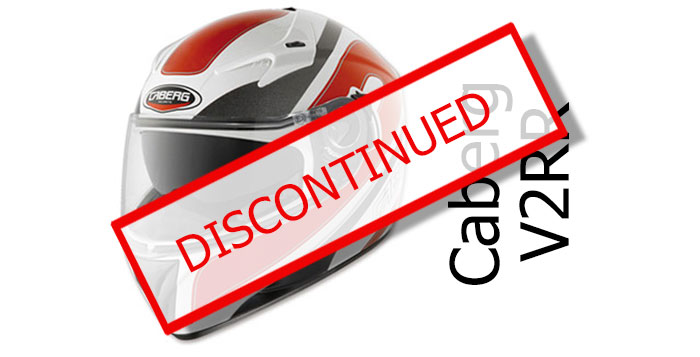
Summary: A low cost 5 star SHARP safety rated helmet. It has a polycarbonate shell with integral sun visor and it’s well liked by owners. A great buy. Now slightly updated as the V2RR.
Note. This helmet is now discontinued and no longer available. Try checking out our top 10 full face helmets to find a great alternative.
5 Star SHARP rated – maximum score
Not Snell Certified
ECE approved only so not for sale in the US
1.5 Kg weight
Integral sun visor
Wind noise – acceptable up to around 70 mph
Ventilation – pretty good
Polycarbonate shell
Prices range from $90-$140 model dependent
There are heaps of helmets at the low cost end of the crash helmet market which are poorly built and score badly on safety. They may look OK but they don’t perform well in an accident – and if they’re not good in a crash, what’s the point?
The Caberg V2R is a low cost helmet that gets maximum score in the SHARP safety test, so it’ s got to be a top candidate for your hard earned wodge. So let’s take a look at what people who own them think (this review is a compilation of V2R crash helmet reviews and user-comments gleaned from all over the web – not just one reviewer but the people who actually buy and use them).
Comfort
If you get the helmet fit right, the Caberg is a winner. Users report that it’s comfortable and broke in quickly. All day comfort is a phrase often used so no worries on comfort – and the helmet weight is 1.5Kg which is light (and about average for a full faced helmet). Both liner and cheek pads are removable for repositioning and washing.
Ventilation
here’s the usual multipoint ventilation, at the chin and forehead with an exhaust vent at the back. Users report the ventilation works very well keeping them cool and doing a good job at demisting the visor. One or two comments that the chin ventilation is perhaps a little too angled towards the eyes, pushing cold air onto the eyes rather than the visor.
Shield
That said, because the helmet comes with an anti fog shield, the shield works well at most speeds – though can fog a little at lower speeds. The shield can be removed without tools. The standout feature for the shield is the secondary sun visor. Caberg were the first crash helmet manufacturer I noticed offered integral sun visors and it’s a great feature. No comment from users other than it works well, even with gloves, though users of other lids with sun visors do report some have a tendency to fog over.
Wind noise
Seems to come in about average – fairly quiet up to around 70 but noisy above.
Finish
The shell’s polycarbonate but the finish is good in terms of surface finish and brightness of design. It’s not so good in terms of feel – some owners saying some of the parts feel like they’re cheap and plasticy (probably not a major surprise from a cheap helmet that’s made of plastic, but there you go). Of course polycarbonate helmets are seen as a more ‘entry level’ material than, say, fiber glass or carbon fiber, and are more prone to sustaining minor damage which renders them fit for the bin (though we’ll look into the reality of some of the materials used in crash helmet constructions some time in the not too distant future). The lid’s secured with a ‘micometric’ fastener which seems to work pretty well.
As you can see above, owners of the V2R and it’s more recent counterpart the V2R-R are generally pretty pleased over the performance of the helmet in pretty well all areas. Couple that with its low price and owners love their Caberg V2Rs. And so, we heartily recommend them as a great, low cost, high safety crash helmet. Well done Caberg!
Found this on youtube. Some impressionable soul has obviously been watching too much Ghostrider and thought he’d have a go. Thank goodness for Dainese leather and Shark crash helmets! Completely irresponsible riding of course (though have to admit I liked watching the original Ghostrider!) and unfortunately for this eejut, he apparently entirely lacked the bottle to pull it off.
Scary scenario to find yourself in – we’ve all had that closing speed bum-clenching moment I’m sure.
Hopefully for this dude, it means he’s off the road indefinitely!
Still, with his Dainese leathers and Shark crash helmet, it’s staggering that he got away with it almost unscathed. Been checking out the Shark crash helmets website – still can’t decide what model it is – any ideas gang?
Here’s the video:
Would love to know what crash helmet he’s using. He’s even wearing it in the post crash interview it looks like it didn’t even hit the deck! Please comment if you know which it is and i’ll maybe write a review on it.
If you’re interested in buying a Shark crash helmet– please check out the prices by clicking the link to the page at Sportsbikeshop below. If you buy from there, we get a small sum from the sale – thanks!